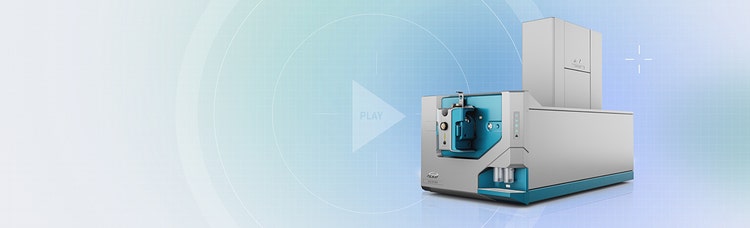
See how researchers are applying the ZenoTOF 8600 system across omics workflows
Access on-demand scientific presentations featuring real-world applications in proteomics, metabolomics, lipidomics, and multi-omics discovery.
Real data. Real workflows. Designed for confident evaluation.
Real research, beyond performance claims
These on-demand presentations feature researchers sharing how they apply the ZenoTOF 8600 system across diverse omics workflows.
Explore how advanced acquisition strategies and fragmentation approaches support:
- deeper identification across complex datasets
- more confident interpretation of MS/MS data
- scalable workflows from discovery to large-cohort studies
- structural insight across proteins, metabolites, and lipids
What you will learn
- Move from detection to confident interpretation
- Scale from individual experiments to population datasets
- Capture structure, modification, and function together
- Evaluate real workflows for omics research
Featured scientific presentations

Gary Patti (Washington University)
Solving chimeric MS/MS challenges in metabolomics and exposomics
- Understand why conventional MS/MS approaches, including DDA, challenge untargeted metabolomics, lipidomics, and chemical exposomics analyses
- Learn how scanning DIA significantly increases the number of features that can be resolved by deconvolution, leading to more confidence and more IDs
- Explore scalable approaches for large cohort chemical exposomics and why high-quality data matters for real-world disease research
Result: More confident identification across complex datasets
Lindsay Pino (Talus Bio)
Chemoproteomics with residue-level confidence
- Detect covalent drug binding events with higher confidence
- Improve site localization and quantitative hit calling
- Move from inference to direct measurement of drug-protein target engagement
Result: Faster, more confident decisions in drug interaction and drug discovery workflows

Nicola Zamboni (ETH Zurich)
Deeper metabolomics and lipidomics insights at scale
- Increase identification coverage of metabolites and lipids across complex datasets
- Improve MS/MS selectivity while maintaining acquisition speed
- Scale from LC workflows to high-throughput analysis
Result: Confident detection of low-abundance and biologically relevant features

Lingjun Li (University of Wisconsin)
Advancing multi-omics workflows with structural insight
- Enable LC-MS/MS workflows across multi-omics workflows, such as global proteomics, glycoproteomics, and lipidomics
- Use tunable electron-activated dissociation (EAD) fragmentation for enhanced structural characterization
- Gain insight from low-level, single-cell inputs to complex biological samples
Result: A more complete biological picture across workflows
Access the full video library
Register to watch these on-demand presentations and explore how researchers are applying the ZenoTOF 8600 system across real workflows.