Abstract
Sensitivity and dynamic range are critical performance attributes for analytical methods, particularly capillary electrophoresis–sodium dodecyl sulfate (CE-SDS), which is widely used across the biopharmaceutical pipeline to assess biomolecule purity. Sensitivity can be enhanced through approaches such as laser-induced fluorescence (LIF). However, LIF requires chemical labeling of primary amines, which may alter physicochemical properties, including solubility, and requires optimization. Native fluorescence (NF) detection offers an alternative means of improving baseline stability and sensitivity without labeling. To address this need, the BioPhase 8800 system now incorporates NF detection, which primarily exploits aromatic amino acid transitions, such as those from tryptophan.
This technical note compares the sensitivity and dynamic range of ultraviolet (UV) and NF detection on the BioPhase 8800 system using CE SDS. Detector performance was evaluated using serial dilutions of the NIST monoclonal antibody (NISTmAb) from 2.5 mg/mL to 0.15 µg/mL. Linearity, limits of detection (LOD), and limits of quantitation (LOQ) were determined by linear regression analysis.
Key learning points
- NF detection provides enhanced sensitivity compared to UV detection for CE-SDS analysis
- Both UV and NF detection modes demonstrate excellent linearity over at least four orders of magnitude. R2 of 0.9999 for NF over a concentration range of 2,500 – 0.15 µg/mL of NISTmAb
- The BioPhase 8800 system enables reliable low level impurity detection of approximately 0.01% of lysozyme spiked NISTmAb at 1 mg/mL
Introduction
Current industry guidance for bioanalytical method development emphasizes defining how an analytical method is designed, optimized, and validated for its intended use. This process requires a thorough understanding of key analyte characteristics, including physicochemical properties that influence analytical performance. Method parameters such as selectivity, specificity, sensitivity, calibration range, and linearity must be carefully evaluated to ensure method robustness.
The International Council for Harmonization (ICH) provides general guidance for analytical method validation in the ICH Q2(R2) guideline,1 which applies to procedures used for release and stability testing of drug substances and drug products. These recommendations encompass methods used to assess identity, purity, impurities, and quantitative measurements.
Capillary electrophoresis (CE), as a high-resolution separation technique, is widely applied for both qualitative and quantitative analyses. CE-SDS is commonly used for the characterization of biotherapeutic products, including the assessment of product-and process-related impurities.
Accordingly, performance characteristics such as linearity, dynamic range, sensitivity, LOD, and LOQ are critical for CE-SDS method validation. In this study, NISTmAb was used under reducing and non-reducing conditions to generate calibration curves and to determine LOD and LOQ using signal-to-noise criteria for the NF detector and these results were compared to the performance of UV detection on the BioPhase 8800 system.
Methods
The BioPhase CE-SDS Protein Analysis kit (P/N: C30085), the BioPhase BFS capillary cartridge - 8 x 30 cm (P/N: 5080121), BioPhase sample and reagent plates (4,4,8) (P/N: 5080311), NISTmAb (P/N 5089359) were from SCIEX (Marlborough, MA). The β-mercaptoethanol (β-ME) (P/N: M3148-25 mL), Iodoacetamide (IAM) (P/N A3221) were obtained from Sigma-Millipore.
Sample preparation for UV or NF detection:
Take 12.5 µL of a 10 mg/mL NISTmAb and mix with 90 µL of sample buffer pH 9, add 2 µL of the 10 kDa Internal Standard, both present in the CE-SDS Protein Analysis kit, and 5 µL of β-ME for reduced condition or 5 µL of 250mM of IAM for non-reduced condition. The mixture was incubated at 70o C for 10 minutes.2 Afterward, the sample was serially diluted with sample buffer down to 0.15 µg/mL.
Capillary electrophoresis instrument: The BioPhase 8800 system (P/N: 5314860) equipped with UV, LIF, and NF was from SCIEX (Marlborough, MA). The BioPhase 8800 system and the BioPhase 8800 software, version 1.5 e-license, were used to create methods and sequences for data acquisition and analysis.
Instrument methods: Lightning CE-SDS separation for the BioPhase 8800 system was used as described in the technical note3 and can be downloaded at SCIEX.com/support.
Discussions
For separation-based techniques such as CE, it is important to assess the detector’s linearity response and dynamic range, as well as the LOD and LOQ to demonstrate an assay such as CE-SDS has the sensitivity to determine drug substance purity. LOD is typically determined at the concentration of an analyte with a signal-to-noise ratio of 3:1 and the LOQ with a signal-to-noise ratio of 10:1.1
Dynamic range of NISTmAb under non-reducing conditions
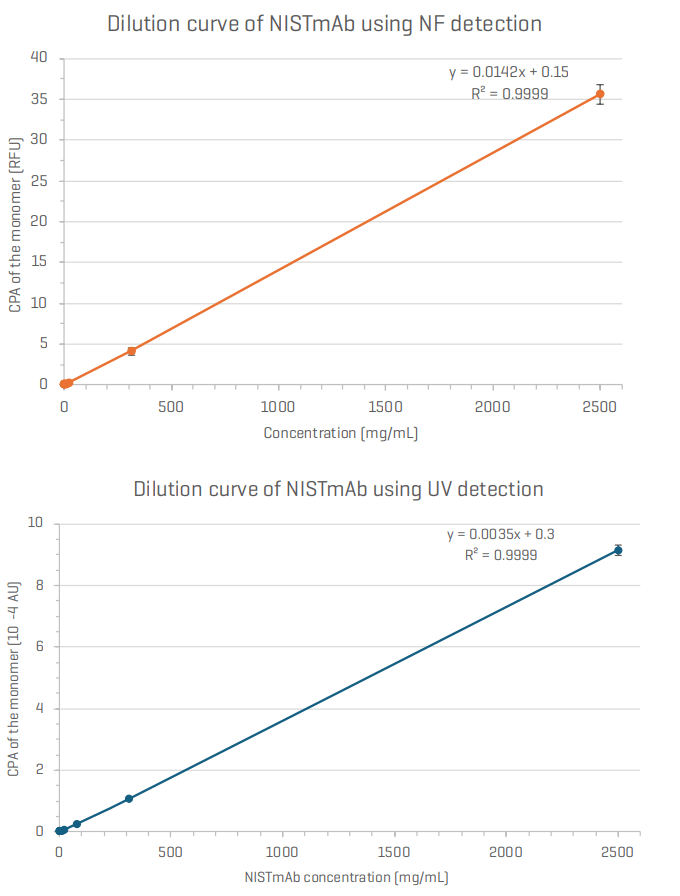
To assess dynamic range, non-reduced NISTmAb samples were analyzed across ten concentration levels spanning 2,500 µg/mL to 0.15 µg/mL. Each concentration was injected in triplicates. Corrected peak areas were plotted as a function of concentration, with error bars representing standard deviation (n = 3).
As shown in Figure 1, both UV and NF detectors exhibited excellent linearity across approximately four orders of magnitude. Linear regression determined coefficients of determination (R²) of 0.9999 for both detection modes, indicating highly linear detector responses.
LOD and LOQ of NISTmAb under non-reducing conditions
LOD and LOQ were evaluated based on signal-to-noise ratios of approximately 3:1 and 10:1, respectively, as recommended by ICH Q2(R2). Signal-to-noise ratios were estimated by the signal-to-noise ratio of the lowest detectable concentration in the dilution series.
Noise levels were evaluated using peak-to-peak noise calculations as described in United States Pharmacopeia General Chapter <621>.2 Using this approach, the estimated LOD under non-reducing conditions was approximately 0.3 µg/mL for NF detection and 0.5 µg/mL for UV detection. These values represent a 5x improvement relative to the PA 800 Plus system, which demonstrated an LOD of approximately 2.5 µg/mL with UV detection is 5 µg/mL (data not shown). The LOQ was approximately 1.2 µg/mL for both UV and NF on the BioPhase 8800 system.
The improved sensitivity observed here is attributed to the optical system of the BioPhase 8800 platform, which reduces stray light and minimizes noise.
Inter-capillary linearity comparability of NISTmAb under reducing conditions
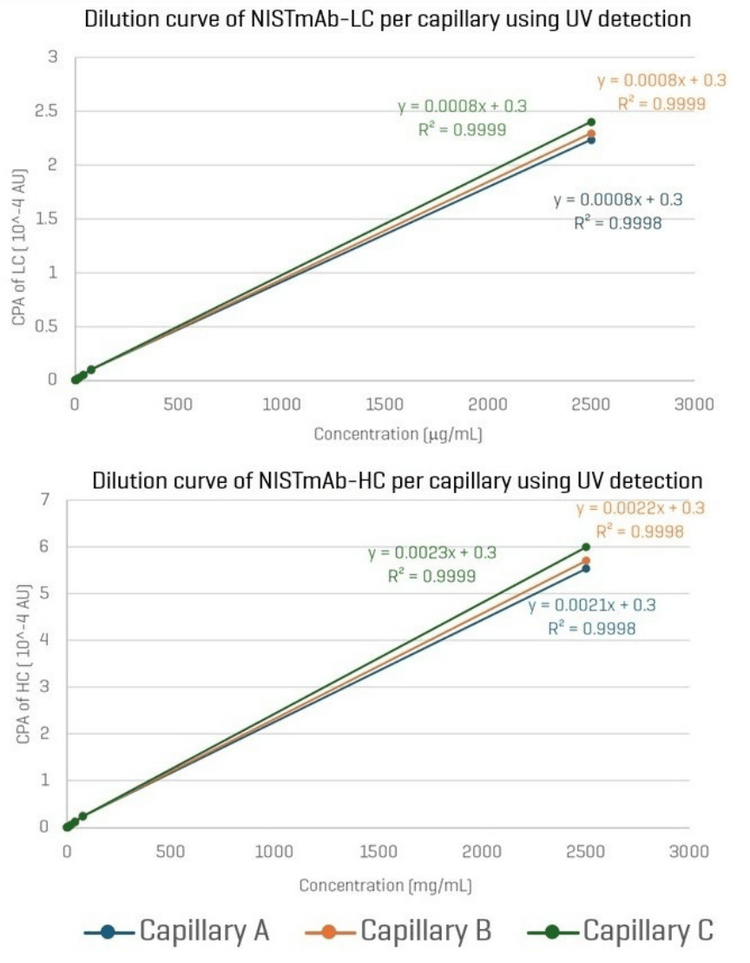
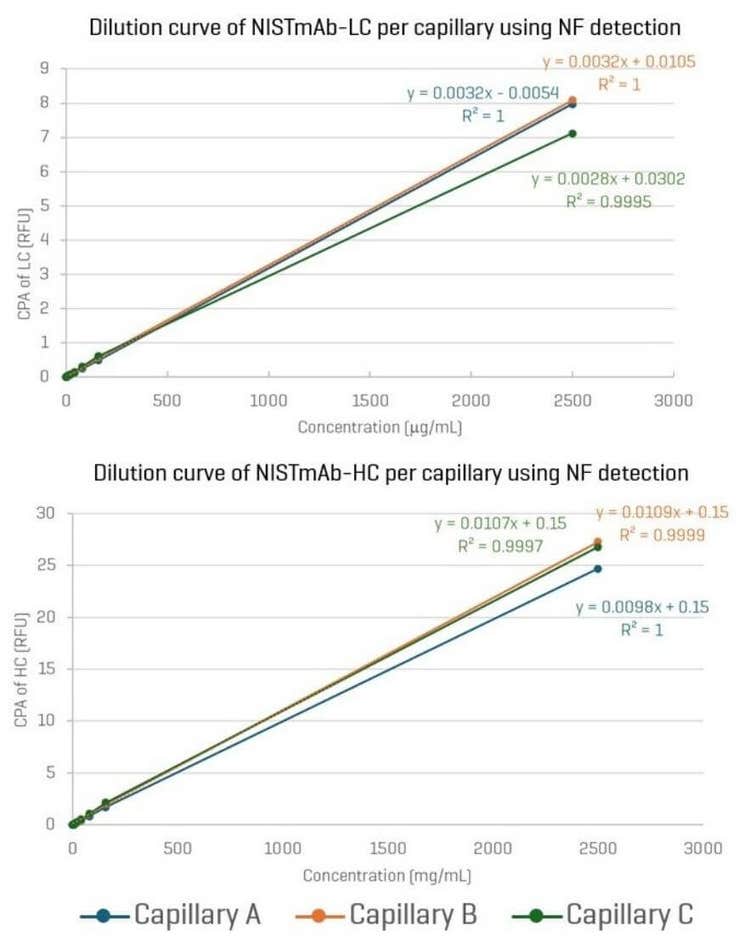
To demonstrate the inter-capillary linearity response comparability, a dilution curve of reduced NISTmAb was prepared by splitting each dilution point between capillaries A, B, and C.
Figure 2 and 3 shows the dilution curve for the light chain (LC) and heavy chain (HC) of NISTmAb using UV and NF, on capillaries A, B, and C. The graph shows good linear correlation in all cases, but most notably in the slope. The slope of a dilution curve using UV detection is a measurement of the molar absorptivity of a molecule. Not only is it consistent between the 3 capillaries for LC and HC, but also the slope is different between the LC and HC. This behavior is expected because of the near-zero stray light, making the UV detector response truer to the molar absorptivity of each individual molecule.
Likewise, in NF detection, the slope of the calibration curve represents the sensitivity of the assay. The slope for the HC is, on average, 0.01, and for the light chain, 0.003. Because the NF signal is dependent primarily on the presence of tryptophan (Trp), it is expected that the slope will be different between the LC and the HC because the LC has fewer Trp residues than the HC.
Sensitivity – Lysozyme spiked in NISTmAb under non-reducing conditions
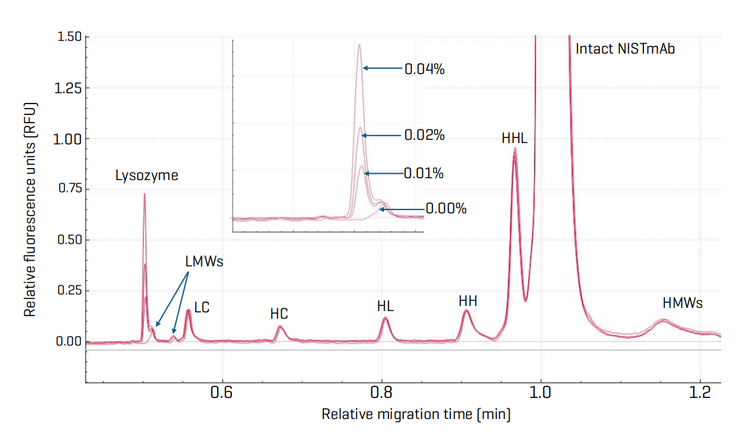
Figure 4 shows the CE-SDS-NF separation of NISTmAb spiked with lysozyme in 0.04%, 0.02%, 0.01% (w:w) relative to 1 mg/mL of NISTmAb. The inset shows an overlay of the lysozyme peak, which, even though it migrates close to a low molecular weight species of NISTmAb, the specificity of the CE-SDS shows the increasing peak height corresponding to the increasing amounts of lysozyme.
The least amount of lysozyme at 0.01% relative to NISTmAb satisfies the requirements of ICH Q3A(R2) guidelines for new drug substances and Q3B(R2) for drug products, and establishes the threshold of 0.1% for impurities requiring identification. This work demonstrates the effectiveness of NF in detecting low levels of impurities.
Conclusions
-
UV and NF detection on the BioPhase 8800 showed excellent linearity over ~4 orders of magnitude for NISTmAb CE-SDS analysis under non-reducing conditions
-
NF detection provided higher sensitivity than UV
- LOD is 0.3 µg/mL for NF
- LOD is 0.5 µg/mL for UV
- LOQ is 1.2 µg/mL for both NF and UV
-
High linearity and consistent slopes across capillaries demonstrated strong inter-capillary reproducibility
-
Heavy- and light-chain slope differences matched expected molar absorptivity (UV) and Trp content (NF)
-
NF detection enabled sensitive impurity analysis, detecting lysozyme at 0.01% relative to NISTmAb
-
Overall, the BioPhase 8800 with NF delivers a sensitive, reproducible, wide-dynamic-range CE-SDS platform for biopharmaceutical analysis
References
- ICH Harmonized Guideline Validation Of Analytical Procedures Q2(R2). 2023.
- USP General chapter <621> Chromatography. 2022.
- Z. Yang, M. Santos, T. Li, M. Pulido, J. Luo and S. Mollah; Lightning capillary electrophoresis sodium docedyl sulfate (CE-SDS) workflow for high-throughput analysis of biotherapeutics, RUO-MKT-02-14803-A.