Abstract
his technical note highlights a streamlined ion-pairing reverse-phase liquid chromatography-mass spectrometry (IP RPLC-MS) workflow for intact oligonucleotide analysis with enhanced MS sensitivity. This workflow combines the benefits of high MS sensitivity offered by the ZenoTOF 8600 system and easy-to-use features of Biologics Explorer software, leading to rapid quality and impurity assessment of oligonucleotides with increased confidence and user experience.
Oligonucleotide therapeutics are a diverse group of drugs targeting a variety of diseases through different mechanisms of action.1 Synthetic oligonucleotides often carry various modifications and product-related impurities. Intact IP RPLC-MS is a common approach to verify the identity of a synthetic oligonucleotide and assess the level of impurities. A streamlined workflow−from data acquisition to result interpretation−is essential to enable rapid mass confirmation and impurity assessment, accelerating the development of therapeutic oligonucleotides.
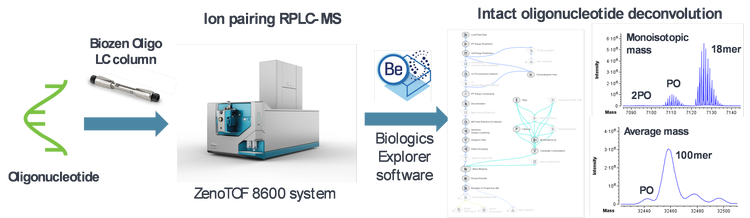
Key features of the streamlined IP RPLC-MS workflow for intact oligonucleotide analysis
- High sensitivity: The improved hardware of the ZenoTOF 8600 system leads up to 10X gain in MS sensitivity compared to the previous platform, enabling oligonucleotide impurity analysis with reduced sample load
- Streamlined: Biologics Explorer software provides an easy-to-use, optimized data analysis workflow for oligonucleotide sequence creation, intact deconvolution and mass mapping
- Flexibility: Biologics Explorer software offers the flexibility for advanced users to fine-tune processing parameters or algorithms to achieve the optimal result
- Excellent visualization: The 2-dimensional ion map within Biologics Explorer software enables rapid data/result review and impurity assessment
- Consistent recovery: Biozen Oligo LC column combines core-shell particle technology and bioinert hardware, significantly increasing the chromatographic efficiency
Methods
Sample preparation: A desalted oligonucleotide 18mer and an HPLC-purified sgRNA 100mer were purchased from Integrated DNA Technologies (IDT). A stock solution of 1 mg/mL was prepared for 2 oligonucleotides. This solution was diluted to 10 ng/µL, from which 5 µL (50 ng) was injected for IP RPLC-MS analysis.
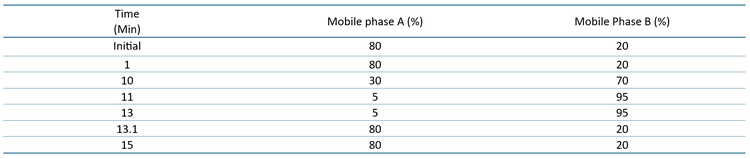
IP RPLC separation: Oligonucleotides were separated based on IR RPLC using a Phenomenex Biozen Oligo LC column (2.6 µm, 50 x 2.1 mm) installed on a Nexera XS inert HPLC system (Shimadzu). The separation was performed using the gradient shown in Table 1 with a column temperature of 60°C and flow rate of 0.4 mL/min. Mobile phases A and B are water and methanol/water (1:1 v/v), respectively, with 50 mM 1,1,3,3,3-hexafluoroisopropanol (HFIP, Sigma-Aldrich) and 15 mM diisopropylethylamine (DIPEA, Sigma-Aldrich).
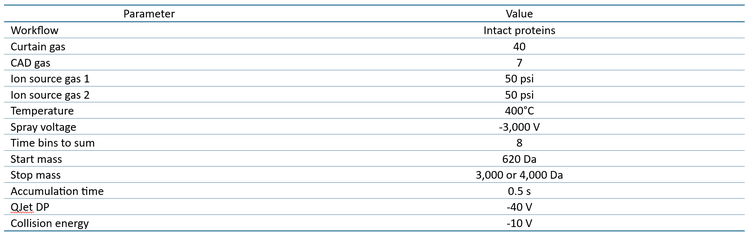
Intact oligonucleotide deconvolution workflow
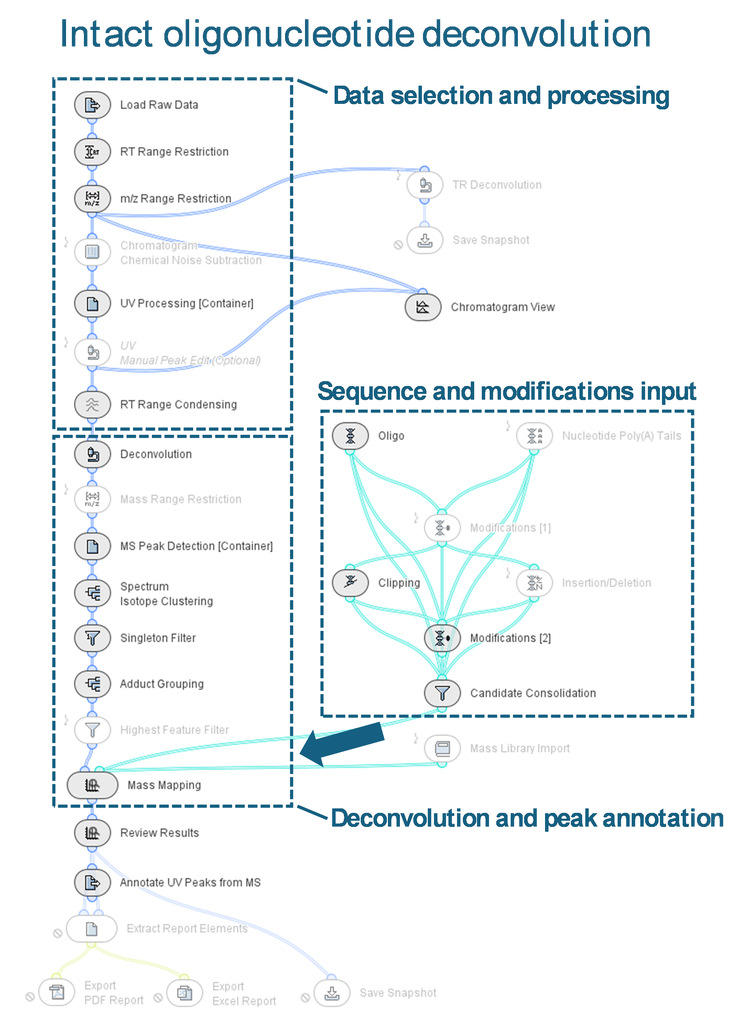
Built upon powerful algorithms from Genedata Expressionist®, Biologics Explorer software offers optimized, easy-to-use data analysis workflows, such as intact MS, peptide mapping and top/middle-down MS, for rapid characterization of biopharma molecules. These streamlined workflows require minimal user’s input and hence are quick to learn and easy to run. For advanced users, the workflows offer the flexibility to fine-tune various settings or algorithms.
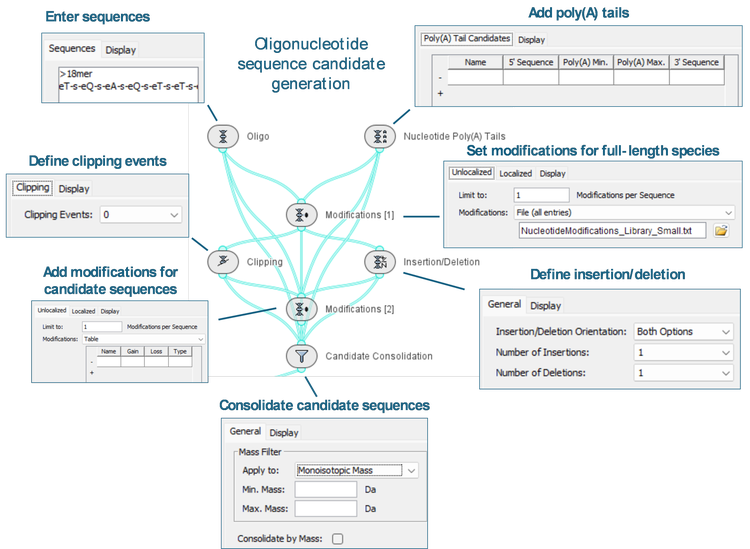
Figure 3. Oligonucleotide sequence candidate generation. Biologics Explorer software provides flexibility in creating oligonucleotide sequence candidates for mass mapping. The oligonucleotide sequence is defined based on the sugars, linkers or bases defined in the Nucleotide Editor (Figure 4), where users can also add custom entries. The poly(A) tails and insertion/deletion are specified in 2 separate activities, which may be disabled if they are not applicable. Up to 2 clipping events on the 3’ and/or 5’ ends can be set. The modifications can be defined for the sequence with or without the poly(A) tails (see “Modification [1]” activity) or for the variants resulting from clipping or insertion/deletion (see “Modification [2]” activity). The monoisotopic or average masses of all the candidate sequences are consolidated for mass mapping with the deconvolution results.
Figure 2 shows an overview of the intact oligonucleotide deconvolution workflow introduced in the Version 7.0.1 of Biologics Explorer software. Compared to the intact protein deconvolution workflow, this data analysis workflow includes a cluster of activities for creating oligonucleotide sequences and their sequence variants (Figure 3). Any of these activities can be enabled or disabled depending on the need and goal. This allows the flexibility and versatility in creating candidate sequences of an oligonucleotide and its variants with or without modifications. A consolidated list of monoisotopic or average masses from the Candidate Consolidation activity serves as the input for mass mapping with the deconvolution results for peak assignment and annotation (Figures 2 and 3).
Oligonucleotide sequence generation
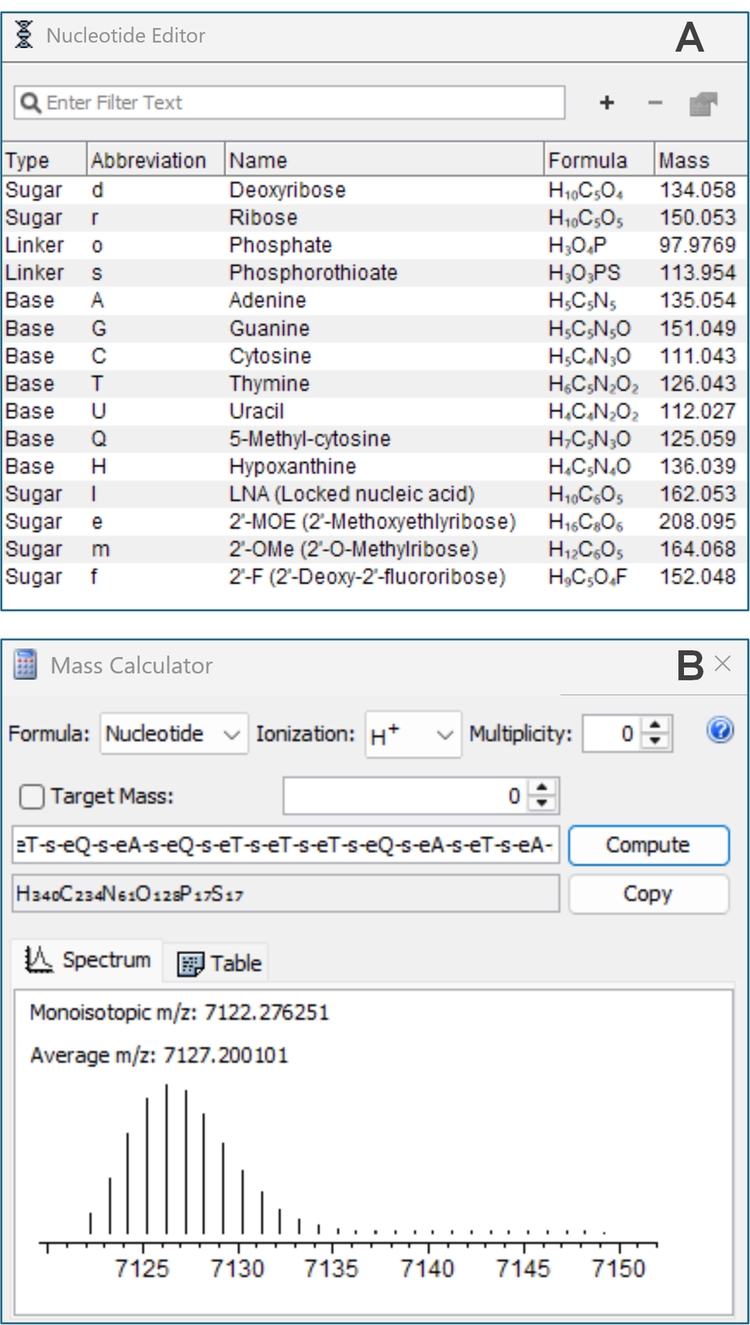
Biologics Explorer software offers user-friendly tools to help define and create oligonucleotide sequences with or without modifications. The nucleotide editor contains a list of sugars, linkers and bases commonly found in oligonucleotides and the custom entries created by the user (Figure 4A). Each of the building blocks is represented with a unique 1-letter abbreviation. For example, 5-methyl-cytosine and 2’-methoxyethylribose (2’-MOE) were defined as Q and e, respectively. With these building blocks defined, the sequence of the 18mer analyzed in this study was defined as the following:
eT-s-eQ-s-eA-s-eQ-s-eT-s-eT-s-eT-s-eQ-s-eA-s-eT-s-eA-s-eA-s-eT-s-eG-s-eQ-s-eT-s-eG-s-eG
where the dash (“-“) symbols are optional. This sequence was entered into the Oligo node (Figures 2 and 3) for the generation of a candidate mass list for mass mapping. The oligonucleotide sequence can also be copied to the mass calculator for formula and mass calculation (Figure 4B).
Intact deconvolution and mass mapping
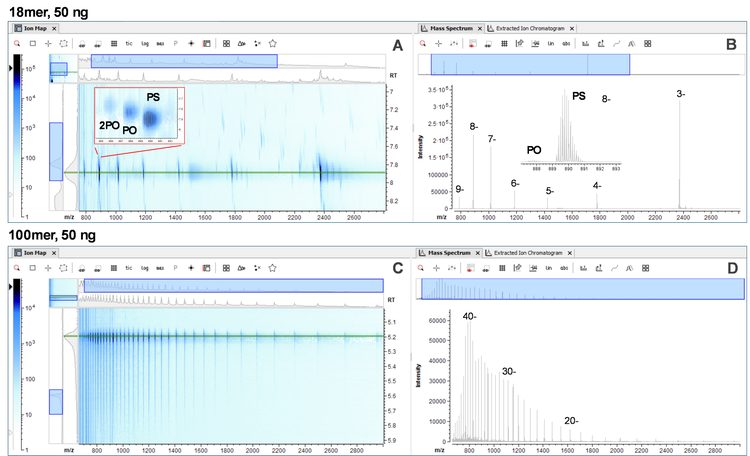
Biologics Explorer software provides excellent visualization tools for rapid assessment of data quality and impurity level. Figure 5 shows the ion maps and mass spectra from IP RPLC-MS analyses of 18mer and 100mer (50 ng) using the ZenoTOF 8600 system. The ion map offers a 2-dimensional view of the raw data of these 2 oligonucleotides (Figures 5A and 5C). The mass spectrum at specific RT (Figures 5B and 5D) or extracted ion chromatogram (XIC) of a specific m/z (not shown) can be conveniently viewed side-by-side with the ion map. A closer view of the 18mer data revealed the presence of the full-length product (PS) and its PO species, which were partially separated from the PS (insets in Figures 5A and 5B).
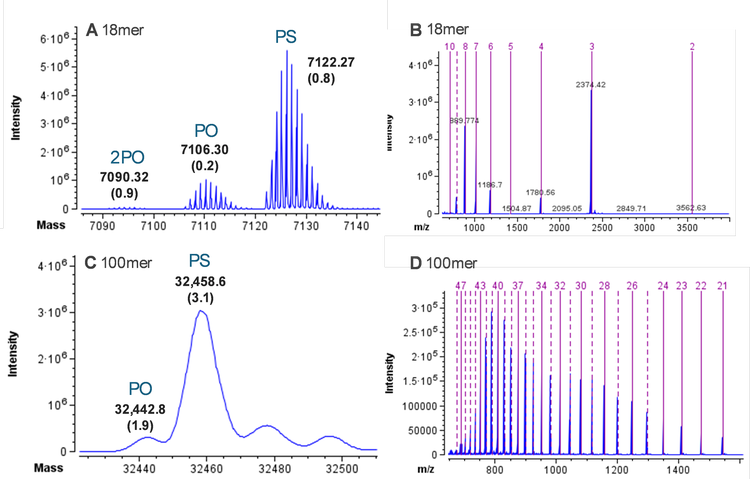
Intact oligonucleotide deconvolution and mass mapping were performed for the 18mer using the monoisotopic mass and for the 100mer using the average mass. Figure 6 shows the devolution results of 2 oligonucleotides. The ZenoTOF 8600 system offered high MS sensitivity for the detection of a low-abundant 2PO species with 2 desulfurization (PS®PO) in the 18mer (Figure 6A). A high mass accuracy (<5 ppm) was achieved for all the PS and PO species.
In summary, this technical note highlights a streamlined workflow leveraging high MS sensitivity of the ZenoTOF 8600 system and powerful while intuitive tools from Biologics Explorer software for enhanced intact oligonucleotide analysis.
Conclusion
- A streamlined IP RPLC-MS workflow was developed for enhanced intact oligonucleotide analysis, leveraging the high MS sensitivity offered by the ZenoTOF 8600 system and an easy-to-use, optimized data analysis workflow from Biologics Explorer software.
- Biologics Explorer software provides an array of powerful tools for oligonucleotide sequence creation, intact deconvolution and mass mapping.
- The ion map offers excellent visualization of oligonucleotide data for rapid sample quality and impurity assessment.
- Biozen Oligo LC column combines core-shell particle technology and bioinert hardware, significantly increasing the chromatographic efficiency.
- The streamlined workflow can be easily implemented for rapid oligonucleotide analysis by different levels of LC-MS scientists.
Acknowledgements
The authors thank the Phenomenex team for providing the columns used in this work.
References
- Pourshahian S. (2021) Therapeutic oligonucleotides, impurities, degradants, and their characterization by mass spectrometry. Mass Spectrom. Rev. 40:75-109.