Abstract
This technical note outlines a streamlined, capillary electrophoresis (CE)-based RNA analysis workflow. It uses the Biomek i7 Hybrid Automated workstation for automated sample and reagent preparation with the RNA 9000 Purity & Integrity kit, followed by automated separation and data analysis on the BioPhase 8800 system.
The surge in RNA-based therapeutics has significantly expanded the demand for automated, robust, and scalable analytical platforms1-2. The streamlined and automated workflow described in this technical note provides the capabilities to meet these demands.
Key features
- High-throughput, automated sample and reagent preparation: Automated preparation of samples and reagents for RNA analysis of a full 96 well plate within one hour
- Simplified operations with flexibility and scalability: The Beckman Coulter® Biomek i7 Hybrid Automated workstation provides configurable options that enhance user experience and increase unattended operation time
- Robust and reproducible RNA purity and integrity analysis: Excellent intra- and inter-capillary reproducibility of migration time and CPA%
- Accurate sizing analysis: Sizing accuracy within 6.0%
- Streamlined workflow: An assay platform integrating automated sample and reagent preparation, multichannel CE data acquisition, and intuitive analysis tools to enable efficient reporting and informed decision making
Introduction
The RNA therapeutics field has experienced rapid growth, driven by the success of RNA-based vaccines against SARS-CoV-2. With this growth, there is an increased demand for robust analytical tools to ensure product quality.1-3 Given RNA’s inherent instability, integrity analysis plays a critical role in confirming that RNA molecules remain intact, pure, and functional throughout the development and manufacturing processes. During the early development phase, analyzing thousands of RNA samples is essential for optimizing synthesis, formulation, and delivery strategies before advancing to clinical trials.4 However, manual preparation of samples and reagents presents a significant bottleneck when scaling up throughput. To address this challenge, integrating automated sample and reagent preparation with high-throughput data acquisition and analysis workflows significantly enhances efficiency. This approach maximizes sample throughput, reduces manual intervention, and streamlines the characterization of large sample volumes.
This technical note presents a fully automated workflow for RNA integrity analysis, from sample and reagent preparation to data analysis. It is designed to meet the demands of modern RNA therapeutic development.
Methods
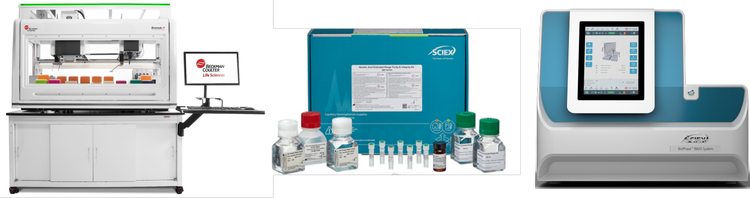
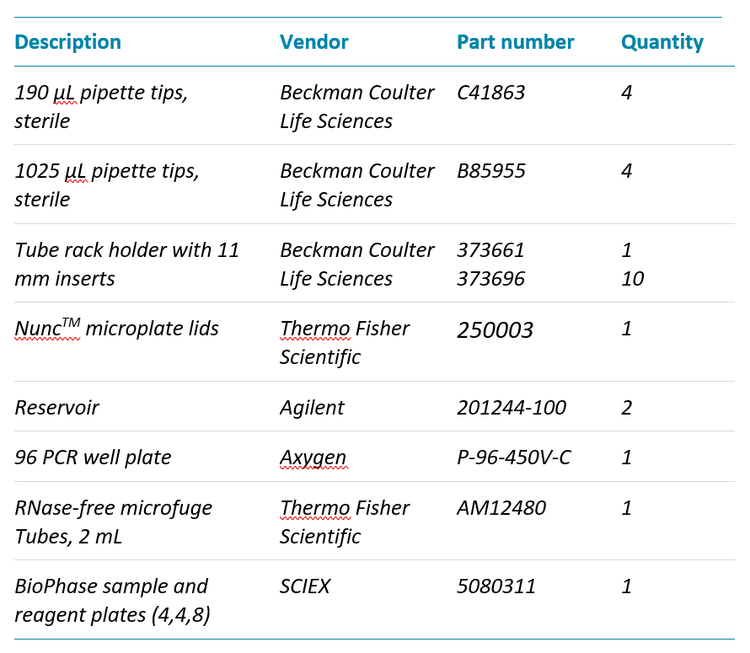
Materials: The RNA 9000 Purity & Integrity kit (P/N: C48231, Figure 2, middle panel), sample loading solution (SLS, P/N: 608082), and the BioPhase BFS capillary cartridge - 8 x 30 cm (P/N: 5080121) were from SCIEX (Marlborough, MA). Rainin LTS filter tips were from Mettler Toledo (Oakland, CA). Nuclease-free water (NFW) (P/N: AM9932) was obtained from Thermo Fisher Scientific (Waltham, MA). The 0.2 µm syringe filter (P/N: 4612) was from PALL (Port Washington, NY). Part numbers for pipette tips, tubes, reservoirs, and plates used in the sample and reagent preparation workflow are listed in Table 1. A pair of custom-made outlet plate adapters was provided by Beckman Coulter Life Sciences (Indianapolis, IN).
Storage of the RNA 9000 Purity & Integrity kit: The Acid Wash/Regenerating Solution and CE Grade Water were stored at room temperature upon receipt. The Nucleic Acid Extended Range Gel and the LIF Performance Test Mix were refrigerated at 2°C to 8°C. The ssRNA Ladder and the SYBR™ Green II RNA Gel Stain* were kept at -35°C to -15°C.5
Preparation of the gel buffer: The Nucleic Acid Extended Range Gel was pre-warmed to room temperature and filtered through a 0.2 µm syringe filter. The SYBRTM Green II RNA Gel Stain was thawed at room temperature in the dark and then added to the filtered gel at a 500-fold dilution.
Liquid handler for sample and reagent preparation: The Biomek i7 Hybrid Automated workstation (Figure 2, left panel, P/N C02613), equipped with a multichannel head, a Span-8 head, 2 ColdPlates, an orbital shaker, and a tip washing station, was from Beckman Coulter Life Sciences. The Biomek software (P/N: B87585) version was 5.1. Detailed lists of the required part numbers for automation hardware and software are provided in the Instructions for Use (IFU).6
The CE Instrument and software: The BioPhase 8800 system (Figure 2, right panel) with UV/LIF (P/N: 5089278)—equipped with a laser-induced fluorescence (LIF) detector utilizing an excitation wavelength of 488 nm and an emission wavelength of 520 nm—was from SCIEX. Automated data acquisition and analysis were performed using BioPhase software version 1.4 from SCIEX.
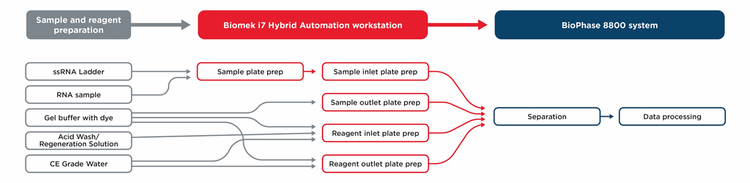
Automated sample and reagent preparation: To demonstrate the Biomek i7 Hybrid Automated workstation’s capability for the RNA 9000 Purity & Integrity kit, a full plate was processed (88 samples in addition to 8 ssRNA ladder standards). The single-stranded RNA (ssRNA) ladder and gel buffer solution with dye were prepared off-deck. Subsequently, all preparation for the sample inlet plate, reagent Inlet plate, sample outlet plate, and reagent outlet plate was performed directly on the Biomek i7 Hybrid Automated workstation. Following these steps, the BioPhase 8800 system executed the sample separation and data processing. An overall workflow is shown in Figure 3. This automated method offers flexibility and scalability, designed to prepare anywhere from 8 to 88 samples in increments of 8. The user can select specific method options to run them separately, or execute the entire process from start to finish with a single user interface to keep the labware and the reagents on deck.
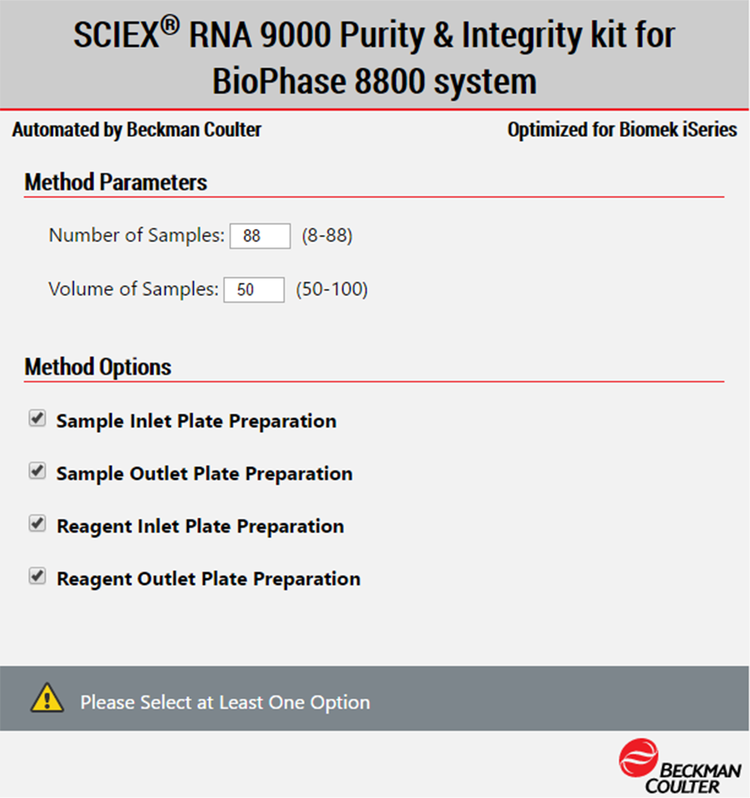
To further simplify operations and enhance user experience, the method is guided by the MOS, as illustrated in Figure 4. The MOS provides a clear, step-by-step framework for setting up the experiment. Complementing this is the Guided Labware Setup, which ensures correct deck configuration and precise reagent volume calculations. This automated method provides flexibility to the workflow and allows customizations for sample processing and throughput.
Results and discussion
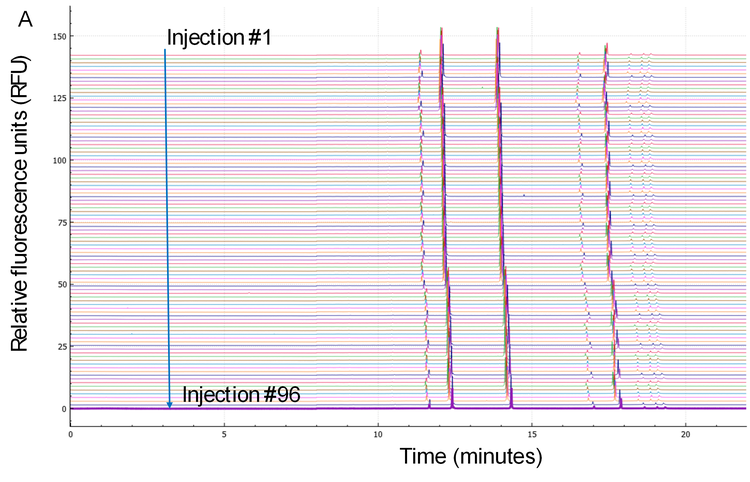
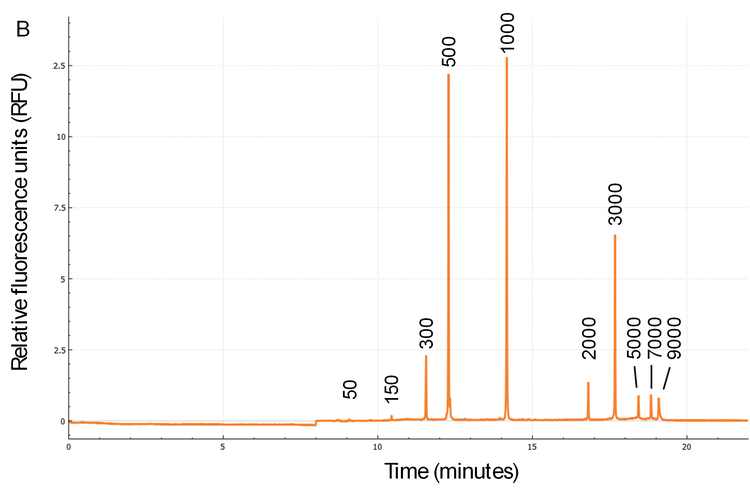
Fully automated RNA integrity analysis: The RNA 9000 Purity & Integrity kit has been well established as an excellent analytical tool for assessing RNA integrity and purity.7-8 The automation of the RNA 9000 Purity & Integrity kit workflow on the Biomek i7 Hybrid Automated workstation is flexible, allowing for adaptation to handle either a full plate or a smaller number of samples, and enables users to perform specific steps offline. In a practical demonstration of its robustness, an ssRNA ladder, serving as the standard for integrity and sizing, was loaded into the first column of the plate. Subsequently, the same ssRNA ladder was dispensed into columns 2-12, serving as the test samples. Following high-resolution RNA separation on the BioPhase 8800 system, 96 individual electropherograms were collected and stacked to show consistent peak profiles and excellent assay repeatability (Figure 1A). No results were excluded, indicating that the sample and reagent preparation by the Biomek i7 Hybrid Automated workstation was reliable. To facilitate interpretation of the data obtained with this method, an electropherogram obtained with the ssRNA ladder in an individual well on the BioPhase 8800 system is shown in Figure 1B. The sizes of the RNA standard fragments in the ssRNA ladder are indicated in bases. All standard fragments were baseline-resolved, demonstrating the excellent separation capability of the RNA 9000 Purity & Integrity kit on the BioPhase 8800 system.
Robustness of the automated sample and reagent preparation process and RNA analysis: The BioPhase 8800 system is a multi-capillary system, capable of separating eight samples simultaneously during each run. Thus, processing 88 samples requires 11 runs or injections. To ensure data reliability, both intra- and inter-capillary variations must be evaluated. The robustness of automated sample and reagent preparation was assessed by examining consistency in migration times and corrected peak area percentages (CPA%) of the main size standard fragments across capillaries and runs.
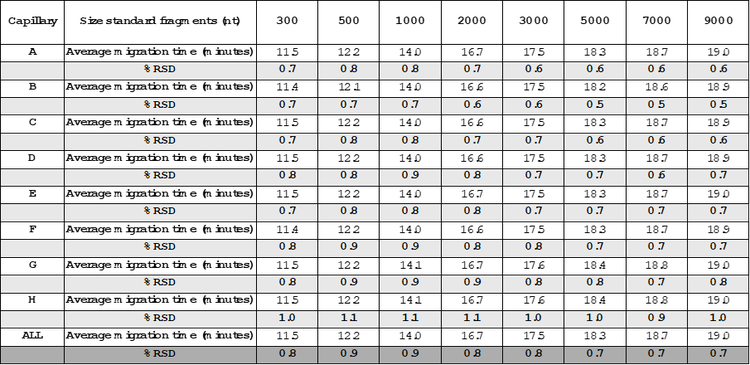
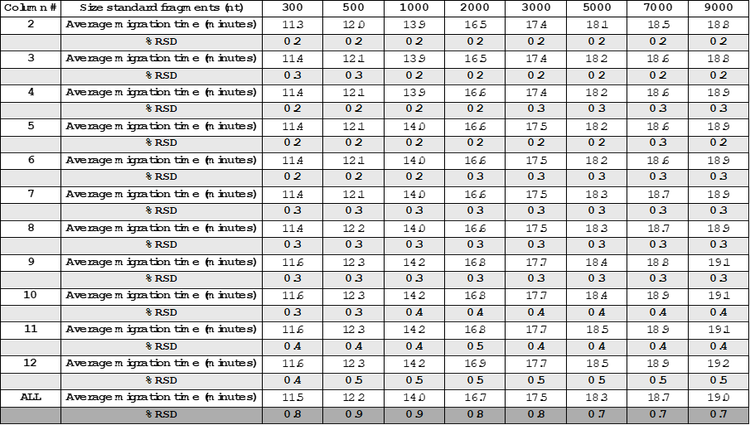
The intra-capillary reproducibility of migration times for the standard fragments in the ssRNA ladder is shown in Table 2. For each capillary, 11 injections were made, each from a different column on the BioPhase sample plate. The average migration time, in minutes, was calculated for each capillary. The %RSD was better than 1.2% for all capillaries and for the 8 standard fragments listed, demonstrating excellent intra-capillary reproducibility. The overall %RSD for 88 sample injections for each standard fragment was lower than 1.0%, indicating high overall assay reproducibility.
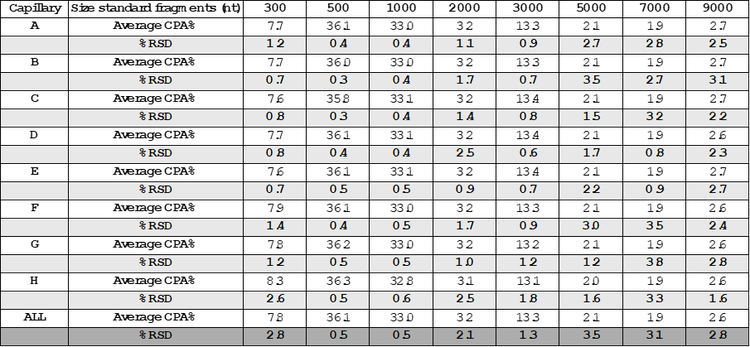
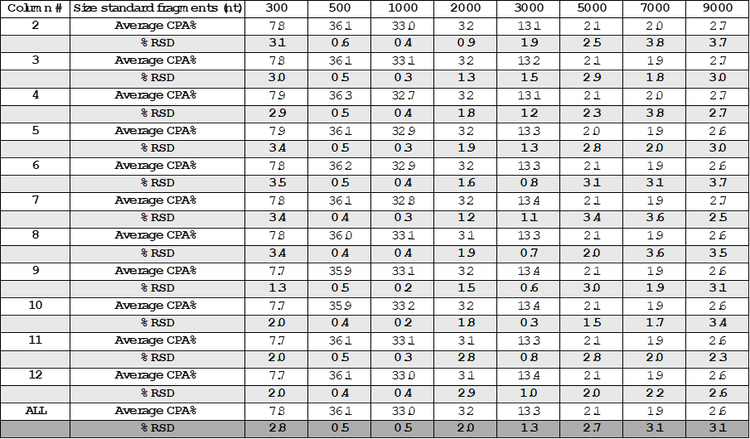
The intra-capillary reproducibility of CPA% for the standard fragments in the ssRNA ladder is summarized in Table 3. For each capillary, 11 injections were made. The average CPA% was calculated for each capillary. The %RSD was better than 4.0% for all capillaries and for the 8 standard fragments listed, demonstrating excellent intra-capillary reproducibility. The overall %RSD for 88 sample injections for each standard fragment was lower than 3.5%, indicating outstanding overall assay reproducibility.
Table 4 summarizes the inter-capillary reproducibility of migration times for the 8 standard fragments. For each column of the BioPhase sample plate, eight injections were performed using different capillaries, and the average migration time was determined. The %RSD for all columns and all eight standard fragments was consistently below 0.6%, confirming excellent inter-capillary reproducibility. The overall %RSD for 88 sample injections for each standard fragment was lower than 1.0%, indicating high overall assay reproducibility and robustness.
Table 5 presents the inter-capillary reproducibility of CPA% across eight standard fragments. For each column of the BioPhase plate, eight injections were performed across different capillaries, and the average CPA% was calculated. The %RSD for all columns and fragments was consistently below 4.0%, confirming strong inter-capillary reproducibility. Considering all 88 injections per fragment, the overall %RSD remained under 3.5%, demonstrating high assay robustness and reproducibility.
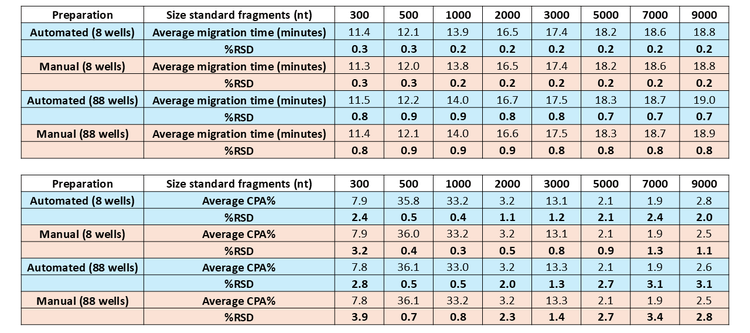
Comparison of automated and manual sample and reagent preparation: The samples and reagents were prepared either with the Biomek i7 Hybrid Automated workstation or manually, following the same design, with an ssRNA ladder in column #1 and 88 samples in columns 2-12. The sample plates were loaded onto the BioPhase 8800 system and separated using the RNA 9000 Purity & Integrity kit. Results are summarized in Table 6. Automated and manual preparation showed no significant differences in average migration times, %RSD of migration times, or average CPA% values for size‑standard fragments. Differences appeared only in CPA% variability (%RSD): in the 8‑well comparison, manual preparation was slightly more consistent, except for the 300 nt fragment, where automated preparation performed better. In the 88‑well comparison, automated preparation was generally more consistent, with the exception of the 7000 and 9000 nt fragments, where both methods produced nearly identical results. Overall, both methods are equivalent in performance, with automation offering greater reproducibility for larger sample sets.
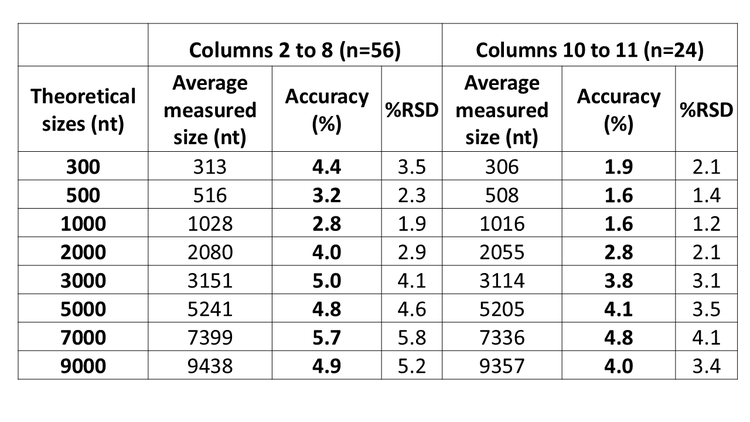
Sizing analysis: Sizing analysis was conducted using BioPhase 8800 software on results obtained from samples and reagents prepared with the Biomek i7 Hybrid Automation workstation. A marker table was set up using the migration times of the size-standard fragments in column 1 and applied to estimate the sizes of the samples in columns 2-8 using the “point-to-point” model. Since the CE method changes the gel after 8 runs, columns 9-12 were run with a second column of gels on the reagent plate, leading to slight migration time shifts. To account for this, column 1 was used as the marker reference for size estimation in columns 2–8, while column 9 served as the reference for columns 10–12. The accuracy, expressed as a percentage relative to the target, is calculated by: ((Measured value - target)/target) *100. This value represents the extent to which the measured size deviates from the target. The average sizing accuracy for the 56 wells in columns 2-8 for all listed size-standard fragments was better than 6.0%. The average sizing accuracy for the 24 wells in columns 10-12 for all listed size-standard fragments was better than 5.0%. In addition, the variations (%RSD) in measured sizes were below 6.0% and 4.5% for columns 2-8 and columns 10-12, respectively. These results demonstrate excellent sizing accuracy and consistency.
Conclusion
- Automated sample and reagent preparation using the Biomek i7 Hybrid Automated workstation effectively minimized manual benchwork, enabling high-throughput processing with exceptional consistency when integrated with the BioPhase 8800 system.
- Robust automation protocols delivered excellent intra-capillary and inter-capillary reproducibility for migration time and CPA%, demonstrating improved consistency relative to the manual preparation method for larger sample sets.
- Accurate sizing performance was consistently achieved across runs, supporting reliable analytical characterization.
- A fully streamlined workflow, combining automated sample and reagent preparation, high-throughput data acquisition, and user-friendly data analysis, accelerated the question-to-answer cycle—ideal for the rapid pace of the biopharmaceutical development environment.
References
- Makkar, S.K. Advances in RNA-based therapeutics: current breakthroughs, clinical translation, and future perspectives. Front. Genet. 2025; 16:1675209.
- Camperi J. et al. Current Analytical Strategies for mRNA-Based Therapeutics. Molecules 2025, 30(7):1629.
- Parhiz H. et al. mRNA-based therapeutics: looking beyond COVID-19 vaccines. The Lancet. 2024; 403(10432):1192-1204.
- Challener C.A. Analysis of mRNA Therapeutics and Vaccines. Pharmaceutical Technology. 2022;46(2):16-21.
- RNA 9000 Purity & Integrity kit for the BioPhase 8800 system, application guide, RUO-IDV-05-13438-D.
- Biomek i5 and Biomek i7 Automated Workstations Instructions for Use. Beckman Coulter, Inc. P/N: B54473AD (March 2025)
- Analytical procedures for the quality of mRNA vaccines and therapeutics (Draft guidelines: third edition). 2024. USP.
- Mantri P. et al. Comparison of capillary electrophoresis-based methods for the analytical characterization of purity and stability of in vitro transcribed mRNA. J Pharm Biomed Anal. 2024 Oct 15:249:116352.