Abstract
This technical note highlights the unique ability to optimize electron kinetic energy (KE) to achieve accurate localization of labile tyrosine sulfation in low-charged peptides using EAD. The electron KE of EAD was fine-tuned to generate sulfate-containing fragments from 2 sulfated peptides, thereby allowing accurate localization of this labile PTM in the peptide sequence.
Introduction
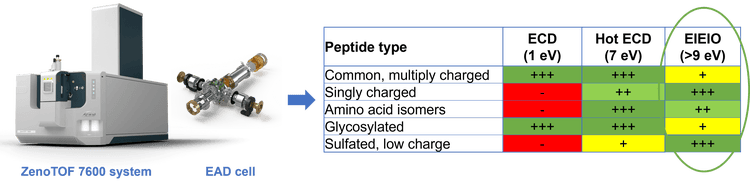
Tyrosine sulfation is an important post-translational modification (PTM) responsible for strengthening protein-protein interactions. Although not extremely common in biotherapeutic proteins, its presence in monoclonal antibodies (mAbs) has been reported previously1 and can affect target binding. Tyrosine sulfation is very labile, making the localization of this PTM in a peptide sequence challenging for traditional MS/MS techniques, such as collision-induced dissociation (CID) and low-energy electron capture dissociation (ECD).2 Recently, it was demonstrated that an EAD platform method is a powerful tool for confident peptide mapping, differentiation of isomers and accurate localization of glycosylation in a single injection using hot ECD.3–6
In this technical note, the electron KE of EAD was fine-tuned to generate sulfate-containing fragments from 2 sulfated peptides, thereby allowing accurate localization of this labile PTM in the peptide sequence (see EIEIO in Figure 1).
Key features of EAD with tunable electron KE
- Characterization of a wide range of peptides: The ability to fine-tune electron KE enables characterization of various peptides including singly charged6 and sulfated peptides that are challenging for traditional ExD approaches
- Ease-of-use: Optimization of electron KE can be easily performed in a data-dependent acquisition or a targeted method
- Reproducible and highly sensitive: EAD provides consistent fragmentation patterns and high MS/MS sensitivity, enhanced by the Zeno trap
- Optimized single injection method: One EAD method provides best-in-class single injection analysis for biopharmaceutical peptide mapping
Methods
Sample preparation: Sulfated leucine enkephalin (LES) and cholecystokinin fragment 26–33 (CLKS) were purchased from Sigma Aldrich with the following sequences:
LES: Tyr (SO₃H)-Gly-Gly-Phe-Leu-OH
CLKS: Asp-Tyr (SO₃H)-Met-Gly-Trp-Met-Asp-Phe-NH₂
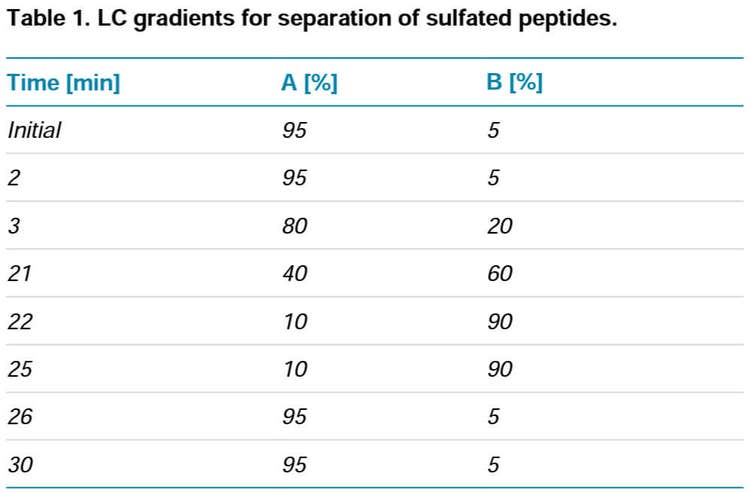
Chromatography: Peptides were separated using an ACQUITY CSH C18 column (2.1 x 150 mm, 1.7 μm, 130 Å, Waters), which was kept at 60°C in the column oven of an ExionLC system (SCIEX). Table 1 shows the LC gradient used for peptide separation at a flow rate of 0.25 mL/min with mobile phases A and B consisting of 1% formic acid (FA) in water and 0.1% FA in acetonitrile, respectively.
Optimization of electron KE for EAD
The power of a generic EAD platform method using an electron KE of 7 eV for in-depth peptide characterization was highlighted previously.3–6 In this technical note, the unique capability of fine-tuning electron KE to achieve optimal EAD data for 2 sulfate-containing peptides will be demonstrated. The result showcases the versatility of EAD with tunable electron KE for characterization of challenging peptides in unique cases.
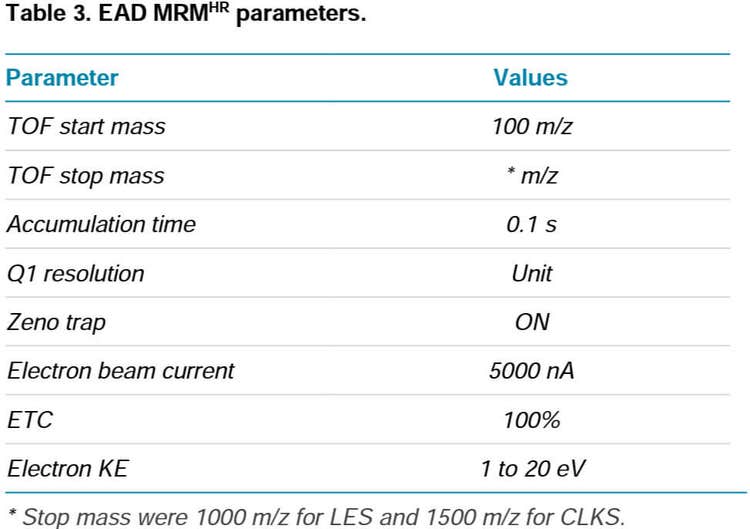
The electron KE, one of the key parameters for EAD, can be adjusted in an information-dependent acquisition (IDA) or a MRMHR method. Depending on the electron KE applied, the EAD mechanism may be altered, from the classic low-energy ExD to hot ECD or EIEIO.3 The effect of electron KE on peptide fragmentation, differentiation of isomers and localization of glycopeptides has been described in a previous technical note.6 In this work, the singly charged LES- and doubly charged CLKS-containing labile tyrosine sulfation were targeted in EAD MRMHR experiments in which electron KE was varied from 1 eV to 20 eV.
Localization of tyrosine sulfation in LES
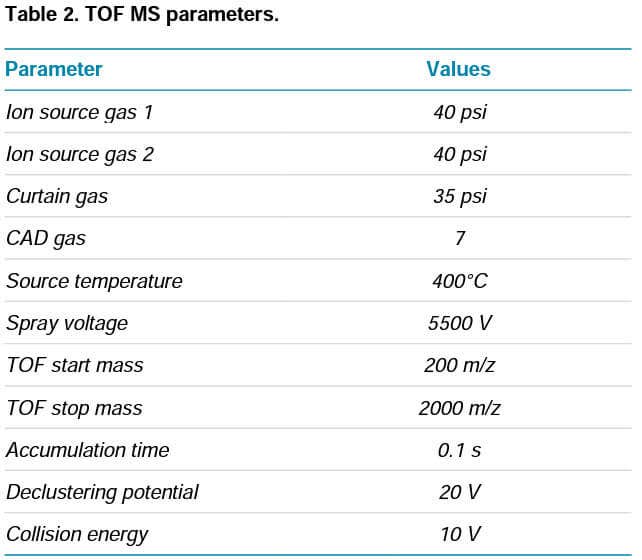
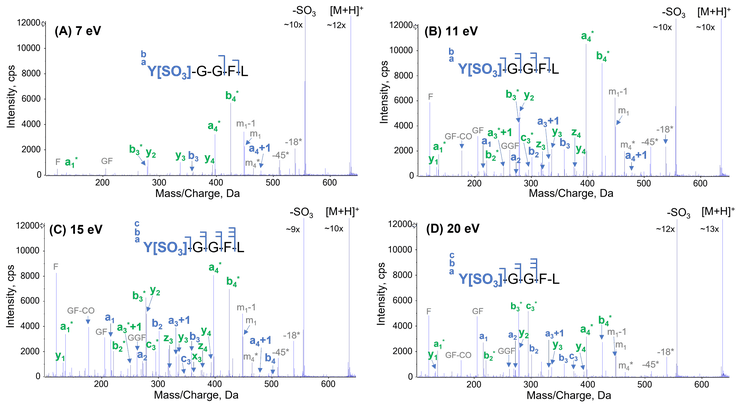
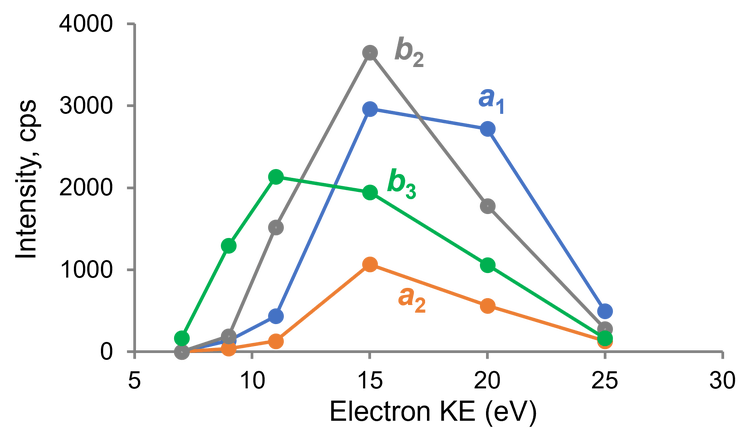
The EAD spectra of the singly charged LES acquired at electron KEs < 7 eV contained very few fragments (data not shown). These results were expected as fragmentation of singly charged species with EAD requires hot electrons with high KE, such as in EIEIO.3 Figure 2 displays the EAD spectra of LES at electron KEs of 7-20 eV. All these spectra contain a series of abundant a/b ions without the sulfate group (see peaks labeled with * in Figure 2), indicating the labile nature of tyrosine sulfation. EAD of LES at KE=7 eV generated 2 low-abundant sulfate-containing a/b ions (b3 and a4+1, see Figure 2A), which were insufficient to accurately localize the sulfate group. Increasing the electron KE to 11 eV or higher (Figure 2B–2D) resulted in the detection of a nearly complete series of sulfate-containing a/b ions, thereby allowing unambiguous localization of the sulfate group. The effect of the electron KE on the formation of 4 sulfate-containing fragments (a1, a2, b2 and b3) is summarized in Figure 3. An electron KE of 15 eV resulted in the overall strongest signal for these fragments.
Localization of sulfation in CLKS
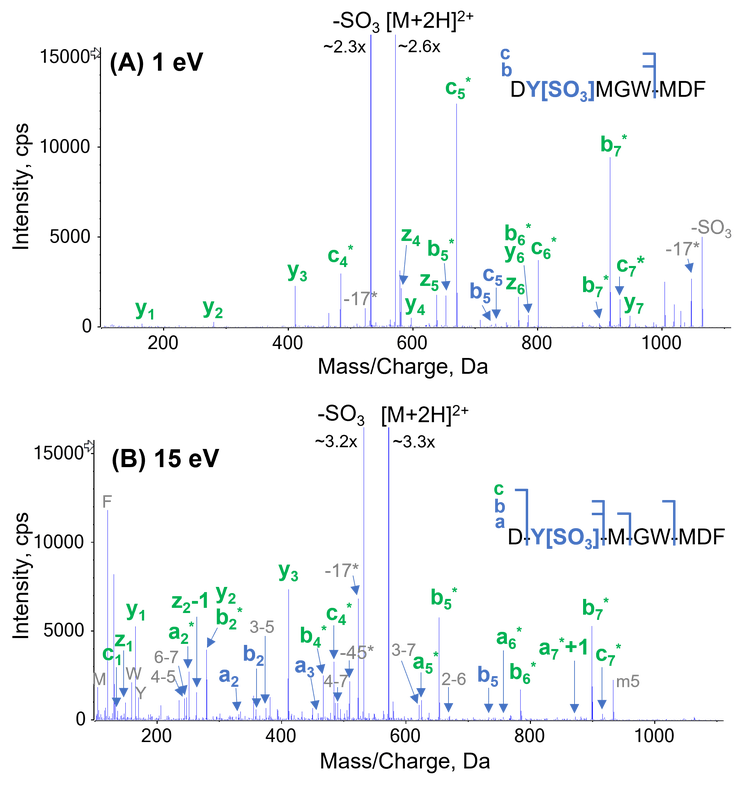
Tyrosine sulfation in CLKS is known to be very labile. A previous study revealed that low-energy electron capture dissociation (ECD) of doubly protonated CLKS yielded no sequence ions containing the sulfate group.2 A similar result was observed for EAD under the ECD-like conditions (KE=1 eV, Figure 4A), except that the sulfate group was retained on 2 low-abundant sequence ions (b5/c5). However, this result alone was not sufficient to pinpoint the location of the sulfate group in CLKS. Increasing the electron KE to 15 eV produced more sulfate-containing a/b fragments, including the a2/b2 ions that correspond to cleavages adjacent to the tyrosine residue (Figure 4B). The detection of c 1 without the sulfate group, which was absent in the spectrum with KE=1 eV (Figure 4A), further supported the localization of sulfation in CLKS at the second residue.
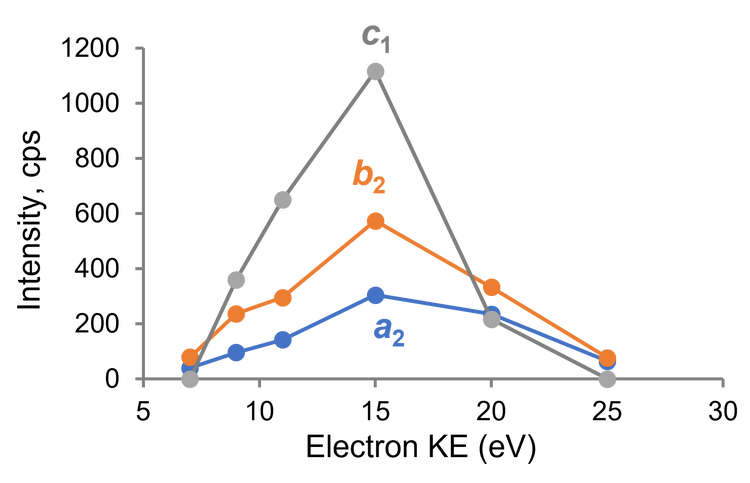
Figure 5 illustrates the effect of electron KE on signal intensity of a2, b2 and c1 ions from CLKS. Similar to the result obtained for LES (Figure 3), an electron KE of 15 eV was determined to be the optimal value for obtaining the most intense signal of these ions necessary for accurate localization of the sulfate group. In summary, the results described above highlight the unique capability of easily adjusting electron KE in EAD to obtain site information about labile tyrosine sulfation, which is very challenging or impossible with traditional low-energy ExD approaches.
Conclusion
- Accurate localization of labile tyrosine sulfation on a singly and doubly charged peptide was achieved using EAD with tunable electron KE
- The optimal signal intensity of sulfate-containing fragments from 2 sulfated peptides analyzed in this study was accomplished with an electron KE of 15 eV
- The result described in this technical note demonstrated the power and potential of EAD for analyzing challenging molecules with fragile modifications that may be encountered in the characterization of new modalities with increasing complexity
References
- Jia Zhao, Jason Sauders, et al. (2017) Characterization of a novel modification of a CHO-produced mAb: Evidence for the presence of tyrosine sulfation. MABS. 9(6): 985-995.
- Haichuan Liu and Kristina Håkansson. (2006) Electron capture dissociation of tyrosine O-sulfated peptides complexed with divalent metal cations. Anal. Chem. 78(21): 7570-7576.
- Takashi Baba, Pavel Ryumin, Eva Duchoslav et al. (2021) Dissociation of Biomolecules by an Intense Low-Energy Electron Beam in a High Sensitivity Time-of-Flight Mass Spectrometer. J. Am. Soc. Mass Spectrom. 32(8):1964-1975.
- Comprehensive peptide mapping of biopharmaceuticals utilizing electron activated dissociation (EAD). SCIEX technical note, RUO-MKT-02-12639-B.
- A new electron activated dissociation (EAD) approach for comprehensive glycopeptide analysis of therapeutic proteins. SCIEX technical note, RUO-MKT-02-12980-A.
- An evaluation of single injection platform method for advanced characterization of protein therapeutics using electron activation dissociation (EAD). SCIEX technical note, RUO-MKT-02-13965-A.