Abstract
Erythropoietin (EPO) products exhibit significant microheterogeneity due to extensive glycosylation, making accurate characterization of charge variants a critical yet challenging quality control requirement.
This technical note demonstrates a high‑throughput capillary isoelectric focusing (cIEF) method for EPO charge variant analysis using the 8‑capillary BioPhase 8800 system and compares its performance with the single capillary PA 800 Plus system. The study shows that parallel 8‑capillary operation on the BioPhase 8800 system achieves equivalent pI accuracy, peak area distribution, and resolution, while delivering reliable results with excellent inter‑capillary consistency and repeatability. These results highlight the suitability of the BioPhase 8800 system for routine EPO charge variant characterization .
Key features
-
Excellent cIEF performance with high-throughput capability: high-resolution separation of different EPO charge variants, while delivering an average run time of approximately 4.5 minutes per sample (36 minutes/8 samples) for rapid analysis of large sample sets
-
Excellent inter-capillary consistency and repeatability: reproducible results across eight capillaries and multiple injections
- %RSD < 0.2% for pI values, < 6.5% for peak area percentages (PA%), and < 5.5% for resolution (R) across capillaries
- %RSD < 0.9% for pI values, < 5.5% for PA%, and < 3.5% for R for repeat injections
-
Confident method transfer: comparable performance to the PA 800 Plus system supports seamless transfer between single- and multi-capillary platforms
Introduction
Erythropoietin (EPO) is a highly glycosylated protein that exhibits pronounced molecular microheterogeneity due to the presence of multiple charge variants. Because glycosylation plays a critical role in the in vivo biological activity of EPO, the distribution and relative abundance of these charge variants are critical quality attributes (CQAs) for EPO products.1
Both capillary zone electrophoresis (CZE) and cIEF have been applied to EPO charge variant analysis.1 The European Pharmacopoeia CZE method offers a relatively simple workflow, particularly with respect to sample preparation and method setup. However, cIEF provides several analytical advantages for more comprehensive characterization of EPO variants.
In a previous study, the cIEF method for EPO charge variant analysis was compared with the European Pharmacopoeia CZE method on the PA 800 Plus system.1,2 Both methods detected the same number of charge variants and produced comparable relative peak area distributions. However, cIEF provided higher resolution, generated pI values for each variant, and demonstrated better repeatability for the eight detected variants. In addition, cIEF completed the separation within 30 minutes, compared with 55–68 minutes or longer for the European Pharmacopoeia CZE method, and required only 12 minutes for capillary equilibration versus approximately 14 hours for CZE. Notably, cIEF for EPO charge variant analysis has also been included in the 2025 edition of the Chinese Pharmacopoeia,3 further supporting its relevance and acceptance for this application.
In this study, EPO charge variant analysis using cIEF was performed on the BioPhase 8800 system. As a multi-capillary platform, the BioPhase 8800 system enables parallel separations across eight capillaries, providing eight-fold analytical efficiency while maintaining data quality comparable to that of the single-capillary PA 800 Plus system. The method demonstrated comparable pI values, peak area percentages, and resolution on the two systems, together with rapid analysis time (36 minutes for 8 samples, or approximately 4.5 minutes per sample), excellent inter-capillary consistency, and strong repeatability across consecutive injections within a single capillary.
Materials
Materials: The BioPhase Capillary Isoelectric Focusing (cIEF) kit (P/N C30101), containing Cathodic Stabilizer, Anodic Stabilizer, cIEF Gel, Urea, Anolyte, Neutral Capillary Conditioning Solution, Catholyte, Chemical Mobilizer, Formamide, and CE Grade Water, was from SCIEX (Marlborough, MA). The pI markers 3.21 (P/N 1002 02), 5.91 (P/N 100212), and 6.61 (P/N 100214) were from Advanced Electrophoresis Solutions Ltd. (Cambridge, ON, Canada). The 3-10 ampholytes (P/N 17045601 ) were obtained from Cytiva (Marlborough, MA).Ultrafiltration membranes ( PN VN01H02) were obtained from Sartorius (Göttingen, Germany).
The European Pharmacopoeia EPO reference standard was purchased from the European Directorate for the Quality of Medicines & HealthCare (EDQM; P/N Y0001725).
Reagent and s ample preparation:
All reagents, including the Cathodic Stabilizer solution and the Anodic Stabilizer solution, were prepared according to the kit instructions.4
The 6M urea cIEF gel solution was prepared by dissolving 3.60 g of urea in the cIEF gel matrix and bringing the final volume to 10.0 mL.
Master mix preparation (for 8 sample s): 810 μL of 6M urea cIEF gel, 54.0 μL of pH 3–10 ampholytes, 135.0 μL Anode Stabilizer, and 4.5 μL each of pI markers (3.21, 5.91, 6.61).
Sample preparation: The European Pharmacopoeia EPO reference standard was desalted using ultrafiltration membranes to a final concentration of 4 mg/mL. For each of the sample preparation, 20 μL of the 4 mg/mL EPO sample were mixed with 110 μL of Master Mix and vortexed thoroughly. 100 μL of the mixture was transferred into each of eight sample wells in a single column of the sample plate. The sample layout is shown in Figure 2.
At this stage, all eight wells contained identical samples. The BioPhas e 8800 system and the BioPhase software were used for data acquisition to evaluate inter- capillary consistency within a single injection and repeatability of six consecutive injections on a single capillary. An additional 100 μL aliquot of the same sample was analyzed on the PA 800 Plus system using 32 Karat software for comparison.
The CE Instrument and software: The BioPhase 8800 system (P/N 5083590), equipped with a UV detector (280 nm), was from SCIEX. Data acquisition and analysis were performed using the BioPhase software, v 1.2.20. The BioPhase plat e pack starter kit (P/N 5080311), and BioPhase neutral capillary cartridge - 8 x 30 cm, 50 μm inner diameter, P/N 5080119) were from SCIEX.
The PA 800 Plus system (P/N 969136) was equipped with a UV detector and a 280 nm filter. Data was collected and analyzed using the 32 Karat software, v 10.3. A neutral capillary (SCIEX, P/N 477441) with a total length of 30.2 cm (20 cm effective length from injector to detector) was used.
Separation conditions: The cIEF separation conditions for EPO charge variant analysis on the BioPhase 8800 system and the PA 800 Plus system were as follows: samples were injected at 25 psi for 99 s, followed by focusing at −25 kV for 6 min. Chemical mobilization was performed using the Chemical Mobilizer in place of the Anolyte at −30 kV for 30 min. The data acquisition rate was set to 4 Hz. The sample compartment temperature was maintained at 10°C, the capillary temperature at 25°C, and UV detection was performed at 280 nm. Initial conditioning of a new capillary cartridge consisted of rinsing with CE Grade Water at 70 psi for 10 min (performed twice), followed by a rinse with the Neutral Capillary Conditioning Solution at 70 psi for 20 min.
For both pre-run and shutdown procedures, the capillary was rinsed with Neutral Capillary Conditioning Solution at 70 psi for 5 min.

Results and discussions
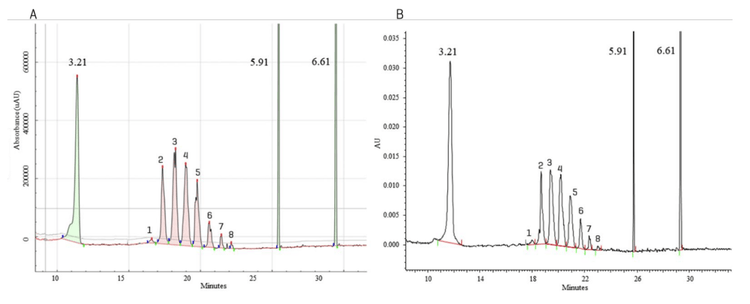
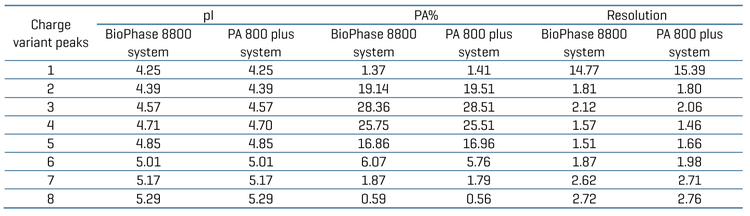
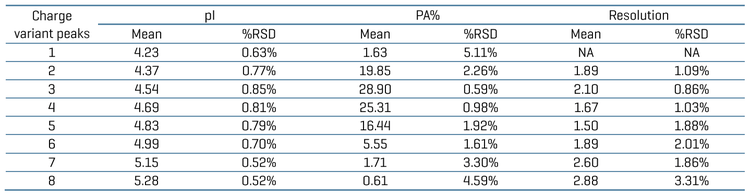
Comparison of results between the BioPhase 8800 system and the PA 800 Plus system: Representative cIEF electropherograms of the same EPO sample acquired using the BioPhase 8800 system and the PA 800 Plus system are shown in Figures 1a and 1b, respectively. The two systems exhibited comparable peak profiles, with eight EPO charge variant peaks consistently detected on both platforms. Comparative results for pI values, PA%, and resolution of the eight charge variant peaks are summarized in Table 1. Excellent agreement was observed between the two instruments, demonstrating highly consistent analytical perform ance
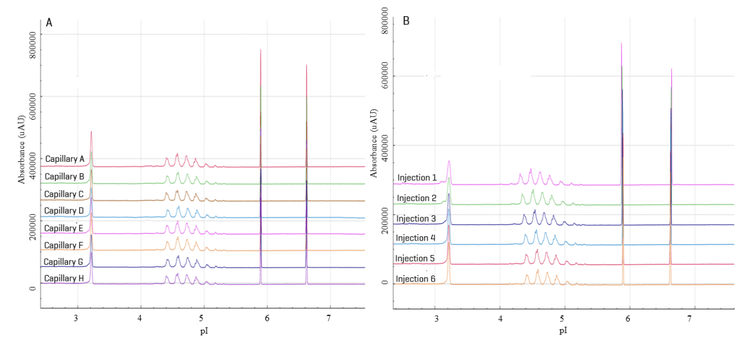
Multichannel repeatability of the BioPhase 8800 system: Six consecutive injections were performed simultaneously across eight capillaries to evaluate inter- capillary consistency within a single run, as well as repeatability for multiple injections on single capillary.
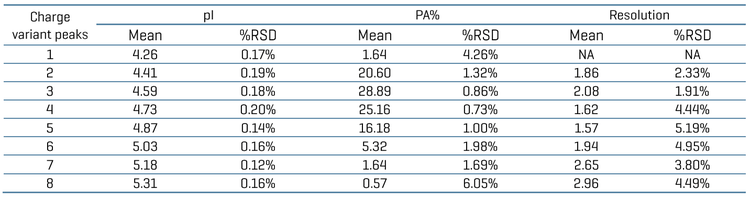
Excellent consistency was observed among the eight capillaries within a single injection. Representative cIEF electropherograms are shown in Figure 3a, and the corresponding statistical results are summarized in Table 2. The RSDs were < 0.2% for pI values, < 6.5% for PA%, and < 5.5% for resolution, demonstrating strong inter-capillary consistency .
Exceptional repeatability was also observed for six consecutive injections on single capillary. The representative electropherogram of 6 injections on capillary A is shown in Figure 3b, and quantitative results are summarized in Table 3. The RSDs were < 0.9% for pI values, < 5.5% for PA%, and < 3.5% for R, confirming the robustness and reproducibility of the method.
Conclusions
This study demonstrates the suitability of the BioPhase 8800 system for high -throughput cIEF analysis of EPO charge variants. The main conclusions are as follows:
- High-resolution separation of EPO charge variants, with pI values, peak area distributions, and resolution comparable to those obtained on the PA 800 Plus system.
- Excellent inter-capillary consistency was demonstrated across eight parallel capillaries.
- Excellent repeatability was achieved for six consecutive injections on a single capillary.
- The method provides high throughput and rapid analysis, making the BioPhase 8800 system well suited for efficient characterization of large EPO sample sets from different batches or sources without compromising analytical performance.
References
- Gebretsadik, H., et al., A comprehensive review of capillary electrophoresis-based techniques for erythropoietin isoforms analysis. Journal of Chromatography A, Volume 1708, 2023, 464331, ISSN 0021-9673.
- Ren, T., et al., Isoforms analysis of recombinant human erythropoietin by polarity-reversed capillary isoelectric focusing. Electrophoresis, Volumn 41, Issue 23 , 2055- 2061
- The Chinese Pharmacopoeia (ChP) 2025 edition
- Capillary isoelectric focusing (cIEF) kit for the BioPhase 8800 system, application guide, RUO-IDV- 05- 8651-C.