Introduction
Key studies for RNA structure and function particularly for promising RNA therapeutics such as vaccines, retroviral and lentiviral vectors, aptamers, anti-sense RNA, and small interfering RNA, highly depend on the characterization of the corresponding coding sequence and its structural conformation.1 The latter gaining momentum for continuous improvements of gene and biological therapies, specifically by expanding the understanding for the RNA mechanism of action, and potential applicability for stability studies or critical quality attributes needed for commercialization. In this technical note, we describe the application of the capillary electrophoresis-based GenomeLab GeXP Genetic Analysis System for RNA structural modeling at the nucleotide level.2 Thus, providing a solution to solving complex RNA conformation questions to better guide actionable studies in the drug development pipeline, and establish timely, cost-effective quality assays for commercialized products.
Briefly, the visualization of RNA conformations depending on x-ray crystallography, small-angle scattering, cryogenic electron microscopy, or nuclear magnetic resonance provide high atomic resolution; however these biophysical methods are extensively laborious and require costly equipment.3 In contrast, RNA biochemical probing coupled to automated capillary electrophoresis instruments have been shown to reduce RNA sample processing time, costs, and can be applied to produce evidence-based RNA conformation models for both small and large RNA molecules.
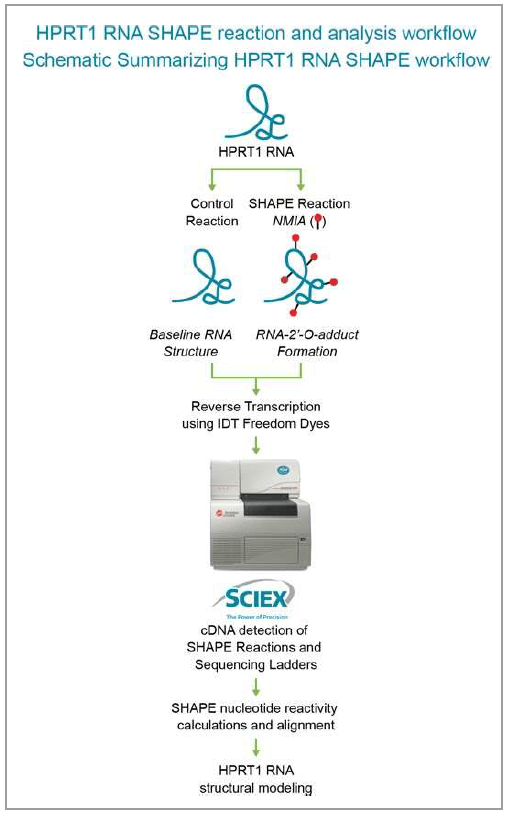
Specifically, we applied the Selective 2’-Hydroxyl Acylation Analyzed by Primer Extension (SHAPE) reaction to determine the accessibility of RNA nucleotides by the highly electrophilic probing reagent N-Methylisatoic Anhydride (NMIA) for RNA-2’- O-adduct formation.4 As a result, a structural map for the human HPRT1 RNA transcript was constructed (fig. 2), after reverse transcription, by applying minimum free-energy computational algorithms. And essential for RNA secondary structure modeling was the high resolution of single modified nucleotides made possible by the separation capabilities and extreme sensitivity of the fluorescent signal found on the SCIEX GenomeLab GeXP.2
Key features
- Evidence based RNA structural modeling reveals regions of nucleotide flexibility, aiding in in-depth understanding of RNA therapeutics actions.
- Built on automated multi-capillary CE platform with ready to use separation reagents, capacity for high-throughput processing, with potential for mapping very large RNA molecules.
- Minimal requirement of RNA samples (6 pmol of RNA per reaction).
- Results within two hours for every eight-capillary run for subsequent computational analysis.
- Fluorescence-based detection, no radioactive waste.
- Single-base resolution, thus every RNA nucleotide can be assessed using optimized GeXP separation conditions.
Materials and methods
Reagents
Labeled primers. Fluorescent reverse primers were synthesized by Integrated DNA Technologies (IDT). Oligonucleotides for the positive SHAPE or acylation reaction were labeled with IDT Freedom™ Dye Cy5™ (Ex. 648 nm, Em. 668 nm). The oligonucleotides for the negative SHAPE or control RNA reaction were labeled with IDT Freedom™ Dye Cy5.5™ (Ex. 685nm, Em. 706 nm). The IDT Alexa Fluor Dye 750® (Ex. 649nm, Em. 662nm) was used to label oligonucleotides for DNA ladder preparation. The second reference DNA ladder used oligonucleotides labeled with IDT LI-COR IRDye® 800CW (Ex. 767nm, Em. 791nm).
HPRT1 RNA. The human HPRT1 (NCBI, NM_000194.3, 1395bp) in vitro transcribed custom product was provided by the IDT Functional Genomics R&D team, aliquoted into small volumes, and stored at -80° C.
HPRT1 DNA ladder. IDT cloning vector (pUCIDT, Amp) carrying the HPRT1 DNA sequence was selected for its capacity to support genomic fragments up to 5000 base pairs long. The resulting plasmid (~4 µg) can be used directly as a template for DNA ladder preparation or expanded using E.coli.
DNA purification. CleanSEQ® Beckman Coulter Life Sciences paramagnetic beads were used for DNA ladder purification (PN A29151). Magnetic plate required (PN A32782). Ethanol precipitation could also be used for sequencing ladder purification.
GeXP sample loading solution. (SLS, SCIEX. PN 608082).
GeXP separation buffer. (SCIEX. PN 608012). mineral oil (PN 608114). separation gel (20 mL: PN 391438).
DNA Sep cap array. 33-75B (SCIEX. PN 608087).
Other molecular biology grade reagents
N-Methylisatoic anhydride (NMIA) (PN, M25), SuperScript™ III (PN 18080044), dNTP Mix (PN R0192), Sequenase Cycle Sequencing Kit (PN 78500), Magnesium Chloride (PN AM9530G), Potassium Chloride (PN AM9640G), Tris-ETDA buffer (PN 12090015), and Tris- HCl, pH 8.0 (PN 15568025) were purchased from Thermo Fisher Scientific.
Dimethyl Sulfoxide (DMSO) (PN D8418), Sodium Acetate 3M pH 5.2 (PN S7899), Sodium Hydroxide (PN 72068), and Hydrochloric Acid (PN H1758) were purchased from Sigma-Aldrich.
Ethanol (PN BP2818) and EDTA (PN AAJ15694AE) were purchased from Thermo Fisher Scientific.
Nuclease-free water and not DEPC-treated (PN AM9930), was obtained from Invitrogen.
Section I.
HPRT1 RNA folding
Renaturation of the in vitro transcribed HPRT1 RNA product (6-12 pmol) was performed following a series of salting and heating conditions to mimic its biological conformation. As a first step, the RNA sample was mixed with potassium chloride and heated up to 85° C and cooled down to 4° C (0.1° C /sec). In the next step, a magnesium chloride and potassium chloride buffer was applied to the renatured RNA and warmed up to physiological conditions (37° C) for at least 30 minutes and placed at room temperature.6,7
Section II.
SHAPE reaction: HPRT1 RNA-2’-O-adduct formation
To gather information on HPRT1 RNA nucleotides prone to secondary structure formation or their likeliness to be found in local flexible regions, the highly electrophilic probing reagent, N- Methylisatoic anhydride (NMIA) was added to a sub-sample of the folded HPRT1 RNA sample and incubated at physiological conditions (37° C) for about 50 minutes. The negative or RNA control reaction was prepared similarly by using dimethyl sulfoxide (DMSO).6,7
Section III.
GeXP detection of HPRT1 modified nucleotides
A note about primer design: Reverse primers should be designed at every 350 to 400 nucleotides of the RNA molecule of interest. The 1395 bases RNA transcript corresponding to hypoxanthine phosphoribosyltransferase 1 (HPRT1) had four different reverse primers designed to cover the length of this transcript. Each primer was labeled four different ways: Cy5, Cy5.5, Fluor Dye 750, IRDye 800CW.
SHAPE positive and negative reactions
HPRT1 RNA-NMIA modified products were reversed transcribed using the SuperScript III kit in the presence of the dNTP mix following Freedom Dye Cy5 hybridization for about 50 minutes at 50° C. In parallel, the negative or control reaction involved hybridization with the IDT Freedom Dye Cy5.5 followed by reversed transcription also using the SuperScript III kit in the presence of the dNTP mix. Labeled cDNA fragments from SHAPE and control reactions were pooled together, purified by ethanol precipitation, and resuspended in 40 µL of SLS.6,7
HPRT1 sequencing ladder reactions
The HPRT1-pUCIDT plasmid from IDT was used as template for Sequenase Cycle Sequencing. Optimized thermal cycling conditions generated varying sized DNA products with incorporated fluorescence determined by a dideoxynucleotide (ddNTP) of choice. For this protocol, a sequencing reaction was prepared by using a reverse primer labeled with the IDT Alexa Fluor Dye 750 in the presence of the ddATP termination mix. For the second ladder reaction, a sequencing reaction was prepared by using a reverse primer labeled with the IDT LI-COR IRDye 800CW in the presence of the ddTTP termination mix. Each DNA ladder reaction was purified using the Beckman Coulter CleanSEQ paramagnetic beads and eluted with 40 uL of SLS.6,7
A mixture of (positive and negative SHAPE reactions) cDNA products and sequencing ladders were combined at an optimum ratio, reflecting unsaturated and above background signals, and loaded onto the GenomeLab GeXP Genetic Analyzer.
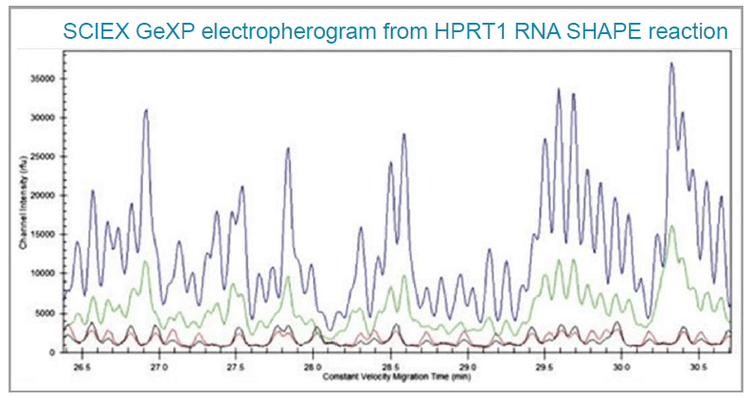
An electropherogram was generated within two hours after loading the sample for analysis, yielding signals in the blue, green, black, and red channels originating from cDNA products labeled with Cy5, Cy5.5 and sequencing ladders labeled with Alexa Fluor Dye 750 and LI-COR IRDye 800CW, respectively.
Section IV.
HPRT1 RNA structural analysis and modeling
Nucleic acid reactivity following exposure to NMIA was examined through truncated cDNA products, as a result of premature reverse transcription termination, sized to specific nucleotide positions found at flexible regions of the HPRT1 RNA transcript due to RNA-2’-O-adduct formation. For this protocol, the computational set of algorithms found within the ShapeFinder software were used to quantitate nucleic acid reactivity by deciphering the GenomeLab GeXP electropherogram.8 These reactivity values were normalized and used for RNA conformational modeling by using RNAThor, ViennaRNA Web Services, or RNAstructure software.
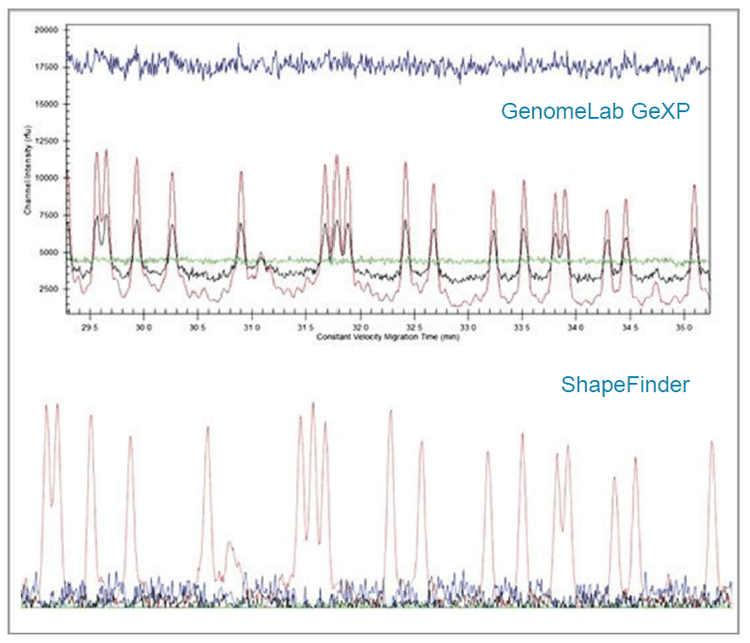
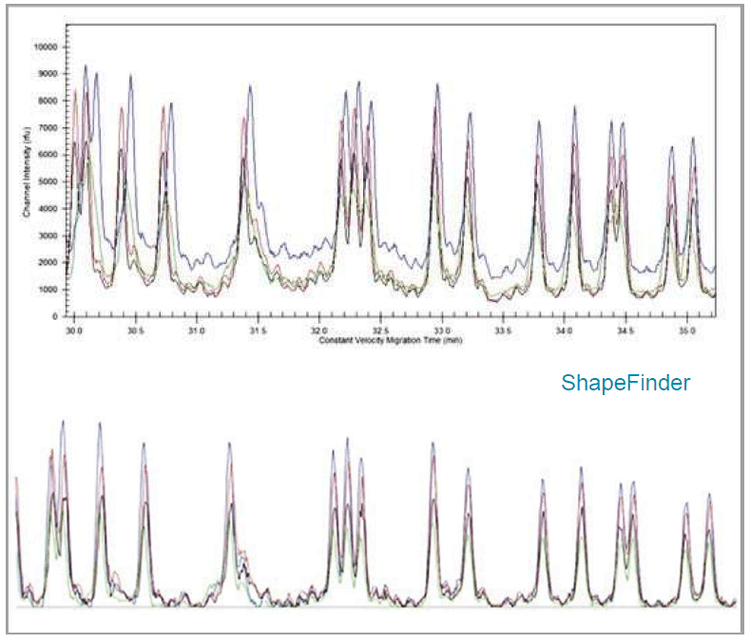
Preliminary analysis: fluorescent dye cross-talk and mobility shift correction. Prior to analyzing GenomeLab GeXP electropherograms for nucleotide reactivity values deriving from NMIA exposure, fluorescent dye cross-talk and mobility shift correction reactions were set up for proper analysis. As shown in figures 4a and 4b; using CleanSEQ paramagnetic beads for DNA purification, following HPRT1-pUCIDT plasmid amplification by using the Sequenase Cycle Sequencing kit and keeping the same ddTTP termination mix in the four separate reactions, with each reaction utilizing the same labeled reverse primer sequence with Cy5 (fig 4a), Cy5.5, Fluor Dye 750, or IRDye 800CW (fig. 4b), corresponding samples were analyzed followed by signal cross-talk correction. Figure 4c, shows a mixture of the reactions mentioned above, needed for mobility shift correction due to the difference in molecular weight as a result of the reverse primer labeled with different fluorescent dyes.
Preliminary analysis for SHAPE value calculations. Figures 4a and 4b demonstrate the HPRT1 fluorescent dye cross-talk and mobility shift correction for nucleotide alignment and reactivity value calculations for the first ~400 bases of the full length transcript. This step was also applied to correct Cy5.5 and Alexa-750 signal cross-talk. Figures not shown.
Results and Discussion
HPRT1 RNA SHAPE reaction resolved by SCIEX GeXP
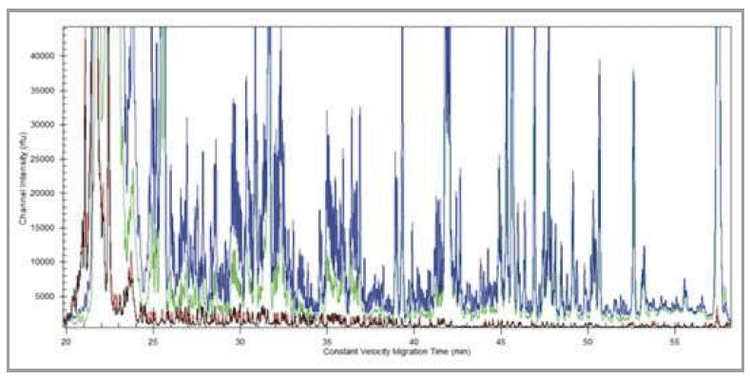
To empirically determine an RNA conformation model of the full length HPRT1 transcript conjugated with NMIA (see experimental part), and to maximize reverse transcription efficiency, reverse primers labeled with respective fluorescent dyes were designed at ~250-400 nucleotides apart depending on coding sequence properties like GC-rich regions or long repeats. Figure 5 shows the entire GenomeLab GeXP raw electropherogram for the first 408 nucleotides of the HPRT1 RNA molecule assessed for SHAPE cDNA products along with the complementary sequencing ladders. Using a previously determined NMIA concentration obtained by performing a titration assay with varying NMIA concentrations and including a control reaction by adding DMSO, varying Cy5 peaks were observed following optimized separation conditions. This peak variation (blue trace) suggests the quantitation of Cy5 cDNA products as a result of truncated reverse transcription due to RNA-2’-O-adduct formation. The green trace (Cy5.5) shows the DMSO treated HPRT RNA molecule, suggesting the baseline cDNA products due to random or possibly rigid structures. The mostly uniform peak height or signal intensity for the black (Alexa Fluor Dye 750) and red (IRDye 800CW) traces correspond to the sequencing ladders used for alignment and sequencing functions.
SCIEX GeXP separation technology and dye quality: Critical factors for SHAPE reactivity value calculation
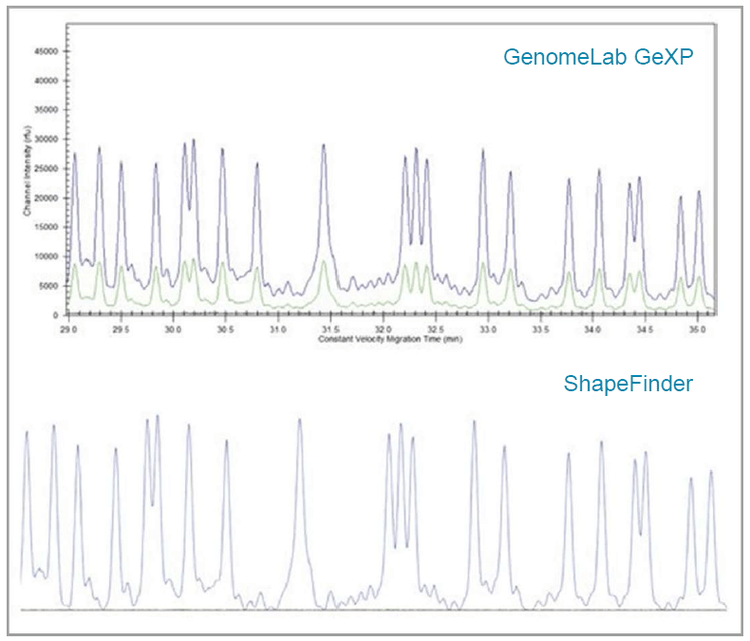
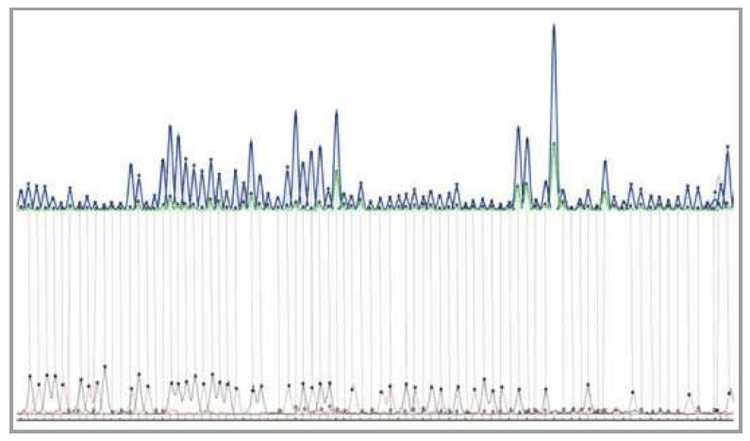
For this SCIEX technical note, ShapeFinder was applied for the quantitation of SHAPE based nucleic acid reactivity by taking the difference of the positive reaction (Cy5, blue trace) over the negative reaction (Cy5.5, green trace). In addition, to their alignment to the reference HPRT1 RNA sequence by integrating the ddATP and ddTTP based sequencing ladders: black and red traces (Alexa Fluor Dye 750, and IRDye 800CW, respectively). Figure 6, highlights the single nucleotide resolution made possible by the SCIEX GeXP proprietary separation technology as shown by the sequencing ladders, and critical for the alignment and integration of the SHAPE reactions and the sequencing ladders was the quality of the fluorescently labeled reverse primers obtained from Integrated DNA Technologies. As a result ShapeFinder peak calling occurred mostly automatically, thus providing an advantage for minimizing the manual alignment of SHAPE reactions and sequencing ladders to the reference HPRT1 RNA sequence.
SCIEX GeXP SHAPE quality data and normalization
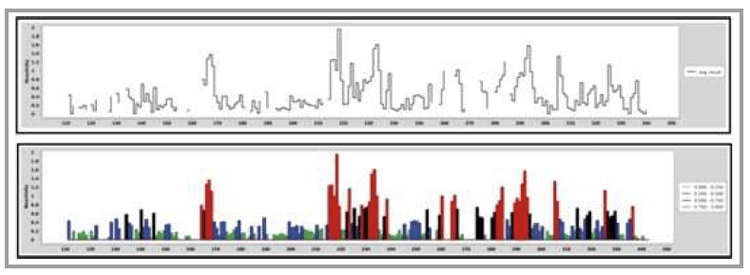
RNAthor, a new software tool, was recently introduced for the fully automated normalization of SHAPE data resolved by capillary electrophoresis instruments like the SCIEX GeXP.5 This cloud-based computational tool takes ShapeFinder files following alignment and integration and performs a series of steps to filter out outliers while retaining quality data. Also, a normalization step occurs resulting in a comprehensive view or reactivity map profiling indicating the respective Shape value or pseudo-energy constraint information for each RNA nucleotide due to NMIA exposure. As shown in figure 7, gaps in the reactivity profiling plot for the first 408 nucleotides of the HPRT1-RNA molecule, suggest exclusion of data points as a result of hard-stops or outliers in the data set. Applying RNAthor or functionally-similar computational tools may become highly beneficial for assay assessment, quality of RNA sampling and processing, or dominant structural properties of RNA molecules.
The path from a SCIEX GeXP Cy5 intensity peak to a pseudo-energy constraint or SHAPE value
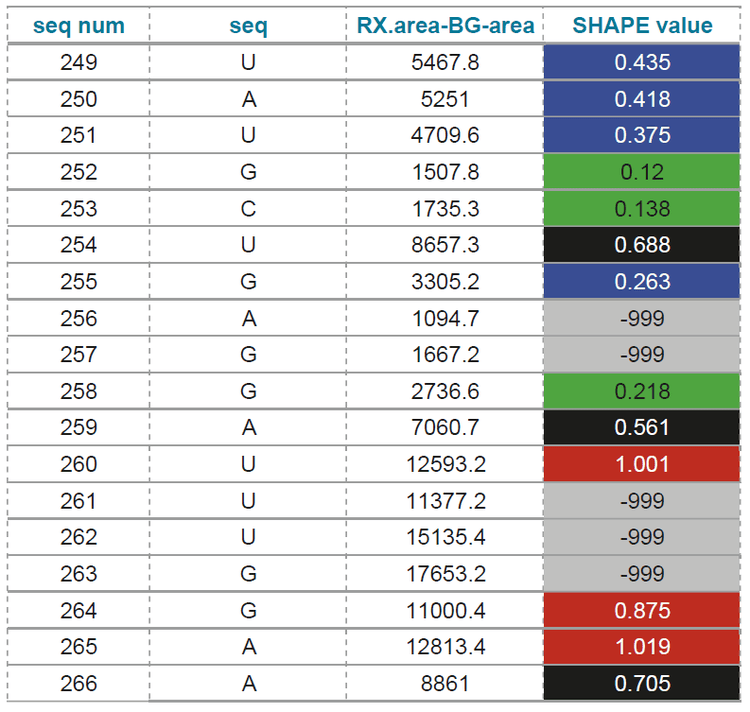
RNA structural changes due to nucleotide variation could also be studied using the SCIEX GeXP Genetic Analyzer by characterizing Cy5 (blue) peaks of interest matching the RNA reference sequence. For example, RNA SHAPE-treated variants following data normalization could be compared for Shape reactivity values or structural conformation. In detail, and as shown in Table 1, RNAthor software converted GeXP electropherogram-based data into relative SHAPE values meaningful for RNA conformation modeling. As a result, iterations of this computational process may be applied to compare structural differences among RNA variants.
Solving HPRT RNA secondary structure using the GeXP
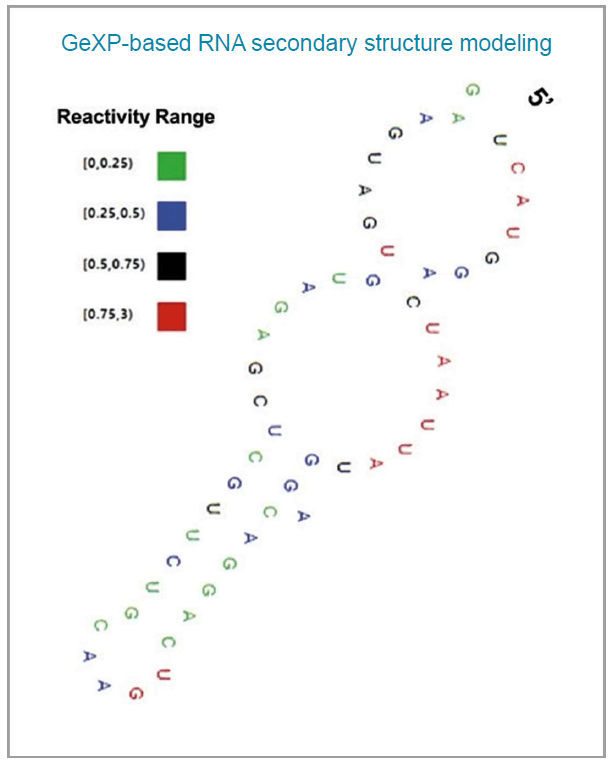
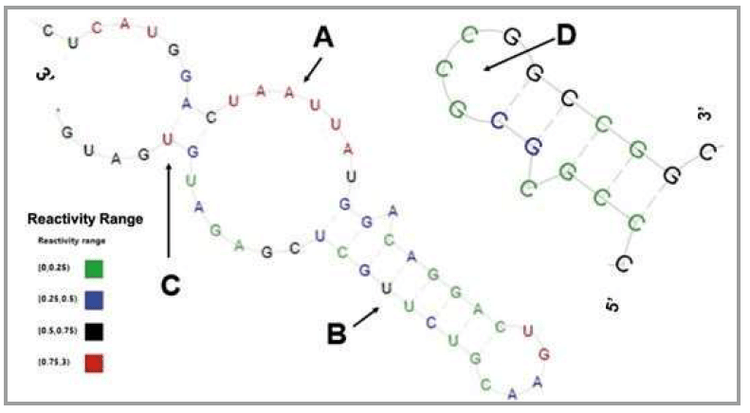
SCIEX GeXP evidence-based RNA nucleotide flexibility has the potential to reveal unexpected structures or to confirm structural information of RNA molecules alone or in combination with ligands such as small molecules, other RNAs, or proteins both in vitro and in vivo. Figure 8, shows a portion of a color-coded HPRT1 structural modeling using RNAthor. Green colored bases suggest a lower SHAPE value compared to the red colored nucleotides. Interestingly, arrow A shows a cluster of bases with high SHAPE values concentrating as part of a large pocket. Arrow B on the other hand, suggests that bases with a low SHAPE values are involved with rigid structure formation. ArrowC, suggests a breaking point as a nucleotide (U) with a high SHAPE value is found at the edge of a structural pocket. Substitution of this nucleotide or neighboring bases may be of interest to better understand the mechanisms behind RNA structure formation. Lastly, arrow D suggests the possibility of RNA folding involving GC-rich domains.
Surveying SHAPE-less HPRT1 RNA structural modeling
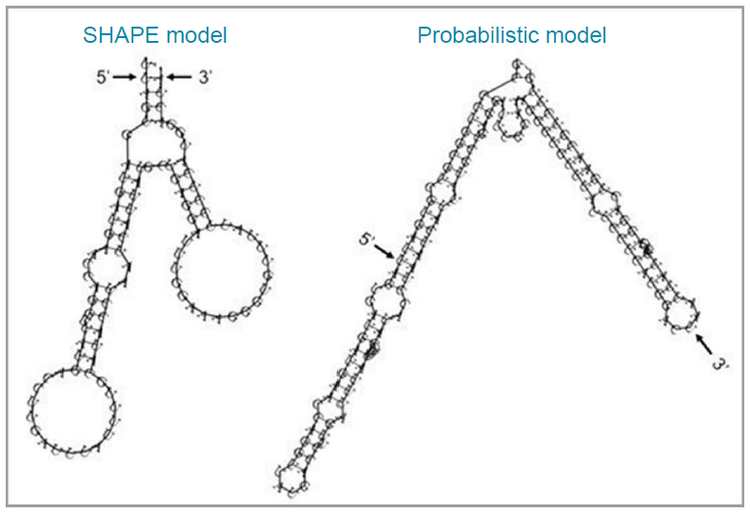
Because RNA structure is known to substantially contribute to biological processes and very likely as well to be involved in the mechanism of action of RNA therapeutics, we modeled the first 408 nucleotides of the HPRT1 RNA transcript, first by using constrained values derived from the SHAPE reaction, and second by using a probabilistic approach. In summary, an analysis comparing a secondary structure model for this HPRT1 RNA fragment constrained by SHAPE values demonstrated substantial divergence from a theoretical model by using the ViennaRNA Web Services.9 Figure 9, provides a visual for secondary structure conformation calculated from minimum free energy and partition functions. The black arrows illustrate a sequence chosen for comparison within the 408 HPRT1 RNA fragment for visualization purposes, highlighting structural differences between the experimental and the theoretical model. In addition to base- paring differences, there are various pocket formations inconsistent from the theoretical model. In conclusion, application of the SCIEX GeXP Genetic Analyzer for RNA structural studies may be instrumental for the characterization of promising RNA therapeutics or for quality assessment of commercialized products.
Conclusions
- The SCIEX GeXP can be used to establish a high-through processing and systematic approach for interrogating both small and large RNA molecules.
- IDT Freedom quality dyes contributed to single base resolution and sequencing alignment.
- SCIEX GeXP capillary electrophoresis proprietary technology allows for single base separation, thus instrumental for supporting evidence base RNA conformational modeling.
References
- Kenyon, J., et.al. Biochem. Soc. Trans. 2014. 42. 1251-1255.
- SCIEX GenomeLab Genetic Analysis System User’s Guide.
- Li, B. et al. Front Genet. 2020 Oct 26;11:574485.
- Wilkinson, K.A., et. al. Nat Protoc. 2006;1(3):1610-6
- Gumna, J., et. al. PLOS ONE 15(10): e0239287.
- https://rnathor.cs.put.poznan.pl/
- Gumna J., et.al. RNA Biol. 2019 Dec;16(12):1749- 1763.
- Smola, M., et. al. 2015. Nat Protoc 10, 1643–1669.
- Vasa, S. M., et. al. RNA. 2008 Oct;14(10):1979-90.
- http://rna.tbi.univie.ac.at/