buttojn-id
Wen Jin1, Lyle Burton1, Stefano Gotta2, Doug Simmons1 and Kerstin Pohl3
1
SCIEX, Canada; 2GeneData, Switzerland; 3SCIEX, USA
Download PDF
/content/dam/SCIEX/tech-notes/biopharma/ruo-mkt-02-13736-a/RUO-MKT-02-13736-A_Impurity%20detection%207600%20and%20Biologics%20Explorer.pdf
_blank
Abstract
Abstract
Key features
Key-features
Methods
Methods
Impurity
Impurity
Engaging the Zeno trap
Engaging
Traceability of data processing
Traceability
Conclusion
Conclusion
References
Relative
Abstract

Abstract

Here, synthetic peptides were spiked into a digest of a monoclonal antibody (mAb) to mimic protein-derived impurities. An untargeted data acquisition strategy on the state-of-the-art ZenoTOF 7600 system was used and data were processed using the new Biologics Explorer software.

Protein-derived impurities can negatively affect the stability, safety and efficacy of protein therapeutics and must be carefully monitored and controlled.1 Therefore, workflows that enable sensitive detection and identification of impurities in biotherapeutics must be employed to determine their identity2 and to ensure their amounts are below established thresholds.3

In this technical note, 20 heavy labeled peptides were spiked into a NISTmAb digest at 25-50 ppm, relative to the concentration of mAb. The samples were then analyzed with the ZenoTOF 7600 system using data-dependent acquisition (DDA), both with and without engaging the Zeno trap. The new Biologics Explorer software from SCIEX was used to analyze the data with a comparative workflow template. This template allows users to screen for the presence and absence or relative fold-change of analytes between a given sample and its control sample. Traceability from raw data to processed data ensured transparent data interrogation at every step of processing in the Biologics Explorer software.

Key-features

Key features of the ZenoTOF 7600 system and Biologics Explorer software for impurity analysis

  • Sensitive detection of low-level impurities in biologics using the ZenoTOF 7600 system
  • Enhanced fragment sensitivity in impurity detection and identification due to the automatic engagement of the Zeno trap on the ZenoTOF 7600 system
  • Reliable data processing using the Biologics Explorer software provides comprehensive detection of protein-based impurities
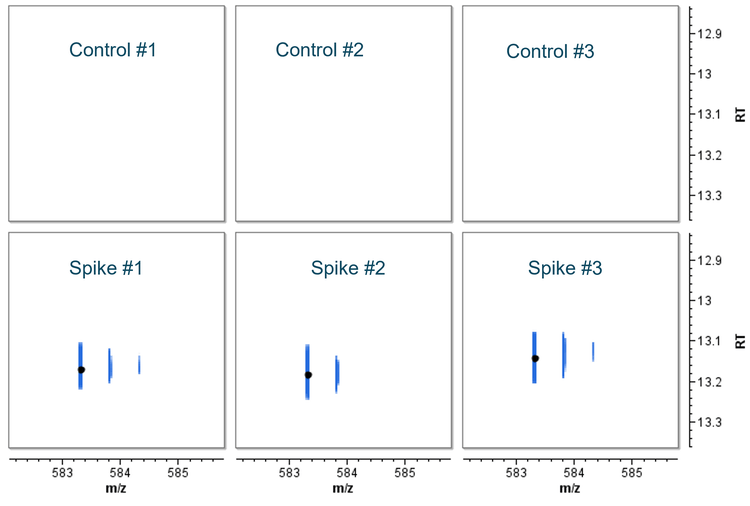
Figure 1. Ion map of 3 replicates of NISTmAb digest sample without (top) and with (bottom) spiked peptides.  The ion map was zoomed into the precursor  m/z and retention time (RT) of one of the spiked peptides, AVGANPEQLTR, which was spiked at 30 ppm relative to the concentration of NISTmAb. The blue lines indicate the isotope clusters of the 2+ charged precursor of the peptide, which is present in the 3 spiked samples but absent in the 3 control samples. The black dots indicate the RT at which the MS/MS was triggered for this precursor ion.
#efefef
image-top
Methods

Methods

Sample preparation: NISTmAb digest (40 µg/vial) and a peptide calibration mix containing 20 non-naturally occurring, synthetic peptides (SCIEX PepCalMix, #5045759) were used for this experiment. A solution of 0.2 µg/µL of NISTmAb digest was attained by adding 200 µL of 0.1% formic acid to the NISTmAb vial. One µL of peptide calibration mix was then spiked into the prepared NISTmAb solution. The final concentration of each of the spiked peptides was 5 fmol/µL, which translates to 25 to 50 ppm, relative to the concentration of NISTmAb. A sample without spiked peptides was also prepared and used as control.
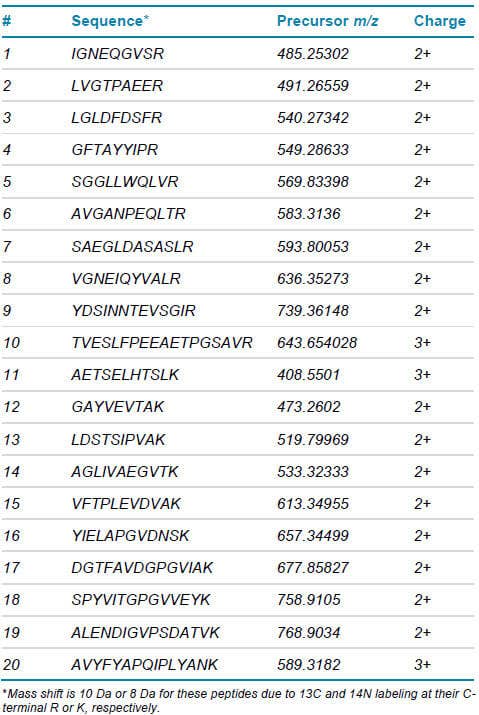
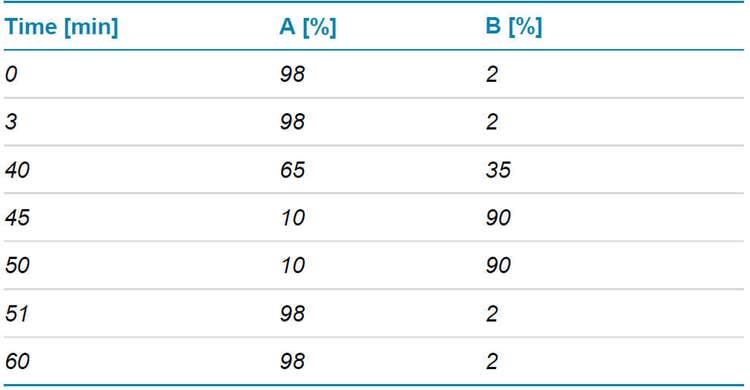
Table 1. MS parameters.
#efefef
image-bottom
Chromatography: Samples were loaded on a Waters ACQUITY UPLC CSH C18 column (2.1×100 mm, 1.7 µm, 200 Å) and separated using an ExionLC AD system with a 0.2 mL/min flow rate and the gradient specified in Table 2, at a column oven temperature of 45°C. Five µL of the sample (1 µg of NISTmAb digest) was injected. Water with 0.1% formic acid was used as mobile phase A and acetonitrile with 0.1% formic acid was used as mobile phase B.
Table 2. LC gradients for separation of peptide isomers.
#efefef
image-top
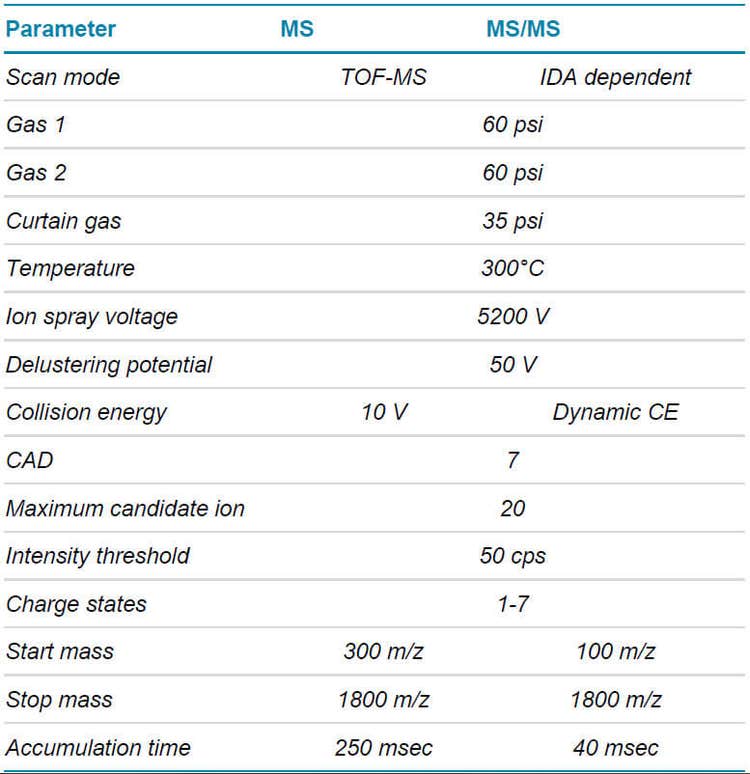
Mass spectrometry: Three replicate injections of both control and spiked sample were acquired on a ZenoTOF 7600 system (SCIEX). The data were collected using information-dependent acquisition (IDA), leveraging CID for fragmentation. Data acquisition was performed both with and without the Zeno trap enabled. Detailed information can be found in Table 3.
Table 3.  Mass spectrometry parameters.
#efefef
image-top
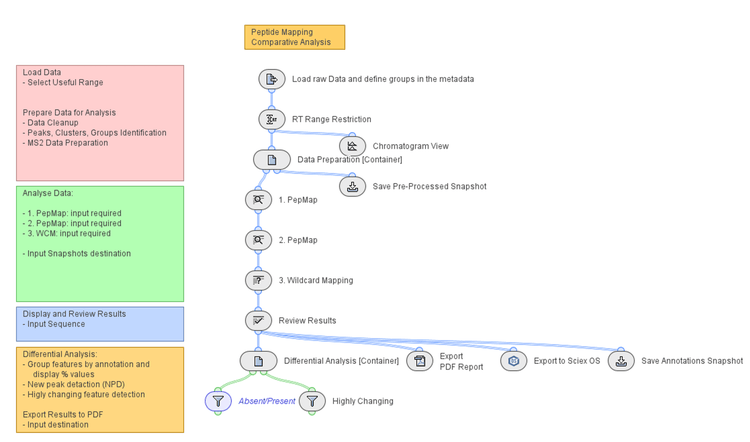
Data processing:  Data were processed with the Biologics Explorer software (SCIEX) using the peptide mapping comparative workflow (see Figure 2). This workflow is used to compare datasets to report peptides that are unique to one dataset (Absent/Present) or have a specified fold-change difference between sample sets (Highly Changing). The chemical noise subtraction threshold was set to 8 cps with a minimum RT length of 4 scans and minimum  m/z  length of 3 points. Both NISTmAb and spiked peptide sequences were entered with modifications such as carbamidomethylation, deamidation, oxidation, lysine-loss, N-terminal glutamine to pyro-glutamate conversion and heavy labeled K and R. The score cutoff for peptide identification was set to 80. Wild card mapping activity was bypassed. The  Differential Analysis  container is where the criteria of the comparison between the data sets are specified and analyzed. The results are then tabulated in the  Absent/Present  step for new peak detection or in the  Highly Changing  step for fold-change detection. The filter for the  Absent/Present analysis was set at 0.003% volume in this study, such that the only peptides present in volumes greater than 0.003% of the volume of the most abundant component of the sample were considered for analysis. For all remaining data processing settings, the default values from the peptide mapping comparative workflow template were used.
Figure 2. Peptide mapping comparative workflow from the Biologics Explorer software used for impurity analysis.  This workflow is used to compare datasets to report peptides that are absent in one sample set, but present in the other (Absent/Present) or that have more than a specified fold-change difference between the sample sets (Highly Changing). Snapshots are intermediate data processing results that can be saved to reduce re-processing time.
#efefef
image-top
Impurity

The Absent/Present  search step at the end of the peptide mapping comparative analysis generated a list of peptides detected in only 1 sample, shown in Figure 3. As expected, the spiked peptides were detected only in the spiked samples (see example in Figure 1). The abundance of the spiked peptides was normalized to the total volume in each sample and 19 of the 20 spiked peptides were consistently identified as new peaks when comparing the replicates of the spiked sample with the control sample. MS1 evidence within Biologics Explorer software. This workflow can be used for any known impurity in a sample.
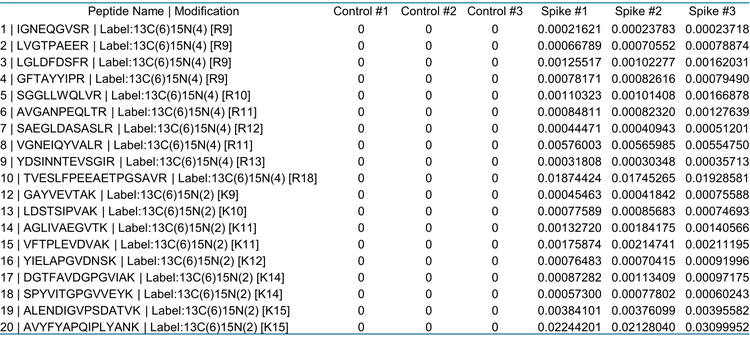
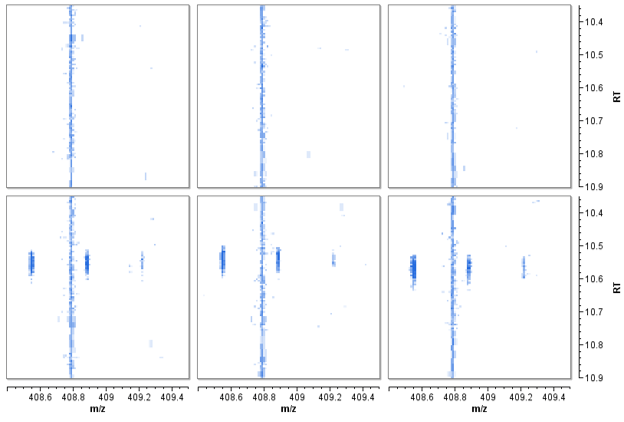
Figure 3. Detected peptides and their normalized %volume using the Biologics Explorer software from SCIEX. The spiked-in peptides were not detected in the control replicates, as expected. The identified peptides in the spiked samples could be quantified automatically in %volume, as shown.
#efefef
image-top
The ion map in Figure 4 shows that the peptide, AETSELHTSLK, was present in all 3 spiked samples, but absent in all 3 control samples at the expected  m/z and retention time. No MS/MS spectra were triggered for this peptide during DDA acquisition, likely due to the low MS1 intensity and coeluting species from the NISTmAb digest. A longer gradient or a higher number of MS/MS per cycle can circumvent missing MS/MS for the particular peptide. Despite the lack of MS/MS information, it is still possible to quantify the peptide relative to the mAb using its MS1 evidence within Biologics Explorer software. This workflow can be used for any known impurity in a sample.
Figure 4. Ion map of 3 control (top) and 3 spiked (bottom) samples. Ion maps are zoomed at the isotope cluster region of the 3+ charge state of AETSELHTSLK. Missing dot on the isotope peak cluster indicates no MS/MS data are available.
#efefef
image-top
Engaging

Engaging the Zeno trap

The Zeno trap is an ion trap, which increases the duty cycle of the MS/MS from approximately 5-25% to up to 95% by trapping the ions and injecting them into the TOF pulser in a controlled manner. Engaging the Zeno trap on demand for low-abundant precursor ions can significantly enhance the quality of the MS/MS spectra and improve the S/N ratio, permitting a more confident identification of peptide impurities. The overall improvement in the MS/MS data quality is reflected in an MS/MS score improvement when using the Zeno trap, as can be seen in a score histogram of all identified peptides, including NISTmAb and spiked peptides (Figure 5). When the Zeno trap was employed, the scores of identified peptides shifted towards higher values, indicating higher confidence in the peptide identification results.
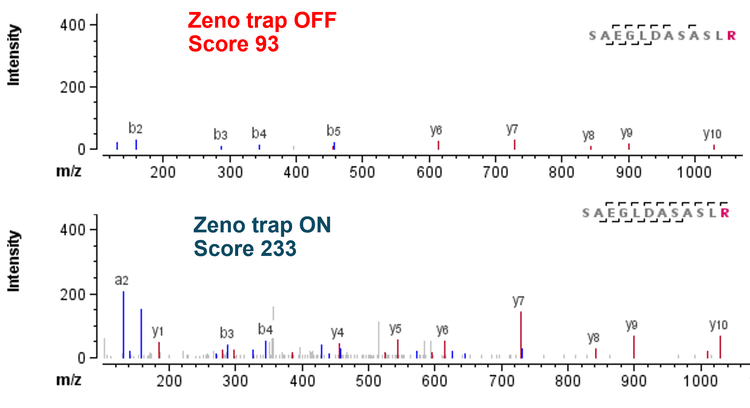
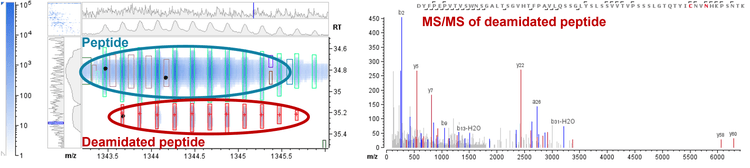
Figure 5. Score histogram of all peptides without (blue) and with (green) Zeno trap enabled. The scores of identified peptides shifted to higher values when the Zeno trap was enabled on demand. This is reflective of a higher confidence identification.
#efefef
image-top
Figure 6 shows an example of the MS/MS spectrum quality of a spiked peptide, SAEGLDASASLR, with and without engaging the Zeno trap. For this peptide, enabling the Zeno trap during acquisition improved MS/MS spectrum sensitivity, resulting in fragments that were approximately 6 times more intense compared to the spectra without enabling the Zeno trap. This boosted signal improved fragment ion matching, shown by the peptide fragment ladder sequence in the top right corner of the MS/MS spectrum in Figure 6. Therefore, the MS/MS spectrum score was also significantly higher with the Zeno trap enabled than without (233 versus 93, respectively).
Figure 6. MS/MS spectra of SAEGLDASASLR without (top) and with (bottom) Zeno trap enabled. MS/MS scores for both spectra are indicated. A significantly higher score was achieved with the Zeno trap enabled than without, as the MS/MS spectrum was of higher quality and more fragments were successfully matched.
#efefef
image-top
Enabling the Zeno trap improved the sensitivity of the assay and assisted the identification of peptides. Within the NISTmAb digest, several low-abundant peptides could be identified only when using the Zeno trap. For example, Figure 7 shows the identification of a low-abundance peptide of 0.4% containing a deamidation.
Figure 7. Identification of a deamidated peptide with the Zeno trap enabled. The left panel shows the ion maps of the unmodified and deamidated versions of the peptide. The right panel shows the MS/MS spectrum, obtained with the Zeno trap enabled, that permitted the identification of the peptide with deamidation at position N206. The MS/MS spectrum generated without the Zeno trap enabled was not descriptive enough to successfully identify the peptide (data not shown).
#efefef
image-top
Traceability

Traceability of data processing

The Biologics Explorer software allows the user to trace the results after each processing step to ensure data integrity throughout data processing. Specialized processing capabilities are available throughout the workflow to increase confidence in results and reduce data analysis complexity. The impact of each step on the data can be reviewed by a user.

One example is the consolidation of MS/MS spectra from the same precursor to increase the S/N ratio of the spectrum and therefore improve peptide identification ability. Additionally, MS/MS spectra can be deisotoped to reduce their complexity. Fewer spectra with higher data quality facilitate a user’s ability to review data and verify peptide identifications. Figure 8 shows the ion maps for a particular peptide obtained during the  Load raw Data  step (top) and the  Review Result  step (bottom). The ion map from the  Load raw Data step showed 2 to 3 MS/MS events associated with the doubly charged precursor in each spiked sample (2 to 3 black dots in Figure 8). These MS/MS spectra were consolidated into one single fragment spectrum, deisotoped and used for peptide identification. This identification was facilitated by using a chemical noise reduction step to reduce the background chemical noise.
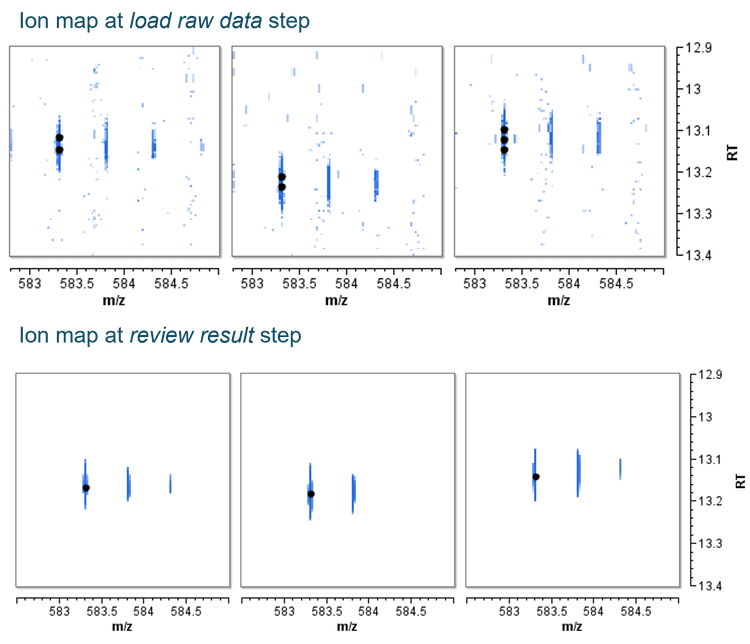
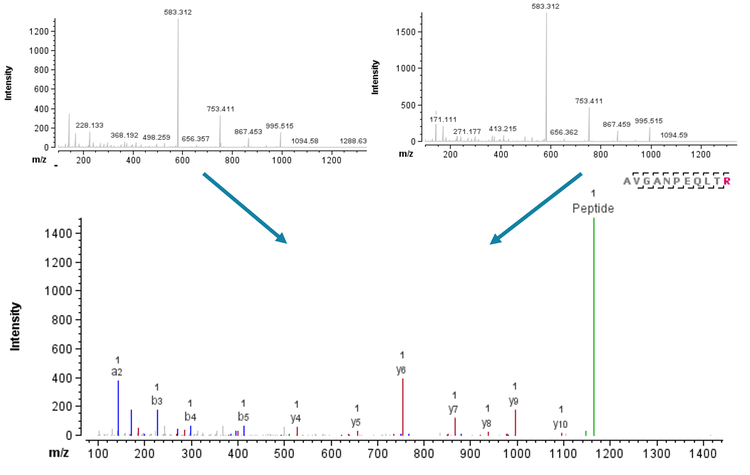
Figure 8. Ion maps obtained at  Load raw Data  step (top) and at  Review Result  step (bottom).  Example ion maps are shown for the spiked peptide, AVGANPEQLTR. The  Load raw Data  step shows 2 to 3 MS/MS spectra triggered (black dots) in each replicate, whereas the  Review Result step shows a single consolidated MS/MS spectrum (black dot) for each replicate. In addition, the S/N ratio was enhanced by reducing the chemical background noise.
#efefef
image-top
Figure 9 illustrates the MS/MS deisotoping activity, which is used to perform isotope clustering and deisotoping on high-resolution MS/MS data. The output MS/MS spectrum resulting from this activity contains only singly charged, monoisotopic peaks. For example, the doubly charged precursor at  m/z  583.312 in the 2 raw MS/MS spectra shown in Figure 9, top, is converted to the singly charged peptide at  m/z 1165.62, Figure 9, bottom. As a result, this deisotoping step reduces the time required for MS/MS searches and improves the scores of identified MS/MS spectra.
Figure 9. Two MS/MS spectra from the raw data (top) were automatically merged and deisotoped to yield the consolidated fragment spectrum (bottom) for the peptide, AVGANPEQLTR. The consolidated MS/MS spectrum (bottom) contains only singly charged monoisotopic peaks to simplify and facilitate data review. Merging multiple MS/MS spectra for the same precursor ion enhances the S/N ratio of the fragment ions, enabling more confident identification of the peptide.
#efefef
image-top
Conclusion

Conclusion

  • Sensitive detection and identification of low-level, protein-derived impurities were demonstrated using DDA on the ZenoTOF 7600 system and Biologics Explorer software from SCIEX
  • Increased confidence in identifying peptides was achieved by enabling the Zeno trap and improving overall MS/MS quality and scores of peptides
  • Intuitively comparing data processing of controls vs samples is facilitated by ready-to-use workflow templates in the Biologics Explorer software
  • Data integrity and consistency are ensured by full traceability of the processed data at each step of processing using Biologics Explorer software
References

References

  1. Daniel G. Bracewell, Richard Francis and C. Mark Smales (2015) The future of host cell protein (HCP) identification during process development and manufacturing linked to a risk-based management for their control. Biotechnol Bioeng  112(9):1727-1737.
  2. Yu Huang et al. (2021) Toward unbiased identification and comparative quantification of host cell protein impurities by automated iterative LC–MS/MS (HCP-AIMS) for therapeutic protein development  J. Pharm & Biomed Analysis 200: 114069
  3. ICHQ6B (Sept.1999): Test procedures and acceptance criteria for biotechnological/biological products -step 5.