Abstract
This technical note demonstrates rapid metabolite identification (ID), relative quantitation, and time course analysis of cyclosporine A (CysA) in rat liver microsome (RLM) (Figure 1). MS-level metabolite identification was achieved at concentrations of 0.12% and estimation of modification sites was demonstrated at concentrations as low as 0.19% (Figure 5).
Development of cyclic peptide therapeutics is rapidly gaining attention as new therapeutic modalities and drug delivery system (DDS). Therefore, understanding the sequence and in-depth metabolite identification are critical for drug development. Given the molecular size, the cyclic structure, multiple modification sites and lack of processing software, the analysis of cyclic peptides can be quite challenging.
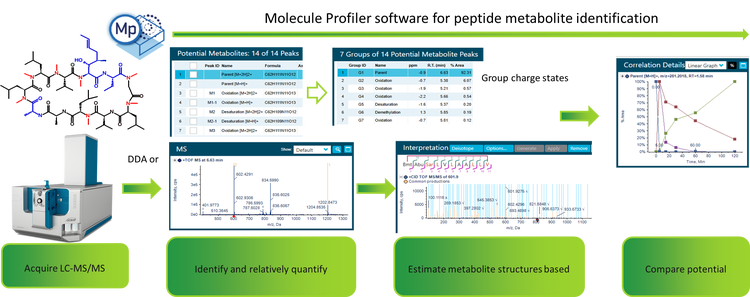
Key benefits for cyclic peptide metabolite analysis using the ZenoTOF 7600+ system and Molecule Profiler software
- Enhanced sensitivity and increased confidence in metabolite identification: Generate fragment-rich spectra, enabling more confident identification of low-abundant metabolites using Zeno trap on the ZenoTOF 7600+ system
- Rapid and comprehensive metabolite identification: Search metabolites using various peak search strategies, including software-generated accurate mass lists of potential modifications of various charge states
- Rapid and reliable sequence confirmation: Fragment ions are automatically assigned to calculated fragment ions from the sequence based on user-specified fragment ion types, generating the final sequence coverage.
Introduction
Cyclic peptides are more stable in structure than linear peptides and are rapidly becoming more common not only in new therapies but also in DDS systems.
Metabolite identification is important to ensure the efficacy of pharmaceutical products. LC-MS/MS is a promising tool for the analysis of small molecule therapeutics, but the size and complex structure of cyclic peptides make it difficult to perform structural analysis.
MS/MS-based peptide sequencing is widely used for protein identification, but for cyclic structures, various synthetic amino acids, modifications and linkers, and lack of processing software make this technique difficult to apply.
Therefore, there is a strong demand for the development of a method to quickly and easily identify metabolites of cyclic peptides and perform sequence confirmation. In this technical note, a highly sensitive and comprehensive method for cyclic peptide metabolite identification is demonstrated utilizing the ZenoTOF 7600+ system and a streamlined data processing method on the Molecule Profiler software. The amino acid analysis mode was applied on Molecule Profiler software where the main components were registered as sequences and the detected metabolites were also expressed as sequences. As a result, confirmation of MS/MS based analysis was performed using sequence notation rather than complex chemical structures for a more streamlined estimation of the metabolic sites.
Methods
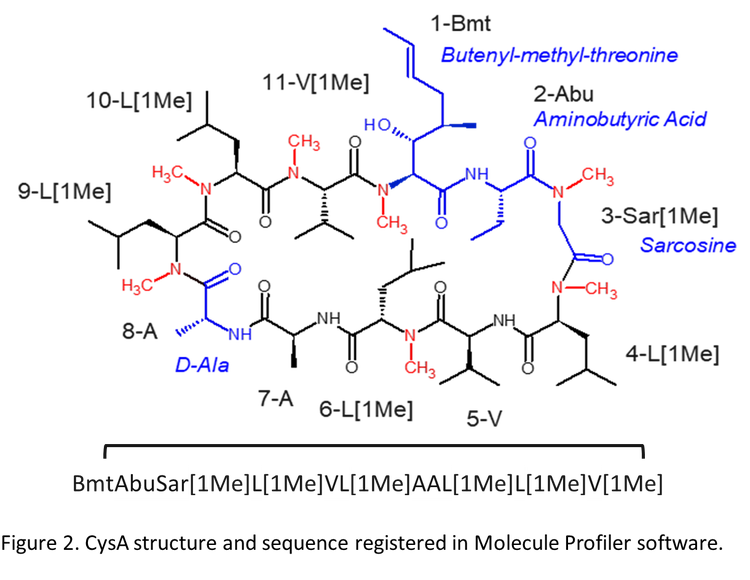
Sample preparation: 10 µg/mL of CysA (Figure 2) was incubated in 1 mg/mL rat liver microsomes (RLM, BD bioscience) for 0–60 min at 37°C. Samples were removed from the incubation and quenched with 3 volumes of cold acetonitrile, then vortexed for approximately 30 seconds. Samples were then centrifuged at 10000 rpm for 10 min at 4°C. The supernatant was aliquoted and diluted 2.5-fold with water. The final solution was transferred to an LC vial for analysis.
The final concentration of CysA added corresponded to 1 µg/mL. As control samples, samples without CysA were treated similarly. Sample information is shown in Table 1.

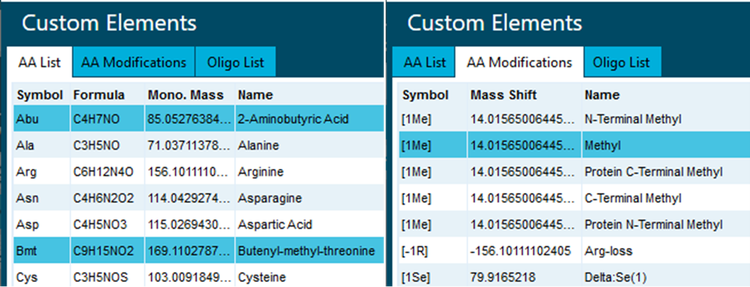
The software combines the biotransformation list with the catabolites to create a list of potential metabolites for all the specified charge states and searches for the metabolites within the list and reports the parent compound, potential metabolites, along with information such as neutral mass, retention time and the MS-based % area for each component.
Peaks with different charge states from the same metabolite can be grouped together and the total area of all detected charge states is calculated. The area % is the total area of the detected metabolite divided by the total area of all detected metabolites in all charge states.
Metabolite identification and relative quantitation
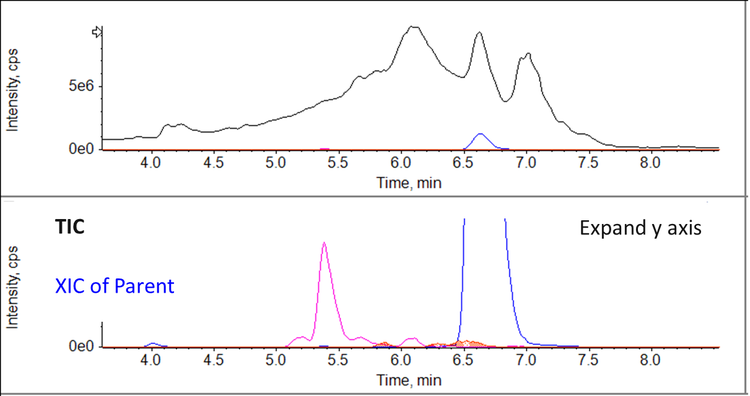
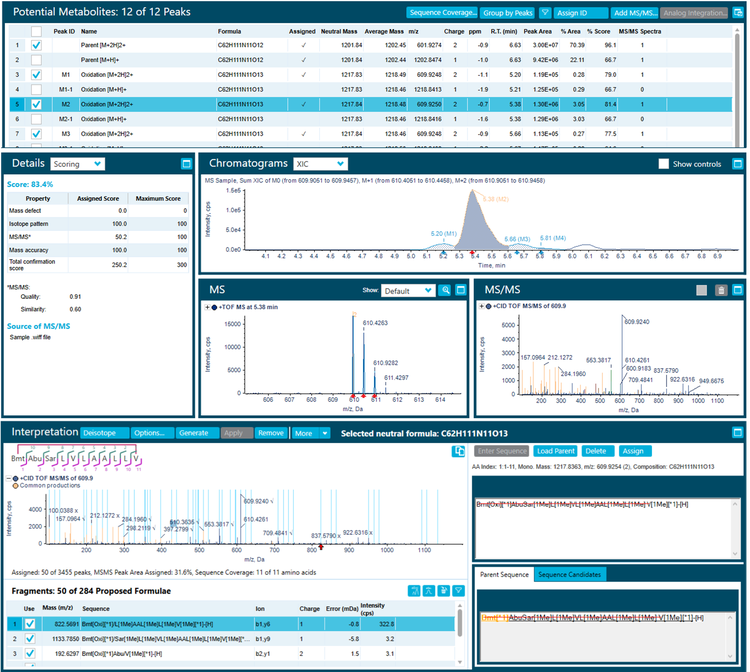
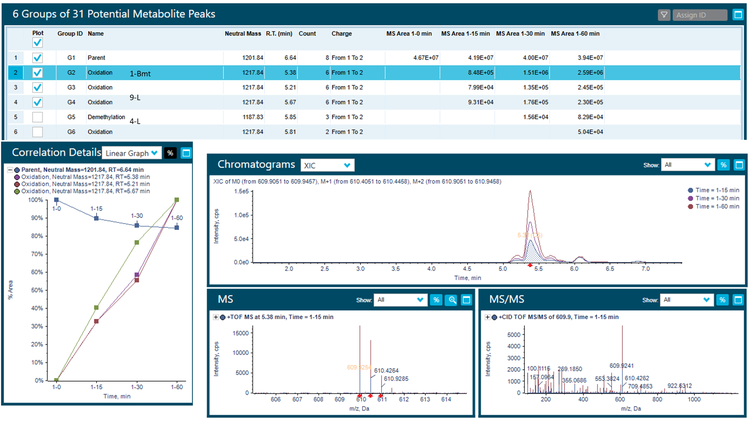
For each sample data, 2 control data were applied for processing: 1) RLM-only data at the same incubation time as the sample and 2) data for 0 min incubation time at the same concentration as the sample. Figure 5 shows the analysis results for sample 1–60 after grouping. The parent compound CysA and the detected metabolites are shown in descending order of area % along with their respective MS area %. Here, 5 metabolites with relative intensities down to 0.12% were detected within the MS accuracy of 2.2 ppm and MS/MS data for all metabolites were automatically acquired by DDA even in heavy matrices as shown in the total ion chromatograms (TICs) in Figure 4. The major metabolite observed was oxidation, where 4 oxidative metabolites (G2, 3, 4, 6) were detected. Figure 6 shows the results view before grouping for the doubly charged ion (M2) of the most intense metabolite G2. The confidence score calculated from the MS accuracy, isotope pattern and MS/MS was 81.4%. The XIC of oxidation shows 5 peaks. The fifth peak (RT 6.1 min) was not detected as it did not increase over time and was assigned to the oxidation impurity cyclosporine C (oxidized of 2-Abu) (data not shown).

Determining site of oxidation with Zeno CID DDA
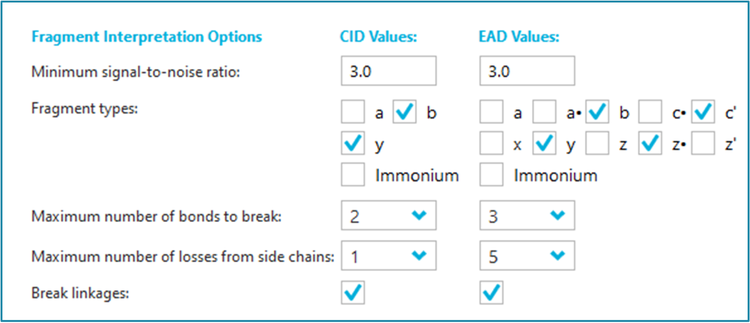
MS/MS peaks are assigned automatically from a list of theoretical fragment ions, which are calculated from the selected options (Figure 7) and the provided sequence. The assigned fragments are displayed in a table with their corresponding sequence and ion type.
Figure 8 shows the interpretation view of parent CysA and oxidative metabolite G2 and demethylated metabolite G5.
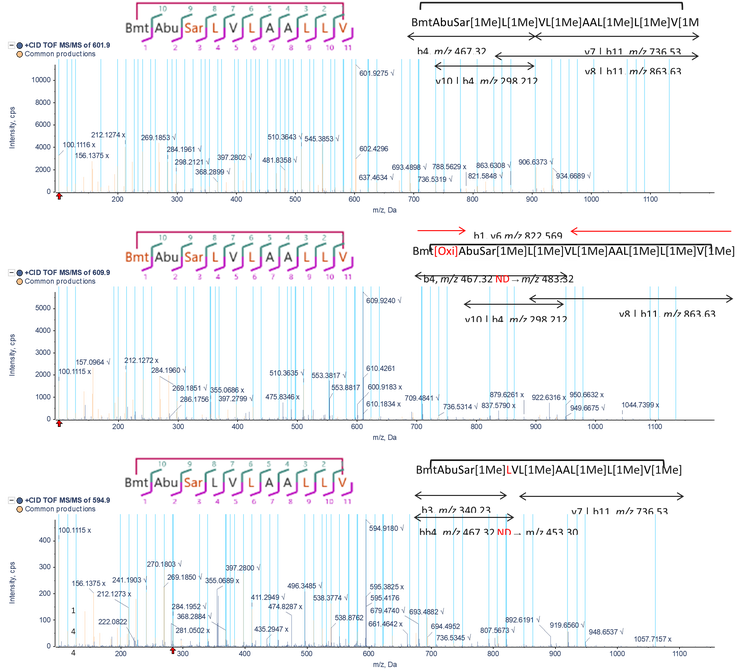
Fragment ions identical to registered ions from parent compound are displayed in orange in the spectrum to guide the assignment of metabolic sites.
Based on the detected y10 | b4, y8 | b11 ions and other fragment ions identical to those of the parent compound, metabolite G2 was estimated to be oxidized at the 1-Bmt residue. On the other hand, in metabolite G5, the ion at m/z 467.32 corresponding to the b4 ion of the parent compound was not detected, but the b3 and y7 | b11 ions were preserved, so the demethylation site of metabolite G5 was estimated to be 4-L. Similar analysis was performed for metabolites G3 and G4, and the oxidation sites were predicted to be 9-L and 4-L, respectively (data not shown). Metabolites G2, G3, and G5 have been reported as major metabolites of CysA.1
For all metabolites analyzed, additional fragment ions containing the metabolic sites were assigned to the sequences and showed 100% sequence coverage. It was demonstrated that the biotransformation sites could be estimated even at metabolite concentrations as low as 0.12%.
Time course study
The results of the time course study are shown in Figure 9. The time course of the detected metabolites could be easily graphed and confirmed, and all metabolites showed similar profiles.
Conclusions
- Analytical methods for characterization, relative quantitation and correlation study in vitro metabolites of cyclic peptide in liver microsome samples are shown using the ZenoTOF 7600+ system integrated with Molecule Profiler software.
- Fast MS/MS scanning speed and high MS/MS data quality enhanced using the Zeno trap with the ZenoTOF 7600+ system, allows for the identification of very low abundant metabolites in heavy matrix.
- Molecule Profiler software simplifies analysis, reduces manual workload, and provides easy-to-understand results by analyzing peptides in sequence notation, speeding up metabolite identification, metabolic localization, and correlation studies such as time course studies.
References
- Burke, M.D., Macintyre, F., Cameron, D., Whiting, P.H. (1989). Cyclosporin A Metabolism and Drug Interactions. In: Thomson, A.W. (eds) Cyclosporin. Springer, Dordrecht.
- Empowering peptide catabolite discovery: software-aided orthogonal fragmentation analysis on the ZenoTOF 7600+ system with Molecule Profiler software. SCIEX poster MKT-33889-A.
- Metabolite ID and relative quantification of oligonucleotides in plasma. SCIEX technical note RUO-MKT-02-13320-A.
- Breaking the limits_ An ultra-sensitive complementary fragmentation for confident identification and characterization of drug metabolites. SCIEX technical note MKT-34517-A.