Abstract
This technical note describes a streamlined, single-platform quantification workflow using an integrated M5 microflow LC system coupled to a SCIEX 7500 system to demonstrate a highly reproducible and sensitive microflow workflow.
Introduction
Microflow LC coupled to tandem nominal mass spectrometry (MS/MS) provides enhanced sensitivity and reproducibility for the quantification of complex molecules such as peptides, antibodies and oligonucleotides.1 Microflow LC systems operate at low flow rates (1-200 µL/min) and generate droplets that are only a few microns in diameter. Small droplets improve the efficiency of electrospray ionization (ESI) and therefore can help increase sensitivity. Microflow LC-MS/MS is highly advantageous for analyzing analytes in complex matrices at sub-nanomolar concentrations when sample availability is limited and high precision is needed. Direct integration of the M5 microflow LC system into SCIEX OS software allows fast and efficient data management on a single platform, providing a streamlined experience.
Here, a streamlined, user-friendly and MS-integrated microflow LC analysis using a trap-and-elute setup was demonstrated using a peptide quantification workflow. An integrated system was evaluated for 1000 injections performed over 7 days. These injections were divided into 2 sets to avoid chromatographic variation due to high back pressure buildup on the trap column. Each set included 500 consecutive trap-and-elute injections of an antibody signature peptide (Figure 1). Data acquisition, analysis and reporting were performed using SCIEX OS software. No software or hardware interruptions were observed during the run. The %CV for the peak area ratio stability was <3.8% and the retention time precision was <1% for quantification of the signature peptide in rat plasma using the SCIEX 7500 system.
The M5 microflow LC system integrated into SCIEX OS software allowed users to benefit from sensitive, reproducible and easy data handling in a single platform.

Key features of the M5 microflow LC system integration with the SCIEX 7500 system
- Robust microflow LC-MS/MS workflow: Robustness was demonstrated over 1000 consecutive injections with a %CV <3.8% for the peak area ratio stability and retention time precision of <1% for both sets of injections
- Single software control: Quantitative workflows were easily developed and optimized using the M5 microflow LC system with seamless integration into SCIEX OS software. A single platform was employed for streamlined method development, data acquisition, processing and management with SCIEX OS software.
- Easy to use: Intuitive software design enabled users to develop methods efficiently, run samples and process data

Methods
Sample and reagents: The trastuzumab emtansine antibody was purchased from Myonex. SILUmab (MSQC3, Sigma) was used as an internal standard (IS). A trypsin/lys-C mixture (Promega) was used for digestion.
Sample preparation: The sample was extracted using immunoaffinity extraction and was analyzed by microflow LCMS/MS after digestion. The antibody and the internal standard mixture were spiked into rat plasma. Samples were incubated with Biozen Magbeads (Phenomenex, CA) according to the manufacturer's manual. Conjugated magnetic beads were pulled down using magnetic racks and washed as per directions from the manufacturer's manual. Antibodies were eluted using 0.1% trifluoroacetic acid (TFA). For the digestion process, the pH was adjusted to >7 using 1mM calcium chloride in 500mM ammonium bicarbonate. Samples were denatured at 90°C for 10 minutes and digested with 0.25 µg/mL of trypsin/lys-C overnight at room temperature. The digestion was stopped by adding 3 µL of formic acid. Samples were spun down and transferred to vials. The final concentration of the antibody trastuzumab emtansine was 500 ng/mL, and the internal standard (IS), SILUmab, was 125 ng/mL.
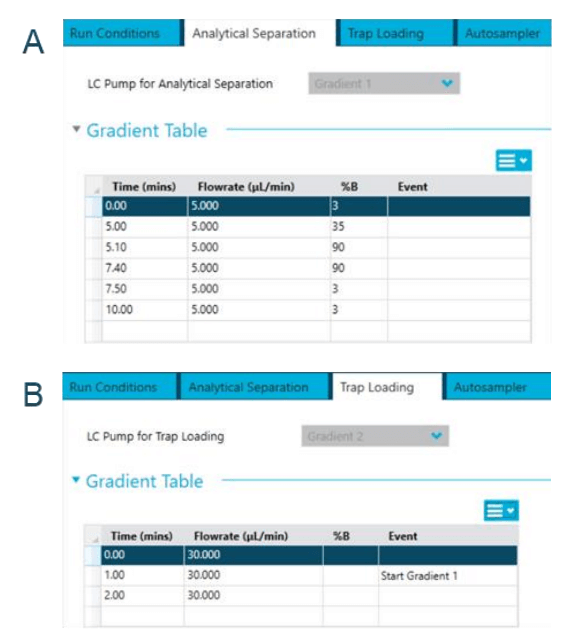

SCIEX OS software was used to create the microflow LC methods, including the gradients for analyte separation (Figure 3A) and trapping (Figure 3B).
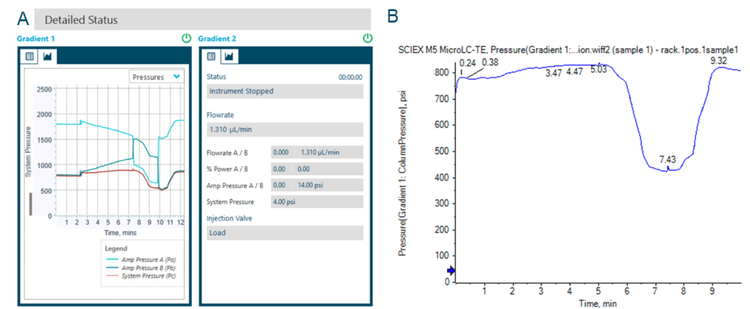
Samples were analyzed in 2 sets of 500 injections. During data acquisition, real-time traces were monitored for column and trap pressures. A significant increase in the pressure on the trap column was observed beyond 600 injections. Therefore, a new trap column was installed for each set of 500 injections to minimize chromatographic challenges related to high back pressure.
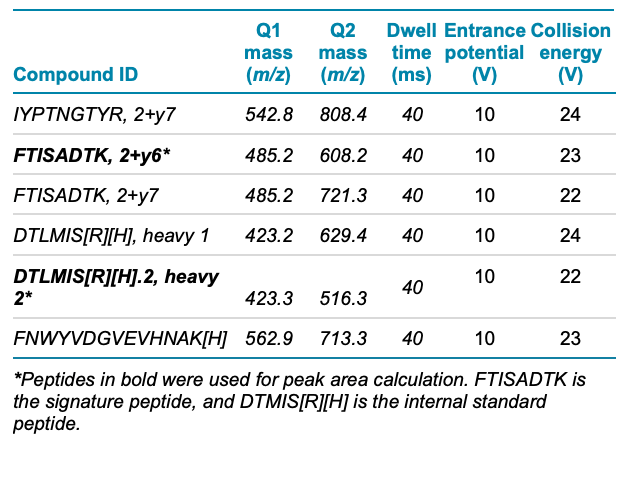
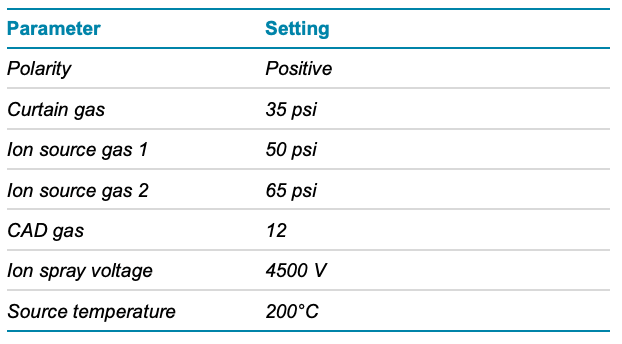
Mass spectrometry: A SCIEX 7500 system with an OptiFlow Pro ion source with an E Lens probe and a micro (low) electrode was used in positive MRM mode. The MRM transitions and optimized analyte-dependent MRM parameters used are listed in Table 2. The optimized source and gas parameters used are listed in Table 3.
Software integration
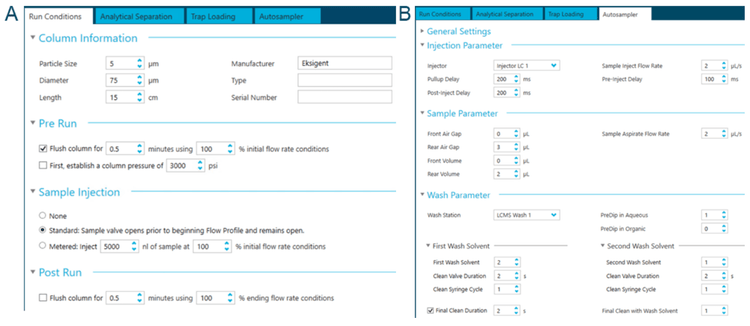
The M5 microflow LC system is integrated with SCIEX OS software to allow users to control LC parameters in a single streamlined and user-friendly interface. In the LC method module, users can view and control the instrument run conditions (Figure 4A), analytical separation and trapping gradients (Figures 3A and 3B) and autosampler parameters (Figure 4B).
Robustness test
Two sets of 500 consecutive injections were performed to demonstrate the robustness of the integrated system. Figure 1 shows the stability of the streamlined workflow throughout the run. The %CV based on the peak area ratio for the trastuzumab emtansine signature peptide was 3% for the first set and 3.8% for the second set of injections. Figure 6 shows the representative total ion chromatogram (TIC, Figure 6A) and extracted ion chromatogram (XIC, Figure 6B) for the signature peptide for the first and last injections. No significant changes in peak widths were observed. The %CV for retention time for the signature peptide used for quantification was less than 1% of overall injections.

Conclusion
- A seamless integration of the M5 microflow LC system with SCIEX OS software was demonstrated by the quantification of the signature peptide for trastuzumab emtansine
- Two sets of 500 consecutive injections were successfully performed without software or hardware interruptions
- The overall %CV was <3.8% for peak area ratio stability and the retention time precision was <1%, demonstrating system robustness
- Real-time LC traces were readily available to users during the run and recorded in the data file for post-run diagnostics, demonstrating efficient and streamlined integration
- User-friendly, streamlined and integrated data acquisition, processing and reporting were performed using SCIEX OS software
References
- Jun Zhang, Wilson Shou, Tairo Ogura, Shu Li and Harold Weller (2019). Optimization of microflow LC–MS/MS and its utility in quantitative discovery bioanalysis. Bioanalysis 11(11).