Abstract
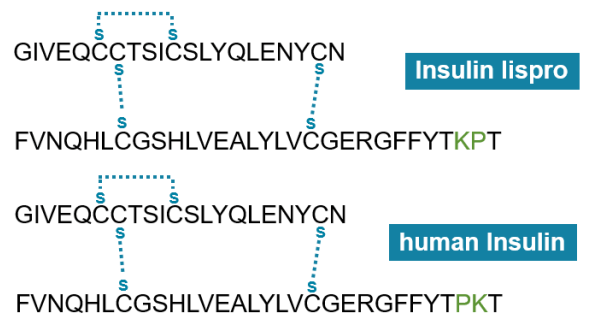
Insulin analogs are altered forms of natural insulin that offer options for insulin replacement strategies with similar or improved actions for glycemic control. Among them are prandial insulin analogs, such as insulin lispro, aspart and glulisine, which tend to be more readily absorbed and act faster than human insulin (Figure 1). It is vital to study the pharmacokinetic and pharmacodynamic profiles of insulin analogs. However, developing sensitive LC-MS methods to quantify them in matrices remains challenging for multiple reasons: 1) the low ionization and CID fragmentation efficiency related to the high molecular weights, 2) low concentrations in matrices, 3) endogenous inferences from natural insulin.
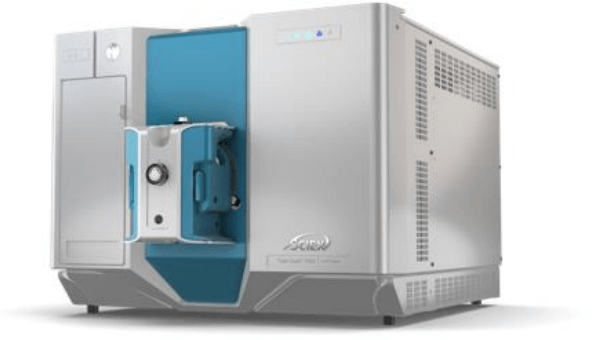
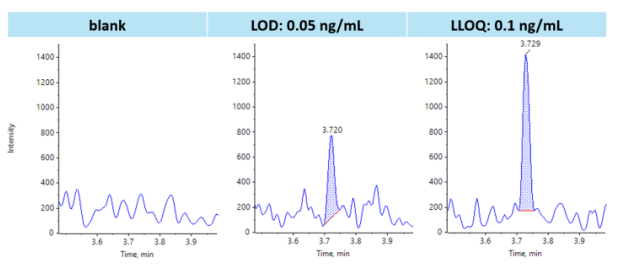
In this technical note, a sensitive LC-MRM method was developed for the quantification of intact insulin lispro in rat plasma using the SCIEX 7500 system. The OptiFlow Pro ion source, together with the DJet ion guide, offers significantly improved sensitivity for intact insulin analogues. It improves desolvation and focusing to improve instrument sensitivity and thus MRM performance. Insulin lispro was quantified at 0.1 ng/mL in rat plasma without analyte enrichment, with outstanding reproducibility, accuracy and linearity.
Key features of cyclic peptide quantification workflows
- Enhanced sensitivity of the SCIEX 7500 system through the introduction of key hardware features that provide significant gains in the generation, capture and transmission of ions1 : the OptiFlow Pro ion source with E Lens technology combined with the DJet ion guide
- Simple sample preparation strategy, requiring no enrichment step
- Robust quantification of insulin lispro at 0.1 ng/mL in rat plasma
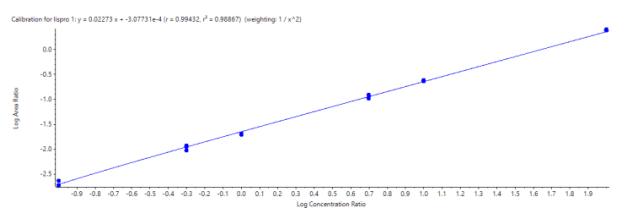
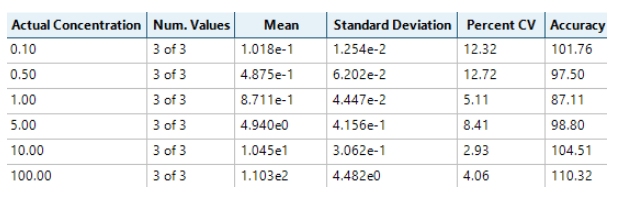
- High reproducibility, precision and accuracy across the calibration curve, with excellent linearity
- A 4-fold improvement in S/N was observed when compared to the performance of the SCIEX Triple Quad 6500+ system
- SCIEX OS software—a single, compliant-ready platform for acquisition, processing and data management, that is customizable and easy to use
Methods
Sample preparation: Insulin lispro and bovine insulin (internal standard) were spiked into rat plasma. Serial dilution was performed to prepare calibration curve standard samples. The samples were protein precipitated, and the supernatants were collected and processed by mixed-mode SPE. The eluents from the SPE plate were diluted with water and injected directly into the LC-MS/MS for analysis.
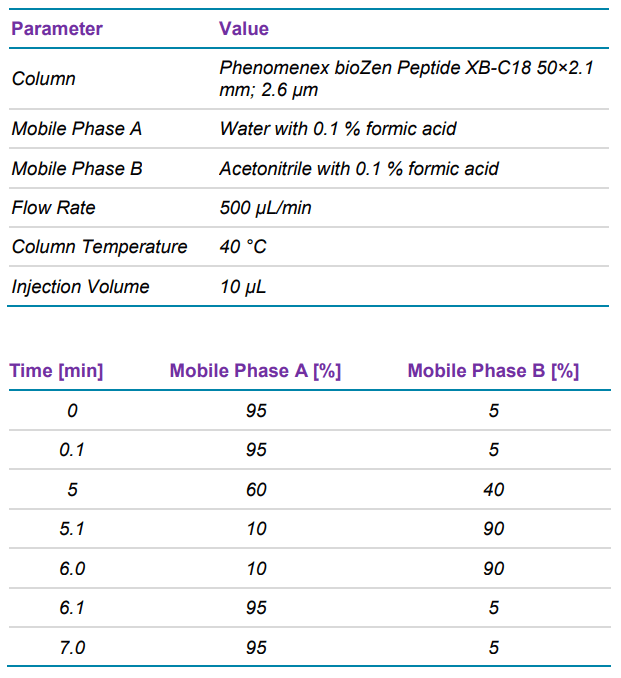
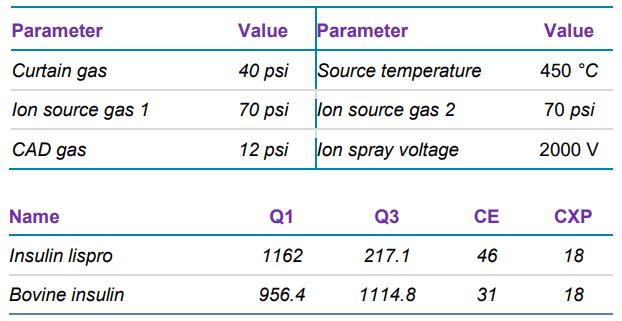
LC-MS conditions: Samples were analyzed in triplicate by a SCIEX 7500 system, coupled with an ExionLC system. The method details are summarized in Table 1 and 2. The same sample set was also injected into a SCIEX Triple Quad 6500+ system, coupled with the same HPLC system, to measure the sensitivity difference between the two mass spectrometers. All MRM parameters were optimized on both systems for accurate performance comparison.
Data processing: Calibration curves were processed using Analytics in SCIEX OS software 2.0.
Insulin lispro quantification results
The SCIEX 7500 system has multiple novel hardware features to improve instrument sensitivity. First is the OptiFlow Pro ion source with E Lens technology. 1 The E Lens technology creates a stronger field at the ESI probe that the droplets must traverse, leading to more efficient release of ions from the droplet, and deflection of more ions towards the orifice, improving sensitivity.
Next is the addition of the DJet ion guide, which more efficiently captures and transmits the ions in the higher vacuum region behind the orifice plate. Its tapered dodecapole geometry, efficiently focuses the ions into the second stage QJet ion guide.
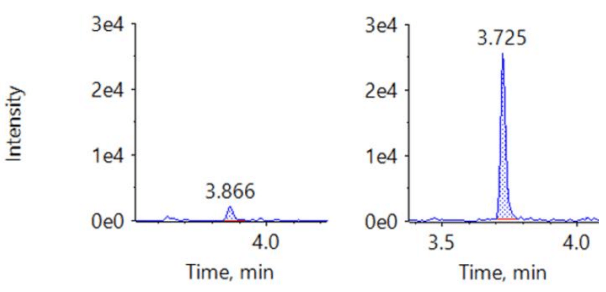
Together these technologies result in a significant sensitivity improvement in the SCIEX 7500 system over previous generations. To characterize the sensitivity improvement, the insulin calibration curves were analyzed on both the SCIEX 7500 system and the SCIEX Triple Quad 6500+ system. A 4-fold increase in S/N was observed (Figure 2).
Conclusion
- An ultra-sensitive MRM based workflow using the SCIEX 7500 system was established for intact insulin lispro quantification in rat plasma
- Insulin lispro was quantified at 0.1 ng/mL in rat plasma with outstanding reproducibility, accuracy and linearity
- Combining the OptiFlow Pro ion source with E Lens Technology and DJet ion guide on the SCIEX 7500 system provided a 4-fold improvement in S/N over the SCIEX Triple Quad 6500+ system.
References
- Enabling new levels of quantification. SCIEX technical note RUO-MKT-02-11886-A.
- Improved LC-MRM quantification sensitivity for cyclic peptides from the natriuretic peptide family. SCIEX technical note RUO-MKT-02-11883-A.