Abstract
Capillary electrophoresis–sodium dodecyl sulfate (CE-SDS), performed under both reducing and non-reducing conditions, is a widely used analytical technique in biopharmaceutical workflows, including upstream bioprocessing, analytical development, and quality control. The reduction of disulfide bonds facilitates complete denaturation and dissociation of higher-order structures. β-Mercaptoethanol (BME) is a commonly used reducing agent for this purpose, effectively converting disulfide linkages into free sulfhydryl groups and disrupting tertiary and quaternary protein structures.
Despite its effectiveness, the use of BME is associated with significant safety concerns due to its strong odor and toxicity, necessitating handling in a chemical fume hood. Consequently, many laboratories restrict or prohibit the use of BME in both manual and automated sample preparation workflows.
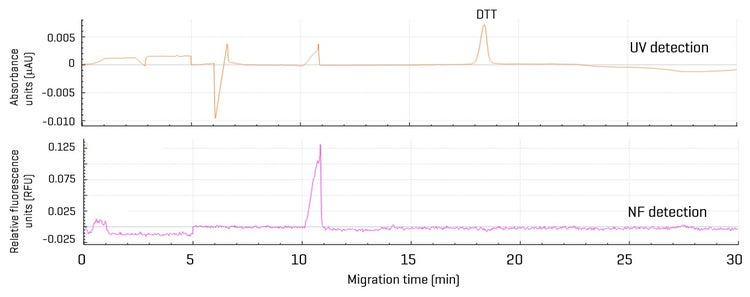
Dithiothreitol (DTT), also known as Cleland’s reagent, is frequently used as an alternative reducing agent. However, DTT exhibits strong ultraviolet (UV) absorbance at 220 nm (Figure 1, top trace) which can result in a prominent interfering peak in CE-SDS electropherograms when UV detection is used. This interference complicates data interpretation and has limited the adoption of DTT in CE-SDS workflows relying on UV detection.
This technical note demonstrates that, despite its UV absorbance, DTT does not interfere with CE-SDS analysis when native fluorescence (NF) (Figure 1, bottom trace) detection is employed. By leveraging NF detection, the use of DTT as a reducing agent in CE-SDS becomes viable, enabling safer and more flexible sample preparation without compromising analytical performance.
Key learning points
- Enable safer CE-SDS workflows by replacing BME with low-odor, automation-friendly DTT.
- Eliminate DTT-related interference by pairing DTT reduction with native fluorescence (NF) detection.
- Maintain analytical confidence, as DTT delivers CE-SDS-NF results comparable to the BME gold standard, with <1% CPA difference for major species (LC and HC).
- Enables easy automation setup: no fume hood required
- Simplify method adoption with a robust, high-throughput-ready CE-SDS solution without compromising CQA assessment
Introduction
DTT functions primarily as a reducing agent that cleaves disulfide bonds in proteins and peptides, thereby preventing the formation of both intramolecular and intermolecular disulfide linkages between cysteine residues.1,2 By disrupting these covalent bonds, DTT promotes protein denaturation and facilitates effective separation under reducing CE-SDS conditions. When comparing DTT with BME, each reducing agent presents distinct advantages and limitations. DTT is a stronger and more effective reducing agent; however, it is considerably less stable than BME and must be prepared fresh. In contrast, BME is more chemically stable but is highly volatile and characterized by a strong, unpleasant odor. DTT’s significantly reduced odor improves laboratory handling conditions and overall user safety. Consequently, DTT is often the reducing agent of choice for use with liquid handling systems in high-throughput sample preparation workflows.
The reducing action of DTT occurs via thiol–disulfide exchange reactions. DTT contains two thiol (–SH) groups that donate electrons to disulfide (S–S) bonds within proteins, converting them into free thiol groups. This mechanism typically proceeds through two sequential steps: the formation of a mixed disulfide intermediate between DTT and the target disulfide bond, followed by intramolecular cyclization of DTT to form a stable six-membered ring and the subsequent release of the reduced protein.1,2
The reducing efficiency of DTT is pH-dependent, with optimal activity observed at pH values above 7. In contrast, BME maintains effective reducing capability over a broader pH range, which may influence reducing agent selection depending on assay conditions.
Materials
The BioPhase CE-SDS Protein Analysis Kit (P/N: C30085), the BioPhase BFS capillary cartridge - 8 x 30 cm (P/N: 5080121), BioPhase sample and reagent plates (4,4,8) (P/N: 5080311), NISTmAb (P/N 5089359) were from SCIEX (Marlborough, MA). The BME (P/N: M3148-25 mL), DTT (P/N 20290) were obtained from Sigma-Millipore (St Luis, MO).
Preparation of 0.5M DTT solution: Using an analytical balance, weigh 77 mg of DTT and mix with 1 mL of distilled and de-ionized (ddi) water. This solution must be prepared fresh and discarded after use.
Preparation of sample blanks: Take 95 µL of sample buffer pH 9 and mix with 5 µL of 0.5M DTT solution, mix well. Incubate for 10 minutes at 70 °C. Let the sample cool to room temperature before CE experiment.
Sample preparation for UV or NF detection: Mix well 10 µL of NISTmAb with 90 µL of sample buffer pH 9 and 5 µL of the 10 kDa internal standard and 5 µL of BME or DTT. Incubate for 10 minutes at 70° C. Let the sample cool to room temperature before the CE experiment.
Capillary electrophoresis instrument: The BioPhase 8800 system (P/N: 5314860) equipped with UV, LIF, and NF was from SCIEX. The BioPhase 8800 system and the BioPhase 8800 software, version 1.5 e-license, were used to create methods and sequences for data acquisition and analysis.
Instrument methods: This work used the lightning CE-SDS separation method for the BioPhase 8800 system, which can be downloaded at SCIEX.com/support.
Discussions
DTT interfering peak using UV detection
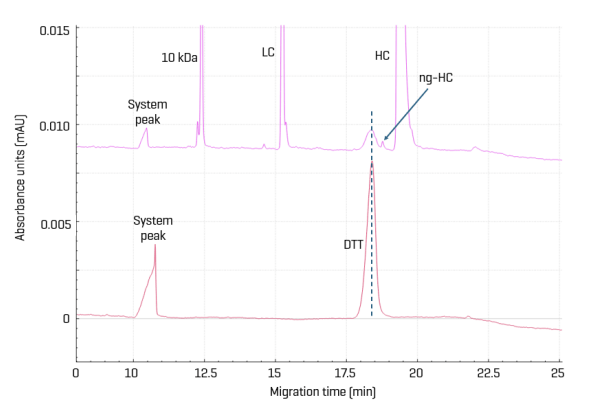
Figure 2 compares the CE-SDS-UV electropherogram of NISTmAb reduced with DTT (top trace) to that of a sample blank with DTT (bottom trace). The results clearly show that DTT migrates in a region typically occupied by several minor product-related impurity species. Notably, the DTT peak migrates in close proximity to the non-glycosylated heavy-chain (ng-HC) species, which is an important critical quality attribute (CQA) due to its classification as a product impurity.³ Consequently, despite the advantages of DTT as a reducing agent, its co-migration with critical impurity species renders it unsuitable for reduced CE-SDS analysis when UV detection is employed.
DTT and NF detection
Although DTT is not compatible with reduced CE-SDS analysis when UV detection is used, a different outcome is observed when native fluorescence (NF) detection is used. Figure 1 presents an overlay of CE-SDS separations of the sample blank (containing only DTT) acquired using UV detection (top trace) and NF detection (bottom trace). While a prominent DTT peak is evident in the UV electropherogram, no corresponding signal is observed under NF detection conditions.
The absence of a detectable DTT signal with NF detection demonstrates that DTT does not cause detectable interference and is therefore compatible with reduced CE-SDS analysis using NF detection.
Comparison: DTT and BME using NF detection
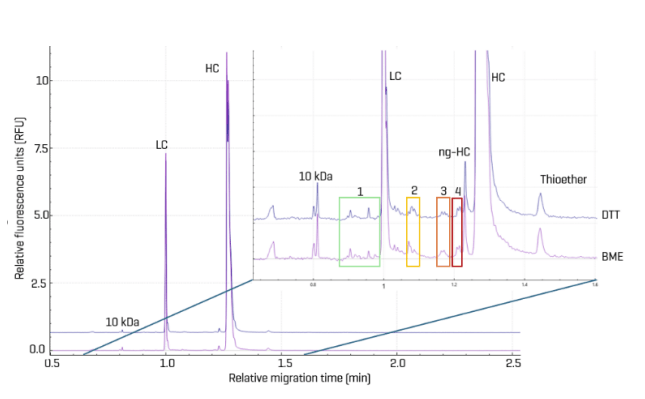
BME has traditionally been the reducing agent of choice for CE-SDS-based separations.⁴ Therefore, a direct comparison of CE-SDS separation profiles of NISTmAb reduced with DTT and BME is essential to assess the suitability of DTT as an alternative reducing agent. Figure 3 presents an overlay of CE-SDS-NF separations of NISTmAb reduced with DTT (top trace) and BME (bottom trace), demonstrating a high degree of similarity between the two profiles.
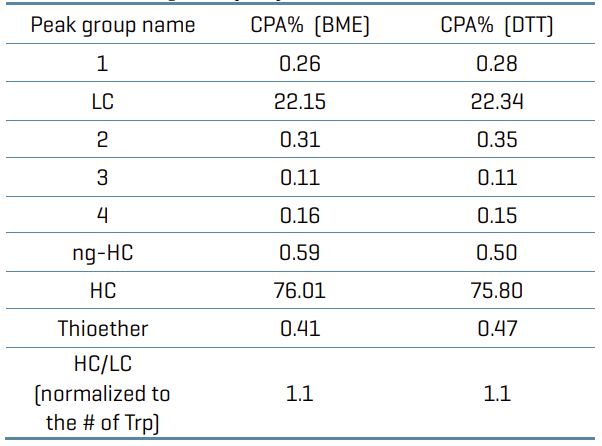
To confirm this observation, table 1 summarizes the corrected peak area percentages (CPA%) obtained from the separation profiles in Figure 3.
To simplify the data analysis, the minor species peaks were grouped as follows: the minor species before the LC were integrated together as group 1, while species migrating between the heavy chain (HC) and LC were assigned to Groups 2, 3, and 4.
Conclusions
- DTT does not show interference in CE-SDS-NF analysis
- BME and DTT exhibit comparable performance in reduced CE-SDS-NF analysis of NISTmAb, with similar separation profiles, purity (CPA%), and HC/LC ratios (Table 1)
- DTT is associated with reduced odor and lower toxicity relative to BME , enabling safer and more convenient handling
- The lower volatility of DTT may facilitate liquid handling and support high-throughput workflows by reducing the need for chemical fume hoods
References
- I. B. Santarino, S. C. B. Oliveira, A. M. Oliveira-Brett; Protein reducing agents dithiothreitol and tris(2-carboxyethyl) phosphine anodic oxidation; Electrochemistry communications 23(2012)114-117.
- M. Dadouch, Y. Ladner and C. Perrin; Analysis of Monoclonal Antibodies by capillary electrophoresis: sample preparation, separation, and detection; Separations 8(2021)4.
- Liu GY, Kim JK, Tang S, Yan Y, Hopkins M, Laredo D, Yang TC, Mutino J, Kamen DE, Graham KS, Shameem M, Wang S, Li N. The non-glycosylated variant in therapeutic monoclonal antibodies preferentially forms large aggregates under typical thermal stresses used in forced degradation studies. Mabs 17-1(2025)2543768.
- A. Guo, G. Camblin, M. Han, C. Meert and S. Park; Role of CE in biopharmaceutical development and quality control; Capillary electrophoresis methods for pharmaceutical analysis, Elsivier, Amsterdam 2008, pp.357-400.
- M. Santos and Z. Zhang, The CE-SDS lightning separation method using the BioPhase 8800 system with UV, LIF and NF detection; SCIEX technical note