Introduction
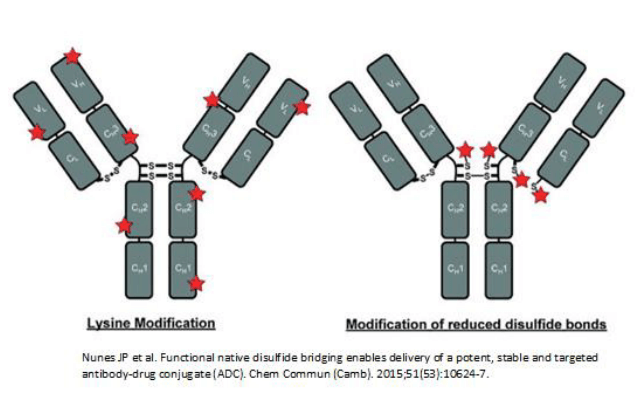
Antibodies can be used as a delivery system to deliver a targeted payload. The targets can be fluorophores (for target cell labelling), peptides (targeted activation or deactivation of cells) or small molecules where the small molecule, often a cytotoxic compound, is used as a target treatment (ADCs). These payloads are usually attached through Lysine or Cysteine conjugation with the antibody. When antibodies are used in this way the amount of payload attached to the antibody is an important physical characteristic of the complex and payload analysis, referred to as drug antibody ratio (DAR) is achieved through various techniques cIEF, UV-Vis, HIC, MS etc.
Antibody peptide conjugate analysis is possible using Hydrophobic Interaction Chromatography (HIC), Mass Spectrometry (MS) and UV-vis spectrometry. In this study we show an alternative method using CESDS on the PA 800 Plus Pharmaceutical Analysis System to obtain Drug-to-Antibody-Ratio (DAR) values.
Materials and Equipment
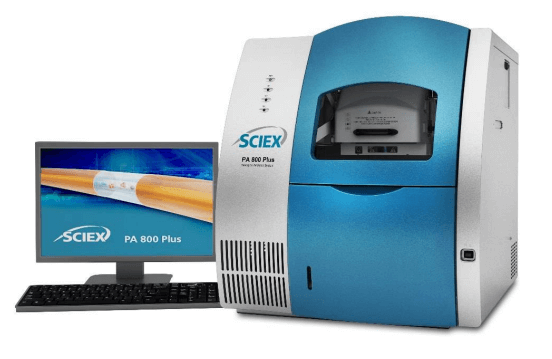
Samples were analyzed by CE using a PA 800 Plus Pharmaceutical Analysis System with UV/VIS optical detection. Separations were performed using the EZ-CE cartridge (SCIEX, Part No. A55625). Samples were prepared using the SDS-MW assay Kit/Purity/Sizing (SCIEX, Part No. 390953).
Methods
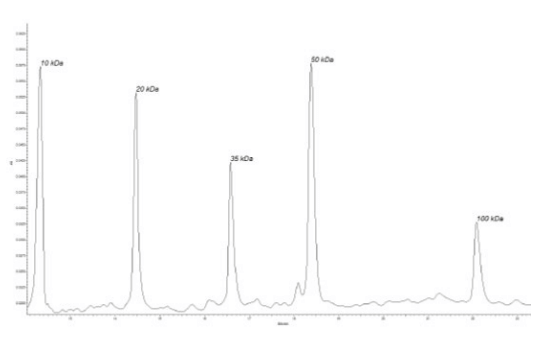
To calibrate the analysis a 10 -100 KDa sizing standard was first analysed to allow estimation of the ADC molecular weight. An example of a typical electropherogram of this standard is shown in Figure 3. The standard range from 10- 100 KDa provided a fit >0.999 for molecular weight.
The antibody reduced and non-reduced samples were then analyzed using a EZ-CE cartridge which had an effective separation length of 20cm. Samples and buffer and method used following the standard CE-SDS protocol which comes with SDS-MW assay kit which was used in collaborative ring trial [1].
Results
Lysine Antibody Conjugate Analysis
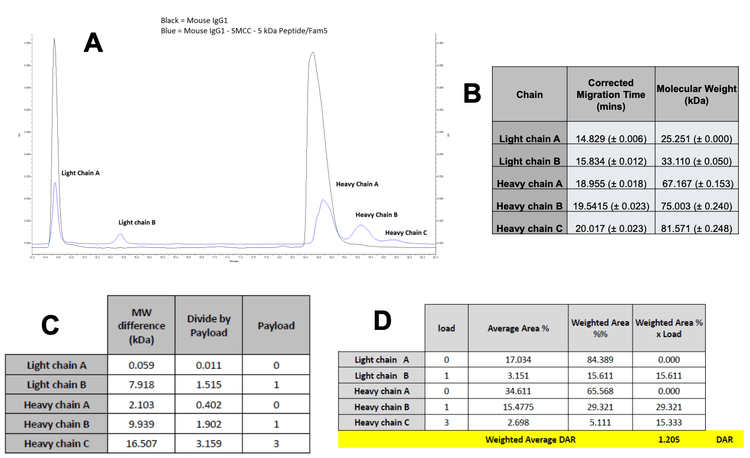
In this study a Mouse IgG1 antibody was conjugated in a 2-step protocol. Initially a SMCC linker was conjugated to lysine residues then the 5 kDa Peptide/Fam5 is attached to antibody bound SMCC linker so that when a full SMCC-5 kDa Peptide/Fam5 was attached it would result in ~5.225 kDa MW increase. The Mouse IgG 1 - SMCC - 5 kDa Peptide/Fam5 was then analyzed in it’s non reduced form. The results from this analyses were inconclusive as the resolution observed was not sufficient to resolve unconjugated from a conjugated species which were separated by a 0.39m min corrected migration time shift. The antibody and lysine conjugate were therefore reduced and reanalyzed as shown in Figure 4.
DAR=2x(Σ(weighted peak area of light chain)+Σ(weighted peak area of heavy chain)) / 100
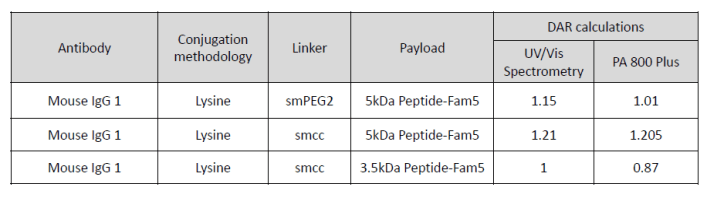
In Figure 3 the DAR ratio was calculated by using the above calculation [2]. The Mouse IgG ADC like material was also analysed by UV-VIS to calculate a comparative DAR ratio. The UV/VIS was 1.21 and very close to the DAR ratio calculated by the new CE-SDS method. To verify that this this complementary nature of CE-SDS to UV-VIS analysis was not just related to one sample a series of different species were analysed by both techniques and the DAR ratios compared. Figure 5 highlights that the two techniques provide similar results
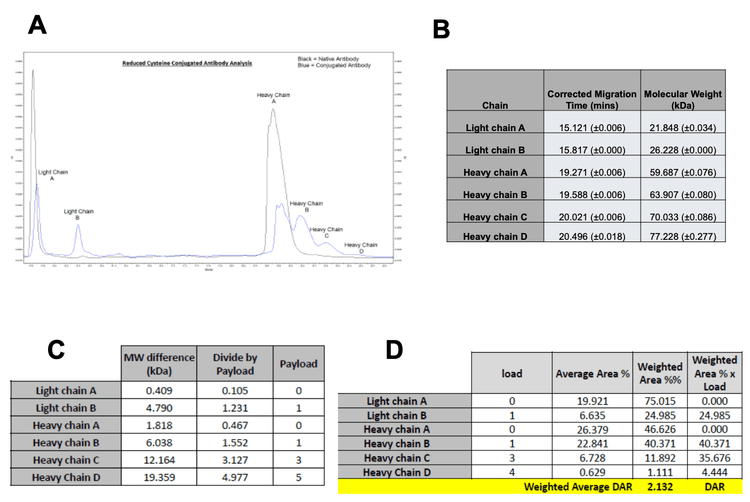
In this study a Mouse IgG1 antibody was reduced and conjugated via its cysteine residues. In this case a single peptide addition to the antibody resulted in an approximate 3.89 KDa mass increase. The cysteine conjugated IgG was first analyzed in it’s non reduced form but it was found that the SDS broke non covalent bond opened up the antibody structure which made this ADC like material prone to fragmentation so again the cysteine antibody was analyzed in it’s reduced form. The results from this analyses are shown in Figure 6
Conclusion
- Molecular weight (kDa) shifts in antibody light and heavy chains created through linker-peptide attachment via lysine and cysteine conjugation were successfully calculated by CE-SDS analysis on the PA 800 Plus
- Calculated molecular weight differences identify peptide payload attachment and DAR calculation is possible
- DAR values calculated using CE-SDS appear comparable to UV-vis spectrometer and Hydrophobic Interaction Chromatography calculated DAR
References
- Nunally, B et.al. A series of collaborations between various pharmaceutical companies and regulatory authorities concerning the analysis of biomolecules using CE. Chromatographia, 2006 , 64, P359-368.
- Ouyan, J, Drug-to-Antibody Ratio (DAR) and Drug Load Distribution by Hydrophobic Interaction Chromatography and Reversed Phase Hugh-Performance Liquid Chromatography. Antibody Drug conjugates Springer Protocols 2013. P275-284
Trademarks/Licensing
AB Sciex is doing business as SCIEX.
© 2019 AB Sciex. For Research Use Only. Not for use in diagnostic procedures. The trademarks mentioned herein are the property of AB Sciex Pte. Ltd. or their respective owners. AB SCIEX™ is being used under license.
Document number: [RUO-MKT-10-9087-A]