Abstract
The data presented here demonstrate that novel electron activated dissociation (EAD) 1,2 is highly comparable to traditionally used collision induced dissociation (CID) with regards to sequence coverage in a peptide mapping workflow. In addition, streamlined, advanced characterization in one injection is possible through high-speed, highly reproducible, alternative fragmentation. This solution takes peptide mapping experiments to a new level, one previously thought unachievable.
Ensuring drug safety and efficacy is essential for biotherapeutics, which drives the need for in-depth characterization during their development. This includes the verification of the sequence on the MS and MS/MS level, and the identification and localization of posttranslational modifications (PTMs). Bottom-up approaches employing liquid chromatography coupled to mass spectrometry (LC-MS) are still the method of choice for assessing these quality attributes in a streamlined manner. To obtain more detailed information on the order of a sequence in a given peptide or to localize PTMs, MS/MS is performed. CID is considered the gold standard for MS/MS experiments, offering a fast dissociation mechanism, and highly reproducible results. However, CID has known limitations, especially when descriptive fragmentation of larger moieties is required, or when deeper information on the peptides or their potentially labile modifications is needed. Alternative fragmentation techniques filled that gap, but long cycle times and low reducibility have limited the wide adoption as a standard technique for biopharmaceutical characterization.
Here, a new fragmentation type based on EAD was evaluated.1, 2 Compared to traditional fragmentation techniques, such as CID, it provides better sensitivity, reproducibility, and acquisition speeds while maintaining comparable sequence coverage and fragment ion coverage. Powerful data reduction with Protein Metrics Inc. software allows for automatic interpretation in a routine fashion.
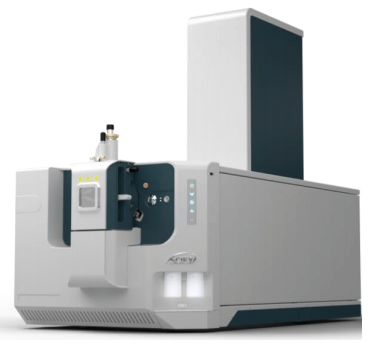
Key features of the SCIEX ZenoTOF 7600 system
- New depths of peptide mapping analysis: EAD with fast DDA enables alternative fragmentation for routine, in-depth analysis of next generation protein therapeutics and standard mAbs
- Higher levels of structural information: Changing the mechanism of fragmentation by tuning the electron energy may provide a higher level of structural information,
- Higher MS/MS sensitivity: Increased detection of fragments (5 to 10 fold) using the Zeno trap enables higher confidence in data assignment
- High reproducibility: Reproducible fragmentation with EAD for singly, doubly, and multiply charged ions enables analysis of more precursors than other alternative and low reproducibility fragmentation techniques
- Streamlined and easy-to-use: Fully automated data acquisition in DDA mode using EAD with SCIEX OS software, and automated data interpretation with Byos software (Protein Metrics Inc.) simplifies the entire user experience
Methods
Sample preparation: The mAb sample (adalimumab) was denaturated with 7.2 M guanidine hydrochloride, 100mM Tris buffer at pH 7.2, followed by reduction with 10mM DLdithiothreitol and alkylation with 30mM iodoacetamide. Digestion was performed with trypsin/Lys-C enzyme at 37 °C for 16 h.
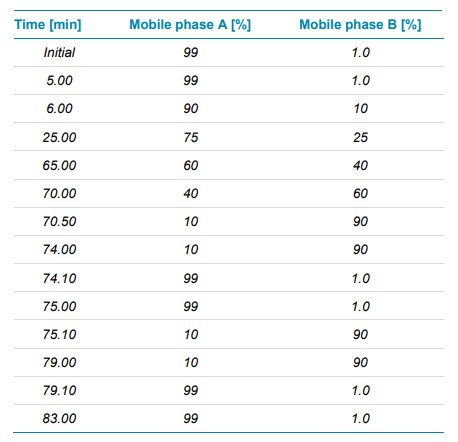
Chromatography: 4 µL (2 µg) of the trypsin/Lys-C digest were separated with a CSH C18 column (2.1×100 mm, 1.7 μm, 130 Å, Waters) using an ExionLC AD system. The mobile phase A consisted of water with 0.1% formic acid, while the organic phase B was acetonitrile 0.1% formic acid. A gradient profile was used at a flow rate of 300 μL/min (Table 1). The column temperature was maintained at 50°C.
Results and discussion
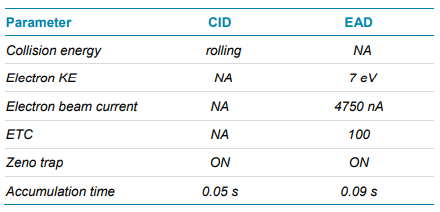
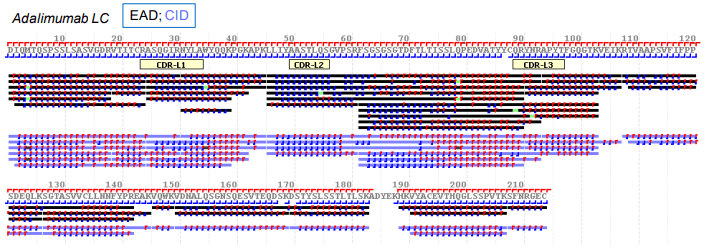
The enzymatically digested adalimumab sample was run in six replicate injections on the same instrument using either EAD or CID for fragment generation. The summary of sequence and fragment coverages for all replicates obtained is listed in Table 4. Only matches within the mass tolerance of 6 ppm for MS and 20 ppm for MS/MS and peptides with an MS/MS score above 100 were taken into account for both sets of data. The two fragmentation technologies show highly comparable sequence coverages that are close to 100% for both CID and EAD. Furthermore, EAD showed an improved fragment coverage, especially for the heavy chain (HC) (Table 4). In addition, the repeatability of the sequence and fragment coverage results obtained with EAD was very well aligned with the results achieved with CID. The sequence/fragment coverage map obtained by EAD and CID is shown in Figure 2 (light chain, LC, of adalimumab) and Figure 3 (heavy chain, HC, of adalimumab) as a comparison for one example injection. It highlights the similarity of identification of the same peptides in a comparable number (non-modified forms, modified forms, missed cleaved forms), while showing differences in the number of fragments being detected (hash marks in Figure 2 and 3).
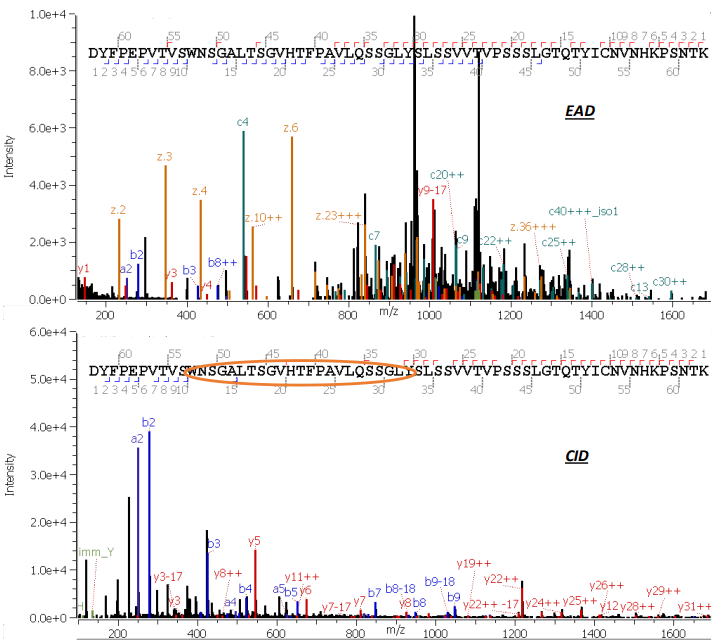
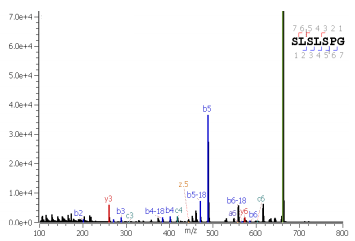
Peptide mapping usually requires identification through MS and MS/MS for a wide range of different peptides. This can include very short, singly-charged peptides to very long, heavily charged peptides. Obtaining comprehensive fragmentation when using CID or even an alternative fragmentation mechanism can be a challenge for such a variety of peptides. However, independent of the charge state, informative MS/MS results can be achieved with EAD (Figure 4 and 5). Even singly-charged peptides can be fragmented well with EAD (Figure 5). A closer look at the sequence coverage maps (Figure 2 and 3) revealed improved fragmentation over CID for large peptides (Figure 4). EAD provided a highly descriptive fragment coverage with overlapping N-terminal and C-terminal fragments—mainly c- and z- ions—for a peptide with 63 amino acids. CID mainly resulted in fragment ions closer to the N- and C-terminus of the peptide, missing a huge portion of the peptide. Regardless, identification based on the precursor mass and some fragments can be performed. More descriptive information increases the confidence in the correct confirmation of the sequence, supporting the general goal of full fragment coverage for biotherapeutic samples.

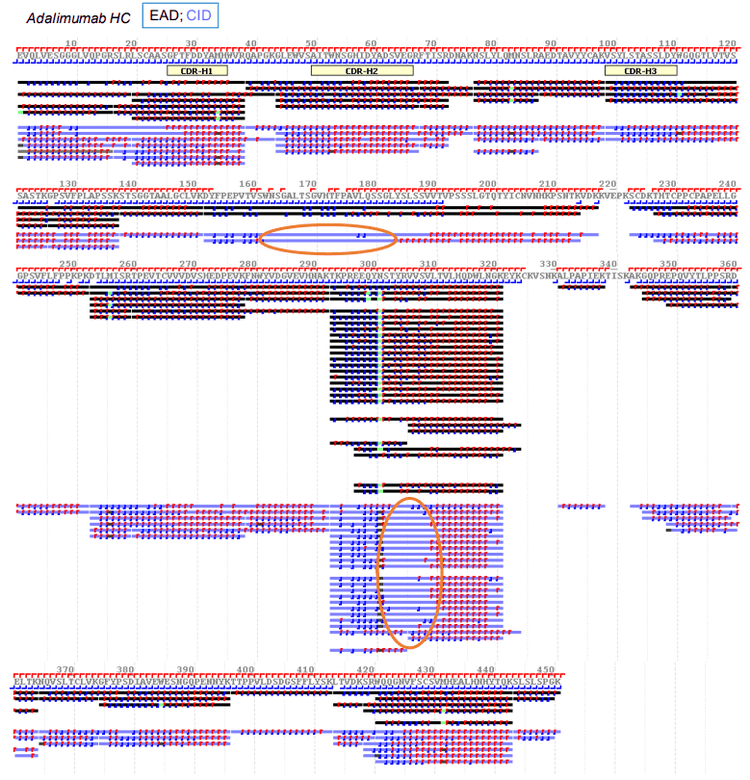
Most antibody therapeutics contain at least a few long peptides without any tryptic cleavage site in the HC. With the market shifting to new modalities and more complex next generation biologics, such cases might become even more common, driving the need for more flexible and highly reproducible analytical tools. Since the amount and variety of fragments achieved with EAD can be significantly higher than with CID, the need for enhancing the fragment detection is a necessity to produce meaningful data. The Zeno trap enables significant enhancement of 5-10x in MS/MS mode, building the foundation for EAD as a widely applicable fragmentation technique. For peptides containing a fragile modification such as the glycosylated Fc region, the fragment coverage was increased using EAD compared to CID (see encircled part in Figure 3), which increases the confidence in the correct identification of the peptide and its modification. Previous studies using EAD for such peptides have shown that the glycosylation remained intact on the fragments allowing for simultaneous localization.3
In summary, Zeno EAD provides comparable sequence coverage and improved fragmentation coverage compared to Zeno CID. Its excellent reproducibility supports the applicability of EAD as a routine method for peptide mapping within the biopharmaceutical environment. In addition, details of structural information, not achievable with CID, can be determined, which might describe critical quality attributes.3-8
Conclusions
- Excellent sequence coverage including fragment coverage with very high reproducibility can be achieved with EAD, a novel fragmentation technique
- Sequence and fragment coverage obtained with EAD were highly comparable, or exceeded the results obtained with traditional CID
- MS/MS fragment detection was significantly enhanced compared to traditional high resolution MS/MS analysis, delivering remarkable data quality for confident fragment assignment. When using the Zeno trap, this is true even for precursors with medium or very low intensities, such as modified peptides.
- The robust, reproducible and easy-to-use alternative fragmentation enables users to answer challenging analytical questions along with a general peptide mapping analysis in one single injection
- Automatic data processing using Protein Metrics Inc. software enables the routine and advanced characterization of complex biotherapeutics and standard mAbs in a reproducible manner
References
- Baba T et al. (2015) Electron capture dissociation in a branched radio-frequency ion trap, Anal Chem, 87, 785−792.
- Baba T et al. (2021) Dissociation of biomolecules by an intense low-energy electron beam in a high sensitivity time-of-flight mass spectrometer. Accepted by JASMS.
- A new electron activated dissociation (EAD) approach for comprehensive glycopeptide analysis of therapeutic proteins. SCIEX technical note RUO-MKT-02-12980-A.
- Comprehensive peptide mapping of biopharmaceuticals utilizing electron activated dissociation (EAD). SCIEX technical note RUO-MKT-02-12639-A.
- Differentiation of leucine and isoleucine using electron activated dissociation (EAD). SCIEX technical note RUOMKT-02-12605-A.
- Differentiation of aspartic and isoaspartic acid using electron activated dissociation (EAD). SCIEX technical note RUOMKT-02-12550-A.
- Confirmation of disulfide linkages in adalimumab using electron activated dissociation (EAD). SCIEX technical note RUO-MKT-02-12913-A.
- Characterization of an antibody-drug-conjugate (ADC) using electron activated dissociation (EAD). SCIEX technical note RUO-MKT-02-12834-A.