Abstract
This technical note demonstrates the identification of novel PFAS compounds in river, aquifer water and sediment using non-targeted acquisition with suspect screening. Analysis was performed using the X500R QTOF system with SWATH acquisition and processed using SCIEX OS software. PFAS identification was performed using MS/MS library matching and diagnostic fragment confirmation. Samples were collected near Wilmington, North Carolina, an area known to have been impacted by perfluoroalkyl ether carboxylic acids (PFECAs) and perfluoroalkyl ether sulfonic acids (PFESAs).
Introduction
Targeted analysis methods, such as the EPA drinking water methods, cover only a small fraction of the approximately 5000 per- and polyfluoroalkyl substances (PFAS). Non-targeted analysis using liquid chromatography and high-resolution mass spectrometry increases the analytical coverage of PFAS present and overcomes the challenges of characterizing emerging PFAS. Quadrupole time-of-flight (QTOF) instruments, such as the X500R QTOF system, provide information on the precursor mass and the MS/MS fragmentation spectra, which is critical for elucidating unknown PFAS (Figure 1).
Key features of the X500R QTOF system and SCIEX OS software
- SWATH DIA acquisition on the X500R QTOF system acquires MS/MS spectra on all detectable compounds, providing comprehensive fragmentation fingerprints for identification
- Experimentally determined high-resolution and accurate mass of the detected peak and the FormulaFinder feature generates candidate empirical formulae
- Analytics module in SCIEX OS software links the candidate formula to possible structures with the extensive ChemSpider database
- MS/MS spectra data is used to evaluate candidate structures by matching in silico fragmentation pattern prediction of candidate structures
Methods
Sample preparation: River and aquifer water and sediment samples were collected from the Cape Fear River in Wilmington, NC, using methanol-cleaned HDPE bottles and bags. Sample preparation followed published methods.1 River water samples were filtered and extracted using Oasis WAX Plus SPE cartridges, and the final eluate was reduced to 1 mL. Sediment samples were dried at 40o C and extracted with 20:80 MilliQ water: methanol three times. Extracts were cleaned with ENVICARB SPE cartridges, and the eluant was reduced to 0.5 mL The final vial composition was 100% methanol.
Chromatography: The SCIEX ExionLC system was modified to replace the fluoropolymer tubing with PEEK and included a delay column to separate PFAS contamination from the LC system. Analytes were separated using a Phenomenex Luna Omega C18 PS column (100 Å, 50 x 2.1 mm, 1.6 μm particle size) using gradient conditions. The mobile phases were water (“A”) and methanol (“B”), both modified with 10 mM ammonium acetate with a flow rate of 0.4 mL/min. The column oven was 40oC, and the injection volume was 10 µL. Initial conditions were 10% “B”, immediately ramped to 55%, and then ramped to 70% B over 2.9 min. The gradient was then ramped to 99% B over 0.1 min, held for 0.9 min, and returned to initial conditions for a total run time of 6.5 min.
Mass spectrometry: Mass spectrometry analysis was performed using the X500R QTOF system with electrospray ionization (ESI) in negative mode. Samples were analyzed using SWATH acquisition, a data-independent acquisition technique that collects MS/MS spectra for all precursor compounds. TOFMS scans were performed from 100-1000 Da with DP = - 40V, CE = -5V and accumulation time of 0.05 sec. Variable SWATH windows were chosen so that window widths were narrowest in regions with the highest precursor density. TOFMSMS scans ranged from 50 to 1000 Da with DP= -40V, CE= -35V and CES = 30V and accumulation time of 0.05 sec. The total scan time was 0.60 sec, resulting in approximately 10- 12 data points across the chromatographic peak.
Data processing: The data was processed in suspect and nontargeted screening workflows with the Analytics module in SCIEX OS software 2.1.
Suspect screening with MS/MS library searching for legacy PFAS
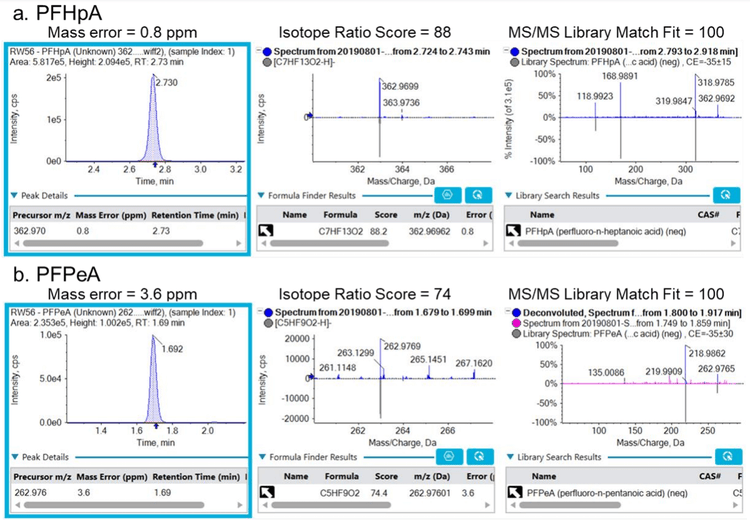
Suspect screening workflows monitor a list of target compounds, utilizing either the chemical formula or exact mass to generate the extracted ion chromatogram (XIC). The compound identification is confirmed using the exact precursor mass error (accuracy <5 ppm) and isotope ratio score. Further, the MS/MS spectrum is compared to a library database for additional confidence. The SCIEX HR-MS/MS Fluorochemical library 2.0 is a verified library containing MS/MS spectra for ~250 PFAS compounds covering negative, positive and zwitterionic compound classes. For example, this approach was used to confirm the detection of two short-chain PFAS in the river water sample, PFPeA and PFHpA (Figure 2). Both PFAS compounds showed good precursor mass error and isotope pattern match and strong MS/MS library match (library “fit” score = 100 for both compounds). The deconvolution algorithm helps to produce a cleaner fragementation spectrum by removing MS/MS ions from interfering, co-eluting precursors that are not associated with the compound of interest. For example, the SCIEX OS software deconvolution algorithm resulted in a cleaner MS/MS spectrum for PFPeA and improved library matching (Figure 2b).
Novel PFAS suspect screening using MS/MS from published data for confirmation
Suspect screening lists may also be generated from novel PFAS compounds in the literature2. The suspect compounds may not be in the Fluorochemical library and can be confirmed based on their mass error, isotope ratio and MS/MS spectrum. In this situation, the predominant MS/MS fragments are manually compared between the experimental and literature-published MS/MS spectrum.
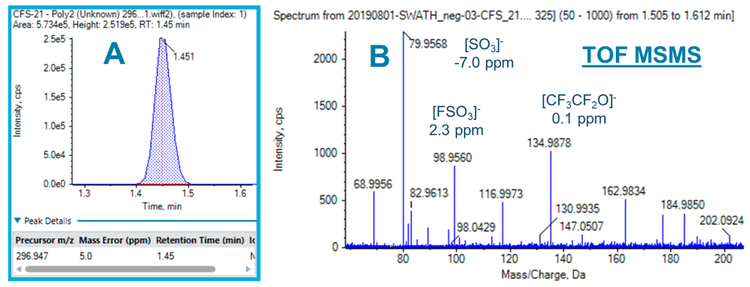
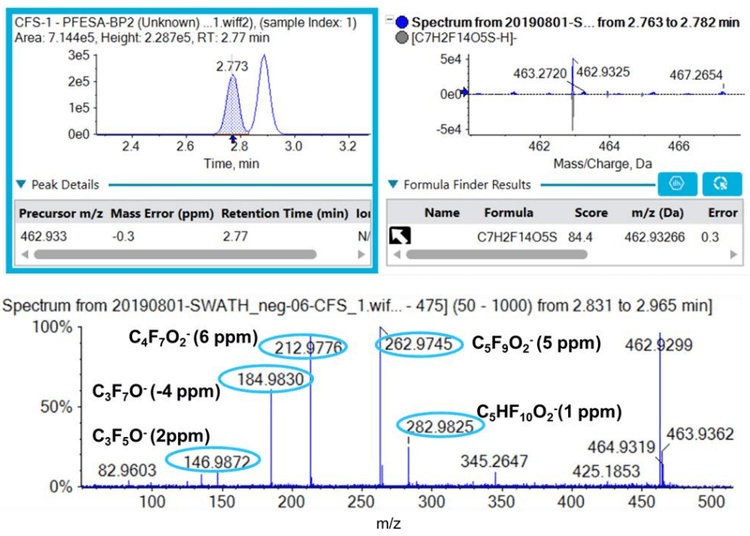
For example, figure 1 shows the identification of NVHOS (C4F8H2O4S) in a sediment sample. The SCIEX OS software shows a good mass error (5 ppm). Further, the major MS/MS fragment ions of [SO3] - , [FSO3] -, and [CF3CF2O]- were present, which is consistent with spectra reported in the literature1, 2 . Based on recent reporting criteria3 , the identification confidence was level 2b. Figure 3 shows another example of using this approach, the positive detection of the PFESA Byproduct 2 compound in a sediment sample. The software showed excellent mass error (-0.3 ppm) and isotope ratio score (84.4), and the major experimental MS/MS fragment ions matched those from chemical standard1 . In addition, PFESA byproducts identified are shown in Table 1.
Non-target data filtering using Kendrick mass defects
Non-target screening workflows return ion characteristics from the features identified by the peak-finding algorithm, including molecular mass, fragment spectra and isotope composition. Highly fluorinated molecules, such as PFAS, are typically characterized by a negative mass defect, defined as the difference between the exact and nominal mass of the compound. To screen for and readily visualize potential novel PFAS, the non-target data was processed using these mass defects2 and Kendrick mass defects (KMD) with different repeating units (-CF2-, -CF2O-, -C2F4O-)4 .
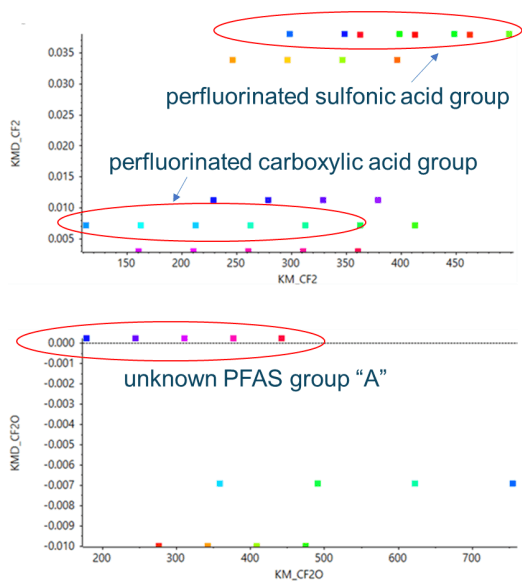
Figure 4 shows that the KMD plots visually identified 9 homologous groups of highly fluorinated compounds in the compiled Cape Fear River samples (i.e., river and aquifer water, sediment samples). Features that fall along the same horizontal line are related to each other and differ only by the number of - CF2 (top panel) or CF2O-(bottom panel) units. For example, the perfluorinated sulfonic acid group (e.g., PFOS, PFHxS) was observed along the line corresponding to KMD (-CF2) of 0.038 units, and the perfluorinated carboxylic acids (e.g., PFOA) were observed along KMD (-CF2) of 0.007 units.
In addition, KMD plots were used to prioritize the resulted peaks for further identification using Formula Finder and ChemSpider features and expansion of suspect list. For example, the KMD (- CF2O) plot showed a homologous series of unknown compounds with KMD (-CF2O) of approximately 0.00 units.
Characterization of emerging PFAS using Formula Finder and ChemSpider in SCIEX OS software
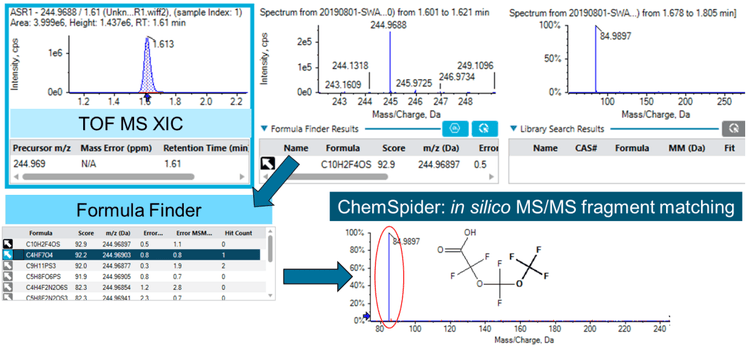
The group of unknown compounds prioritized from the KMD plots in Figure 4 was further characterized using Formula Finder and ChemSpider in SCIEX OS software. These SCIEX OS software modules help characterize emerging PFAS without MS/MS library matches or literature-reported spectra. Specifically, Formula Finder generates candidate empirical formulae based on the TOF MS accurate mass and a userdefined set of potential elements. Then, the generated candidate formulae are matched to structures from ChemSpider database. Within ChemSpider, the experimental MS/MS spectra were compared to the predicted fragmentation pattern of the candidate structures.
Figure 5 shows the characterization workflow for one feature identified in the KMD plot unknown group, m/z 244.9693, in the aquifer water. Formula Finder identified a potential formula of C4HF7O4, and ChemSpider matched the diagnostic m/z 84.9907 fragment (-CF3O), ultimately identifying PFO2HxA.
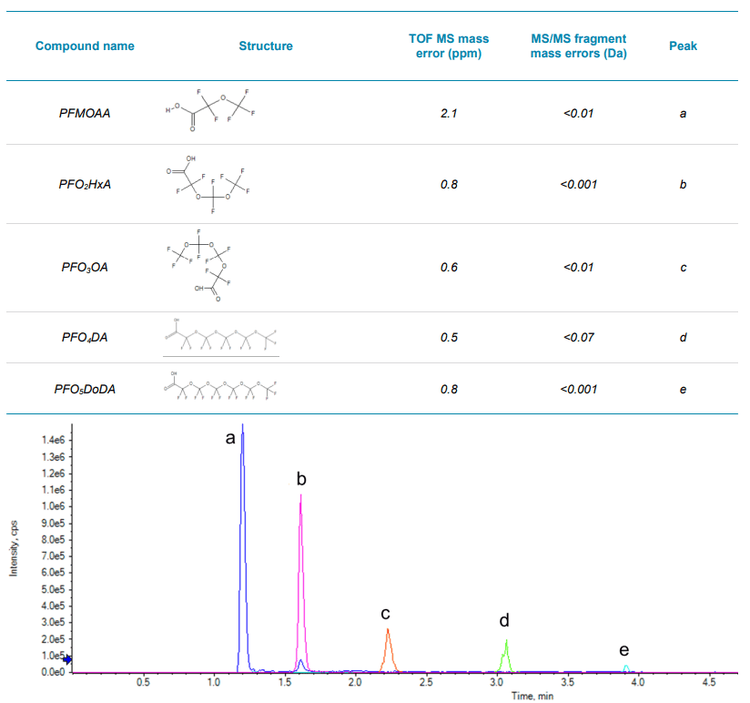
To further screen unknown PFAS in this homologous series, a suspect list was built that contained differing -CF2O repeating units based on PFO2HxA. Ultimately, four additional perfluoropolyether were added to the suspect list and confirmed using their diagnostic ions and mass accuracy (Table 2)
Conclusion
- Multiple PFAS classes were detected using non-target analysis in surface and aquifer water, and sediments from the Cape Fear River basin
- Legacy PFAS, such as the perfluorinated carboxylic acids, were identified using suspected screening with fragment matching from the SCIEX Fluorochemical MS/MS library
- Novel PFAS identified by suspect screening and matching diagnostic MS/MS fragments
- Kendrick Mass Defect plots are used to detect homologous series of novel PFAS with identification through SCIEX OS software Formula Finder and ChemSpider for structural elucidation
References
- Saleeby, B.; Shimizu, M.S.; Sanchez Garcia, R.I.; Avery, G.B.; Kieber, R.J.; Mead, R.N.; Skrabal, S.A. (2021) Isomers of emerging per- and polyfluoroalkyl substances in water and sediment from the Cape Fear River, North Carolina, USA. Chemosphere 262: 128359.
- McCord J, Strynar M. (2019) Identification of per- and polyfluoroalkyl substances in the Cape Fear River by high resolution mass spectrometry and non-targeted screening. Environ. Sci. Technol. 53: 4717-4727.
- Charbonnet JA et al. (2022). Communicating confidence of per- and polyfluoroalkyl substance identification via highresolution mass spectrometry. Environ. Sci. Technol. Lett. 9: 473-481.
- Bugsel, B. & Zwiener, C. (2020) LC-MS screening of polyand perfluoroalkyl substances in contaminated soil by Kendrick mass analysis. Anal. Bioanal. Chem. 412: 4797– 4805.