Abstract
Plastics can undergo various degradation mechanisms and additives are often added to increase the lifespan of plastics. These additives, if not used applied correctly, have the potential to migrate or dissolve into packaged food or drugs and results in consumer exposure. Here, an LC-MS/MS method for the determination of ten common additives in plastic packaging was developed using the SCIEX QTRAP 4500 system.
Introduction
Plastic is commonly used in food, medicine and other products.1 Light, heat, oxygen and other factors might cause the plastic in these products to undergo photodegradation and heat oxidation reactions, resulting in the material aging and decomposing. A strategy to reduce this breakdown and increase the lifespan of plastics is to add plasticizers, antioxidants, light stabilizers or other additives.1,2 These additives have the potential to migrate or dissolve. If the additives are improperly selected or added in excess, foods or medicines might be contaminated by aged packaging and could therefore expose consumers to these additive compounds.1 In recent years, the problem of additives in packaging materials has attracted increased attention, highlighting the importance of methods that can detect common additive compounds in plastics for routine quality monitoring of plastic packaging materials.
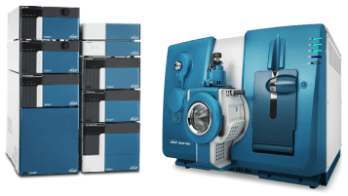
This technical note describes the use of triple quadrupole mass spectrometry on the QTRAP 4500 system for the detection and measurement of 10 common plastic additives. The additives measured included oleic acid amide, didecyl phthalate, UV 351, antioxidant 1010, antioxidant 1076, 2-MBT, UV 9, antioxidant DLTP, UV 234 and antioxidant 1024.
Methods
Sample preparation: Ten mL of methanol was added per 1 g of sample. The sample was ultrasonicated for 1 h, then allowed to extract for 24 h. The sample supernatant was then sampled for LC-MS/MS analysis.
Chromatography: The LC system used was an ExionLC AD system with a Kinetex C18 delay column (3 x 2.1 mm, 5 µm particle size). The analytical column was a Kinetex C18 (5 x 3.0 mm, 2.6 µm particle size) column. Mobile phase A was water with 0.1% formic acid and mobile phase B was acetonitrile. A flow rate of 0.4 mL/min was used and the column temperature was set to 40°C. The gradient runtime was 10 minutes, with starting conditions of 10% B for 0.5 minutes, followed by a ramp to 40% B over 0.5 minutes and then to 98% B over the next 2.5 minutes. The gradient was held at 98% B for 3.5 minutes, then reduced to 10% B over 0.1 minutes and held at 10% B for the remainder of the runtime.
Mass spectrometry: A QTRAP 4500 system was used in multiple reaction monitoring (MRM) scan mode and operated in electrospray (ESI) positive ion mode. Ion source parameters were an ion spray voltage of 5500 V, temperature of 550°C, curtain gas at 35 psi, collision gas at 8 psi, GS1 at 55 psi and GS2 at 55 psi.
Results
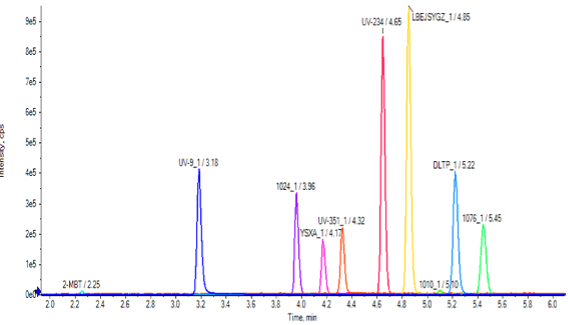
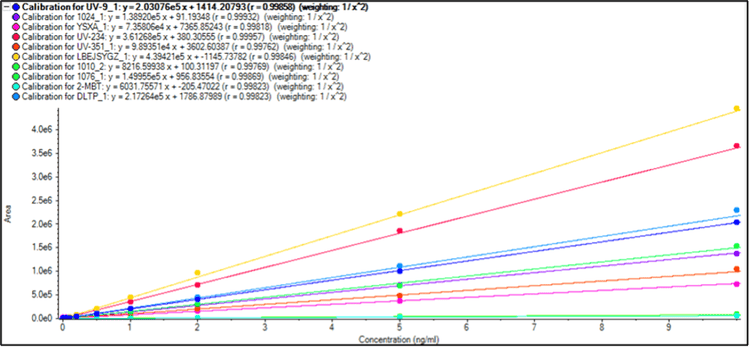
An example chromatogram is shown in Figure 1. The calibration curves for the 10 analytes had correlation coefficients (R2) greater than 0.997 and accuracy between 95% and 110.3% for each data point (Figure 2).
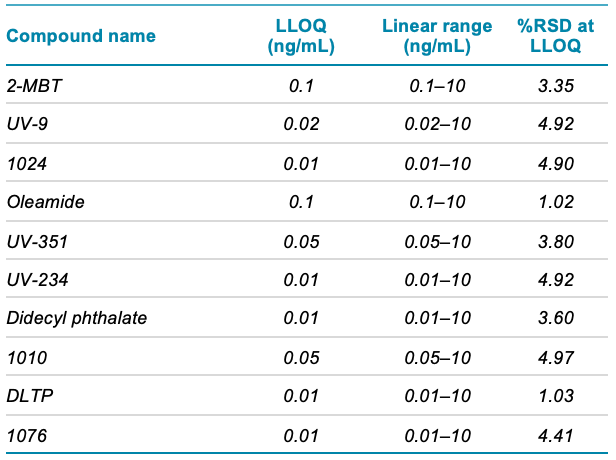
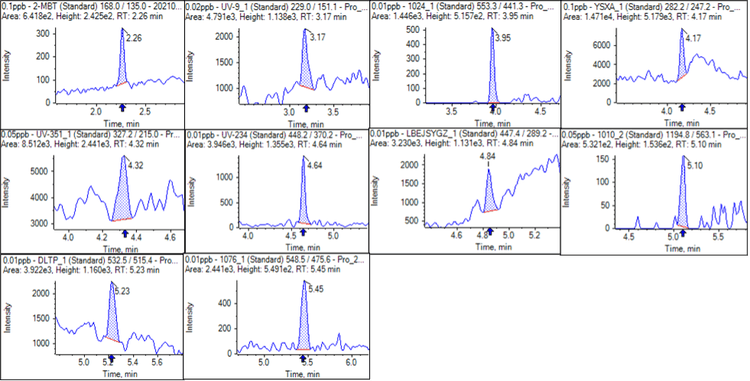
The lower limit of quantification (LLOQ) of the 10 additives ranged between 0.01 and 0.1 ng/mL. A sample was spiked with the 10 plastic additives at their respective LLOQs and then injected 6 times. The RSD from this experiment showed that all analytes were within 5.0% of the expected value (Table 1). The signal observed at the LLOQ for each analyte is shown in Figure 3.
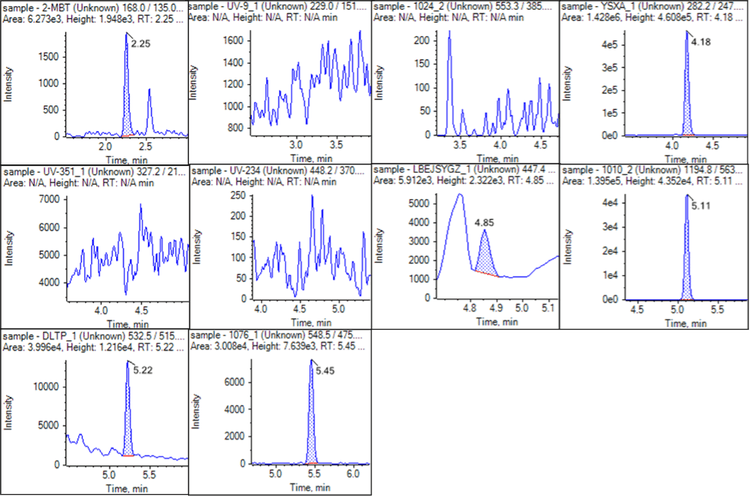
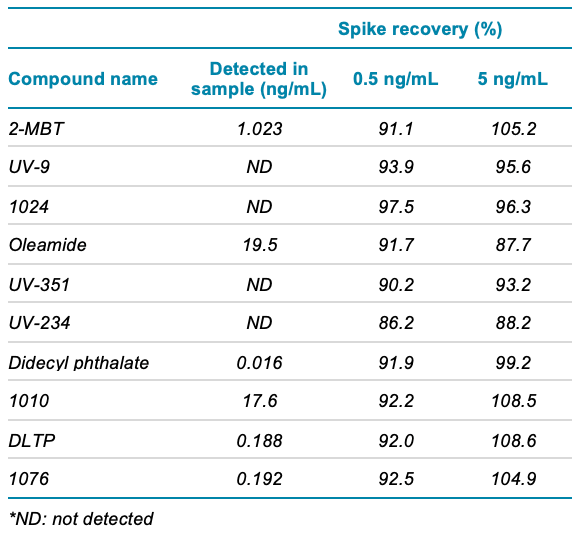
To assess recovery, a treated sample solution was spiked with standard working solutions of 10 additives. The spiked samples were prepared at concentrations of 0.5 ng/mL and 5.0 ng/mL (Figure 4). The recovery results are shown in Table 2. The recoveries of 2 samples with different concentrations of the 10 additives ranged between 86.2 and 97.5% and 88.2 and 108.6%, thereby meeting the method requirements.
Conclusions
Here, an LC-MS/MS method for the determination of 10 common additives in plastic packaging was developed using the QTRAP 4500 system. The results demonstrate that the developed method is highly sensitivity and has good reproducibility. The use of a delay column upstream of the analytical chromatographic column was shown to effectively remove the influence of substances in the background.
References
- Ncube, L.K., Ude, A.U., Ogunmuyiwa, E.N., Zulkifli, R. and Beas, I.N., 2020. Environmental impact of food packaging materials: A review of contemporary development from conventional plastics to polylactic acid based materials. Materials, 13(21), p.4994.
- Alhanish, A. and Abu Ghalia, M., 2021. Developments of biobased plasticizers for compostable polymers in the green packaging applications: A review. Biotechnology Progress, 37(6), p.e3210.