Introduction
Federal legalization of adult-use Cannabis in Canada substantiates the need for robust and reproducible methods for analysis of Cannabis and derivative products for consumer health and safety. Target maximum residue limits (MRLs) for stringent regulations in the United States, including those imposed by Oregon1 and California2 have been demonstrated. These states monitor for 59 and 65 pesticides, respectively, at levels down to 100 ppb in the product. The pesticides represent a wide range of chemical classes and properties.
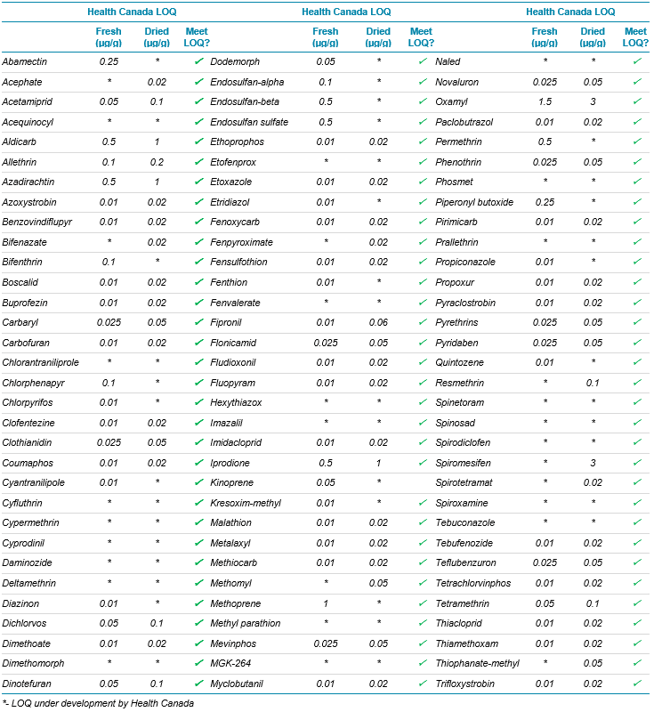
In the United States, pesticide regulations in Cannabis products are governed by individual state legislation, whereas Health Canada regulates pesticide screening at a federal level. Health Canada has currently proposed regulations for 96 pesticides, with tolerance levels between 10 to 500 fold lower than those regulated by California or Oregon, with many analytes regulated at 10 ppb in product3. Health Canada has assigned individual MRLs for dried Cannabis flower, Cannabis oil and fresh Cannabis flower and plants, the last of which has not been regulated elsewhere. Alternative Cannabis products, such as edibles and topicals, are yet to have defined regulations. Although testing for these 96 pesticides in the three matrices has been mandated, only 64% of the MRLs have been defined by Health Canada as of March, 20193. Federal legalization implies unification of regulations across the country, however these incomplete lists necessitate method flexibility, performance and robustness as regulations continue to evolve.
As with the California and Oregon lists, several Canadian list pesticides have been historically analyzed by GC-MS; necessitating complicated sample preparation, derivatization, and long sample run times. Compounds on the Health Canada list such as endosulfans and pentachloronitrobenzene (quintozene) do not have functional groups traditionally ionizable by electrospray ionization (ESI). It has been demonstrated that the sensitivity afforded by ESI can be employed to reach the stringent Health Canada limits for the majority of mandated pesticides, while additionally leveraging the flexibility of atmospheric pressure chemical ionization (APCI) to analyze those compounds that are either not ionizable by ESI, or show better sensitivity by this mechanism. APCI has the advantages of being more robust against matrix effects compared to ESI and, particularly in negative mode, being more selective. This leads to a method that is more robust, which is extremely important in a sample with as much potential for variability, ion suppression and isobaric interferences as Cannabis. This also allows for sample prep to be minimized and streamlined to increase throughput and decrease analysis cost.
Key advantages of ESI / APCI Method
- Leveraging both sensitivity of ESI and flexibility of APCI to meet demanding LOQ criteria and ionize compounds traditionally analyzed by GC-MS
- Efficient desolvation in the IonDrive™ Turbo V Ion Source allows for improved ionization of temperature sensitive analytes
- Solvent extraction and dilution of samples streamlines workflow, maximizes extraction efficiency, and minimizes cost
Experimental
Sample preparation: Analytical standards mixtures were purchased from SPEX CertiPrep (Metuchen, NJ, USA) and individual standards for optimization were purchased from AccuStandard (New Haven, CT, USA). Dried Cannabis flower samples were extracted into acetonitrile according to the protocol below.
- 1 gram of homogenized dried flower was weighed into a 15 mL plastic centrifuge tube and 5 mL of acetonitrile added
- Sample was vortexed for 30 seconds
- Sample was sonicated for 15 minutes
- Acetonitrile extract was decanted to separate vial
- Steps 1 through 3 were repeated on the same sample and extracts were combined to yield a final extract ratio of 1 gram homogenized flower to 10 mL of acetonitrile
- Extracts were winterized for at least 2 hours in a -20ºC freezer or colder
- Supernatant was transferred to another vial and winterized again for 2 hours
- Winterized extracts were centrifuged at 4000 rpm and passed through a 0.2 µm syringe filter
- A 500 µL aliquot was diluted 1:1 with methanol
- For analysis, an injection volume of 1 µL was used for ESI and 4 µL for APCI.
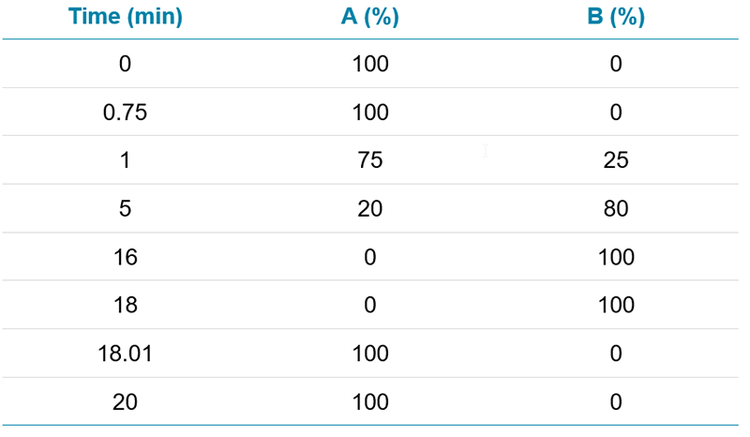
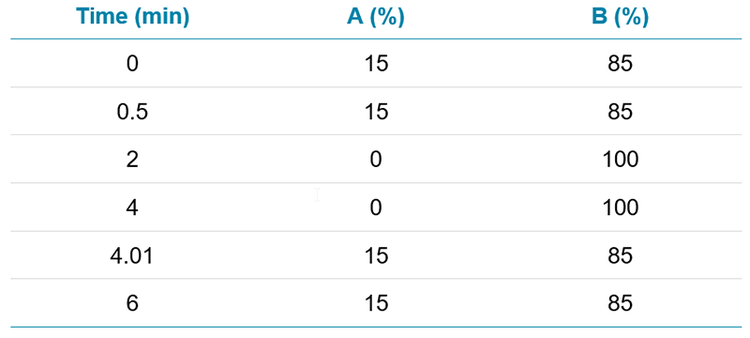
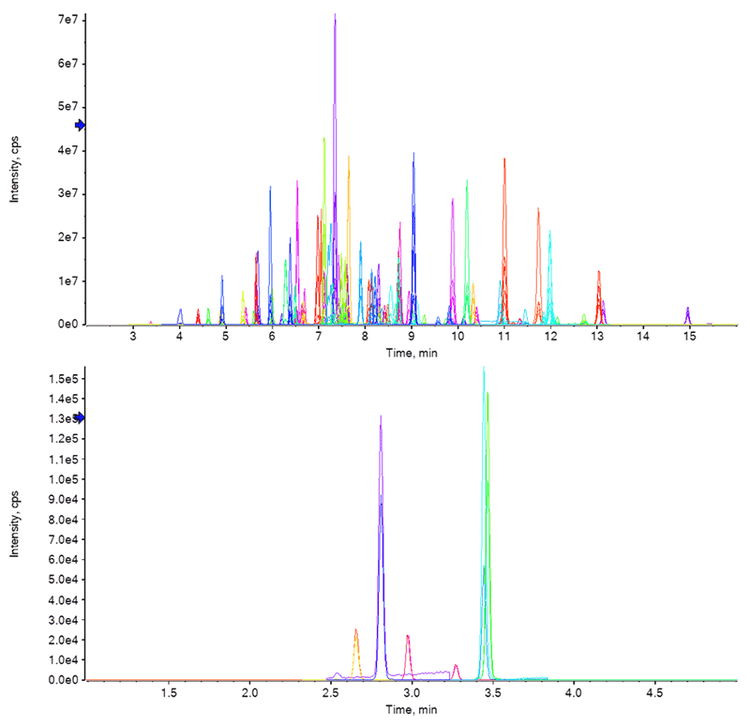
HPLC conditions: Analytes were separated on a Phenomenex Luna Omega Polar C18, 3 µm LC column (150 x 3 mm) using a SCIEX ExionLC™ AD System with a 20 µL solvent mixer. Separation was performed at a flow rate of 420 µL/min with a column temperature of 30ºC and an autosampler sample storage temperature of 10ºC. For ESI analysis, mobile phase solvents were (A) water + 0.1% formic acid + 5 mM ammonium formate and (B) methanol + 0.1% formic acid + 5 mM ammonium formate (B) with a gradient program listed in Table 1. For APCI analysis, mobile phase solvents were (A) water and (B) methanol without modifiers with a gradient program listed in Table 2 and example chromatography in Figure 2.
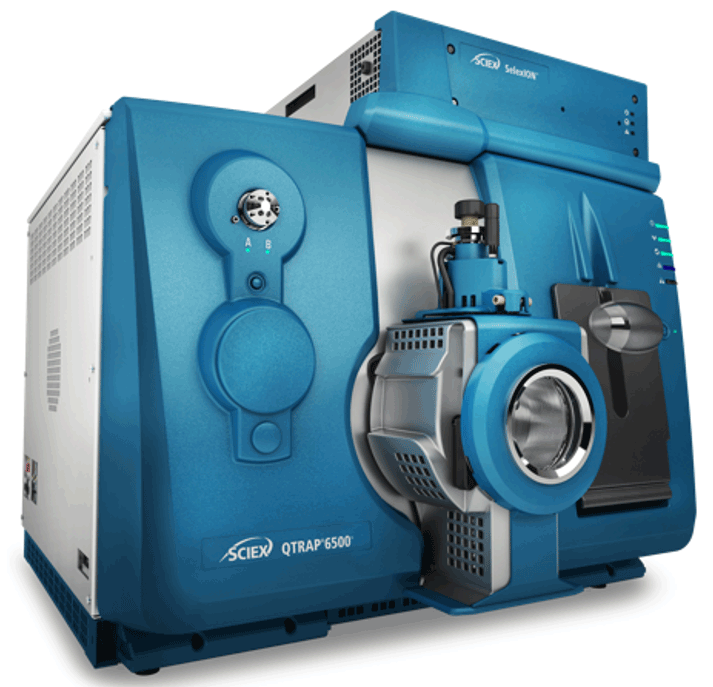
Mass spectrometry conditions: All compounds were analyzed using a SCIEX QTRAP 6500+ System with Scheduled MRM™ Algorithm Pro. The target scan time for both positive and negative polarity experiments was optimized to obtain at least 12 scans across each peak. Pesticides analyzed by ESI were acquired with the following source settings: CUR=50 psi, CAD=HIGH (12), ISV=+3500/-4500 V, TEM=350ºC, GS1=80 psi, GS2=60 psi. Pesticides analyzed by APCI were acquired with the following source settings CUR=50 psi, CAD=HIGH (12), NC= -3 µA, TEM=400ºC, GS1=50 psi.
Two injection quantitative strategy
Testing requirements set forth by Health Canada represent analytically challenging demands for pesticide detection and quantitation in Cannabis. These requirements necessitate an approach utilizing two injections; one using ESI and one using APCI.
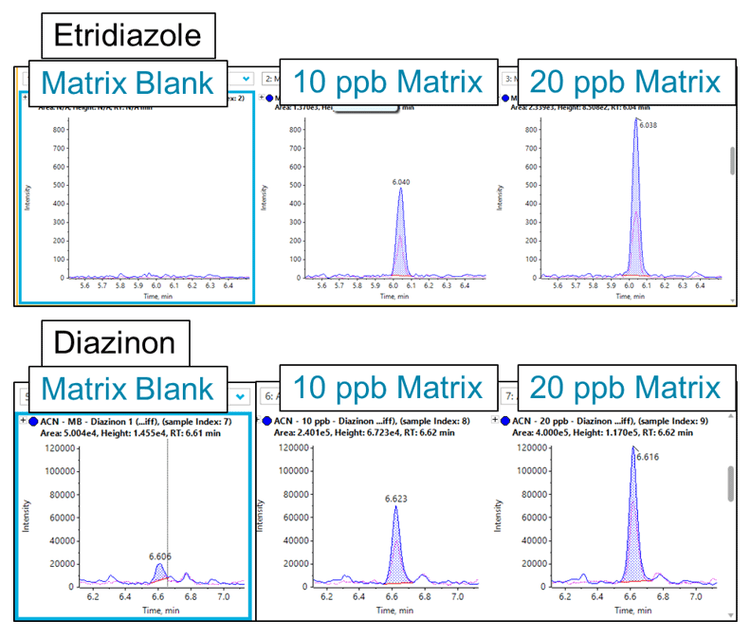
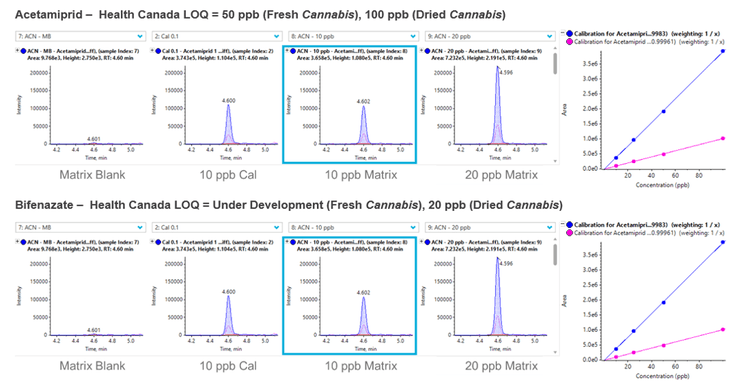
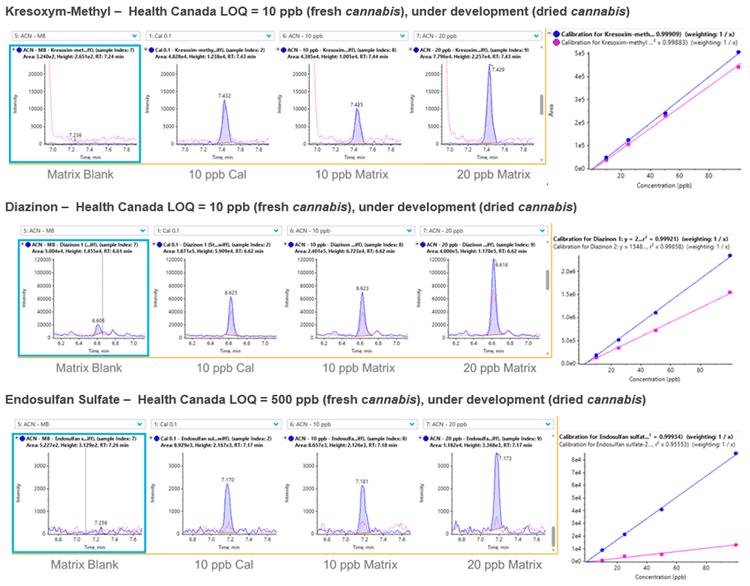
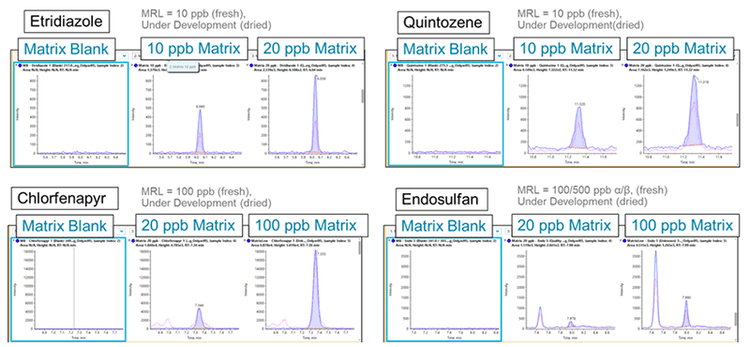
The MRLs set by Health Canada demand the sensitivity afforded by ESI for the majority of the pesticide panel, especially those with LOQ requirements at 10 ppb. The compounds highlighted in Figure 3 show ample signal to noise and excellent linearity for compounds traditionally analyzed by LC-MS/MS. With large-panel multiresidue analyses, it is the compounds that show poor ionization efficiency that are the greatest challenge. Figure 4 highlights compounds that are traditionally analyzed using gas chromatographic (GC) techniques, but show quantitative performance that meets, and in most cases exceeds, the requirements set forth by Health Canada using ESI. Additionally, there are certain compounds that simply do not ionize under traditional ESI mechanisms, such as quintozene, etridiazole and endosulfan, and are traditionally analyzed by GC. For this reason, it is necessary to employ alternative ionization techniques, namely APCI. This also allows for compounds that show improved ionization efficiency by APCI to be analyzed by their more preferred mechanism. Figure 5 highlights the performance of the APCI portion of this method to meet the Health Canada requirements. Together, these two methods have a combined run time under 30 minutes and the same extract is used for both analyses. Switching between ESI and APCI probes takes less than one minute to perform, with no software changes necessary.
Impact of sample preparation
Solvent extraction and winterization have been used to prepare all samples for pesticide analysis from a single extract. No difference in performance was observed between acetonitrile and acidified acetonitrile extracts, and showed improved performance over acetonitrile with QuEChERS salts, so neat acetonitrile was chosen as the extraction solvent for this method. Winterization reduces the solubility of all components in the extract, but only the highest concentration components (i.e matrix components) will precipitate out of solution, while target pesticides at low concentrations remain in solution for analysis. Since fresh Cannabis could not be obtained, only dried Cannabis matrices were tested. Interferences between the two matrices are expected to be similar, but since fresh Cannabis is roughly 50% water, it is anticipated to demonstrate less suppressive character. For Cannabis oil, it may be worthwhile to employ a lipid removal technique as recommended by Health Canada.4 Lipid removal sorbents, either in the form of dSPE or SPE-pass-through cartridges, in combination with winterization, might be expected to remove the majority of the hydrophobic matrix, but compound losses, specifically of daminozide, may still occur.
Conclusions
All Health Canada regulated pesticides were ionized, detected and quantitatively analyzed by LC-MS/MS, using ESI or APCI techniques. Dried Cannabis flower was used as representative matrix, and matrix spikes at the mandated LOQs showed method performance meeting or exceeding LOQ requirements for all but one of the 96 target panel. For kinoprene, the mandated LOQ in fresh Cannabis may able to be achieved using a larger volume injection, as the dried LOQ is still under development, and fresh Cannabis represents a less challenging matrix.
A simplified extraction protocol can be used by leveraging the sensitivity and robustness of the SCIEX QTRAP 6500+ System with IonDrive Turbo V Source, to streamline sample prep by reducing the need for complex and costly cleanup techniques to maintain instrument performance, and analyze the entire pesticide panel together. This workflow also retains the flexibility to add additional components, such as mycotoxins, to further increase productivity in testing labs. This comprehensive approach reduces the need for gas chromatographic techniques, and the frequent maintenance they require when analyzing dirty matrices.
References
- Quantitation of Oregon List of pesticides and cannabinoids in cannabis matrices by LC-MS/MS. SCIEX technical note RUO-MKT-02-6729-B.
- Achieving the California pesticide regulations in cannabis using optimized APCI and ESI techniques. SCIEX technical note RUO-MKT-02-8859-A.
- Mandatory Cannabis Testing For Pesticide Active Ingredients – Lists and Limits. (November 8, 2018). Health Canada.
- Moulins, J.R., et al., (2018) Multiresidue Method of Analysis of Pesticides in Medical Cannabis. J AOAC Int, 101(6):1948-1960.