A Robust and Sensitive Method for the Direct Analysis of Polar Pesticides in Food and Environmental Samples Without Derivatization
Abstract
The Challenge of Polar Pesticides
The prevalence of multi-residue LC-MS/MS analyses for the quantification of pesticides in food and environmental samples has been steadily increasing for many years, and they are now considered to be a minimum requirement of most laboratories working in these fields. Modern tandem quadrupoles are capable of detecting such regulated compounds at very low levels with minimal sample preparation, such as QuEChERS, thereby enabling labs to process large numbers of samples for many analytes with a fast turnaround. However, some very polar compounds which are not amenable to the extraction procedure, chromatographic method or are poor ionizers require additional single-residue methods which involve time-consuming preparation and separation and often involve derivatization to improve detection.
Key Advantages Presented
- All analytes were well retained, allowing detection of the majority of background components which could otherwise interfere. Separation between the analytes was also sufficient to allow unambiguous identification, and retention times were reproducible. Sensitivity in spiked environmental waters was found to be similar to that in standards, and the target limit of detection of 20 ng/L was easily achieved with real drinking water samples.
- Matrix effects were largely eliminated in both the NofaLab method for food sample extracts and the modified method for direct injection of water samples. Use of QTRAP® is expected to confirm positive results by their full-scan MS/MS spectra, but future work will investigate different or additional clean-up.
Growing Concerns
Recent increase in public concern regarding the presence of glyphosate has significantly increased the requirement to analyse it and its metabolites in food, feed and the environment, so has accelerated the need for a more efficient and robust analytical method. The extraction and chromatography of these compounds is well described in the EURL-QUPPE method, but the separation is not robust in practice, so system and method maintenance are intensive. Several different HPLC or HILIC based methods have failed to address the issues of reproducibility and sensitivity, so FMOC derivatization prior to analysis is often still employed for glyphosate, AMPA and glufosinate. Although possible to automate, this procedure is still time consuming or expensive, and is not applicable to the other polar pesticides of interest.
Creating a High Throughput Method
NofaLab is an independent sampling and testing laboratory based near Rotterdam, Netherlands, specializing in the fields of food, feed and environmental safety. The increasing pressure to provide fast, quantitative analysis has driven NofaLab to add to their portfolio of LC-MS/MS instrumentation and develop a new method which covers as many of these polar pesticides in a single analysis as possible. Ion chromatography has been shown to be beneficial for separation, but the need for a suppressor is detrimental to MS analysis and the inefficiencies of changing inlet systems on a heavily used mass spectrometer makes it impractical in a busy lab performing primarily reverse-phase LC.
So, the final method, presented here, makes use of an IC column in a method-switching reverse phase (RP) system with MS amenable mobile phases at around pH 9. Such conditions configure glyphosate ideally for MS detection with good retention and separation of the other analytes and matrix interferences. The method meets the DG-SANTE1 requirements of reproducibility (<20%) and recovery (80-110%), and the LOD of the method is below 0.01 mg/kg. Excellent long-term stability and robustness were achieved throughout the validation of this method for food samples extracted by the QUPPE procedure.
Where environmental samples require testing, the regulatory limits are much lower5 and interference from matrix more problematic in traditional analyses with a short retention time, so derivatization is often the only option. However, since glyphosate is well retained in this new method, the potential to further develop it for direct large-volume injection was investigated in collaboration with SCIEX. By modifying the gradient conditions and optimizing the injection parameters, a second method specific to environmental water samples has been developed. Although the large volume injection (LVI) is more susceptible to changes in pH (for example, due to evaporation of mobile phase) robustness has been shown to be similarly good, and allows detection of the same suite of analytes with a LOD of <0.02 ng/l.
Experimental Considerations
Food samples
The QuPPe method for extraction of polar pesticides from samples of plant and animal origin developed by Anastassiades et al. at CVUA Stuttgart2 are well described and have undergone several revisions. Since the analytes are water soluble, it is based on aqueous extraction with addition of methanol and formic acid to improve efficiency.
The addition of internal standards is essential to compensate for the shifting retention times in most chromatographic method and helps to counter matrix effects where present. This was particularly important for grain and seed samples, where chromatographic performance deteriorates, and the MS source becomes dirty, losing sensitivity quickly, so dispersive C18 cleanup as described in the QuPPe-AO3 method was attempted before finalizing on a push-through method with two sorbents using SPE filters.
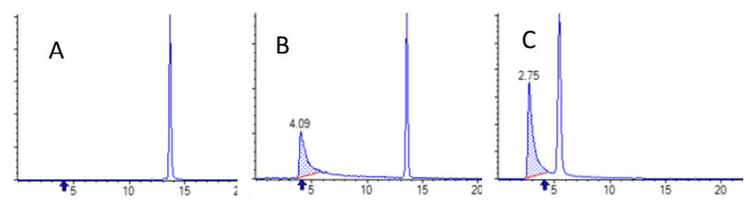
Various chromatographic methods have been investigated and found to have several limitations. Figure 2 illustrates the common practice of extensive conditioning prior to analysis, which after relatively few (typically 30-50) sample injections in order to maintain peak shape and retention time Ion chromatographic methods showed most promise, but the eluents’ incompatibility with electrospray ionization sources requires the use of a suppressor, which is detrimental to peak width. However, by employing a polyvinyl alcohol based column with quaternary ammonium groups and using an ammonium bicarbonate buffer prior to detection by a very sensitive quadrupole mass spectrometer, the need for a suppressor is removed.
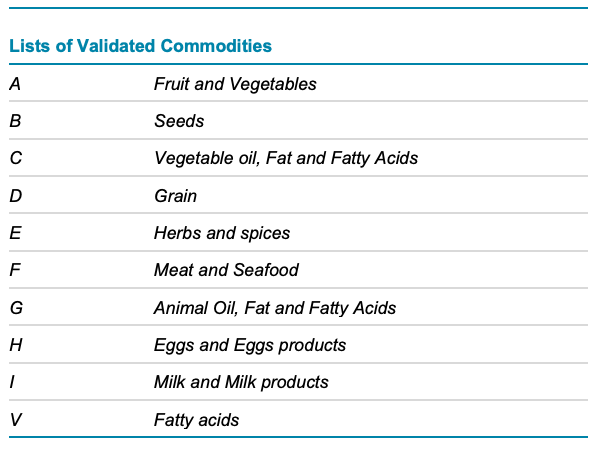
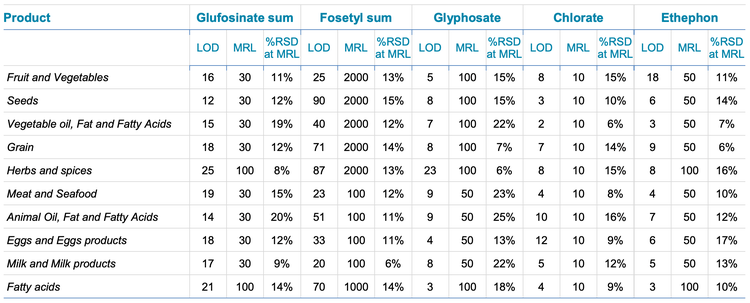
Method verification was performed on a variety of food matrices (Table 1), all subject to clean-up as described above. Performance was robust and reproducible with 10μl injections, but peak shape started to deteriorate after around 200 samples, with significant distortion appearing by the 350th injection due to the limited capacity of the 2mm i.d. column. The final chromatographic method uses a 150 x 4mm column and employs a guard column of the same material and a 0.5μm filter, both of which are replaced every 250 samples to maintain performance and to keep the MS source clean.
Water samples
Environmental and drinking water samples varied widely in the degree of comprised particulate matter, which causes difficulties for LC injection and is detrimental to reproducibility. However, minimal sample preparation is desirable in a high throughput laboratory situation and SPE type clean-up would add significant time and financial cost. In order to overcome these challenges, a simple filtration step using Chromacol 17-SF-02 (RC) from 17 mm syringe filters was performed when transferring samples to the LC vials. Internal standards to a final concentration of 1ppb were added to samples and standards, and QC samples in tap water were prepared in a similar fashion. Experiments were also performed using standard addition to the samples to investigate any potential matrix effects.
Separation was achieved using a Shimadzu Nexera UHPLC system comprising LC-30AD pumps, a SIL-30AC autosampler fitted with a 500μL loop and a CTO-20A column oven. An injection volume of 500μL was employed in a chromatographic method similar to that used for the food samples. During verification of the method, the primary focus was on achieving stable peak shapes and retention times for all analytes. Loop size (irrespective of injection volume), initial conditions, gradient and pH of the mobile phase had very significant effects, so the final optimized method should be fixed, and fresh mobile phases prepared regularly.
Method verification was performed with real drinking water samples, testing for both AMPA and Glyphosate, a LOQ of 20ng/L could be reached.
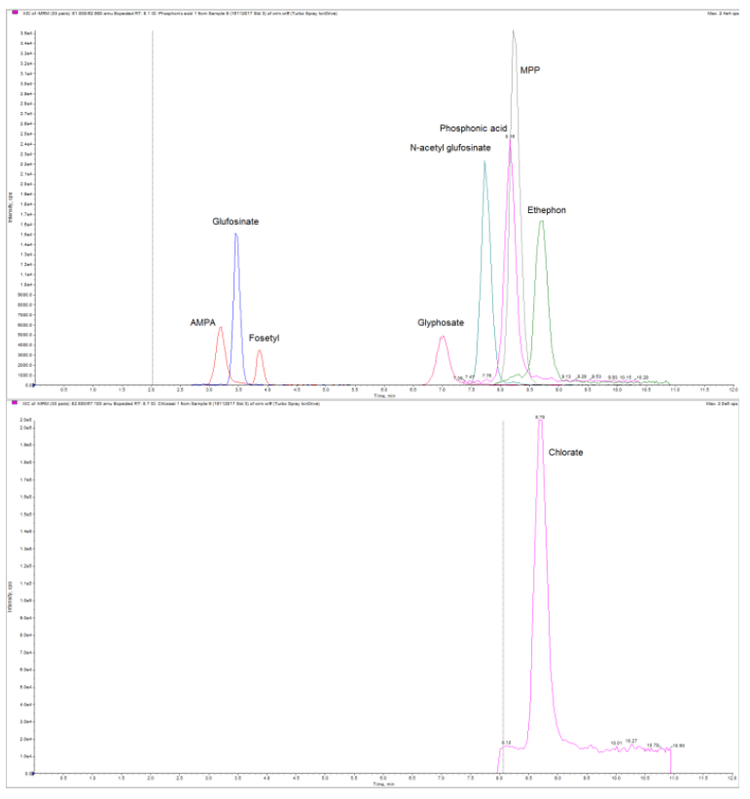
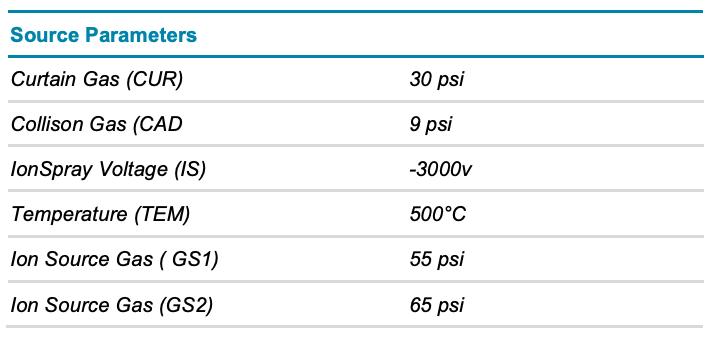
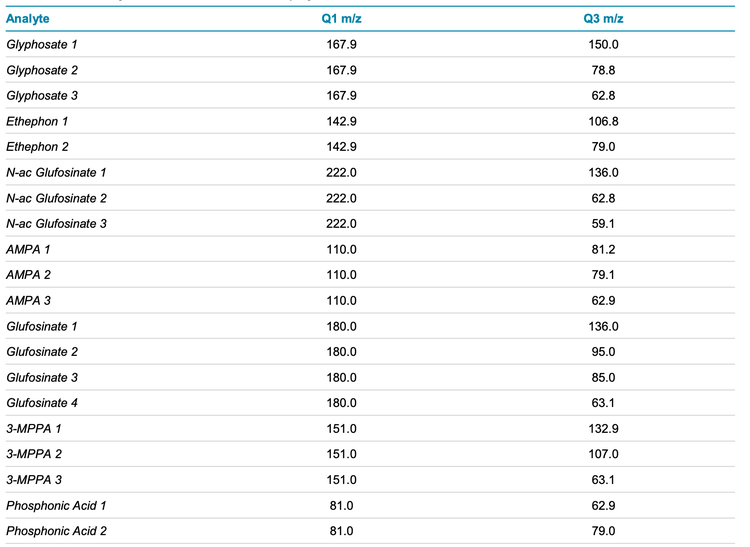
Analyses were performed using a SCIEX QTRAP®® 6500+ mass spectrometer in negative electrospray ionization mode. At least two MRM transitions were optimized for each analyte as outlined in Table 3 in order to quantify and confirm their concentration in all samples. Data was acquired using Analyst® 1.6.3 .and processed for quantitation and confirmation with reference to internal standards using MultiQuant™ 3.0.2 software.
Results and Discussion
Food samples
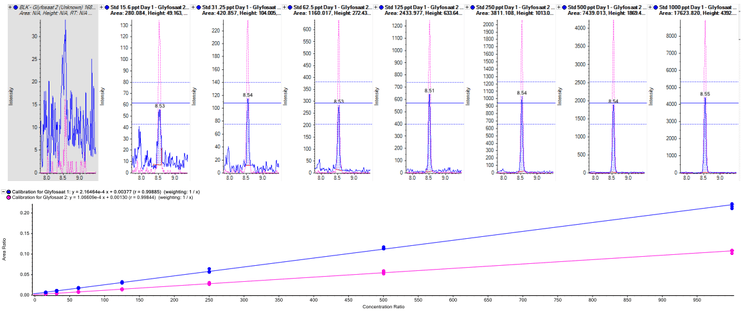
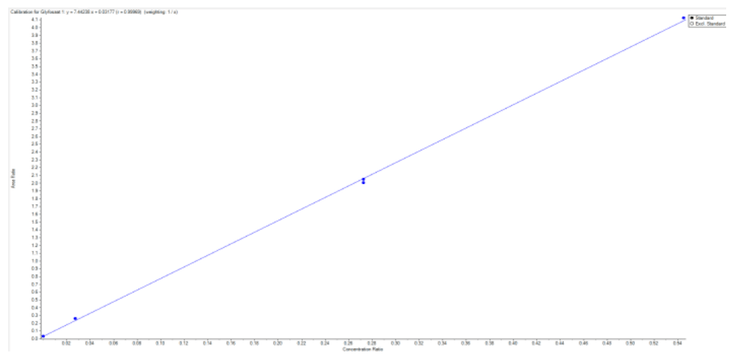
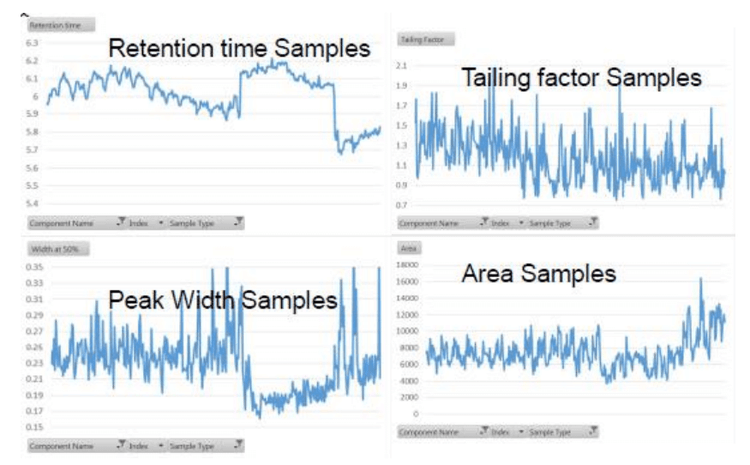
Chromatographic performance using both the NofaLab method for QuPPe extracts of food samples and the modified method for water samples achieved good separation between the analytes and from matrix interferences, and excellent repeatability in terms of peak profile and retention time. The EU maximum residue limits for these compounds in food samples range from 10 to 2000 μg/kg, depending on the commodity and compound4 , so the target for each is variable. Although water regulations are under discussion, a detection limit of 20 ng/L for environmental samples is desirable in anticipation of future regulation. Some analyte/matrix combinations proved to be particularly difficult, but these target concentrations were easily achieved for all samples in the verification of the methods. Over 1000 food samples from a variety of commodities were analyzed at NofaLab without maintenance of the system, and the stability in terms of retention time, peak width, peak area and tailing factor was found to be excellent. Figure 1 shows several measures of reproducibility based on the glyphosate internal standard.
Water samples
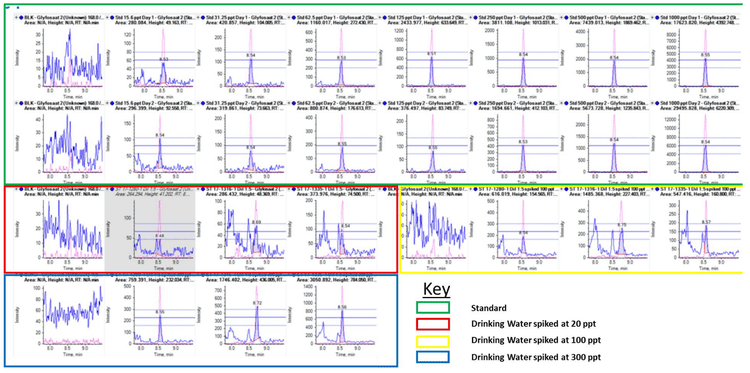
To achieve the target sensitivity for environmental water samples, it was necessary to inject increase the amount of sample, so trials with increasing injection volume and different loop sizes were carried out. With each incremental change, the composition of eluent in the loop was altered, thereby changing initial conditions of the analysis and the retention times and peak shapes of the analytes. To compensate, modification of the stating composition of the mobile phase was required, but when final parameters had been fully developed, the method was found to be as stable and robust as the NofaLab method for food samples. All analytes were well retained, allowing detection after the majority of background components which could otherwise interfere had eluted. Separation between the analytes was also sufficient to allow unambiguous identification, and retention times were reproducible. Sensitivity in spiked environmental waters was found to be similar to that in standards, and the target limit of detection of 20 ng/L was easily achieved with real drinking water samples. In order to verify the results, analyses with standard addition of the target compounds were also performed.
Matrix effects were largely eliminated in both the NofaLab method for food sample extracts and the modified method for direct injection of water samples. However, MRM ion ratios were found to be outside of the normal ±20% tolerance in some very complex sample matrices. Use of the QTRAP® will be advantageous to confirm positive results by their full-scan MS/MS spectra, but future work will investigate different or additional clean-up of samples in order to remove background interferences.
Conclusion
This ion chromatographic approach to the analysis of polar pesticides offers the ability to include multiple analytes in a single injection without derivatization. Deviating from traditional LC buffers has enabled detection by MS/MS and the sensitivity of the SCIEX 6500+ QTRAP® mass spectrometer allowed the analysis to be performed without the need for an ion suppressor using a standard reverse-phase LC based system. Therefore, the need to change inlets between typical pesticide analyses is eliminated, allowing high-throughput laboratories to manage samples efficiently and minimize running costs. System maintenance was found to be within expectations, with a change of guard column only required after approximately 250 sample injections.
The methods were found to be considerably more robust and sensitive than other approaches described in various publications and have achieved the target limits of detection required to meet existing and proposed future regulations. The separation has been found to minimize matrix interferences in most samples, but further work will investigate possible improvements to clean-up in order to achieve confirmatory results in even very complex matrices.
References
- https://ec.europa.eu/food/plant/pesticides/glyphosate_en
- www.eurlpesticides.eu/library/docs/srm/meth_QuPPe.pdf
- http://www.eurlpesticides.eu/docs/public/tmplt_article.asp?CntID=887&LabID =200&Lang=EN
- http://ec.europa.eu/environment/archives/ppps/pdf/ma_reding_ annex4.pdf
- Glyphosate and AMPA in Drinking-water Background document for development of WHO Guidelines for Drinkingwater Quality