Abstract
In this technical note, we describe an easy, fast, robust, and high-throughput CZE analysis method to determine the percentage of A2 β-casein in milk. It provides high-resolution separation of A2 β-casein from other β-casein proteins, with excellent repeatability and reproducibility for accurate and quantitative analysis.
Introduction
Cow milk contains 13 types of β-casein with A1, A2, and B being the most common ones. 1 In some cases, consumption of milk containing A1 β-casein was associated with increased gastrointestinal inflammation and worsening of post-dairy digestive discomfort symptoms. These symptoms can be avoided by consuming milk containing only the A2 β-casein. These findings led to increased demand for cow milk with high A2 β-casein content.1-2 Only 30% of cows produce just A2 βcasein. 3 These special cows need to be identified, segregated, and milked separately from the rest of the herd. Authentication of high A2 β-casein content in milk from the A2 herds is required to ensure the quality of A2 milk. A fast and high-throughput test method is needed for the determination of A2 β-casein in milk samples submitted from various farms. We have developed a CZE-based, fast and high-throughput milk A2 β-casein analysis method with easy sample preparation, excellent assay repeatability, and reproducibility.
Key features of high-throughput milk A2 βcasein determination by CZE-UV workflow
- Easy, fast, and high-throughput milk A2 β-casein analysis enables fast screening of a large number of samples
- Simple and fast sample preparation saves time
- Robust workflow with excellent assay repeatability and reproducibility provides confidence in test results
Materials and methods
Materials: Pre-assembled, BioPhase BFS capillary cartridge (8 capillaries, 30 cm in total length, P/N 5080121) and BioPhase sample and reagent plates (P/N 5080311) were from SCIEX, Framingham, MA. Sodium dihydrogen phosphate heptahydrate (Na2HPO4·7H2O, analytical grade, P/N 191441) was from MP Biomedicals, Solon, OH. Urea (P/N 29700) and hydroxypropyl methylcellulose (HPMC, P/N 45847) were from Thermo Fisher, Rockford, IL. Syringe filter (P/N 4612, 0.2 µm pore size) was from PALL, Nottingham, MD. Citric acid (P/N 251275-100G) and β-casein (P/N C6905-250mg) were from Sigma, St. Louis, MO. Milk samples were purchased from a supermarket in Irvine, CA.
Instrument and software: A BioPhase 8800 system (P/N 5083590) equipped with a UV detector was from SCIEX, Framingham, MA. Data acquisition and analysis were performed using the BioPhase 8800 software version 1.2 (SCIEX, Framingham, MA).
Preparation of stock solutions: 8M urea, 0.3125M Na2HPO4, 1M citric acid, and 1% HPMC were prepared as stock solutions using deionized water. For the preparation of 100 mL of the 8M urea stock solution, 55 mL of deionized water was added to 48.05 grams (g) of urea in a 250 mL beaker and stirred on a stirring plate at 30° C for about 30 minutes or until the urea is completely dissolved. Then, the total volume was brought to 100 mL with deionized water, mixed well, and filtered through a 0.2 µm filter from PALL. The 1M citric acid solution at 50 mL was made by dissolving 9.61 g of citric acid powder in deionized water. The solution was filtered with a 0.2 µm filter from PALL. The 0.3125M Na2HPO4 7H2O solution at 100 mL was prepared by dissolving 8.38 g of Na2HPO4 7H2O powder in deionized water. The solution was filtered with a 0.2 µm filter from PALL. For the preparation of 100 mL of 1% HPMC stock solution, 30 mL of deionized water was heated in a 150 mL slender glass beaker placed on a stirring plate with heat set to 85° C. While the solution was being stirred at 300 rpm, 1 g of HPMC powder was slowly added. The solution became opaque and colloidal. It was stirred for 5 more minutes without heat. Then, 70 mL of the deionized water that was pre-chilled to 4° C was slowly added to the solution. It was stirred for about 30 minutes or until the HPMC powder was completely dissolved and the solution was clear. 4 The beaker was sealed tightly with parafilm and placed on a small rotator for two hours at room temperature. The solution was filtered through a 0.2 µm filter from PALL. The 8M urea and 1% HPMC solutions can be stored at 2–8° C for a month in 10 mL aliquot tubes covered with aluminum foil.
Preparation of background electrolyte and sample buffer: For the preparation of background electrolyte, 12.5 mL of 8M urea, 4 mL of 0.3125M Na2HPO4, 3.5 mL of 1M citric acid, and 5 mL of 1% HPMC stock solutions were mixed in a 25 mL volumetric flask, sealed tightly with parafilm, and placed on a rotator at room temperature for 1 hour. The final background electrolyte was composed of 50mM Na2HPO4, 140mM citric acid, 0.2% HPMC, and 4M urea.1 For the preparation of the sample buffer, 12.5 mL of 8M urea, 2.56 mL of 0.3125M Na2HPO4, 1.6 mL of 1M citric acid, and 3.34 mL of deionized water were mixed in a 25 mL volumetric flask. The final sample buffer contained 40mM Na2HPO4, 80mM citric acid, and 5M urea.1
Preparation of β-casein standard solution: An analytical balance with an accuracy of 0.1 mg was used to weigh 4 mg of the β-casein standard, which was transferred to a 2-mL microcentrifuge tube. Then, 2 mL of deionized water was added, and the mixture was vortexed and centrifuged briefly to collect the solution to the bottom of the tube.
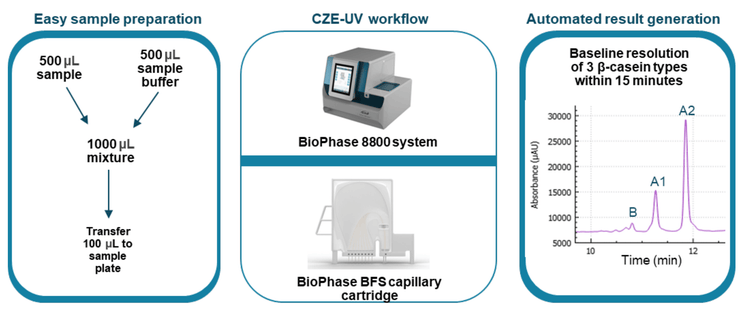
Preparation of samples: 500 µL of milk sample or β-casein standard was mixed with 500 µL of sample buffer by vortexing. After a brief spin, 100 µL of the mixture was removed from the top layer and transferred to a well on the sample plate before analysis on the BioPhase 8800 system.
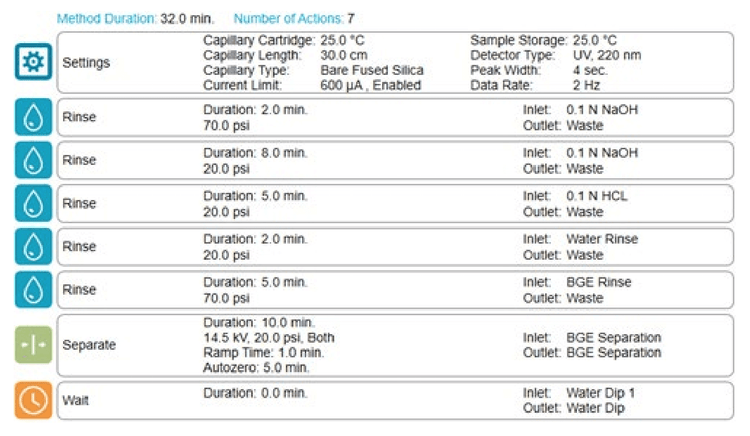
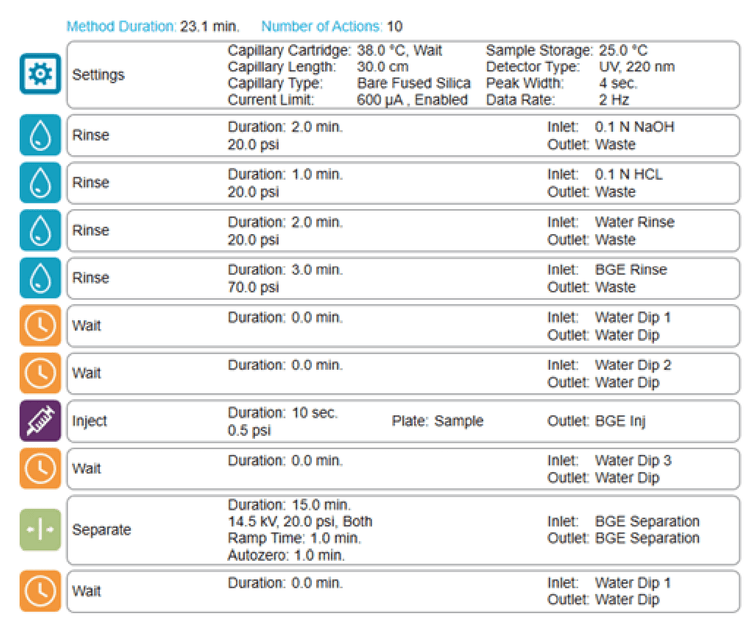
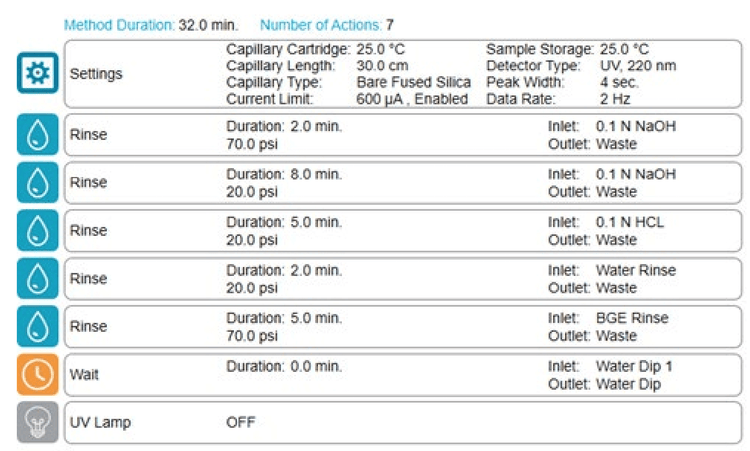
Methods used for CZE analysis of milk A2 β-casein on the BioPhase 8800 system: Detailed settings for parameters for the conditioning, separation, and shutdown methods are shown in Figure 2, Figure 3, and Figure 4.
CZE-UV workflow for milk A2 β-casein analysis on the BioPhase 8800 system
As shown in Figure 5, the CZE-UV workflow for milk A2 β-casein analysis on the BioPhase 8800 system is easy and fast. Briefly, 500 µL of sample is mixed with 500 µL of sample buffer by vortexing. After a quick spin, 100 µL of this mixture is transferred to a well on the sample plate before CZE analysis. Up to 8 samples can be analyzed in a single run using the BioPhase BFS capillary cartridge. Results are automatically collected on the BioPhase 8800 system using pre-defined methods loaded onto the front control panel through the network. After 15 minutes of separation, results are stored in the data server, ready to be retrieved for data analysis.
High-resolution, high-throughput analysis of A2 β-casein on the BioPhase 8800 system
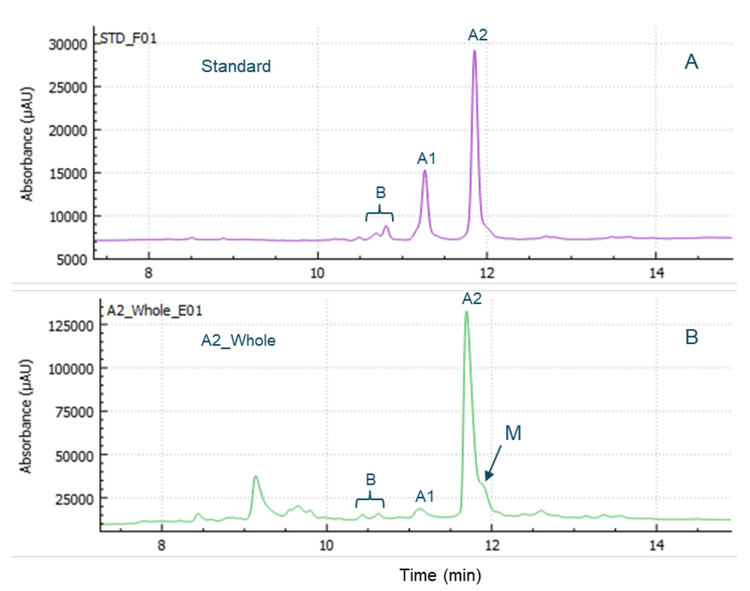
An excellent resolution was obtained when the β-casein standard and an A2 whole milk sample were analyzed by CZE on the BioPhase 8800 system (Figure 6). The three main types of β-casein, B, A1 and A2, were baseline resolved, enabling accurate quantification of the A2 β-casein in the sample. As described previously, during milk sterilization at ultra-high temperature (UHT), the amino groups of some amino acids on milk proteins react with the lactose in a process called the Maillard reaction, leading to the formation of Maillard products.1 Peak M in Figure 6 was the Maillard product of the A2 β-casein. It had longer migration time than the normal A2 β-casein since this Maillard product is like an adduct of the normal A2 β-casein with higher mass and different charge to size ratio. Therefore, the percentage of the A2 β-casein in a sample was calculated by combining the CPA of the normal A2 β-casein peak and its Maillard product shoulder peak, and then dividing it with the sum of the CPA of all 3 types of β-casein: B, A1 and A2. The percentage of the A2 β-casein was 66.69% in the β-casein standard and 93.82% in the A2 whole milk sample, respectively. Peaks with migration time between 8 and 10 minutes in the A2 whole milk sample were not β-casein proteins based on comparison to the electropherogram generated with the β-casein standard. Consequently, these peaks were not integrated during data analysis.
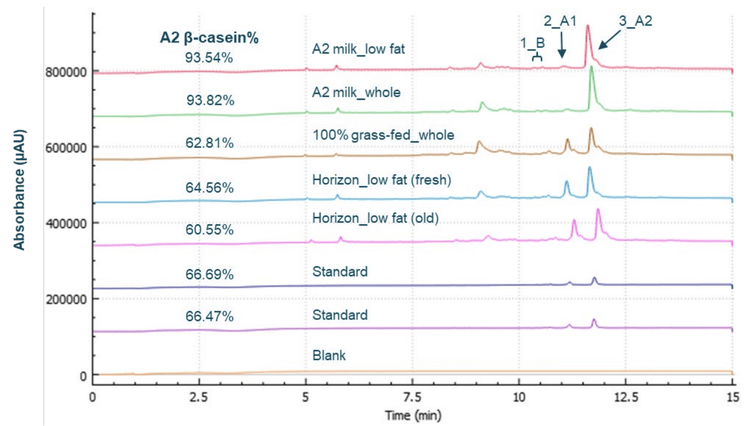
With the multi-capillary capability, up to 8 samples can be analyzed simultaneously on the BioPhase 8800 system. Figure 1 shows 8 electropherograms obtained with the analysis of 8 different samples. The blank control produced a clean and flat baseline as expected. In each trace collected with a milk sample or standard, the three β-casein types: B, A1, and A2, were baseline resolved. The percent of the A2 β-casein in each sample was quantified as described above. The A2 β-casein contents were 93.54% and 93.82% in the A2 low-fat milk and the A2 whole milk samples, respectively. The high A2 β-casein contents in these milk samples were expected since the manufacturer selects cows that produce only the natural A2 protein. In contrast, the A2 β-casein contents were 62.81%, 64.56%, and 60.55% in 100% grass-fed organic whole milk, freshly opened and 3 weeks old Horizon low-fat milk. Manufacturers for these two milk products do not select the A2 herds. Therefore, it is no surprise that these milk samples contain a lower amount of A2 β-casein in comparison to the A2 milk samples. The β-casein standard contained around 66% of A2 β-casein, indicating that this standard might be produced from milk that was generated by regular cows, not the A2 herds.
Robustness of CZE-UV workflow for the A2 β-casein analysis
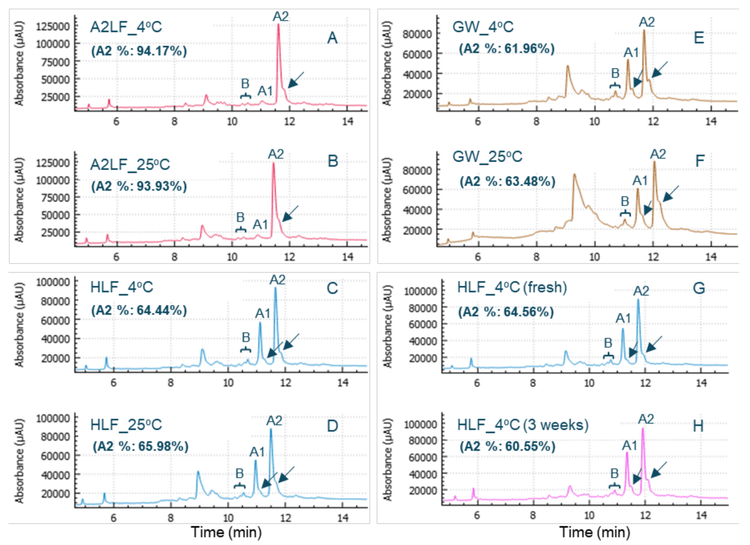
During high-throughput testing of multiple milk samples, it might take an analyst a couple of hours to process a batch of 50 to 96 samples. Therefore, it is important to test the robustness of the CZE-UV workflow for the A2 β-casein analysis. As shown in Figure 7, the A2 low-fat milk (A2LF), Horizon low-fat milk (HLF), and grass-fed whole milk (GW) were either stored at 4°C (panels A, C, and E) or at 25°C (panels B, D and F) for two days before analysis by CZE on the BioPhase 8800 system. The percentage of the A2 β-casein in samples stored at 4°C was very close to that in samples stored at 25°C (room temperature), suggesting good robustness of the workflow. Similar results were also obtained with the A2 whole milk (data not shown). In a separate test, the Horizon low-fat milk was either from a freshly opened carton (panel G, Figure 7) or from a carton that was opened 3 weeks ago but stored at 4°C (panel H). The percentage of the A2 β-casein was 64.56% in the freshly opened Horizon low-fat milk, and 60.55% in the sample from the carton that was opened 3 weeks ago. Although these two cartons were from 2 different lots of milk, their A2 β-casein percentages were comparable to each other, further suggesting good robustness of the CZE-UV workflow for the A2 β-casein analysis.
Assay repeatability and reproducibility
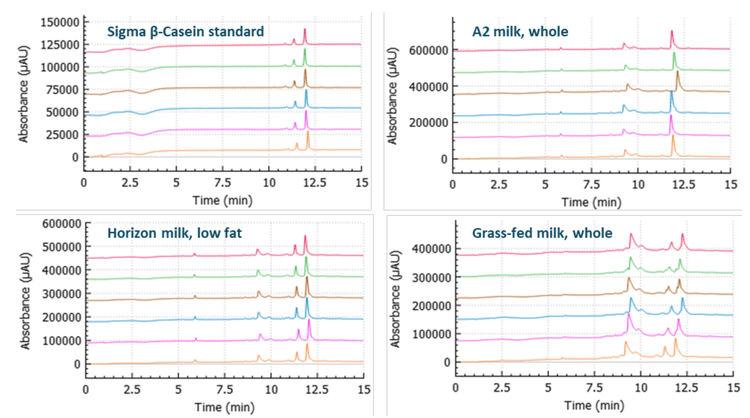
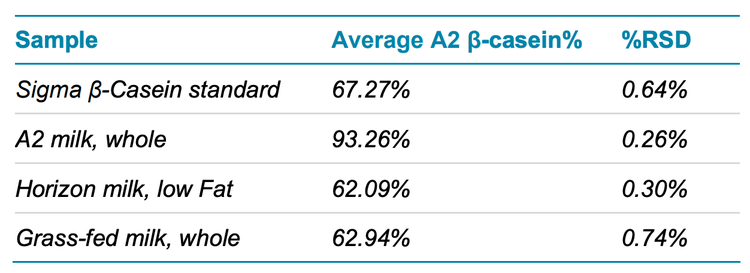
To test assay repeatability, 6 consecutive injections were performed with each of the following samples: the Sigma βcasein standard, Horizon low-fat milk, A2 whole milk, and grassfed whole milk. As demonstrated in Figure 8, the peak profile was consistent among the 6 runs for all 4 samples tested. In addition, the %RSD of the percentage of the A2 β-casein determined for the 6 runs was below 0.80% for all 4 samples (in Table 1), indicating excellent assay repeatability
Conclusion
- An easy, fast, and high-throughput milk A2 β-casein analysis was demonstrated on the BioPhase 8800 system using the CZE-UV workflow
- This workflow was very robust in handling samples stored at different conditions that might be encountered during sample collection and sample testing
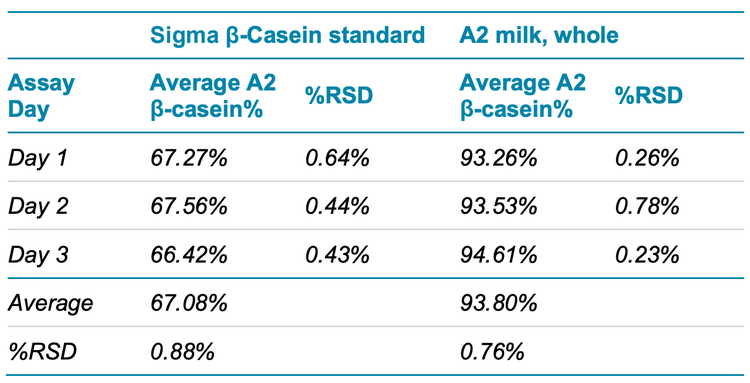
- Excellent assay repeatability and reproducibility were demonstrated with %RSD less than 0.90% for CPA% of A2 βcasein among 6 injections
References
- Determination of A2 β-casein in dairy product by capillary zone electrophoresis. SCIEX technical note, RUO-MKT-02- 10644-ZH-B.
- Determination of A2 β-casein and total β-casein in cow milk and milk powder by capillary zone electrophoresis. (2020) Chinese J. Chromatography. 38(6):722-729.
- Breeding for A2 milk. (2019) University of Minnesota, West central research and outreach center.
- Hydroxypropyl-methyl cellulose product information. (2003) Sigma-Aldrich.