Profiling whey proteins in human milk by capillary electrophoresis sodium dodecyl sulphate
Abstract
CE-SDS is a highly reproducible and high resolution analytical technique where proteins are separated by size after SDS denaturation and uniform negative charging. Smaller proteins migrate faster, larger ones slower, so migration time reflects molecular size and peak area indicates concentration.
The combination of simple sample preparation, validated separation instrument method and ready to use separation gel buffer, enables the analyst to quickly and confidently analyse complex milk samples with ease.
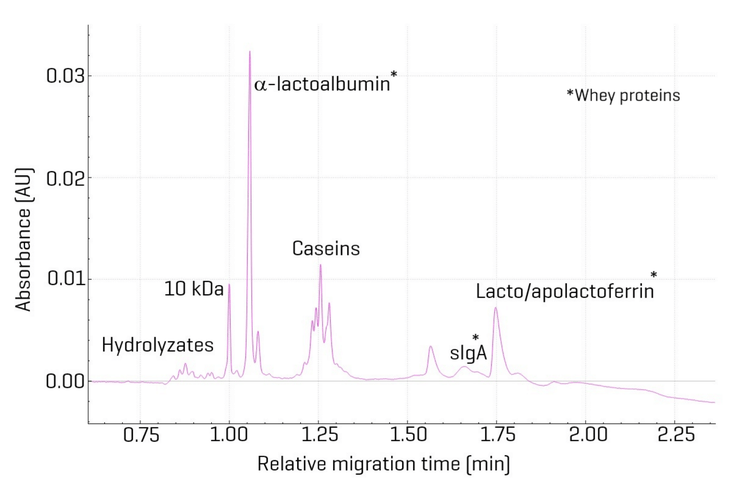
This technical note examines the feasibility of separating human milk proteins and other ingredients in off-the-shelf artificial milk formulations and supplements using capillary electrophoresis with sodium dodecyl sulphate (CE-SDS) (Figure 1). Human milk standards were used as references for peak assignment.
Key features
- Simple sample preparation and streamlined analysis: 2 steps sample preparation. centrifugation and filtration.
- Successful separation of key human milk proteins: a-lactoalbumin, secreted immunoglobulin A and Lacto/apolactoferrin and caseins.
- Protein peak assignment performed based on protein standards
- Casein protein peaks identified by acidic sample treatment.
Introduction
Human breast milk is the optimal source of nutrition for infants, especially those born prematurely or with medical complications. Its unique composition, rich in antibodies, proteins, and bioactive compounds, supports immunity, gut health, and neurological development. Hospitals rely on donor milk to reduce risks such as necrotizing enterocolitis (NEC) in preterm babies.1-5
The human breast milk market, worth hundreds of millions, is projected to grow significantly in the coming years with companies - developing shelf-stable and fortified breast milk products to meet clinical needs.
This trend highlights the need for accurate analytical methods to ensure safety, authenticity, and nutritional integrity. Understanding breast milk protein composition is essential for creating high-quality products that deliver life-saving benefits to vulnerable infants.
Human milk is an extremely complex mixture. Most of it is composed of water (about 87%), followed by carbohydrates, including lactose and the critically essential and unique human milk oligosaccharides (HMO),6 lipids to provide energy and essential nutrients.1-7
The protein fraction in milk is equally vital for growth and development including whey1-4 and casein proteins8, lactoferrin9,10 for its anti-inflammatory activities, and lysozyme an enzyme that helps protect against infection by destroying bacterial cell walls.
Human milk also contains vitamins such as A, C, D, and E, which are essential for various bodily functions, minerals like copper, folate, iron, calcium, phosphorus, magnesium, potassium, and sodium that are important for growth and bone development. Important growth factors that play a role in the development of the neonatal gastrointestinal tract.5
This work demonstrates a simple and efficient CE-SDS workflow to qualitatively profile key proteins (whey and caseins) in human milk and infant formula.
Materials
Materials: The SDS-MW Analysis kit (P/N: 390953), the pre-assembled capillary cartridge (P/N: A55625), and PA 800 plus universal vials (P/N A62251) and caps (P/N A62250) were from SCIEX (Marlborough, MA). The β-mercaptoethanol (β-ME) (P/N: M3148-25ML). Human breast milk samples (P/N HUMANBRMILK-000024) were obtained from BIOIVT (Woodbury, NY). Apolactoferrin, from human breast milk (P/N16-13-A20103) and secretory immunoglobulin A (sIgA), from human colostrum (P/N 16-13-090701), were from Athens Research & Technology, Inc. (Athens, GA). α-Lactalbumin, from human milk (P/N L7269), and lactoferrin, from human milk (P/N L0520), were from Sigma-Millipore (St. Luis, MO). The easy-digestion baby formula (ED-BF), and human milk fortifier composed of protein hydrolyzates (PH) were purchased from a local pharmacy.
Human milk sample preparation: 1 ml of human milk was centrifuged at 15,000 g at 4 o C for 30 minutes. After centrifugation, the sample splits into 3 layers. The top yellowish thin layer corresponds to the lipid content. The large middle layer consists of whey proteins, and the bottom layer is composed of a white solid material as a colloidal form of caseins. The middle layer was carefully extracted and further filtered through a 0.2 µm filter. The protein standards were prepared by weighing and dissolving the standards in water to a suitable concentration.
Capillary electrophoresis instrument: The PA 800 Plus system (P/N A66528) equipped with a photodiode array detector was from SCIEX (Framingham, MA). Data acquisition was performed using 32 Karat software V10, and analysis were performed using the BioPhase 8800 system software V1.5.
Instrument methods: The SDS-MW methods used in this study are as described in the CE-SDS application guide.11
Sample preparation for CE separation: 30 mL of whey protein or the protein standards were mixed with 65 mL of sample buffer, 5 mL of b-mercaptoethanol, and 2 mL of 10 kDa migration time standard. The mixture was thoroughly mixed and incubated for 10 minutes at 100 °C. After incubation, the samples were allowed to cool down to room temperature and transferred to sample vials for CE separation.
Results and discussion
Separation of whey proteins in human milk by CE-SDS
Capillary Electrophoresis–Sodium Dodecyl Sulfate (CE-SDS) is a reliable technique for separating proteins by molecular weight using an electric field. In this method, SDS serves two key roles: it denatures proteins so they can pass through the sieving matrix and uniformly coats them with a negative charge. Under the electric field, these negatively charged proteins migrate according to size-the smaller the protein, the faster its migration time; conversely, larger proteins migrate more slowly. This relationship between migration time and molecular weight enables precise evaluation of protein purity, identity, and structural heterogeneity.12
The separation profile of human milk whey proteins obtained via CE-SDS reveals a highly complex mixture (Figure 1), with analytes spanning a broad molecular weight range-from below 10 kDa to over 225 kDa. This wide separation window enables the resolution of both intact proteins and low-molecular-weight fragments.
Figure 2 illustrates an overlay of the human milk sample with four commercially available protein standards and a pH marker. Based on relative migration time (RTM), the cluster of peaks observed below the 10 kDa marker is likely attributable to hydrolysed protein fragments. Among the intact proteins, α-lactalbumin is the most abundant, dominating the electropherogram. Additional peaks are consistent with lactoferrin and apolactoferrin (iron-depleted lactoferrin), although no significant size difference between these two forms was detectable under the CE-SDS conditions employed (data not shown).
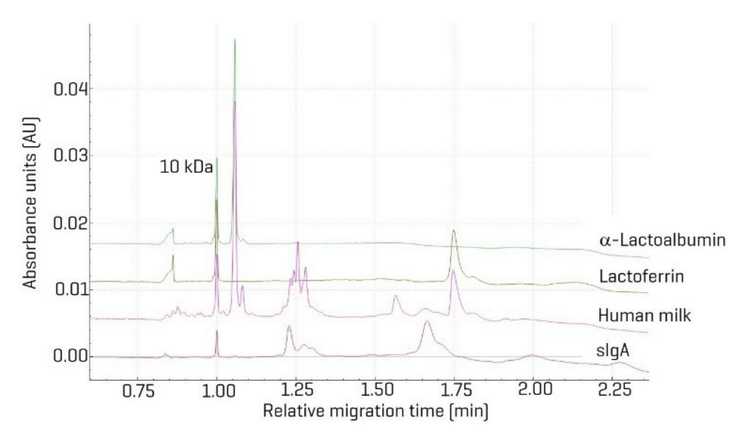
Secretory immunoglobulin A (sIgA), a major immunological component of colostrum, has a native molecular weight of approximately 365 kDa. Structurally, sIgA consists of two IgA monomers linked via a 15 kDa J-chain through disulfide bonds.13
Under reducing conditions, partial dissociation of the sIgA complex was observed. Peaks at approximately 2.00 and 2.25 minutes were assigned to the IgA monomer and the intact sIgA complex, respectively, suggesting incomplete reduction. Additional peaks at 1.25 and 1.65 minutes correspond to the IgA light chains (LC, ~25 kDa) and glycosylated heavy-light chains (HL, ~75 kDa), respectively. The IgA heavy chain (HC, ~50 kDa) migrates at approximately 1.65 minutes. Lactoferrin, a glycosylated protein with an apparent molecular weight of ~80 kDa, migrates at 1.75 minutes, just after the putative IgA HC peak.10
Casein removal and sample preparation for CE-SDS and effect of acid precipitation on human milk protein profile
Human milk contains approximately 13% caseins within its total protein content. These proteins exist in three major forms: α-, β-, and κ-casein. κ-casein plays a stabilizing role by forming colloidal particles with the otherwise insoluble α- and βcaseins, allowing these complexes to remain in solution. However, caseins can be selectively precipitated under acidic conditions.8
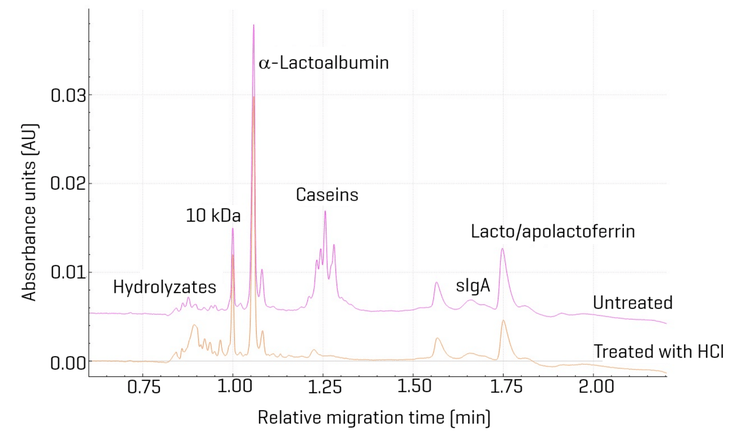
To isolate the whey protein fraction, the human milk sample was treated with 0.1 M hydrochloric acid (HCl). No visible precipitation or turbidity was observed immediately following acidification. The sample was subsequently centrifuged at 15,000 × g for 30 minutes at 4 °C. A minor phase separation was noted, and the upper layer-presumed to contain the soluble whey proteins-was carefully collected. This fraction was then prepared for CE-SDS analysis as described in the Methods section.
Figure 3 shows an overlay of CE-SDS separation profiles of human milk samples before (upper trace) and after (bottom trace) treatment with 0.1 M HCl to precipitate caseins. The acid-treated sample exhibits a marked reduction in peak intensity within the 1.2–1.35 min region, indicating that these peaks are associated with solubilized caseins.
Concurrently, the cluster of peaks below the 10 kDa marker increases in intensity, suggesting that acid treatment may have induced partial hydrolysis of proteins. This shift in the profile highlights the sensitivity of CE-SDS in detecting structural and compositional changes in milk proteins following chemical treatment.
Comparison Between Human Milk and Easy-Digestion Baby Formula
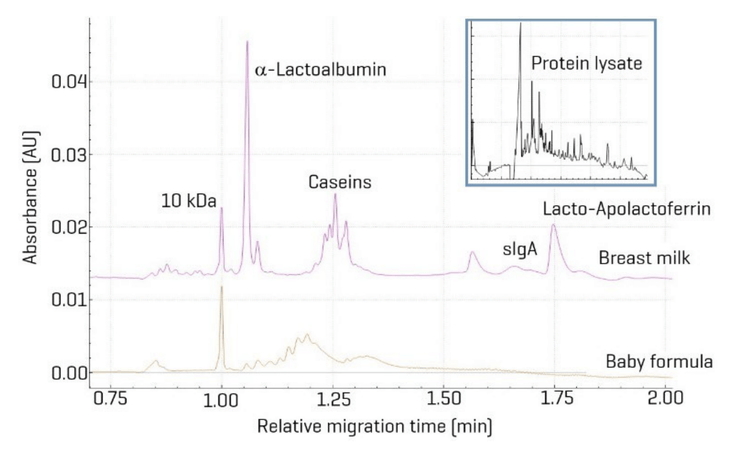
Figure 4 illustrates a comparative CE-SDS analysis of the whey protein fraction from human milk and an easy-digestion baby formula. The electropherograms show distinct differences in protein composition. Key proteins typically found in human milk—α-lactalbumin, lactoferrin, caseins, and immunoglobulin A (IgA)—are notably absent in the easy to digest baby formula sample.
This absence is consistent with the formulation goals of easyto-digest baby formula, which is designed to support gentle digestion in infants. The lack of intact high-molecular-weight proteins suggests extensive hydrolysis, reducing the potential for digestive discomfort or allergenic responses. The observed profile is characteristic of protein hydrolysates (inset figure 4), which are easier for infants to absorb and metabolize.
Importantly, infant formulas like ED-BF are intended as supplements, not replacements for human milk. The data presented here reinforces that distinction, highlighting the unique and complex protein composition of human milk and the tailored simplicity of formula products designed for specific nutritional needs.
Conclusion
- SDS-MW Analysis Kit for the PA 800 Plus Pharmaceutical Analysis System was successfully utilized for the profiling of whey and caseins of human milk
- CE-SDS separation of whey proteins in human milk showed the presence of a-Lactalbumin, caseins, lactoferring and sIgA.
- Simple 2 - step sample preparation: just centrifugation followed by filtration
References
- C.-Y. Boquien; Human Milk: An Ideal Food for Nutrition of Preterm Newborn; Front. Pediatr., Volume 6 – 2018,
- L. F. Stinson, A. D. George; Human Milk Lipids and Small Metabolites: Maternal and Microbial Origins; Metabolites. 2023,13(3):422.
- M. L. Gianni, P. Roggero, C. Baudry, C. F.-Mazda, C. Galli, C. Agostoni, P. le Ruyet, F. Mosca; An infant formula containing dairy lipids increased red blood cell membrane Omega 3 fatty acids in 4 month-old healthy newborns: a randomized controlled trial; BMC Pediatr. 2018,13;18:53.
- O. Ballard, A. L. Morrow; Human Milk Composition: Nutrients and Bioactive Factors; Pediatr Clin North Am. 2013 February ; 60(1): 49–74.
- National Academies of Sciences, Engineering, and Medicine; Health and Medicine Division; Food and Nutrition Board; Harrison M, editor. Nutrition During Pregnancy and Lactation: Exploring New Evidence: Proceedings of a Workshop—in Brief. Washington (DC): National Academies Press (US); 2020 Jun 17.
- M. Szigeti, A. Meszaros-Matwiejuk, D. Molnar-Gabor, A. Guttman; Rapid capillary gel electrophoresis analysis of human milk oligosaccharides for food additive manufacturing in-process control. Anal Bioanal Chem 413, 1595–1603 (2021).
- B.M. Mehta, (2015). Chemical Composition of Milk and Milk Products. In: Cheung, P., Mehta, B. (eds) Handbook of Food Chemistry. Springer, Berlin, Heidelberg.
- C. Broyard, F. Gaucheron, Modifications of structures and functions of caseins: a scientific and technological challenge. Dairy Sci. & Technol. 95, 831–862 (2015).
- P. Lacasse, K. Lauzon, M.S. Diarra, D. Petitclerc; Utilization of lactoferrin to fight antibiotic-resistant mammary gland pathogens. J Anim Sci. 2008 Mar; 86(13 Suppl):66-71.
- B. Lönnerdal, S. Iyer; Lactoferrin: molecular structure and biological function.; Annu Rev Nutr. 1995:15:93-110.
- SDS-MW Analysis Kit for PA 800 plus system application guide.
- J. P. Landers; Handbook of Capillary Electrophoresis, Second Edition, 1996,
- Mantis, N., Rol, N. & Corthésy, B. Secretory IgA's complex roles in immunity and mucosal homeostasis in the gut. Mucosal Immunol 4, 603–611 (2011).