Introduction
The use of liquid chromatography (LC) coupled with tandem mass spectrometry (MS/MS) is currently considered the method of choice for analysis of compounds in biological matrices. This has led to the development of high throughput methods with little or no sample preparation and short chromatographic run times.
Methyldienolone is an anabolic androgenic steroid (AAS) prohibited by the World Anti-Doping Agency (WADA) in all types of sports, and for which the minimum required performance limit (MRPL) is set at 5 ng/mL.1, 2 The detection of methyldienolone in human urine is made challenging because biological matrices often contain various substances similar in structure and mass to the target analyte. This means that an approach with little or no sample preparation and short chromatographic runtimes can cause co-elution of these isobaric compounds that interfere with the analysis of methyldienolone. In order to maintain this type of high throughput approach that is adopted by many labs, a solution was investigated to separate the interfering compounds during the LC-MS/MS run.
In this technical note, an innovative and selective method for the analysis of methyldienolone in urine samples is presented using a SCIEX QTRAP 5500 System equipped with the SelexION+ Differential Mobility Separation Device. The presented method enables accurate quantification of methyldienolone with rugged bioanalytical performance and minimal sample preparation, enabling high-throughput and sensitive detection of this substance without the need for derivatization or additional sample preparation steps.
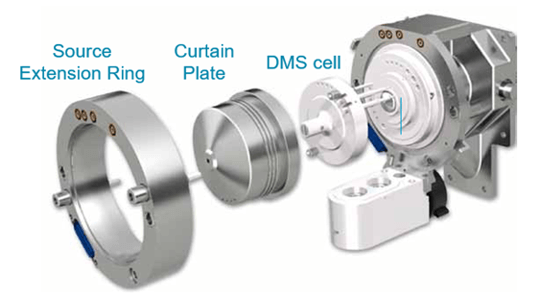
Key advantages of SelexION+ Technology for methyldienolone analysis in urine samples
- The SelexION+ Differential Mobility Separation Device is shown to resolve isobaric interferences that cannot be achieved by tandem mass spectrometry alone
- The combination of SelexION+ Technology with MRM analysis on the SCIEX QTRAP 5500 System enabled sensitive and accurate quantitative analysis of methyldienolone using a dilute and shoot methodology in doping control samples
- The loss in background noise improved the S/N value, resulting in improvement of detection limits
- The use of SelexION+ Technology resulted in LOD of 0.05 ng/mL and LOQ of 0.5 ng/mL for methyldienolone in matrix
Experimental details
Reagents: Methyldienolone was purchased from National Measurement Institute (NMI), Australia. Stock solution was prepared by weighing 10 mg of standard in 100 mL methanol. Mass spectrometric grade acetonitrile and methanol were purchased from J.T. Baker, India and formic acid was obtained from Fluka, India.
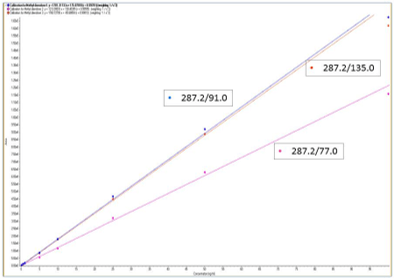
Sample preparation: A dilute and shoot sample preparation procedure was used to analyze the urine samples. In short, 1 mL of blank human urine was centrifuged and spiked with working standard of methyldienolone at desired concentration. The sample was further diluted 5 times with water to perform dilute and shoot analysis. To investigate the linearity of the assay, aqueous spiked dilutions were prepared in the range of 0.05 - 500 ng/mL. A calibration curve was prepared by diluting spiked urine at 0.1-500 ng/mL.
Liquid chromatography: HPLC separation was performed on a Shimadzu Prominence HPLC system equipped with a Waters BEH C18 column (2 mm x 100 mm, 1.7 μm) held at 60°C. Mobile phases consisted of water, acetonitrile and modifiers. The LC flow rate was 0.5 mL/min and the total run time was 8 min. The injection volume was 10 µL.
Mass spectrometry: MS data were collected on the SCIEX QTRAP 5500 System equipped with SelexION+ Technology using Analyst® Software. The Turbo V™ Ion Source was used with an electrospray ionization (ESI) probe operating in positive mode. The SelexION+ Technology was operated at low temperature and low resolution setting without the use of any modifier. Separation voltage and compensation voltage were set at 3000 V and 3.0 V respectively while the offset voltage was kept at -3.0 V. Comparative experiments were performed with the SelexION+ Device “on”, and in “transparent” mode.
Data analysis: Data were processed in MultiQuant™ Software where calibration curves and concentration calculations were automatically generated.
SelexION+ Technology reduces background interferences in urine samples
The SelexION+ Technology coupled with LC-MS/MS has proven to resolve ions that are indistinguishable by mass spectrometry alone.3, 4 Ions are separated on mobility scale due to differences in molecular size and shape, thereby providing highly selective analysis with minimal background interferences.4,5,8 The SelexION+ Technology with the SCIEX QTRAP 5500 System brings the power of differential ion mobility separation to quantitative analysis in complex matrices, enabled by multiple innovations in ion mobility.6 This approach is particularly suited for the analysis of analytes that are challenging to resolve from the matrix background. The use of the SelexION+ Technology coupled with LC-MS/MS was investigated for the analysis of methyldienolone in urine samples.
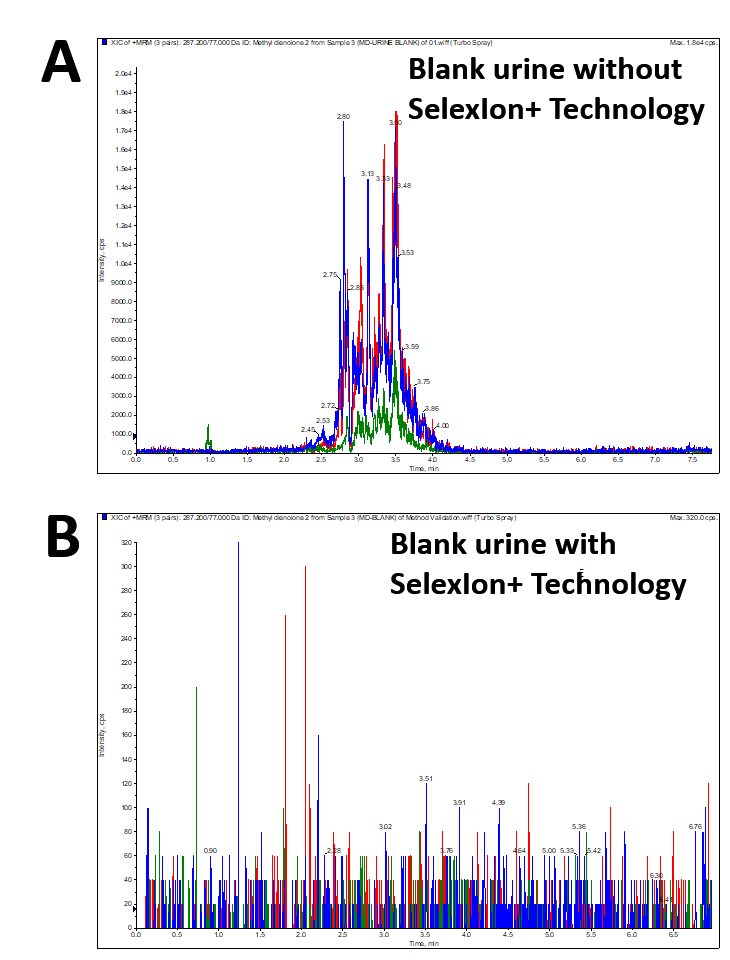
Figure 2A shows the extracted ion chromatogram of a blank urine sample analyzed without SelexION+ Technology. With a dilute and shoot LC-MS/MS method based on MRM (without SelexION+ Technology), isobaric interferences and high baseline were observed at the retention time of methyldienolone in the blank urine sample. Figure 2B shows the resulting extracted ion chromatogram of the same blank urine sample analyzed using the LC-DMS-MS/MS setup with the SelexION+ Technology turned on, and after selecting the appropriate value for compensation voltage. The chromatogram shows that the use of the SelexION+ Technology removed all isobaric interferences and the high baseline from the blank urine sample.
Reduction in background interferences leads to sensitive and accurate quantification of methyldinolone in urine samples
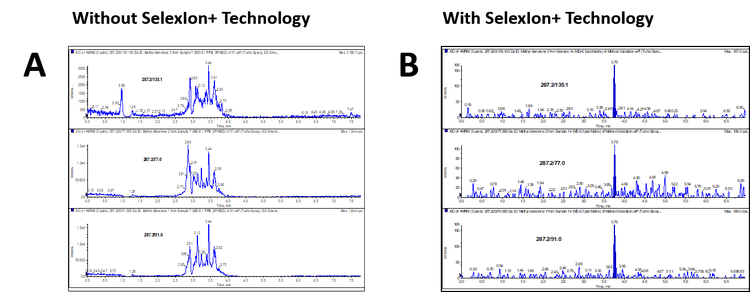
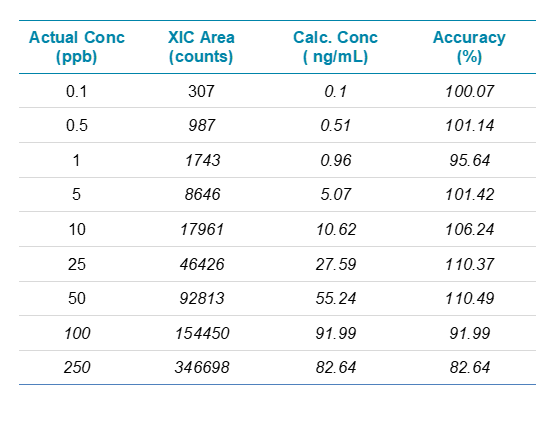
The ability of the SelexION+ Technology to reduce background interferences and improve detection of analytes that would be otherwise indistinguishable by mass spectrometry alone was further investigated. Control urine samples spiked with methyldienolone were prepared at concentration levels ranging from 0.05 to 500 ng/mL and injected in triplicate. Figure 3 shows the extracted ion chromatogram for each of the three MRM transitions monitored for methyldienolone spiked in urine at 0.5 ng/mL (LOQ). Figure 3A shows the chromatograms for the three methyldienolone MRM transitions monitored in this study without using SelexION+ Technology. The chromatograms show isobaric interferences and high baseline at the retention time of methyldienolone. The same sample was re-injected with the SelexION+ Technology on. Figure 3B shows a drastic decrease in background and an increase in signal-to-noise ratio (S/N) for each of the MRM transitions monitored for methyldienolone. The limit of detection (LOD) obtained was 0.05 ng/mL with S/N>30 for all three MRM transitions monitored. Intra-day precision (n=10) obtained as %CV was 2.05% for methyldienolone at the LOD (0.05 ng/mL). The results indicate that the use of the SelexION+ Technology greatly reduces background interference, hence improving detection of methyldienolone in urine samples.

Conclusions
The technique of differential mobility spectrometry (DMS) was investigated to determine its use as an ion-pre-filter for mass spectrometry, to provide reduced chemical noise, and improved quantitative accuracy.6,7,8 The SelexION+ Technology coupled with LC-MS/MS has proven to resolve ions that are indistinguishable by mass spectrometry alone.3, 4 Ions are separated on the mobility scale due to differences in molecular size and shape, thereby providing highly selective analysis with minimal background interferences.4,5,8
From the results presented here, the SelexION+ Technology was demonstrated to be successful in the optimization of a dilute‑and-shoot methodology for the analysis of methyldienelone. This allows the use of a simplified sample preparation approach by eliminating all interfering ions. It reduces the background noise and increases the S/N value, improving detection limits. The LOD of 0.05 ng/mL and LOQ of 0.5 ng/mL were achieved using SelexION+ Technology. They were 2 and 5 ng/mL, respectively, without SelexION+ Technology. The innovative SelexION+ Technology, with the SCIEX QTRAP 5500 System, brings the power of differential ion mobility separation to quantitative analysis in complex matrices.6
References
- WADA Prohibited list.
- WADA Technical Document TD2014MRPL.
- Schneider BB, Covey TR, Coy SL, Krylov EV, Nazarov EG. (2010) Chemical Effects in the Separation Process of a Differential Mobility/Mass Spectrometer System. Anal. Chem., 82 (5), 1867-1880.
- Analysis of prostaglandin isomers using the SelexION device. SCIEX technical note RUO-MKT-02-10666-A.
- Krylov EV, Coy SL, Vandermey J, Schneider BB, Covey TR, Nazarov EG. (2010) Selection and generation of waveforms for differential mobility spectrometry. Rev Sci Instrum. 81, 024101.
- Schneider BB, Covey TR, Coy SL, Krylov EV, Nazarov EG. (2010) Planar differential mobility spectrometer as a pre-filter for atmospheric pressure ionization mass spectrometry. Int J Mass Spectrom. 298 (1-3), 45-54.
- Parson WB, Schneider BB, Kertesz V, Corr JJ, Covey TR, Van Berkel GJ. (2011) Rapid analysis of isomeric exogenous metabolites by differential mobility spectrometry – mass spectrometry. Rapid Commun. Mass Spectrom. 25, 3382-3386.
- SelexION technology: a new solution to selectivity challenges in quantitative analysis. SCIEX technical note RUO-MKT-02-3251-A.