Abstract
This technical note describes a method for the rapid and high-throughput detection and quantitation of glucose in a defined budding yeast fermentation medium using the Echo® MS module with the SCIEX Triple Quad 6500+ system. Glucose is one of the most widely used carbohydrates in the formulation of defined culture media, and itis used commercially to support the growth of yeast and bacteria in industrial biosynthesis.
Optimal growth conditions are crucial for achieving high biosynthetic yields; therefore, glucose levels must be continuously monitored. Current methods for measuring glucose in defined media are enzymatically based or require derivatization and chromatographic separation prior to analysis. The ability to rapidly, accurately, and precisely measure glucose without using time-consuming assays is a significant analytical advance that addresses the high-throughput demands of a commercial biosynthetic enterprise.
The Echo MS system utilizes an acoustic ejection system and an open port interface (OPI) to measure analytes without the need for chromatographic separation. The instrument can measure glucose levels directly from diluted fermentation media with a throughput of 1 sample every 2.5 seconds. The inclusion of 13C-glucose in the diluted sample enables accurate quantitation. Furthermore, the unique design of the ECHO module eliminates carryover, which would otherwise affect the quantitative performance of the assay.
Here, Saccharomyces cerevisiae grown in defined media was used as a model system to test the Echo® MS system’s ability to monitor glucose levels (Figure 1). These data were favorably compared to those obtained by HPLC-FTIR analysis—a common, but more time-consuming, method used for glucose monitoring.
Key features for saccharide analysis using the Echo® MS module with the SCIEX Triple Quad 6500+ system
- Minimal, dilution-based sample preparation in multi-well plates, facilitating high throughput fermentation experiments (‘dilute-and-shoot’)
- Sample analysis speed of 2.5 seconds per sample
- Rapid contactless sampling and no carryover.
- MRM-method for simultaneous quantification of the saccharide and 13C-glucose internal standard, which enables high reproducibility and batch-to-batch comparison
Introduction
Glucose is the simplest and preferred primary energy source that drives the metabolism of budding yeast, such as Saccharomyces cerevisiae. These cells can readily shuttle available glucose into the central carbon metabolism pathway, enabling cell growth, maintenance, proliferation, and survival [1]. Glucose metabolism has been extensively studied, and due to its importance in conserved central metabolism, microbial studies often include glucose as the most abundant carbohydrate in chemically defined media. One of the most frequently used chemically defined media, SC, is featured in this note. The main ingredient of SC medium is yeast nitrogen base (YNB) that contains all necessary vitamins and trace elements in a concentration that promotes growth. Supplementation with all the essential amino acids and a primary carbohydrate, such as glucose, completes the defined medium, making it a suitable growth medium for microbial cells [2,3].
Several analytical solutions are currently available for the analysis of carbohydrates such as glucose, including but not limited to HPLC-RI [4- 6], HPAEC-PAD [7,8], and LC-MS [9,10]. Here, we introduce a novel quantitation method that utilizes the Echo MS module with the SCIEX Triple Quad 6500+ system. This high-throughput mass spectrometry platform employs acoustic droplet ejection to deliver nanoliter-scale samples directly into the mass spectrometer, thereby enabling rapid, label-free analysis with minimal sample preparation and no sample carryover. One advantage of this method is the ability to significantly improve sample throughput by effectively reducing the analysis time from several minutes per sample using traditional chromatography-based systems to just 2.5 seconds per sample.
Materials and methods
Sample preparation: Samples were generated by inducing engineered strains of S. cerevisiae to ferment in chemically defined SC medium. An aliquot of the fermentation medium was diluted 1/10 in water (Biosolve), and the 13C-labelled glucose internal standard was added for a final concentration of 0.1% (w/v). 50 µL of the prepared sample was transferred to an Echo MS® system-qualified 384-well plate (Labcyte, San Jose, USA; part number: C74290), which was then centrifuged for 5 min at 3000 rpm and subsequently shaken for 1 min at 1350 rpm in a plate shaker. The samples were then analyzed using the Echo® MS system, equipped with the SCIEX Triple Quad 6500+ system.
Acoustic ejection: Using the Echo® MS module with the SCIEX Triple Quad 6500+ system, a 2.5 nL-sized droplet was ejected from every well of the plate into the Open Port Interface (OPI), which connects the acoustic ejection system to the mass spectrometer’s ionization source via a capillary. SP mode was used for analysis, and droplet ejections were inter-spaced with a delay of 2.5 seconds. The carrier solvent consisted of 70% (v/v) acetonitrile (VWR) in LC-MS grade water (Biosolve), spiked with 0.1% (v/v) formic acid (VWR), and had a constant flow rate of 400 µL/min.
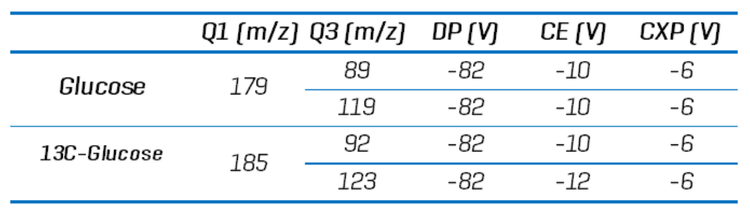
Mass spectrometry: Data were acquired using an Echo® MS module with the SCIEX Triple Quad 6500+ system in MRM scan mode, which simultaneously measured 4 transitions in negative ion mode: 2 for glucose and 2 for 13C-glucose. The deprotonated molecular ion [M-H]- for each compound was selected in Q1 and subsequently fragmented in the collision cell. In Q3, the quantifier ions at m/z 89.0 and 92, and the qualifier ions at m/z 119.0 and 123.0were analyzed for glucose and 13C-glucose, respectively.
The spray voltage was set to -4000V, and the source temperature was 350°C. Ion source gas 1 was 90 psi, gas 2 was 70 psi, and the curtain gas was 30 psi. Table 1 lists MRM transitions and compound-specific parameters used for the glucose method, such as collision energy (CE), declustering potential (DP), and cell exit potential (CXP).
Results
Calibration curve for quantitation of glucose
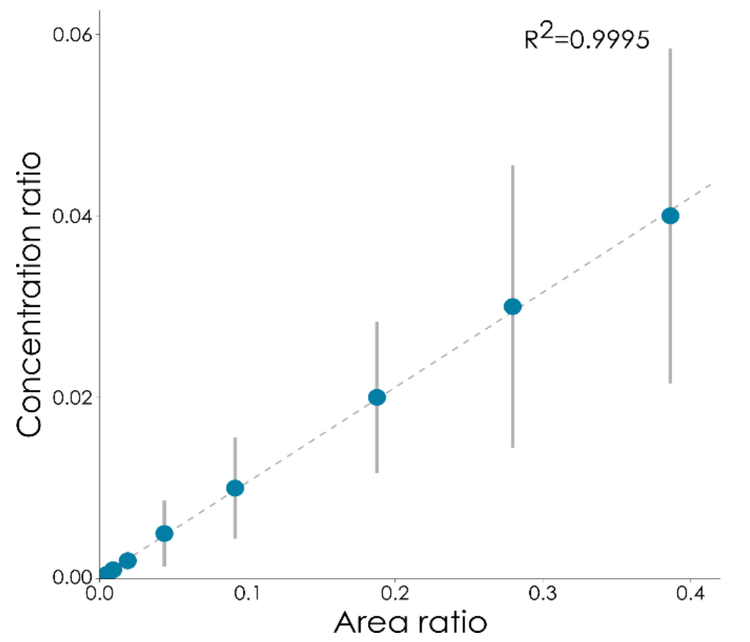
A series of eight different calibration standards was prepared in LC-MS grade water (Biosolve) with a glucose concentration ranging between 0 and 0.4% (w/v) and a 13C-glucose concentration of 0.1% (w/v) per standard (Figure 2). Area ratios were calculated by dividing the area of the glucose quantifier by the area of the 13C glucose quantifier. These ratios were then plotted against the concentration ratios of each sample, calculated as the percentage of glucose (%w/v) divided by the percentage of 13C glucose (% w/v) in the respective standard. The calibration curve, measured over six replicate injections per standard, was linear over the reported concentration range (r² = 0.9995) and was used for interpolating sample data.
High-throughput quantitation of glucose in fermented SC medium
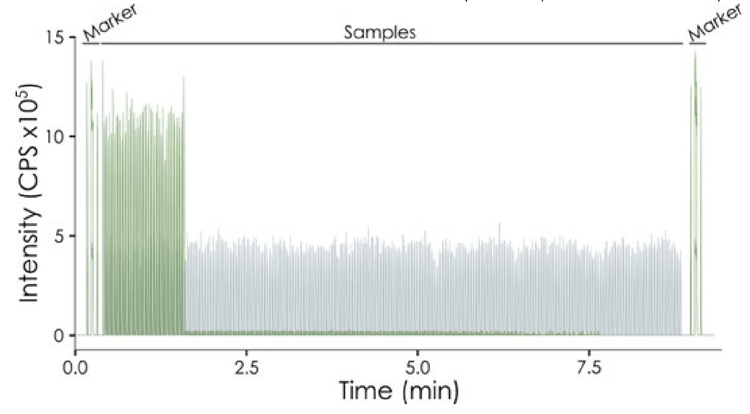
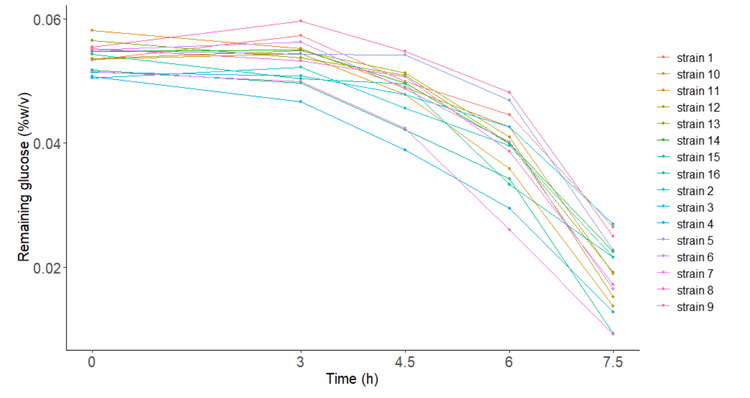
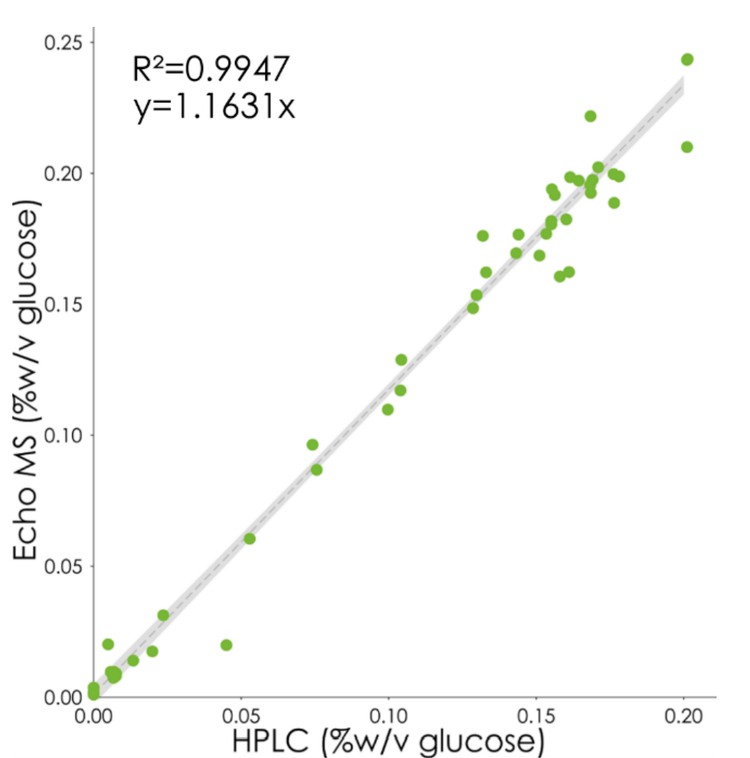
The sample type used to test the method’s performance was fermented SC medium, in which the performance of 16 genetically modified S. cerevisiae strains was assessed by tracking their glucose consumption over time. For each strain, 3 biological replicates were included. 50 µL of a 1:10 diluted sample, with 0.1% (w/v) 13C-glucose internal standard added, was transferred to every well of an Echo® MS-qualified 384-well plate and subsequently analyzed in triplicate. Figure 1 shows two overlaid XICs (glucose- and internal standard quantifier transitions) of a set of 336 samples analyzed on the system. This data shows a relatively stable signal for the quantifier of 13C-glucose across all samples, with the first set of 48 samples (5% (w/v) glucose medium fermented overnight at a low pitching rate) exhibiting a signal in the range of 105. Subsequent samples showed significantly lower signal intensities in the 103 range, following the consumption of glucose by yeast during fermentation, starting at a glucose concentration of 0.05% (w/v). Using the previously constructed calibration curve, area ratios were converted to concentrations. The glucose concentration of the unfermented samples was approximately 0.054% (w/v) on average, which matches the concentration added to the medium before the start of the fermentation experiment (0.05% w/v). The measured concentrations of the samples taken at different time points during the fermentation experiment are visualized in Figure 3.
Performance comparison between Echo® MS and HPLC-IR for glucose quantitation
To assess the analysis quality of the Echo® MS, the same set of samples was subsequently analyzed on an Acquity Arc HPLC (Waters) equipped with a 2414 RI detector (Waters). An Aminex HPX-87H 300 x 7.8 mm column (Biorad) was used, with a 5 mM sulphuric acid mobile phase at a flow rate of 0.6 mL/min and a sample injection volume of 20 µL. The column temperature was 50°C, the RI flow cell temperature was 35°C, and the autosampler temperature was 8°C.
The relation between the results of both analyses is shown in Figure 4. A linear regression fit explained 99% (R² = 0.9947) of the variation in the Echo® MS data compared to the validated HPLC-IR data but exhibited a consistent 16% deviation from a 1:1 relationship. This deviation was the immediate motive for the high number of technical replicates measured for each sample and calibration standard (Figure 2), after which we determined that this deviation was indeed consistent and could be corrected for in sample data processing. This correction factor was not applied to the sample data shown in this technical note, as the Echo® MS was the only measuring platform used routinely for this research, employing the same matrix and calibration method for every batch.
Due to the very high throughput of the Echo® MS module with the SCIEX Triple Quad 6500+ system, the number of technical replicates can be increased from 1 to 6 compared to HPLC, thereby enhancing accuracy and precision per individual sample, which would otherwise be too time-consuming on HPLC.
Conclusions
- The Echo® MS module with the SCIEX Triple Quad 6500+ system can accurately measure glucose in fermentation media at a rate of 1 sample per 2.5 seconds
- A direct comparison of glucose measurements obtained using the Echo® MS system or HPLC-IR showed similar quantitative performance
- The rapid rate of sample measurement using the Echo® MS system enables multiple replicates for each sample that can improve quantitative accuracy and precision
References
- Kayikci Ö, Nielsen J. (2015) Glucose repression in Saccharomyces cerevisiae. FEMS Yeast Research, 15(6). https://doi.org/10.1093/femsyr/fov068
- Hahn-Hägerdal B, Karhumaa K, Larsson CU, Gorwa-Grauslund M, Görgens J, van Zyl WH. (2005) Role of cultivation media in the development of yeast strains for large-scale industrial use. Microb Cell Fact, (4)31. doi: 10.1186/1475-2859-4-31
- Bergman LW. (2001) Growth and maintenance of yeast. Methods Mol Biol, (177)9-14. doi: 10.1385/1-59259-210- 4:009
- Kaeslin J, Zenobi R. (2022) Resolving isobaric interferences in direct infusion tandem mass spectrometry. Rapid Commun Mass Spectrom, 36(9):e9266. doi: 10.1002/rcm.9266
- Jurková, M. et al. (2014) ‘Determination of Total Carbohydrate Content in Beer Using Its Pre-column Enzymatic Cleavage and HPLC-RI’, Food Analytical Methods, 7(8), pp. 1677–1686. Available at: https://doi.org/10.1007/s12161-014-9805-y.
- Filip, M. et al. (2016) ‘Simultaneous determination of glucose, fructose, sucrose and sorbitol in the leaf and fruit peel of different apple cultivars by the HPLC–RI optimized method’, Food Chemistry, 199, pp. 653–659. Available at: https://doi.org/10.1016/j.foodchem.2015.12.060.
- Correia, D.M. et al. (2014) ‘Dietary Sugars Analysis: Quantification of Fructooligossacharides during Fermentation by HPLC-RI Method’, Frontiers in Nutrition, 1. Available at: https://doi.org/10.3389/fnut.2014.00011.
- Hu, Y. et al. (2024) ‘A high-performance anion-exchange chromatographic method for the fast analysis and precise determination of varied glucose-derived acids during biomass biorefinery’, Food Chemistry, 460, p. 140626. Available at: https://doi.org/10.1016/j.foodchem.2024.140626.
- Rogatsky, E., Tomuta, V. and Stein, D.T. (2007) ‘LC/MS quantitative study of glucose by iodine attachment’, Analytica Chimica Acta, 591(2), pp. 155–160. Available at: https://doi.org/10.1016/j.aca.2007.04.001.
- Chiles, E. et al. (2019) ‘Fast LC-MS quantitation of glucose and glycerol via enzymatic derivatization’, Analytical Biochemistry, 575, pp. 40–43. Available at: https://doi.org/10.1016/j.ab.2019.03.020.