Top-down proteomics driven by high-sensitivity CID and EAD LCMS/MS fragmentation
Abstract
This technical note describes a top - down proteomics workflow for the analysis of intact protein mixtures using multiple MS/MS fragmentation strategies on the ZenoTOF 8600 system. The superior sensitivity of the ZenoTOF 8600 system enables increases in prot ein sequence coverage by as much as 24% over previous- generation ZenoTOF systems. The ability to generate protein MS/MS data using either collision-induced dissociation (CID) or electron activated dissociation (EAD) pathways provides maximum versatility an d complementarity for deep protein characterization.
Key features of top- down proteomics using CID and EAD MS/MS fragmentation on the ZenoTOF 8600 system
- Streamlined protein characterization workflow: Top- down proteomics eliminates the need for enzymatic digestion, thereby enabling direct characterization of post-translational modifications and enhanced sequence information in certain regions of proteins.
- Superior sensitivity: Protein sequence coverage is improved by as much as 24% relative with top- down proteomics workflows on the ZenoTOF 8600 system compared to the previous-generation ZenoTOF 7600+ system.
- Powerful, versatile MS/MS strategies: Fast, tunable EAD-based MS/MS offers complementary protein fragment information relative to CID- based MS/MS. Protein sequence coverage improves as much as 36% using EAD -MS/MS versus CID-MS/MS with the top- down proteomics workflow.
Introduction
Top-down proteomics is an advanced mass spectrometry-based approach that analyzes intact proteins rather than peptide fragments generated from enzymatic digestion. By preserving the full protein structure, this method enables comprehensive characterization of proteoforms, including post-translational modifications (PTMs), sequence variants, and truncations, which are often lost in bottom- up workflows. Top-down MS strategies provide deep insights into protein heterogeneity and functional regulation, making them essential for studying complex biological systems and advancing precision proteomics (1). Alternative MS/MS fragmentation techniques, namely electron activated dissociation (EAD), have shown to be highly effective for MS-based top-down proteomics by providing fragment ion information complementary to that obtained using traditional collision-induced dissociation [CID] fragmentation, thereby maximizing protein sequence coverage (2). The results here demonstrate that the increased sensitivity of the ZenoTOF 8600 system significantly improves protein sequence coverage relative to the ZenoTOF 7600+ system, and that higher sequence coverage was obtained using EAD-based MS/MS than with CID-based MS/MS. The sensitivity and versatility of the ZenoTOF 8600 system make it the ideal platform for top- down proteomics research.
Methods
Sample preparation: Pierce intact protein standard mix, comprising 6 intact protein standards ranging from 9.1 kDa to 68 kDa, was purchased from ThermoFisher. The mixture was diluted to final concentrations of 2 ng/µL, 10 ng/µL, 50 ng/µL, and 200 ng/ µL in buffer containing water with 0.1% formic acid. Final mixture dilutions contained intact bovine serum albumin protein (Sigma) spiked to a final concentration of 20 fmol/ µL to minimize non-specific protein binding.
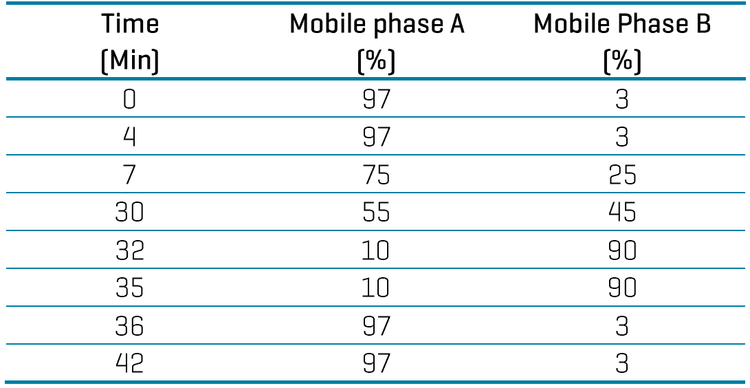
Chromatography: Chromatographic separations were performed with a Waters M-Class UPLC system using a Waters nanoEase M/Z Protein BEH C4 column (50 mm x 0.3 mm, 300 Å, 1.7 µm particle size). The LC method used a 26 -minute active separation gradient and 42-minute total run time at a flow rate of 10 µL/min (gradient profile shown in Table 1). The column was heated to 50°C for the analysis.
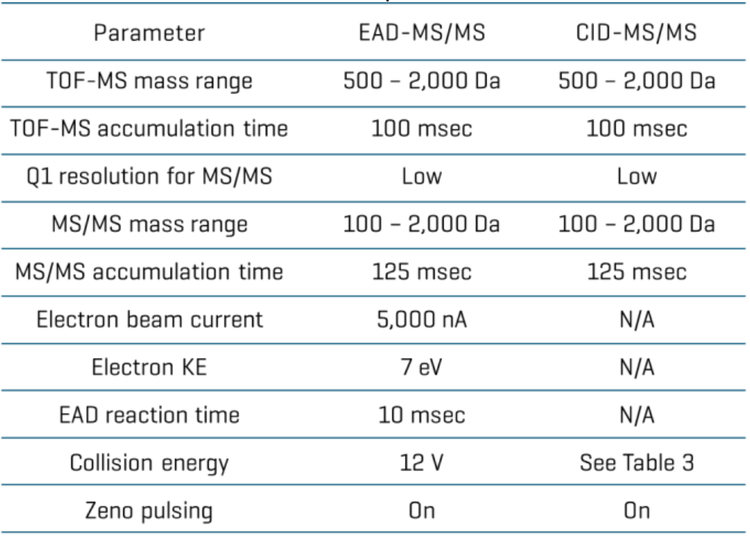
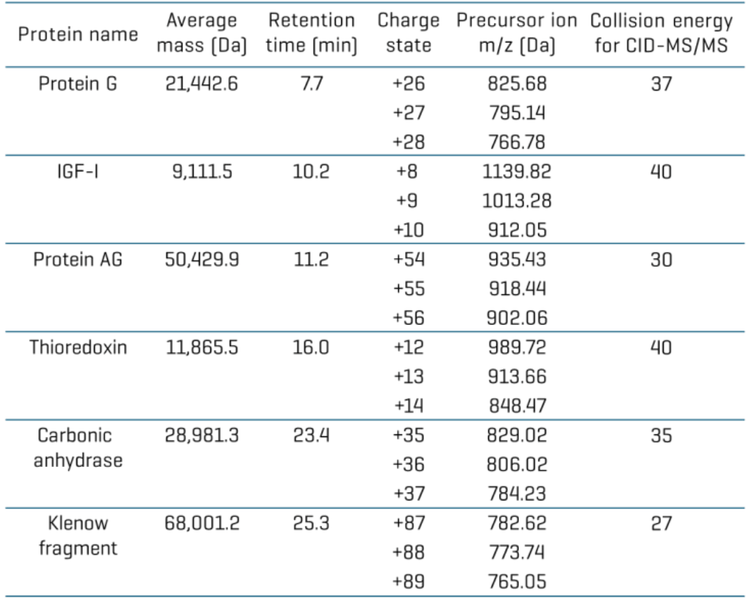
Data processing: WIFF data files were converted to indexed centroided mzML format using the SCIEX MS Data Converter software. The resulting files were deconvoluted using FLASHDeconv software, and the deconvoluted files were subsequently processed using ProSight Lite v1.4 software to determine protein sequence coverage, as previously described (2). To determine the sequence coverage for each protein, the lists of deconvoluted MS/MS fragment ion masses for each of the 3 charge states (limited to those near the exp erimentally observed retention times, summarized in Table 3) were combined and imported into ProSight Lite software. The fragment matching threshold was set to 10 ppm.
The top-down proteomics workflow using MRMHR
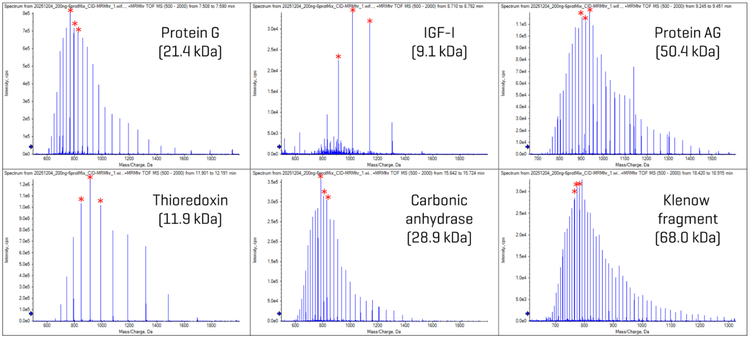
The top-down proteomics workflow performed here utilized targeted MS/MS fragmentation of selected charge states from each protein in the analyzed mixture. Analysis of deconvoluted fragment ion masses generated from targeted MS/MS using available software tools (FLASHDeconv software and ProSight Lite software) (3,4) enabled the determination of protein sequence coverage. Different intact protein precursor charge states may yield different fragment ion profiles upon MS/MS fragmentation. By combining fragment ion lists from multiple charge states, the analysis efficiency is improved. In this case, the 3 most intense precursor charge states per protein were chosen for MS/MS (determined empirically, highlighted in Figure 2), thereby maximizing the sensitivity of the analysis. As the ZenoTOF systems enable different MS/MS fragmentation modes, protein sequence coverage using either CID -MS/MS or EAD-MS/MS was directly compared. The sensitivities of both the ZenoTOF 8600 and ZenoTOF 7600+ systems were compared by analyzing a commer cial protein mixture at on- column loadings ranging from 2 ng to 200 ng. The EAD -MS/MS parameters used were as previously described (2). For CID-MS/MS, the optimal collision energies were determined empirically for each protein (data not shown).
Superior protein sequence coverage using EAD-MS/MS with the ZenoTOF 8600 system
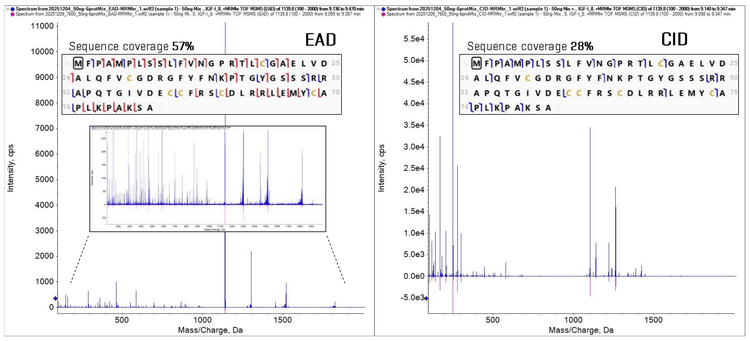
CID-MS/MS and EAD-MS/MS of peptides and proteins are known to yield distinct predominant fragment‑ion series. CID-MS/MS primarily produces b‑ and y‑ions, whereas EAD-MS/MS generates c‑ and z‑ions (5). Consistent with these established dissociation characteristics, the data obtained in this study reflect clear differences between the two fragmentation modes. Figure 1 presents MS/MS spectra acquired for the +8 charge‑state precursor of the IGF‑I protein (50 ng on‑column) using either EAD or CID. As is typical for intact‑protein fragmentation, both methods predominantly produced ions mapping to the N‑ and C‑terminal regions of the protein. However, the comparison underscores a substantial difference in sequence coverage: EAD‑MS/MS achieved 57% coverage for this protein, whereas CID‑MS/MS yielded 28%. In addition, the enhanced sensitivity of the ZenoTOF 8600 platform—relative to the ZenoTOF7600+—is evident from the inverted spectral overlays shown in Figure 1, further highlighting the performance advantages obse rved in this work.
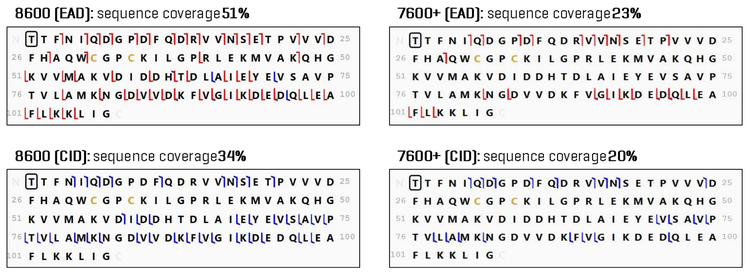
Figure 3 shows another example of the differences in fragmentation performance between EAD and CID MS/MS, as well as the comparative sensitivities of the ZenoTOF 8600 and ZenoTOF7600+ platforms. In this figure, sequence coverage is shown for Thioredoxin protein at an on- column loading of 2 ng. Consistent with the distinct fragmentation chemistries of the two activation methods—EAD generating predominantly c- and z-type ions and CID yielding primarily b- and y-type ions—the EAD MS/MS workflow again produced superior sequence coverage relative to CID MS/MS. Moreover, the ZenoTOF8600 system outperformed the ZenoTOF 7600+ system, emphasizing the advantage of enhanced sensitivity when analyzing low sample amounts.
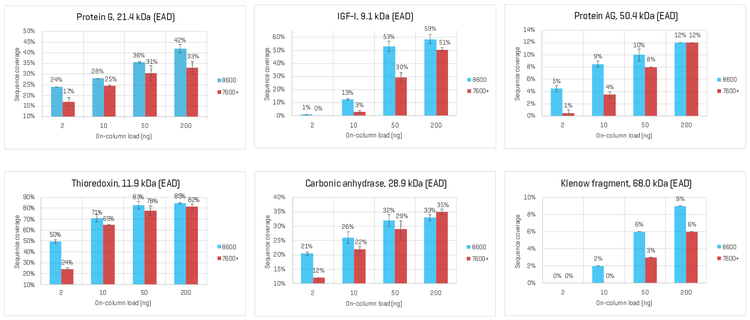
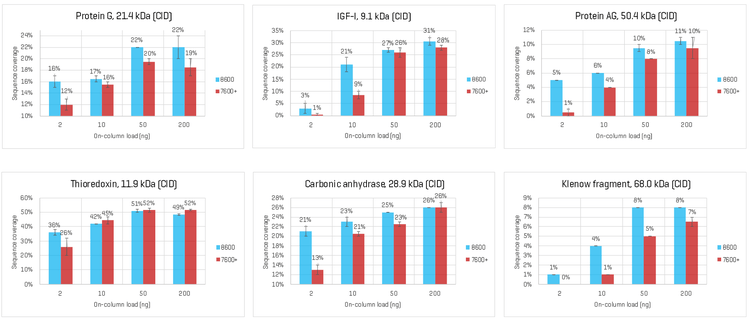
Figures 4 and 5 summarize the protein sequence coverage for all proteins in the commercial mixture, across different on - column loadings, using EAD -MS/MS and CID-MS/MS, respectively. Consistently, across all proteins in the mixture, the performance difference between the two systems was most drastic at the lower on- column loadings, owing to the superior sensitivity of the ZenoTOF 8600 system. EAD -MS/MS also consistently provided higher sequence coverage than CID - MS/MS.
These results demonstrate the powerful capabilities of the ZenoTOF 8600 system for top - down proteomics, particularly when using EAD-MS/MS fragmentation. The fast MS/MS acquisition speed of the ZenoTOF 8600 system enables this workflow to be potentially applicable to the analysis of protein samples of varying complexity. Although EAD-MS/MS generally exhibited superior protein sequence coverage than CID-MS/MS, top- down MS/MS can be highly variable and dependent on the unique sequence and charac teristics of ea ch protein. CIDMS/MS may also yield important information about the protein, and a holistic approach to top- down protein characterization (combining the complementary information generated from multiple fragmentation and analysis strategies) is ideal.
Future points to consider
Although this study employed conventional LC separation methods, proteome-scale LC –MS analysis of intact proteins remains inherently challenging and demands extensive optimization of front- end separation, instrument settings, and data analysis workflows. Future improvements to top‑down proteomics using the ZenoTOF 8600 system could explore alternative front- end approaches such as direct infusion or capillary electrophoresis (CESI), along with advanced software tailored for EAD data interpretation.
Conclusion
- A comprehensive workflow for top- down proteomics on the ZenoTOF 8600 system is presented, leveraging superior instrument sensitivity, EAD-MS/MS fragmentation, and freely available data processing tools.
- The sensitivity of the ZenoTOF 8600 system allowed for protein sequence coverage gains of up to 24% compared to the previous- generation ZenoTOF 7600+ system.
- For the top- down proteomics analysis of a commercial protein mixture, EAD-MS/MS fragmentation resulted in protein sequence coverage gains as much as 36% compared to traditional CID-MS/MS.
- The fast acquisition of EAD- and CID- based MS/MS on the ZenoTOF platforms enables top- down proteomics analysis of complex mixtures at LC timescales.
References
- Roberts, D.S., Loo, J.A., Tsybin, Y.O., Liu, X., Wu, S., Chamot-Rooke, J., Agar, J., Pasa-Tolic, L., Smith, L.M., and Ge, Y. (2024). Top- down proteomics. Nat. Rev. Methods Primers, 4:38.
- Searfoss, R.M., Zahn, E., Lin, Z., and Garcia, B.A. (2025). Establishing a top - down proteomics platform on a time- of-flight instrument with electron- activated dissociation. J. Proteome Res., 24:1230 -1240.
- Jeong, K., Kim., Gaikwad, M., Hidayah, S.N., Heikaus, L., Schluter, H., and Kohlbacher, O.(2020). FLASHDeconv: Ultrafast, high- quality feature deconvolution for top- down proteomics. Cell Systems, 10:213-218.
- Fellers, R.T., Greer, J.B., Early, B.P., Yu, X., LeDuc, R.D., Kelleher, N.L., and Thomas, P.M. (2014). ProSight Lite: Graphical software to analyze top- down mass spectrometry data. Proteomics, 15:1235-1238.
- Baba, T., Ryumin, P., Duchoslav, E., Chen, K., Chelur, A., Loyd, B., and Chernushevich, I. (2021). Dissociation of biomolecules by an intense low- energy electron beam in a high sensitivity time- of-flight mass spectrometer. J. Am. Soc. Mass Spec., 32:1964-1975.