Abstract
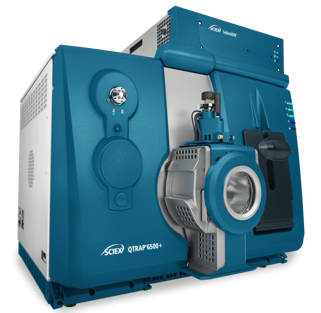
A highly selective, sensitive and high-throughput bioanalytical method was developed and partially verified for the detection of low levels of tandospirone in human plasma using the SCIEX QTRAP® 6500+ LC-MS/MS System. An LLOQ of 1.0 pg/mL in plasma was achieved using a simple extraction method from 250 uL of plasma.
Introduction
Tandospirone is a drug product used to treat various anxiety disorders, depression and post-traumatic stress disorder (PTSD). It belongs to the azapirone class of compounds and is effective due to its activation of postsynaptic 5-HTIA receptors.1
The usual dose of tandospirone is 10–20 mg/day meaning that the concentration in plasma is particularly low and, in addition to this, the period between stopping the medication and it being eliminated from the body being relatively long.
Therefore, a rapid, robust, selective and sensitive method is necessary for the quantification of tandospirone in a human plasma matrix. To ensure accurate quantification, tandospirone-d8 has been used as an internal standard. The main objective of this work was to develop a wide calibration range of 1.000 – 5000 pg/mL in plasma and an LOD of 0.250 pg/mL.
Key features of the SCIEX QTRAP 6500+ System for tandospirone analysis
- The QTRAP 6500+ System provides the sensitivity necessary to achieve low and even sub pg/mL (PPT) levels of sensitivity, which is necessary due to low absorption levels of tandospirone in plasma
- Provides a wide linear range to ensure all samples are within a quantifiable range - this is important because of the low metabolism and low clearance of tandospirone mean that variability in results is to be expected
- Low amounts of carryover were observed, important because when results are variable it is important that the subsequent injection is clear of interferences from the previous sample
- A low plasma volume was used, so that less is needed to perform a typical study or trial
Methods
Sample preparation:Tandospirone citrate standards were prepared in Human K2EDTA plasma between 1.0-5000 pg/mL. QC samples were prepared at 1.0, 2.1, 1008.2, 2016.4 and 4019.9 pg/mL. Samples (250 µL) were spiked with 50 µL of a 1000 pg/mL tandospirone-D8 solution before liquid-liquid extraction was performed using 2.5mL of n-hexane/DCM/IPA (20:10:1 v/v). The samples were vortexed for 10 minutes at 2500 rpm before being centrifuged at 4000 rpm for 10 minutes. The supernatant was removed and evaporated to dryness at 40°C using a nitrogen evaporator. The dried samples are reconstituted with methanol and 5 mM ammonium acetate in water (80:20, v/v) for analysis.
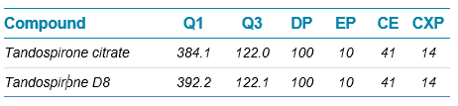
Mass spectrometric conditions:The SCIEX QTRAP6500+ System was operated in positive electrospray ionization mode. The MS conditions were as follows: scan type: positive MRM, Q1 and Q3 resolution at unit; curtain gas set at 50; ion source temperature 600°C, ion source gas (GS1) at 70 and heated gas (GS2) at 60; ionization voltage at 5500 V; and dwell time 200 ms for all transitions. The compound dependent parameters for analyte and internal standard are shown in Table.2.
Data processing:Analyst® Software 1.7.0 was used for data acquisition. Quantification was performed using SCIEX OS Software. A 1/x2 weighted linear regression was used.
Results
When performing initial optimization of tandospirone, it was clear that the most intense MRM transition was 384>122 m/z and therefore this was chosen for quantification. The mass spectrometric parameters for both analyte and internal standard are provided in Table 2.
To separate and obtain maximum recovery of tandospirone in matrix, different extraction techniques such as liquid-liquid extraction (LLE), protein precipitation and SPE were evaluated. The above mentioned LLE provided acceptable recovery, with minimal matrix effects observed and so was subsequently chosen as the method of sample preparation.
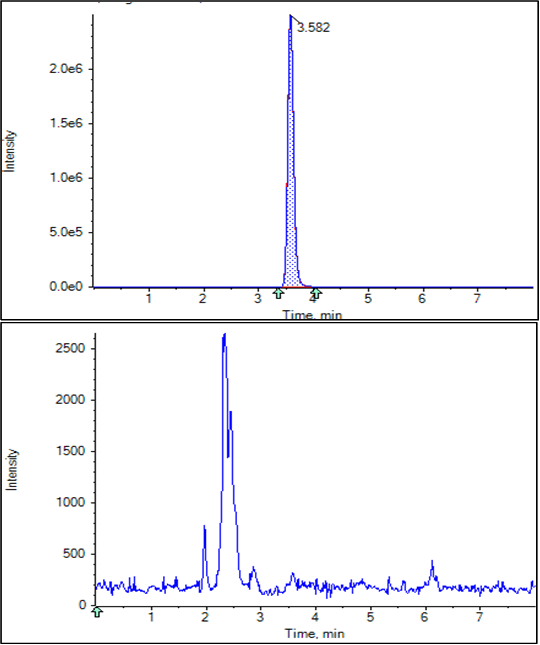
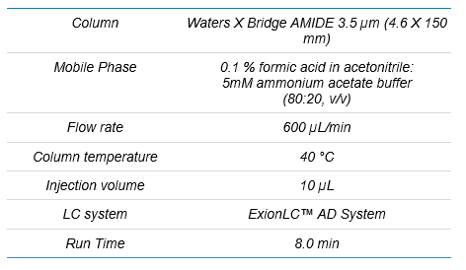
The LC conditions were investigated to obtain optimum sensitivity and peak shape with minimal carry over. This was achieved by using a relatively high concentration of acetonitrile in the mobile phase to ensure that the system was being sufficiently cleared of analyte during each injection, see Figure 1 for an example of the low carryover observed. Acetonitrile was chosen as the solvent due to providing better sensitivity, peak shape and less background noise. The addition of 0.1% formic acid in the organic phase increased the ionization, thus increasing sensitivity.
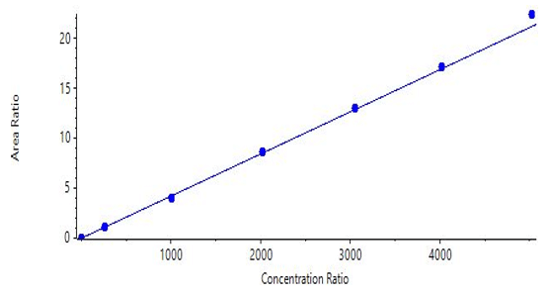
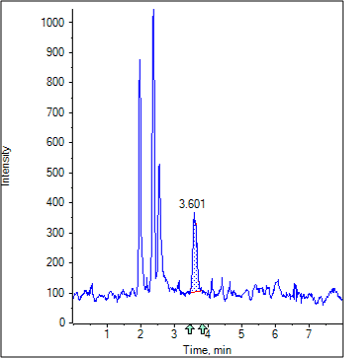
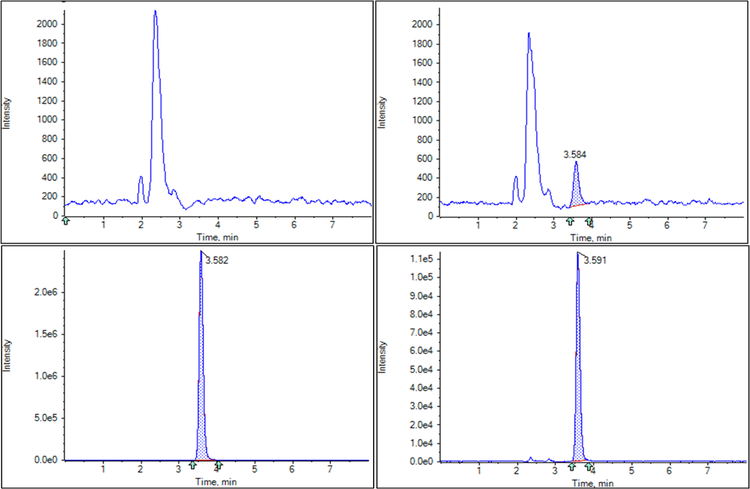
A linearity range of 1.0 to 5000 pg/mL was established using the present method in human plasma as well as an LOD concentration of 0.25 pg/mL (see Figures 3 and 4 for representative chromatograms from the method). The calibration curve is shown in Figure 2 and achieved an r value ≥ 0.99.
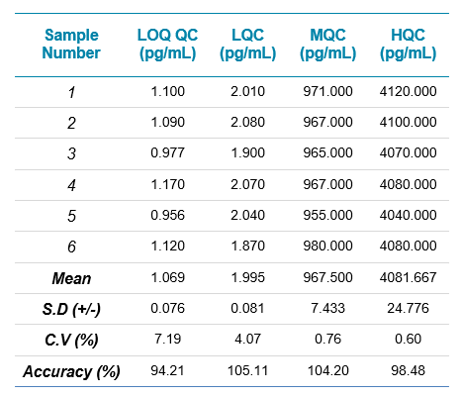
The accuracy and precision data at different QC levels is shown in Table 3, where all QC samples met the acceptance criteria, with %CV values < 20% at LOQ and < 15% at all other levels. Accuracy values were also well within ± 30% at the levels assessed and so all relevant precision and accuracy criteria has been met.
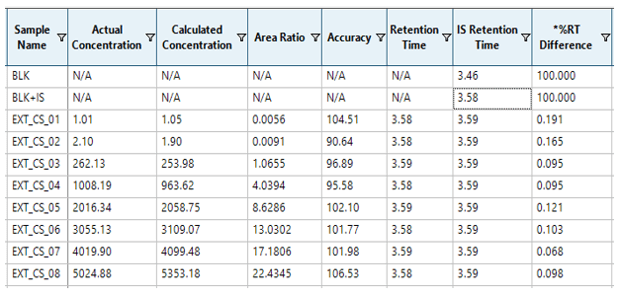
A deuterated form of tandospirone (tandospirone-d8) was used as the internal standard. Both the analyte and IS eluted at the same retention time (RT) confirming the selectivity of the analyte from the matrix interferences (Table 4), where the % difference between the analyte and IS RT was found to be less than 1%. The area of the IS was also consistent throughout the analysis, highlighting the reproducibility of the method.
Conclusions
- A highly selective, sensitive and high-throughput bioanalytical method was developed and partially verified for the detection of low levels of tandospirone, in human plasma using the SCIEX QTRAP® 6500+ LC-MS/MS System
- Tandospirone sensitivity was exceptional in the method, achieving an LLOQ of 1.000 pg/mL in plasma with a high level of reproducibility, precision and accuracy
- A simple extraction technique using a low matrix volume (250 µL) was utilized, which provided good levels of recovery and low matrix effects
- The method is effective over a wide linear range (1.0 – 5000 pg/mL), without minimal carryover after the injection of high concentrations, ensuring that accurate quantification can be achieved across this range.
References
- Huang, et al. (2017) Role of tandospirone, a 5-HT1A receptor partial agonist, in the treatment of central nervous system disorders and the underlying mechanisms. Oncotarget. 8(60): 102705–102720.
- Wenya Hu., Mi Jia., Siyan He., Huiru Xie., Xuehua Jiang., Ling Wang. (2019) Simultaneous determination of tandospirone and its active metabolite, 1‐[2‐pyrimidyl] ‐piperazine in rat plasma by LC–MS/MS and its application to a pharmacokinetic study. Biomed Chromatogr. 33(7): e4525.