Abstract
Selective, sensitive and reproducible bioanalytical method was developed for quantitation of fluticasone propionate (LLOQ of 200 fg/mL) in human plasma with the QTRAP 6500 System. SelexION Technology improves of selectivity for quantitation of Mesalamine in plasma, by reducing background and interfering ions, improving signal to noise by 2x. An LLOQ of 10 ng/mL was achieved for mesalamine quantitation using protein precipitated extraction method in human plasma, with assay quality meeting the typical bioanalytical requirements. Reduced sample volume (500 µL plasma) and a final reconstitution volume of 200 µL for reinjection of samples or repeat analysis chromatography if required in a GLP laboratory.
Introduction
Selectivity and sensitivity are major considerations during the development of bioanalytical methods. In complex matrices, such as crashed human plasma, sometimes assays are affected by different challenges like isobaric matrix interference or high background noise. These would have an impact on both the sensitivity and reproducibility of the analyte at lower concentration in the calibration curve, due to poor signal to noise.
Resolving the matrix interference and lowering the background noise in plasma can often require extensive sample preparation, causing increased time and cost of method development and use. SelexION Technology adds an orthogonal level of separation and selectivity prior to the instrument orifice and can often be used reduce these interfering issues.
In the present study, the capability of SelexION technology coupled with MRM analysis was evaluated for use in the bioanalysis of Mesalamine in human plasma sample.
Key features of DMS for mesalamine quantitation
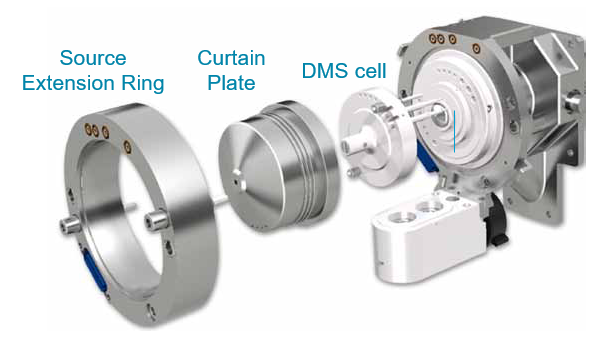
- SelexION Technology is a planar differential mobility separation device (DMS) that separates compounds based on differences in chemical and structural properties (Figure 1).
- SelexION Technology is compatible with the fast cycle times required for monitoring multiple MRM transitions or when using fast HPLC gradients.
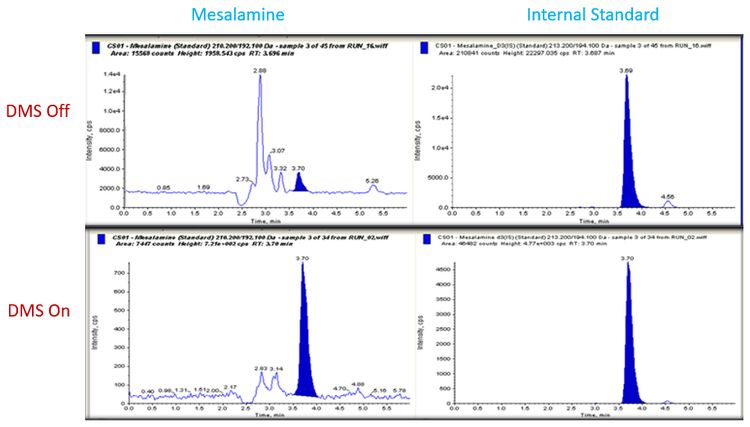
- Use of DMS improved selectivity of the mesalamine assay by reducing the background interferences and improving the signal to noise ration
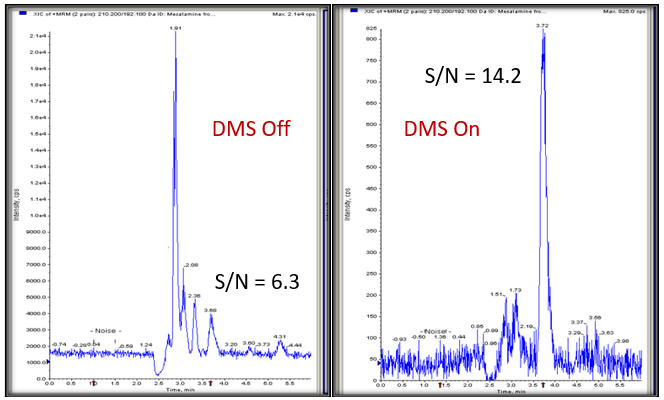
- Signal to noise ratio was improved ~2X using DMS in human plasma.
- An LLOQ of 10 ng/mL for mesalamine was achieved using protein precipitated extraction method in human plasma.
Methods
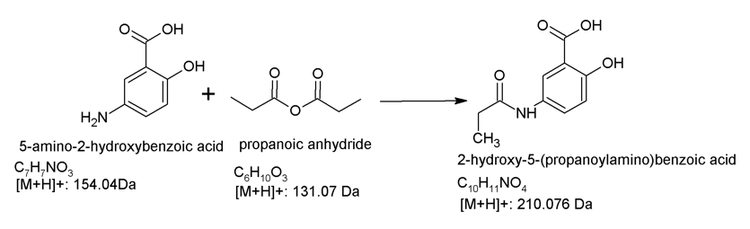
Sample Preparation: Plasma samples were spiked with Mesalamine and deuterated internal standard solution. The samples were derivatized with propionic anhydride at room temperature. Protein precipitation was performed, then the organic phase was collected and evaporated to dryness under nitrogen stream. The residue was finally reconstituted in mobile phase for analysis.
Chromatography: The samples were analyzed using the Shimadzu LC system. Chromatographic resolution was achieved on Kromasil C18 (4.6 x 150 mm column, 3.5 μm). Analyte elution was carried out using 5mM ammonium formate (pH 3.0) and methanol (35:65). Total run time was optimized to 6 min. Injection Volume was 10 µL.
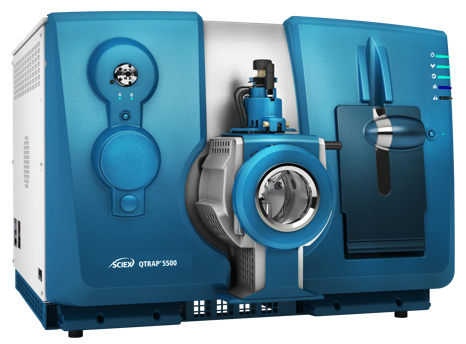
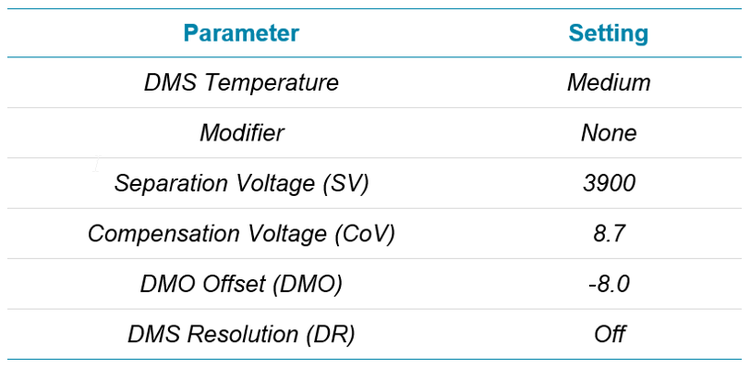
Mass Spectrometry: Sample analysis was performed on a SCIEX Triple Quad 5500 System equipped with SelexION Device using a Turbo V™ Source in positive electrospray mode. DMS parameters for Mesalamine were optimized in T infusion mode for the interest to maximize signal intensity and reduce the background interference. The optimized DMS settings are shown in Table 1. Data was acquired using Analyst® Software 1.6.
Data Processing: Data was processed using MultiQuant™ Software.
Quantitation of mesalamine in human plasma
The mesalamine method was developed using positive electrospray ionization. Mesalamine was derivatized using propionic anhydride to achieve the best sensitivity under room temperature. Protein precipitation was also used because it has less sample preparation steps and it is cost effective. During the method development, many background inference peaks were observed. Therefore, it was decided to determine if differential mobility separation would improve selectivity of the method. DMS separation parameters were optimized for the derivatized mesalamine (Table 1).
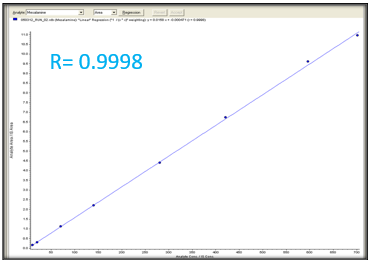
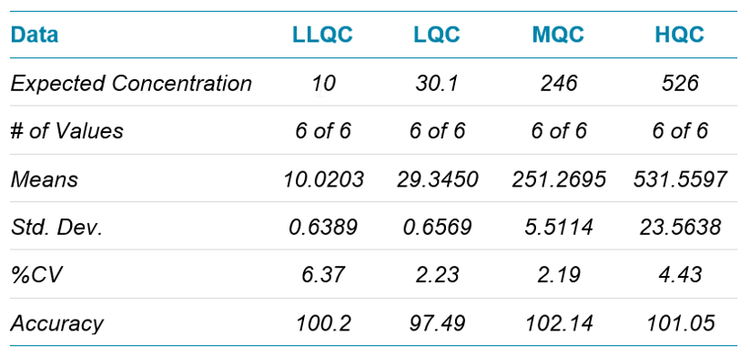
Use of SelexION technology significantly improved the signal to noise (~2X) by reducing the background noise in plasma samples (Figure 3). A linear calibration curve was constructed using the 1/X2 regression. The calibration curve for Mesalamine was linear over a dynamic range of 10.0 – 702 .0 ng/mL in plasma sample (Figure 4) with an r value 0.9998. Two precision and accuracy batches were processed to evaluate the developed method. Results of Mesalamine for precision and accuracy in batch-1 were given in Table 2. Different QCs level samples (n = 6) were also evaluated for precision and accuracy along with the calibration curve.
Conclusions
- Differential Mobility Separation (DMS) using SelexION Technology provides an orthogonal level of selectivity by separating components and interfering ions based on their chemical properties and ion mobility.
- Matrix interference and background noise for the mesalamine was significantly reduced to improve selectivity and thus improved the signal to noise ratio.
- Signal to noise ratio was improved ~2X using DMS in human plasma.
- An LLOQ of 10 ng/mL for mesalamine was achieved using protein precipitated extraction method in human plasma.
- Precision and accuracy batch data for quality control (QCs) samples were meeting the requirements for regulated bioanalytical labs.
References
- SelexION® Technology: A New Solution to Selectivity Challenges in Quantitative Analysis. SCIEX technical note RUO-MKT-02-3251-A.
- Jin W, et al. (2013) A Sensitive and Selective LC-differential mobility – mass spectrometric analysis of allopregnanolone and pregnanolone in human plasma. Anal Bioanal Chem (2013) 405: 9497-9508.
- Schneider BB et al. (2010) Planar differential mobility spectrometer as a pre-filter for atmospheric pressure ionisation mass spectrometry. International Journal of Mass Spectrometry. 298(1-3): 45-54.