Abstract
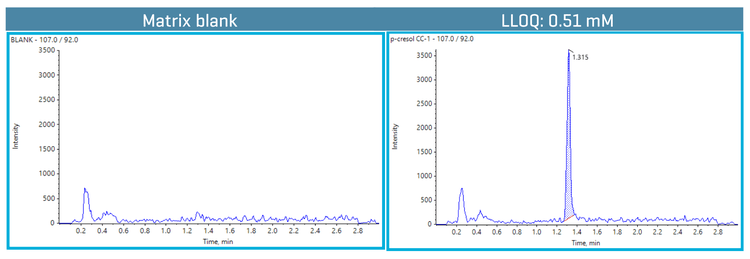
This technical note demonstrates a sensitive method for the quantitation of p-cresol in bacterial growth media. A lower limit of quantitation (LLOQ) of 0.51 mM was achieved using the SCIEX 7500 system (Figure 1).
P-cresol is a cresol that consists of toluene substituted by a hydroxy group at position 4. It is a metabolite produced by intestinal microflora in humans and animals during the process of aromatic amino acid metabolism.1 P-cresol is a valuable biomarker for assessing various disease conditions and organ function. In patients with renal impairment, p-cresol can accumulate and act as a uremic toxin. Its measurement can aid in the diagnosis, monitoring, and management of various health conditions.2 Therefore, it is important to study biomarker exposure during treatment in DMPK research. Commonly, LC-MS platforms have been applied for detection with chemical derivatization. However, the chemical derivatization approach adds method complexity, making it error-prone, laborious, and time-consuming. Here, the development of a sensitive and robust LC-MS/MS method for quantitation of p-cresol in bacterial growth media was shown on the SCIEX 7500 system.
Key benefits for quantitation of p-cresol in bacterial growth media using the SCIEX 7500 system
- Sensitive quantitation: Achieve quantitation of p-cresol in bacterial growth media using the SCIEX 7500 system equipped with OptiFlow Pro ion source for enhanced sensitivity
- Direct detection of p-cresol following a simplified sample preparation: Reach accurate and reproducible quantitative sensitivity for the measurement of p-cresol with a streamlined protein precipitation approach.
- Rapid analysis: Employ a fast 3 min run time for analysis of p-cresol in bacterial growth media.
- Effortlessly met critical quantitative performance criteria: Achieve accurate and highly reproducible assay for the quantitation of p-cresol with %CV <10.
Methods
Standard preparation: The p- cresol and internal standards were procured from the Syngene chemistry department. The calibration curves and quality control (QC) standards were prepared in ultra-pure water, with concentration ranges of 0.51 mM to 20 mM and 1.54 mM to 18.0 mM, respectively. Calibration curve and QC samples were prepared by spiking the working solution into microbial growth blank media. The extraction of p - cresol and internal standard s from media was performed using protein precipitation in ice- cold acetonitrile. Protein- crashed samples were centrifuged , and the clarified supernatant was transferred to a 96 -well collection plate for LC-MS/MS analysis.
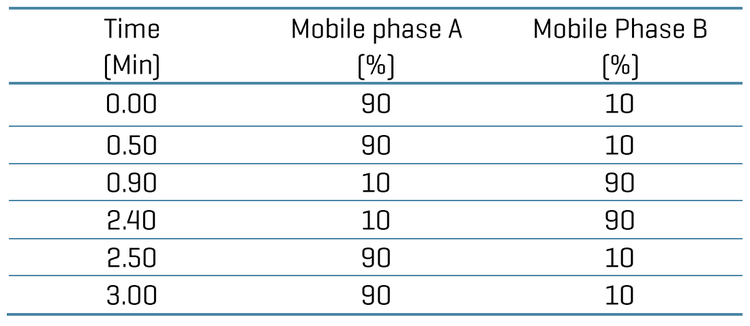
Chromatography: Chromatographic separation was performed using a Shimadzu Nexera HPLC system with a Phenomenex Kinetex C18 (50 mm × 2.1 mm, 5 µm, 100 Å) column, employing a binary gradient method. The mobile phase A consisted of 5 mM ammonium acetate in water, and mobile phase B consisted of methanol. The method achieved optimal separation within a short runtime of 3 mins, maintaining precise temperature control at 40°C . Gradient elution ensured effective separation of the analyte from matrix components. Table 1 summarizes the gradient conditions used.
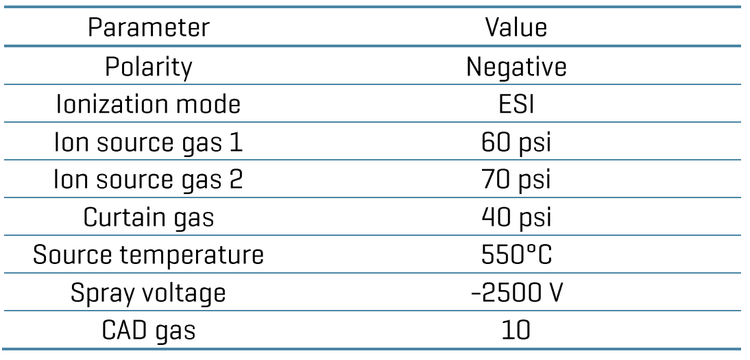
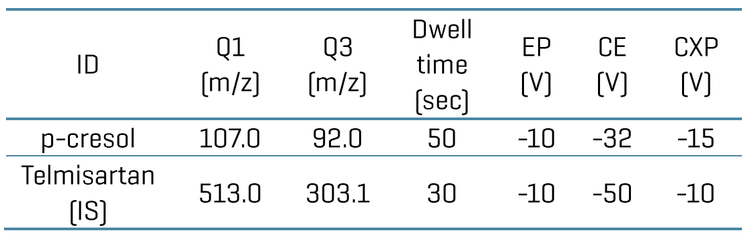
Mass spectrometry: A SCIEX 7500 system equipped with OptiFlow Pro ion source operated in negative electrospray ionization (ESI) mode was used for analysis. Table 2 summarizes the source and gas parameters used. The MRM conditions used for the determination of p - cresol along with the internal standard (IS; telmisartan) are described in Table 3.
Data processing: The data was acquired and processed using SCIEX OS software, version 3.1.
Results and discussion
Quantitative performance on the SCIEX 7500 system
The LC-MS/MS method for the determination of p- cresol in microbial growth samples was developed using the SCIEX 7500 system. Matrix effects and background noise were minimized by optimizing LC conditions and adding ammonium acetate as a mobile-phase additive, thereby improving ionization efficiency. The method achieved an LLOQ of 0.51 mM and provided accurate, highly reproducible quantitation of p- cresol (Figure 1).
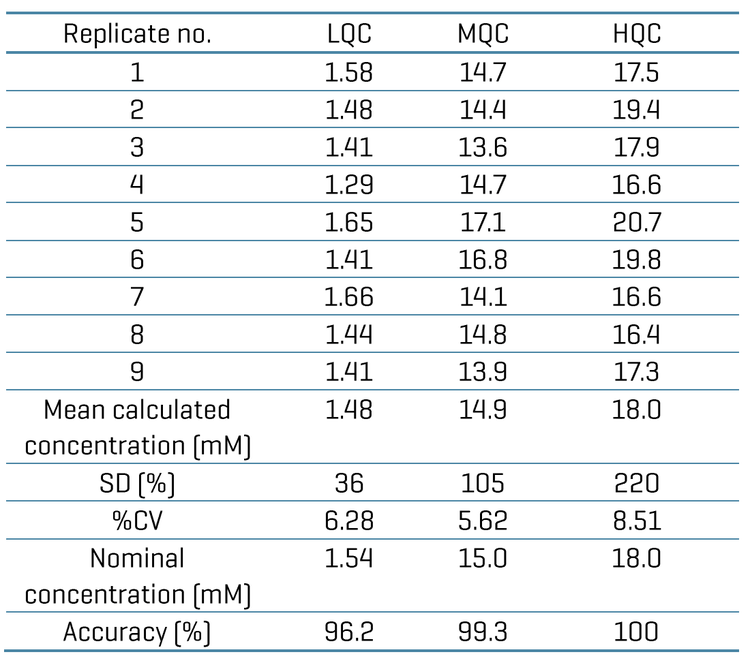
This methodology was employed to assess repeatability and reproducibility across 4 batches, yielding consistent and reliable results with low variability. This confirmed the method's precision and suitability for accurately quantifying p - cresol in microbial growth samples (data not shown). As shown in Table 4, the %CV values at the low, middle and high QC (LQC, MQC and HQC) levels were all below 10%. Overall, the data confirmed the accuracy and high reproducibility of the methodology.
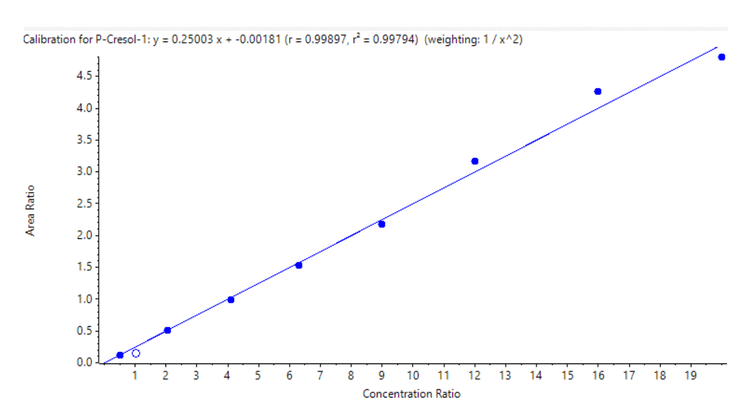
The calibration curve for p- cresol was generated over a concentration range of 0.51 - 20 mM, with a coefficient of determination (r2) >0.998, indicating excellent linearity (Figure 2). The linearity of the calibration curve was confirmed by analyzing QC samples at different levels (Table 4).
Analytical performance was evaluated based on the criteria that the accuracy of the calculated mean should be between 80% and 120% at the LOQ and between 85% and 115% at the higher concentrations. In addition, the %CV of the calculated mean of concentration should be <20% at the LOQ and <15% at all higher concentrations.
Table 5 summarizes the concentration of p - cresol obtained across the standard linearity concentration points. The assay accuracy was within ±3% of the actual concentration, and the %CV was less than 7% (Table 5). The %CV and accuracy for each point were well within the acceptance criteria.
Compliance -ready SCIEX OS software
Equivalent SCIEX OS software capabilities for regulated bioanalysis can be executed on the SCIEX 7500 system, ensuring high fidelity when performing method transfers while retaining critical compliance features.
SCIEX OS software is a closed system and requires records and signatures to be stored electronically, meeting the regulations outlined by 21 CFR Part 11. SCIEX OS software can open raw data files from any visible storage location within a closed network by using designated processing workstations.
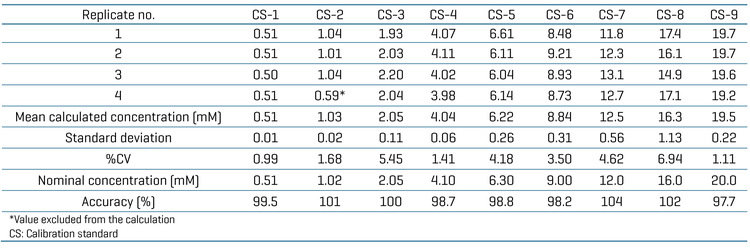
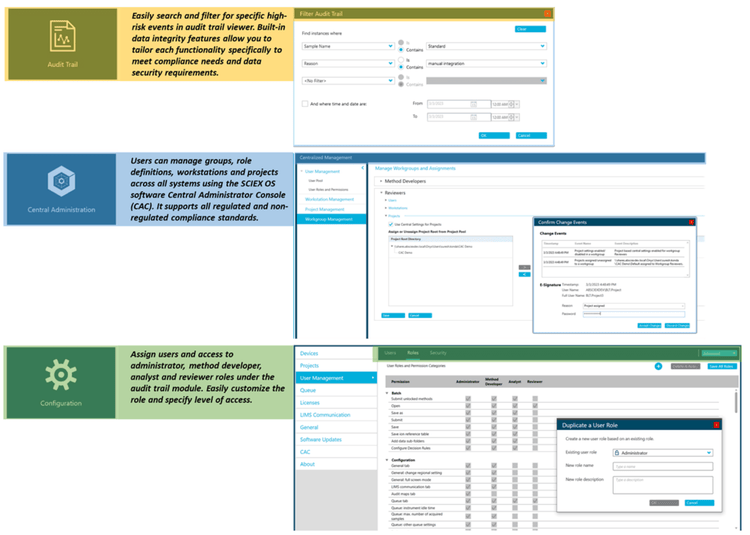
Figure 3 illustrates the features of SCIEX OS software used to monitor the audit trail, acquire and process data, and configure user access. The audit trail feature enables users to audit critical user actions and locks in data integrity.
The Central Administrator Console (CAC) feature allows users to centralize acquisition and processing using a single platform to maximize efficiency for multi -instrument laboratories, independent of compliance standards. The configuration module allows use rs to assign roles and access as the administrator, method developer, analyst, and reviewer.
Conclusion
- Low levels of p- cresol in bacterial growth media samples were quantified using the SCIEX 7500 system.
- Simplified sample preparation without chemical derivatization was demonstrated while maintaining quantitative sensitivity for the measurement of p - cresol using the SCIEX 7500 system.
- Usage of a simple and efficient extraction technique, such as protein precipitation, was performed as a sample preparation method, with minimal background interferences.
- Good quantitative performance was demonstrated with accurate and highly reproducible (%CV < 10) results on the SCIEX 7500 system.
- The data management and processing were simplified and streamlined using the SCIEX OS software. The software has compliance -readiness (21 CFR Part 11) features to support quantitative analysis on the SCIEX 7500 system.
References
- P-Cresol: National Library of Medicine https://pubchem.ncbi.nlm.nih.gov/compound/p- cresol
- Blachier, F., Andriamihaja, M. Effects of the l-tyrosine-derived bacterial metabolite p- cresol on colonic and peripheral cells. Amino Acids 54, 325 –338 (2022)