Abstract
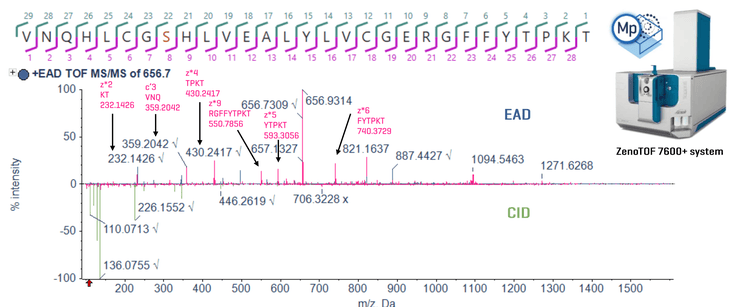
The technical note demonstrates a comprehensive workflow to identify insulin catabolites using Zeno CID DDA and Zeno EAD DDA onthe ZenoTOF 7600+ system paired with Molecule Profiler software. Compared to Zeno CID DDA, more unique fragment ions were observed with Zeno EAD DDA, providing a more confident characterization of insulin catabolites (Figure 1).
Understanding the metabolic outcome of peptide therapeutics supports decision making during early candidate selection and contributes to safety assessments and advancement into clinical trials. Consequently, comprehensive characterization and identification of peptide catabolites are necessary to ensure the drug therapeutic’s safety and efficacy . While LC-MS/MS-based catabolite profiling is typically performed using CID, in this work, a combined CID and EAD fragmentation approach was applied to ensure confident characterization and identification of insulin catabolites in an in vitro study.
Key benefits for performing in vitro insulin catabolite identification with the ZenoTOF 7600 + system
- Comprehensive characterization and confident identification: Achieve complete characterization and identification of insulin catabolites from rat liver S9 incubations using Zeno EAD DDA and Zeno CID DDA.
- Confident sequence assignments: Reach confident and automated annotation by combining CID and EAD spectral data into a single result file.
- Rapid and reliable sequence confirmation: Fragment ions are systematically matched to calculated theoretical sequence fragments according to user‑specified fragment ion types, enabling accurate determination of sequence coverage using Molecule Profiler software.
- Streamlined data processing: Streamline catabolite analysis from data acquisition using SCIEX OS software to data processing using Molecule Profiler software.
Introduction
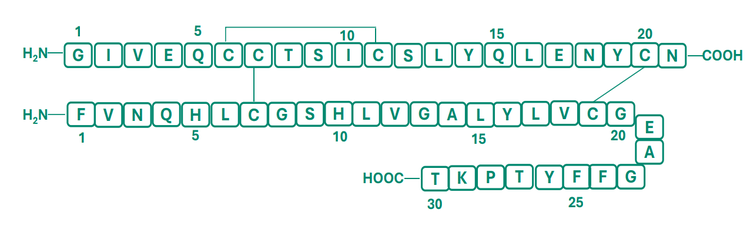
Human insulin is a synthetic, short-acting hormone widely used to manage type 1 and type 2 diabetes by promoting glucose uptake in peripheral tissues and suppressing hepatic glucose production. Insulin serves as a representative example of therapeutic peptide products (TPPs) and cyclic peptides, as it contains 1 intra-chain disulfide bond and 2 inter-chain disulfide bonds linking 2 peptide chains (Figure 2). This cyclic architecture contributes to improved potency, favorable pharmacokinetic properties, and enhanced intracellular activity.1 However, the presence of multiple disulfide bonds and the overall cyclic structure make the identification and characterization of potential catabolites challenging when using CID alone.1,2 The ZenoTOF 7600+ system is equipped with EAD, a tunable electron- based fragmentation technique. By optimizing the EAD kinetic energy conditions, more extensive fragmentation of cyclic structures ,such as insulin catabolites , can be achieved, supporting comprehensive sequence characterization.
Data processing is performed using the Molecule Profiler software, which aids in identifying and characterizing potential catabolites of human insulin. The catabolites were assigned and scored using the EAD and CID MS/MS data in the Molecule Profiler software, where spectra comparisons were performed within a single result file to help identify unique fragments.
Methods
Sample preparation: Human insulin was procured from Medchem Express. Rat liver S9 was procured from BioIVT. 3 mg of insulin was weighed and dissolved in 1 mL of 50 mM ammonium bicarbonate (pH adjusted to 7.4)by adding 2 µL of formic acid. Rat liver S9 (20 mg/mL) was diluted using ammonium bicarbonate (pH 7.4) to obtain a 1 mg/mL concentration and incubated on ice for 5 min. Insulin was added to rat liver S9, where the final insulin concentration in the sample was 120 µg/mL.
Samples were incubated for 0 and 3 hrs. After the incubation, the sample was collected and quenched using cold acetonitrile and centrifuged at 21000 g for 10 min. The supernatant was collected and dried using a nitrogen evaporator. The dried samples were reconstituted with 0.1 mL of water and transferred into autosampler vials for further analysis.
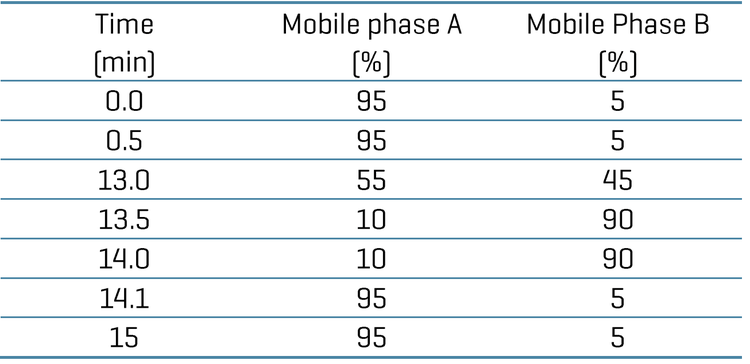
Chromatography: Analytical separation was performed on the ExionLC AD system using a Phenomenex Aries peptide XB-C18 (2.1 × 100 mm, 1.7μm) column at a 0.8 mL/min flow rate. Mobile phase A was 0.1% (v/v) formic acid in water, and mobile phase B was 0.1% (v/v) formic acid in acetonitrile. The column temperature was set to 40°C. The gradient conditions used are summarized in Table 1.
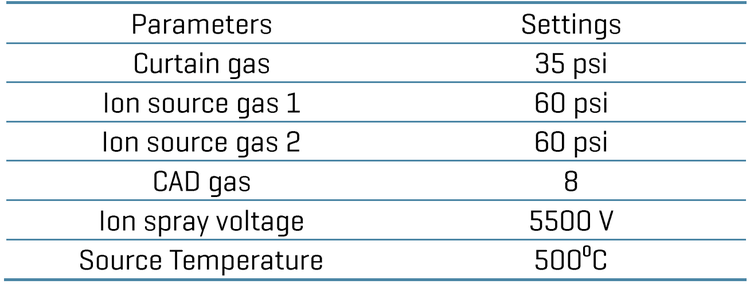
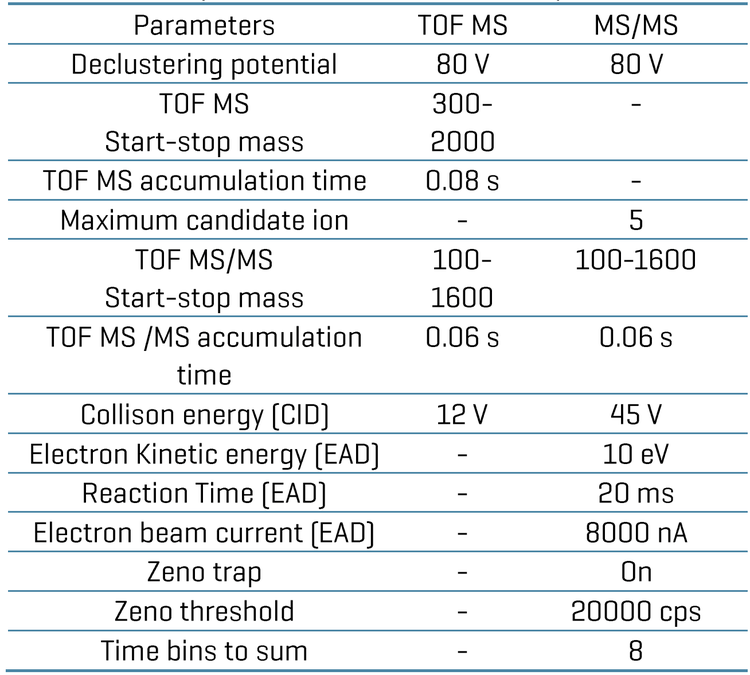
Mass spectrometry: Zeno CID DDA and Zeno EAD DDA workflows were applied for data collection on the ZenoTOF 7600+ system (SCIEX) . Optimized source and gas conditions are summarized in Table 2. The Zeno DDA parameters are shown in Table 3.
Data processing: Data acquisition was performed using SCIEX OS software, version 4.4.0. Data processing was performed using Molecule Profiler software, version 1.3.4.
Streamlined catabolite identification workflow on the ZenoTOF 7600+ system using Molecule Profiler software
Enhanced MS/MS sensitivity is achieved on the ZenoTOF 7600+ system using the Zeno trap. As a result, Zeno DDA acquisition delivers highly sensitive CID and EAD MS/MS spectra for analytes of interest. Data collected on SCIEX OS software can be seamlessly processed on Molecule Profiler software, which predicts potential catabolites arising from proteolytic cleavage, putative biotransformations, or a combination of both. The software facilitates catabolite identification and confirmation by proposing candidate sequences and ranking them using CID and EAD MS/MS fragment ion information. In addition, Molecule Profiler software combines the information across multiple charge states and summarizes relative abundances and cumulative sequence coverage for each identified catabolite, enabling efficient and streamlined data review.
In this study, an in vitro incubation of insulin was performed in rat liver S9, and the generated peptide catabolites were analyzed using Zeno EAD DDA and Zeno CID DDA on the ZenoTOF 7600+ system. Catabolite precursor and fragment identification were performed with a criteria of <10 ppm mass error.
Figure 1 displays VNQHLCGSHLVEALYLVCGERGFFYTPKT catabolite (m/z 656.7309) at a retention time of 9.16 min. Both Zeno CID DDA and Zeno EAD DDA data were evaluated, where Zeno EAD DDA spectra showed several unique c and z fragment ions (m/z 232.1426, 359.2042, 430.2417, 550.7856, 593.3056, and 740.3729), contributing to more confident characterization of the VNQHLCGSHLVEALYLVCGERGFFYTPKT catabolite. As a result, complete sequence coverage was achieved for all 29 amino acids (100%) .
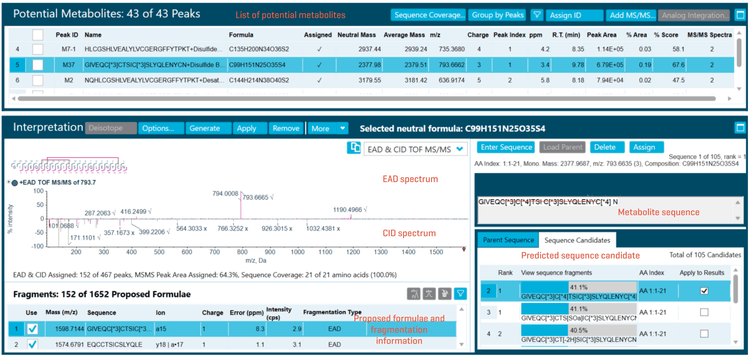
Figure 3 displays the interpretation pane in Molecule Profiler software, with the list of potential catabolites, MS/MS spectra, catabolite sequence, and proposed formulae. The GIVEQCCTSICSLYQLENYCN catabolite (m/z 793.6662) was confirmed and identified with a complete sequence coverage using combined fragment information from EAD and CID MS/MS. The sequence ranked 1 on the sequence candidate list, compared to 104 other potential candidates.
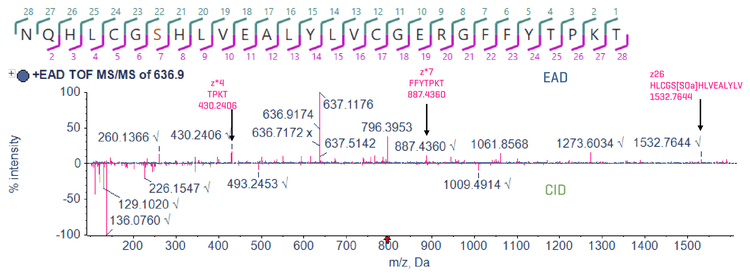
A third insulin catabolite, NQHLCGSHLVEALYLVCGERGFFYTPKT, was identified at a retention time of 8.17 min (Figure 4). MS/MS spectra were acquired for the precursor ion at m/z 636.9174 using both Zeno EAD DDA and Zeno CID DDA. The EAD MS/MS spectra revealed multiple diagnostic z‑type fragment ions, including ions observed at m/z 430.2406, 887.4360, and 1532.7644, which enabled unambiguous sequence assignment and significantly enhanced sequence confidence. Comprehensive fragment ion coverage spanning all 30 amino acid residues was achieved, resulting in complete sequence coverage of the catabolite.
Conclusions
- Characterization and identification of therapeutic peptide catabolites from rat liver S9 incubations of human insulin were demonstrated on the ZenoTOF 7600 + system.
- Zeno EAD MS/MS generated diagnostic, sequence‑informative z‑type fragment ions that enabled unambiguous identification and characterization of insulin catabolites that are challenging to sequence using conventional fragmentation approaches.
- Simplified analysis and easy-to-understand results were easily generated by Molecule Profiler software, which supports peptide sequence notation, catabolite identification, metabolic localization, and correlation studies such as time course studies.
References
- Ming Yao, Tingting Cai, Eva Duchoslav, Li Ma a, Xu Guo, Mingshe Zhu. Software-aided detection and structural characterization of cyclic peptide catabolites in biological matrix by high-resolution mass spectrometry. Journal of Pharmaceutical Analysis. 2020; 10;240-246: https://doi.org/10.1016/j.jpha.2020.05.012.
- Ming Yao, Nian Tong, Rahul Baghla, Qian Ruan. Advancing structural elucidation of conjugation drug catabolites in catabolite profiling with novel electron-activated dissociation. Rapid Commun Mass Spectrom. 2024; 38(20): https://doi.org/10.1002/rcm.9890.