Abstract
This technical note demonstrates a method for the quantitation of N-nitrosodibutylamine (NDBA) and other nitrosamines in intravenous (IV) packaging material, using the SCIEX Triple Quad 6500+ system. A limit of quantitation (LOQ)of 0.035 ng/mL was achieved for NDBA analysis, enabling confident detection at trace levels (Figure 1).1,2
FDA's August 2025 emerging scientific statement highlights the risk of NDBA and other nitrosamines leaching from IV bag packaging into drug products and recommends that manufacturers test their products using sensitive methods with ppb-level detection.1 Given that acceptable intake (AI) limits for nitrosamines such as NDBA can be as low as 26.5 ng/day,1 highly sensitive and selective methods are essential to ensure patient safety and regulatory compliance. LC-MS/MS has been widely recognized as the method of choice for nitrosamine analysis, offering the sensitivity, selectivity, and quantitative reliability required for trace-level detection. Here, the developed method is designed to support low level detection consistent with current regulatory expectations1,2 while maintaining quantitative fidelity for routine pharmaceutical quality and safety assessments.
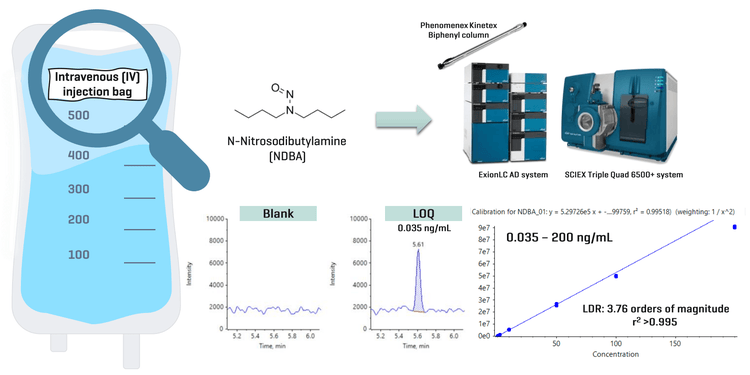
Key benefits or NDBA analysis using the SCIEX Triple Quad 6500+ system
- Low level of quantitation: Reach a limit of quantitation (LOQ) as low as 0.035 ng/mL for the quantitation of nitrosamines in IV bag filtrate.
- Robust analytical performance: Achieve accurate and highly reproducible (%CV <10) quantitative performance at all concentration levels.
- Streamlined data management: Easily acquire, manage, and process data using SCIEX OS software, a 21 CFR Part 11-compliant platform.
Introduction
The FDA has recently reported the presence of NDBA in certain drug products stored in IV bags, highlighting the potential for nitrosamine impurities to arise from packaging -related sources.1 These findings suggest that nitrosamines may form through interactions involving materials such as printed overwraps, adhesives, or packaging components, or migrate into the drug product as leachable contaminants.
Compared to traditionally monitored nitrosamines, NDBA has emerged as a compound of interest due to its potential formation from specific rubber additives, inks, and polymer degradation products used in IV bag systems.1 As a result, regulatory agencies require comprehensive risk assessment, sensitive analytical testing, and demonstrate sufficient selectivity to confidently quantify NDBA in the presence of complex extractable and leachable matrices.1,3
In this study, a panel of 7 nitrosamines (NDBA, NDMA, NDEA, NMBA, NDPA, NDIPA, and NEIPA) was evaluated in IV bag filtrate. Quantitative analysis was performed using the SCIEX Triple Quad 6500+ system, enabling highly sensitive, reproducible, and robust measurement of all 7 nitrosamines .
Methods
Standard preparation: Nitrosamine mix in methanol was purchased from Accustandard (Catalog # FDA - 001S). Calibration points ranging from 0.035 to 200 ng/mL were prepared in a 95:5 (v/v) water/methanol mixture.
Sample preparation: A 3 gram piece from the IV bag, including prints such as the warning, brand, and volume indicators, was cut into smaller pieces. The pieces containing prints were extracted in 3 mL of water by sonicating for 1 hour, followed by vortexing for 1 hour. The supernatant was filtered using a 0.22 µm filter. For the recovery experiment, blank and spiked samples (1 ng/mL of nitrosamine mixture) were prepared in IV bag filtrate.
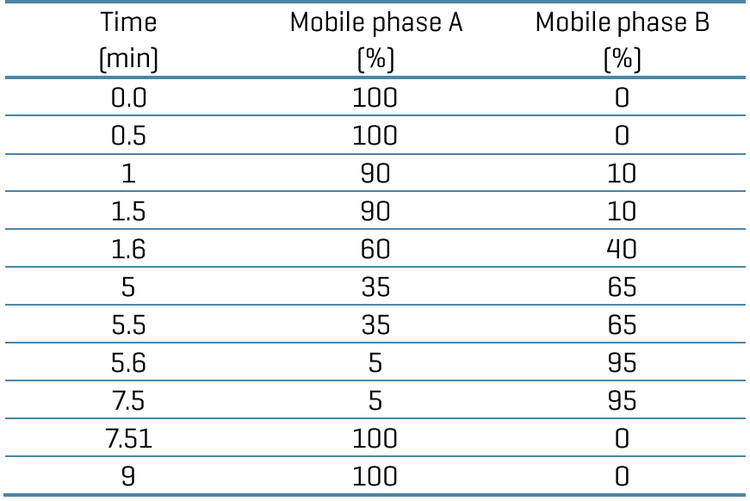
Chromatography: Sample separation was performed using an ExionLC AD system (SCIEX) at a flow rate of 0.6 mL/min on a Phenomenex Kinetex Biphenyl column (2.1 x 100mm, 2.6 µm, 100 Å). The column temperature was maintained at 40 °C. A 9-minute gradient was run using 0.1% formic acid in water as mobile phase A and 0.1% formic acid in methanol as mobile phase B (Table 1). An injection volume of 25 µL was used for analysis. A 90:10 (v/v) methanol/water mixture was used as the needle wash solvent.
Quantitation of nitrosamines on the SCIEX Triple Quad 6500+ system
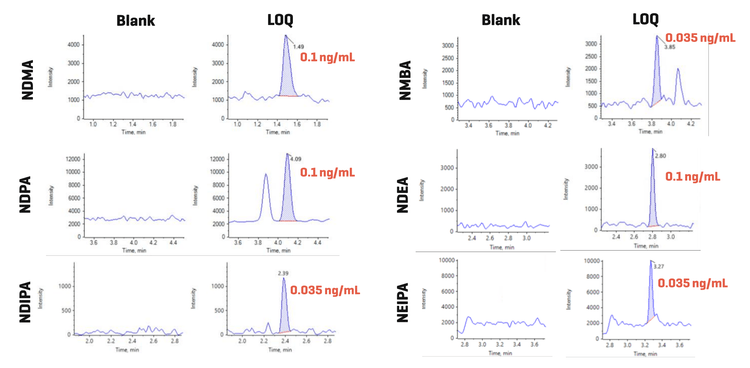
The panel includes predominantly dialkyl nitrosamines (NDMA, NDEA, NDBA, NDPA, NDIPA), along with structurally distinct nitrosamines such as NMBA and mixed alkyl nitrosamines like NEIPA. LOQs were determined following Q2(R1) Validation of Analytical Procedures: Text and Methodology Guidance for Industry guidelines.1,2 Figure 2 shows the XICs of the blank and the LOQ levels for 6 nitrosamines. LOQ of 0.035 ng/mL was reached for NMBA, NDEIPA, and NEIPA, while an LOQ of 0.1 ng/mL was achieved for NDMA, NDPA, and NDEA. The blank XICs shown did not indicate any interferences at the retention time of the nitrosamine analytes.
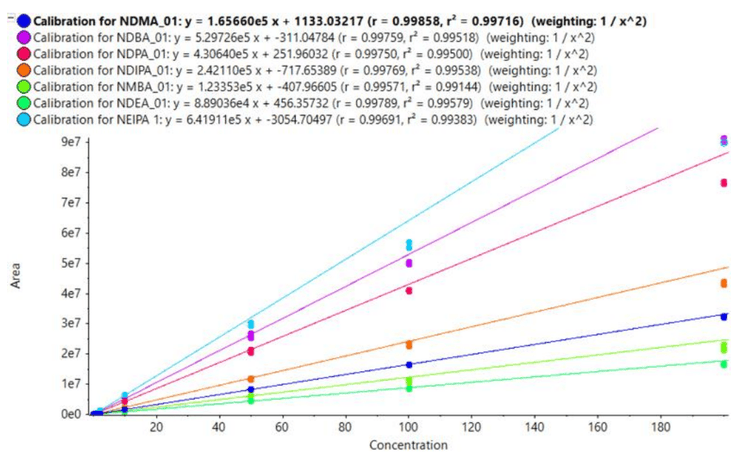
Additionally, the isobaric nitrosamines, NDPA and NDIPA, were baseline-separated using the Phenomenex Kinetex Biphenyl column with retention times of 4.09 min and 2.39 min, respectively. The calibration range for NDBA and NDIPA was from 0.035 to 200 ng/mL (Figures 1 and 3). For NEIPA, the calibration range was between 0.035 and 100 ng/mL. The calibration range for NDMA, NDPA, and NDEA was between 0.1 and 200 ng/mL (Figure 3). Replicate analysis (N=3) was performed at each concentration level.
Excellent linearity was observed across the evaluated ranges, with r2 values >0.996 using a 1/x2 weighting factor (Figures 1 and 3).
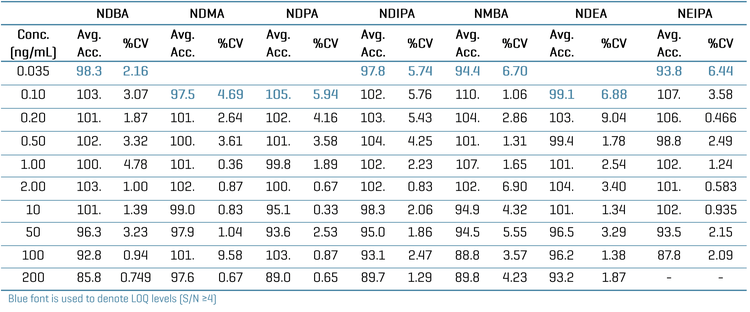
Analytical performance was evaluated for accuracy and precision. The accuracy of the calculated mean was expected to be between 80% and 120% at the LOQ and between 85% and 115% at higher concentrations. The %CV of the calculated mean for each concentration was expected to be <20% at the LOQ.3
For all nitrosamines, %CV values at the LOQ levels were ≤7%, and average accuracy was within ±7% (Table 4), demonstrating reproducible and accurate quantitation performance in alignment with ICH Q2(R1) guidance.2 Assay accuracy for concentrations above the LOQ was within ±15% of the actual concentration with %CV <10. The calculated percentage accuracy and %CV values were within the acceptance criteria for all nitrosamines throughout the concentration range (Table 4).
Recovery was evaluated at 1 ng/mL relative to the blank in the IV bag filtrate using 6 replicates (Table 5). Overall, the recovery across 6 nitrosamines was >86.6% with a %CV <3, indicating a highly reliable and reproducible assay for nitrosamine analysis in IV bag filtrate (Table 5).
Compliance-ready SCIEX OS software
Equivalent SCIEX OS software capabilities for nitrosamine analysis can be executed on the SCIEX Triple Quad 6500+ system, ensuring high fidelity when performing method transfers while retaining critical compliance features.
SCIEX OS software is a closed system and requires records and signatures to be stored electronically, meeting the regulations outlined by 21 CFR Part 11. SCIEX OS software can open raw data files from any visible storage location within a closed network by using designated processing workstations.
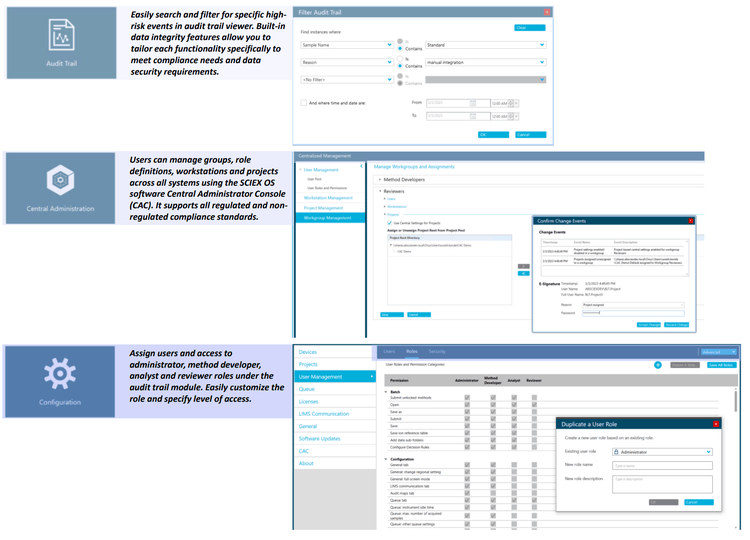
Figure 4 illustrates the features of SCIEX OS software used to monitor the audit trail, acquire and process data, and configure user access. The audit trail feature enables users to audit critical user actions and locks in data integrity.
The Central Administrator Console (CAC) feature allows users to centralize acquisition and processing using a single platform to maximize efficiency for multi -instrument laboratories, independent of compliance standards. The configuration module allows use rs to assign roles and access as the administrator, method developer, analyst, and reviewer.
Conclusions
- Sensitive and reproducible NDBA quantitation was demonstrated in IV bag leachate using the SCIEX Triple Quad 6500+ system, achieving an LOQ of 0.035 ng/mL with excellent linearity over 3.76 orders of magnitude (r2 >0.995 ).
- For the additional 6 nitrosamines, an LOQ of 0.035 ng/mL was reached for NDIPA, NMBA, and NEIPA, while an LOQ of 0.1 ng/mL was achieved for NDMA, NDPA, and NDIPA.
- Good quantitative performance was demonstrated with accurate and highly reproducible (%CV <10) results with excellent linearity (r2 >0.991) on the SCIEX Triple Quad 6500+ system.
- Baseline separation was achieved for isobaric nitrosamines, NDPA and NDIPA using the Phenomenex Biphenyl column.
- Data management and compliance-readiness (21 CFR Part 11) features were shown using the SCIEX OS software to support nitrosamine quantitation on the SCIEX Triple Quad 6500+ system.