Trientine NDSRI analysis using QTRAP identification and MRM quantitation
Abstract
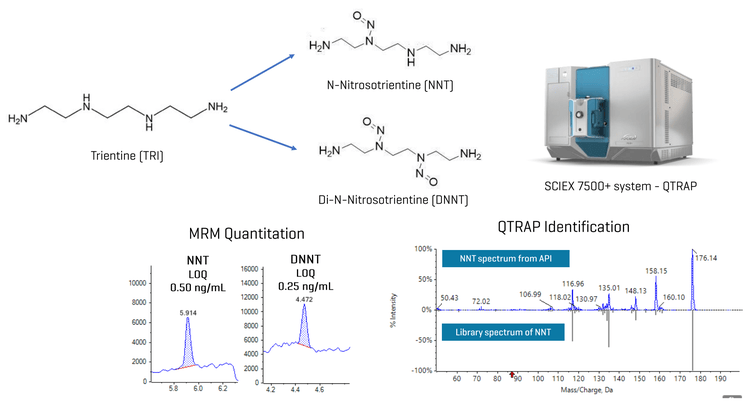
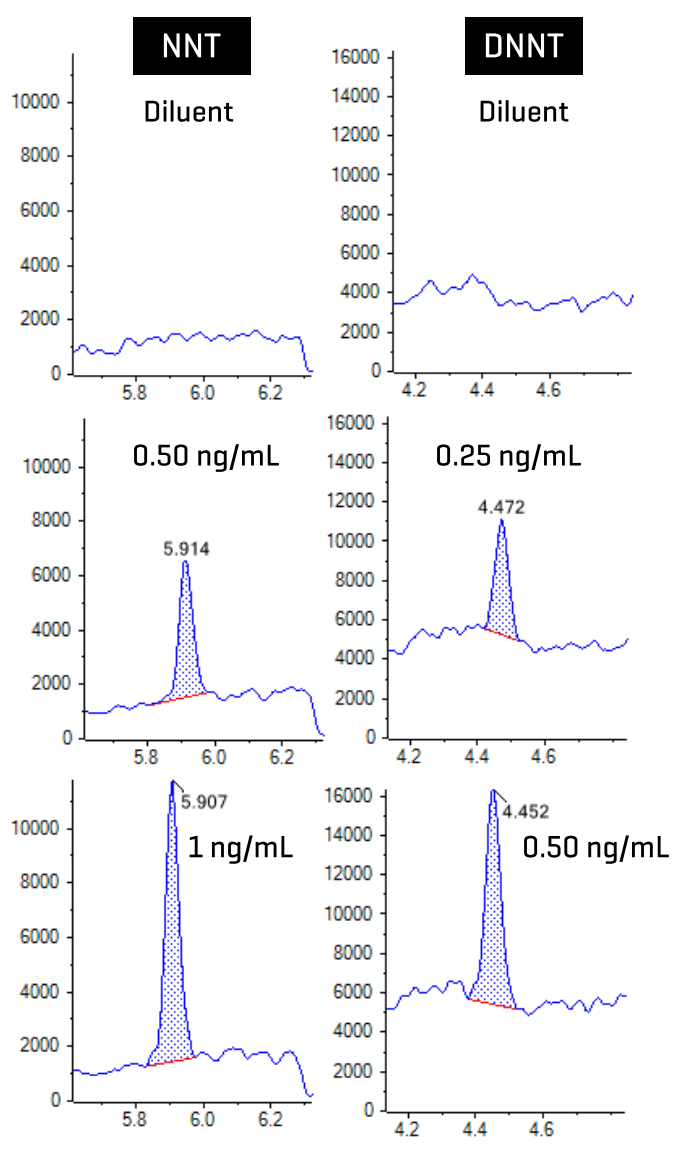
This technical note demonstrates a comprehensive method for sensitive MRM quantitation and confident identification of N-nitroso trientine (NNT) and Di-N-nitroso trientine (DNNT) impurity in trientine dihydrochloride (TRI) API using the SCIEX 7500+ system with QTRAP functionality (Figure 1). A limit of quantitation (LOQ) of 0.50 ng/mL and 0.25 ng/mL was achieved for NNT and DNNT, respectively(Figure 2). Chromatographic conditions were optimized to provide baseline separation of NNT, DNNT, and TRI API.
TRI is a copper chelating medication used in the treatment of Wilson’s disease, a rare genetic disorder causing excessive accumulation of copper in the body tissues and organs. 1 NNT and DNNT are derivatives of TRI and potential carcinogenic nitrosamine drug substance -related impurities (NDSRIs) . As a result, regulatory bodies have set strict limits on the daily acceptable intake (AI, 10 ng/day). 2,3 This is equivalent to a maximum daily dose of TRI of <2000 mg/day.4 An NNT and DNNT limit of 9 ng/mg is required to be quantified in the API. Therefore, sensitive assays are crucial for assessing NN T and DNNT levels in TRI to ensure drug safety and efficacy.
Key benefits for analysis of NDSRIs using the SCIEX 7500+ system - QTRAP
- Sub- ng/mL level of quantitation: Achieve 0.5 ng/mL and 0.25 ng/mL LOQ for the quantitation of NNT and DNNT, respectively.
- Identification of unknown impurities in API: NNT and DNNT impurities were confidently identified using reliable full scan MS/MS data acquisition with IDA-driven MRM > EPI (enhanced product ion) scan.
- Robust analytical performance: Achieve accurate quantitative performance with %CV <10 for NNT and <7 for DNNT at all concentration levels.
- Streamlined data management: SCIEX OS software, a 21 CFR Part 11 - compliant platform, simplifies data acquisition and processing.
Introduction
NDSRIs are highly potent probable carcinogens that are structurally linked to the API.3 NDSRIs are classified into various categories (class 1 -5) using the Carcinogenic Potency Categorization Approach (CPCA). The severity is determined based on the AI and the activating or deactivating features defined in the structures. Based on the structure of TRI, it is placed in the Class 1 category following the CPCA guidelines.7
The formation of NNT and DNNT in TRI has a high probab ility to occur due to the presence of the 2 primary amines and a secondary amine. Since the probability of forming an NDSRI is high, the EU has set a regulation limit of 1 8 ng/day.3 Considering the maximum daily dose of 20 00 mg/day and the regulation limit, NNT and DNNT should be analyzed below 9 ng/mg.5,6
Methods
Standard preparation: Calibration curve dilutions of NNT and DNNTwere prepared across a range of concentrations (0. 25 ng/mL to 100 ng/mL) and analyzed in triplicate.
Sample preparation: A 0.1 mg/mL concentration of TRI was prepared. The spiked API samples were prepared by adding 0.1 mg/mL TRI API samples containing NNT and DNNT, resulting in 0.7 ng/mg of NDSRI (NNT and DNNT) in the API.
Chromatography: Analytical separation was performed on the ExionLC AD system (SCIEX) using an analytical column. A linear gradient was used with a 5 µL sample aliquot for LC -MS/MS analysis, with a total run time of 14 min
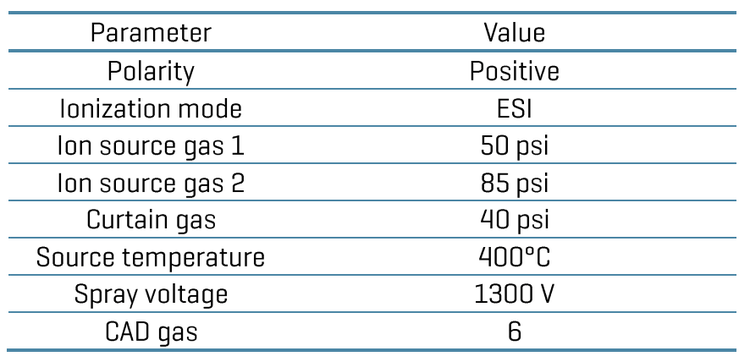
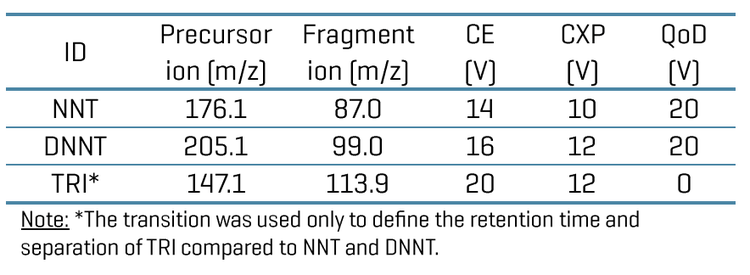
Mass spectrometry: The optimized source and gas parameters used for the analysis are listed in Table 1, and the MRM parameters are included in Table 2.
Data processing: Data collection and analysis were performed using SCIEX OS software, version 4 .0. Peaks were integrated using the MQ4 algorithm for NNT and DNNT quantitation.
Method-specific parameters for sample preparation, LC, and MS can be requested via sciexnow@SCIEX.com.
Identification of NNT using the SCIEX 7500+ system - QTRAP
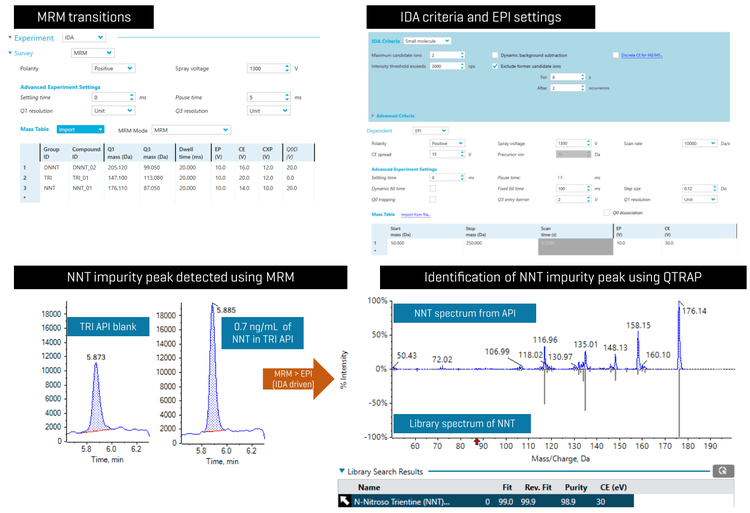
NNT impurity was observed in the TRI API sample as shown in the extracted ion chromatogram (XIC) in Figure 2 . Therefore, an MRM > EPI (IDA driven)method was developed to confirm and verify the identity of the impurity peak. Here, the MRM transition was used to trigger an IDA event to acquire an EPI MS/MS spectrum (Figure 2) .
The TRI API blank and an API sample spiked with 0.7 ng/mL of NNT were analyzed. The fragment ion spectra obtained from the API blank was compared with that of the NNT reference standard. A spectral match of 99.0% was obtained, confirming the presence of NNT in the API blank. Thus, the MRM > EPI workflow on the SCIEX 7500+ system - QTRAP can be reliably employed to confirm and verify the presence of NDSRI impurities in API samples.
Quantitative performance on the SCIEX 7500+ system - QTRAP
TRI, NNT, and DNNT are highly basic polar compounds, making it challenging to retain them on reverse- phase columns. In this study, multiple columns were evaluated to achieve optimal chromatography conditions for baseline separation of these 3 compounds.
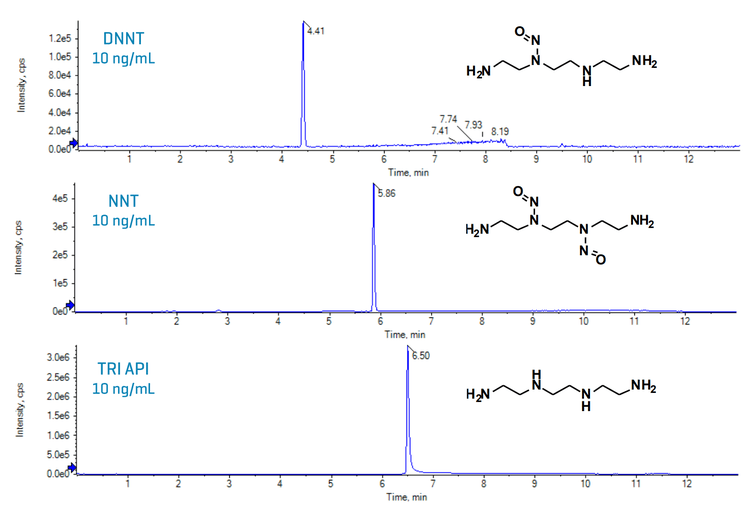
Under the LC conditions used in this study, NNT and DNNT were eluted at 5.8 min and 4.4 min, respectively, while the TRI API was eluted at 6.5 min (Figure 3). A ~0.5 min difference in retention time was achieved between TRI and the NNT, while a ~2 min difference was observed between TRI and DNNT.
NNT and DNNT were analyzed across the concentration range of 0.25 ng/mL to 100 ng/mL. To evaluate reproducibility, each calibration standard was analyzed in triplicate.
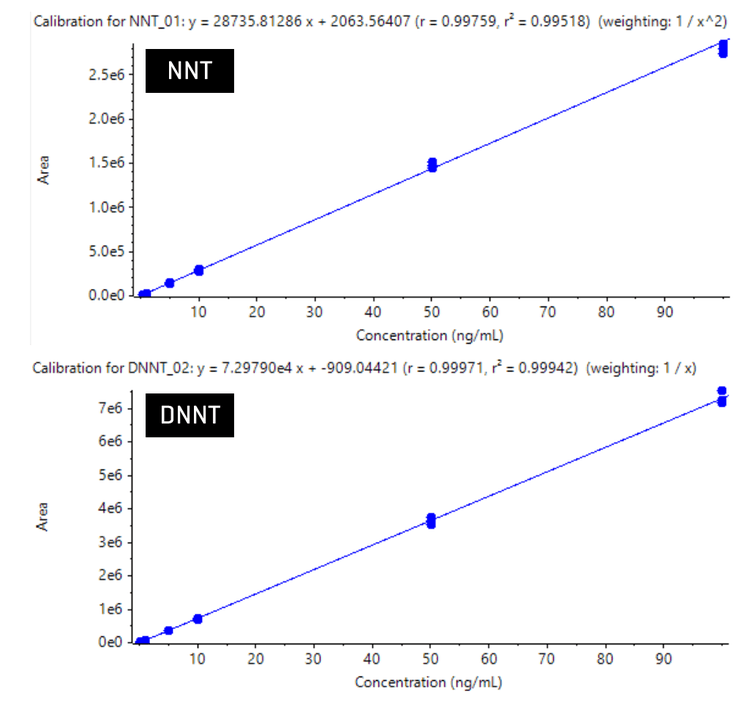
Linearity was achieved across concentrations ranging from 0.25 ng/mL to 100 ng/mL and 0.5 ng/mL to 100 ng/mL for NNT and DNNT, respectively. Coefficients of determination (r2) were >0.997 and 0.999 for NNT and DNNT, respectively (Figure 4).
An LOQ of 0.25 ng/mL and 0.5 ng/mL was achieved for the quantitation of both NNT and DNNT with no interference in the diluent blank (Figure 5).
The specification limit ( 9 ng/mg) was calculated based on the maximum daily dose of 20 00 mg/day. Therefore, NNT and DNNT were analyzed at 7 ng/mg of API, below the calculated specification limit of 9 ng/mg.
The average recovery for the sample spiked with 0.70 ng/mL NNT and DNNT was 107% and 94%, respectively. Since NNT was detected in the TRI API (Figure 2), recovery was calculated as the difference between the peak area concentration of NNT in the control API and that in the spiked sample (Table 3). %CV was <4 for the API blank, NNT in neat, and NNT spiked in TRI API. For DNNT in the API, no interference was observed in the control API samples, with %CV < 7.
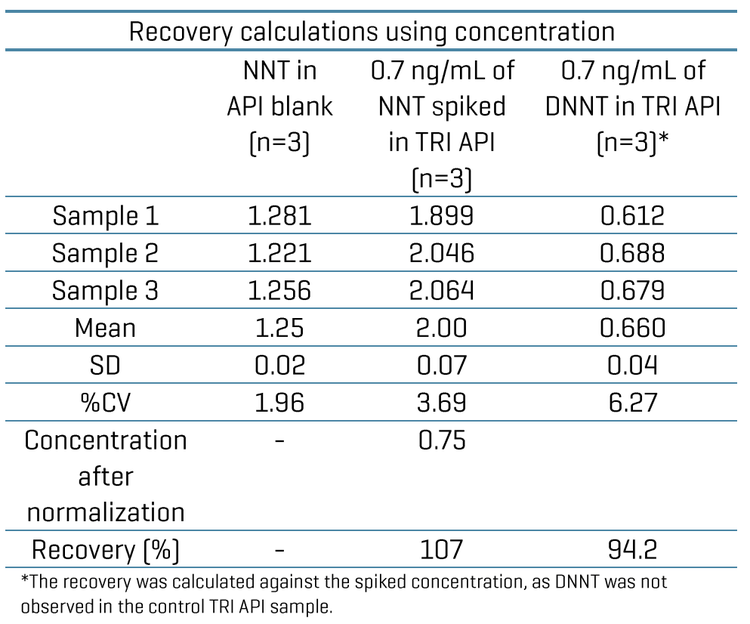
Analytical performance was evaluated based on the criteria that the accuracy of the calculated mean should be between 80% and 120% at the LOQ and between 85% and 115% at the higher concentrations. In addition, the %CV of the calculated mean of concentration should be <20 at the LOQ and <15 at all higher concentrations. Table 3. Recovery and precision calculation.
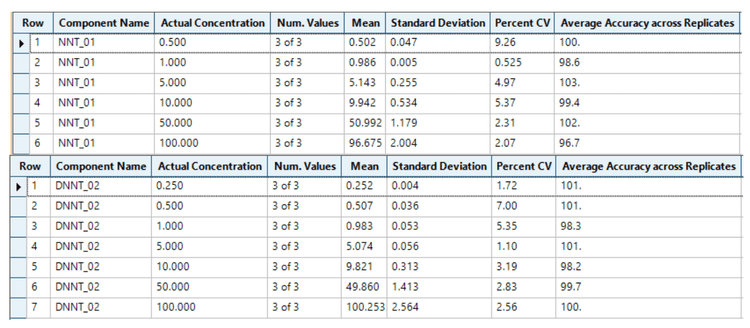
The assay accuracy was within ±4% and ±2% of the actual concentration, and the %CV was <10 and 7 for NNT and DNNT, respectively. The calculated percentage accuracy and %CV values were within the acceptance criteria at each concentration level (Figure 6).
Compliance -ready SCIEX OS software
Equivalent SCIEX OS software capabilities for regulated bioanalysis can be executed on the SCIEX 7500+ system - QTRAP, ensuring high fidelity when performing method transfers while retaining critical compliance features.
SCIEX OS software is a closed system and requires records and signatures to be stored electronically, meeting the regulations outlined by 21 CFR Part 11. SCIEX OS software can open raw data files from any visible storage location within a closed network by using designated processing workstations.
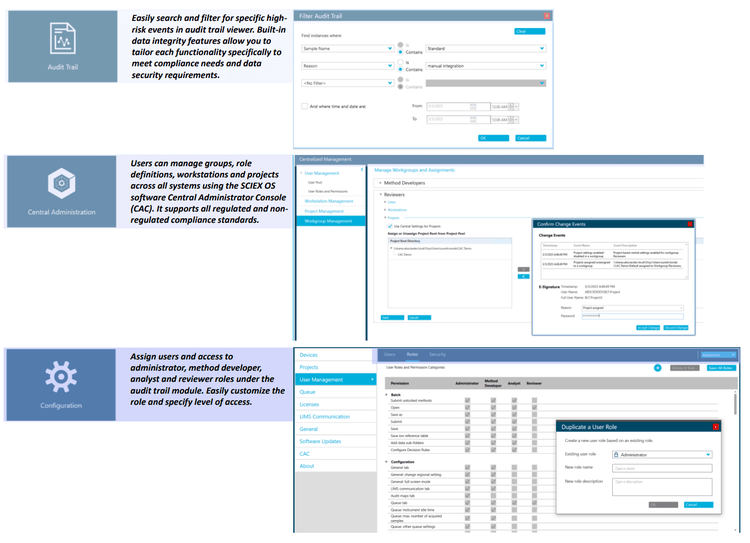
Figure 7 illustrates the features of SCIEX OS software used to monitor the audit trail, acquire and process data, and configure user access. The audit trail feature enables users to audit critical user actions and locks in data integrity.
The Central Administrator Console (CAC) feature allows users to centralize acquisition and processing on a single platform, maximizing efficiency for multi -instrument laboratories, regardless of compliance standards. The configuration module allows users to assign roles and access as the administrator, method developer, analyst, and reviewer.
Conclusion
Quantitation of NNT and DNNT
- A LOQ of 0.25 ng/mL and 0.5 ng/mL was achieved for the quantitation of NNT and DNNT, respectively. Good quantitative performance was demonstrated with high accuracy and high reproducibility (%CV <10 and 7) for NNT and DNNT results on the SCIEX 7500+ system - QTRAP.
- Linearity was achieved at concentrations ranging from 0.50 ng/mL to 100 ng/mL with an r2 >0.997 for NNT and 0.25 ng/mL to 100 ng/mL with r2>0.999 for DNNT.
Analysis and identification of NNT and DNNT in TRI API
- NNT impurity in TRI API was identified and verified by comparing the impurity MS/MS spectra with the NNT standard MS/MS spectra.
- Accurate quantitation with good baseline separation of NNT, DNNT, and TRI API was achieved.
- An average recovery of 110% and 94% was achieved with %CV <4 and <7, where NNT and DNNT were analyzed at 7 ng/mg of API, below the calculated specification limit of 9 ng/mg.
Software compliance
- Retain data management and compliance -readiness (21 CFR Part 11) features using SCIEX OS software to support nitrosamine analysis on the SCIEX 7500+ system - QTRAP.
References
- Trientine dihydrochloride for Wilson's disease Australian Prescriber 2021,Apr vol 44.
- Medicine for Europe, Review of NDSRI in pharmaceuticals drugs: Risk assessment, Acceptable intakes, and QSAR tools by Dr. George Johnson
- Nitrosamine impurities in medications: Established acceptable intake limits . Appendix 1: Established acceptable intake (AI) limits for N -nitrosamine impurities (version: 2024 - 05- 31).
- Trientine Hydrochloride (Waymade- Trientine)
- Website: https://www.fda.gov/regulatory-information/search -fda-guidance - documents/cder-nitrosamine -impurityacceptable -intake-limits
- Website: https://www.tga.gov.au/how-we-regulate/monitoringsafety- and-shortages/industry -information- about-specific -safety - alerts-recalls- and-shortages/nitrosamine - impurities-medicines/established - acceptable -intake-nitrosamines-medicines
- International Council for Harmonisation of Technical Requirements for Pharmaceuticals for Human Use; “ICH Harmonised Guideline - Assessment And Control Of DNA Reactive (Mutagenic) Impurities in Pharmaceuticals to Limit Potential Carcinogenic Risk, M7(R1)”; March 31, 2017.