Abstract
As electrospray ionization is the primary means of interfacing chromatography to mass spectrometers today, the performance of the ionization source is a key component of the LC-MS system. The unique geometry of the Turbo V source has provided excellent sensitivity and robustness to scientist since its development. Further improvements to the design have led to the IonDrive Turbo V source for high flow rate applications and the OptiFlow Turbo V source for low flow rate applications. Here, the innovations in the IonDrive source are discussed. With higher capacity heaters, a more uniform heat distribution, greater ion desorption and a wider optimization sweet spot have been achieved which provides enhanced sensitivity across the high flow regime.
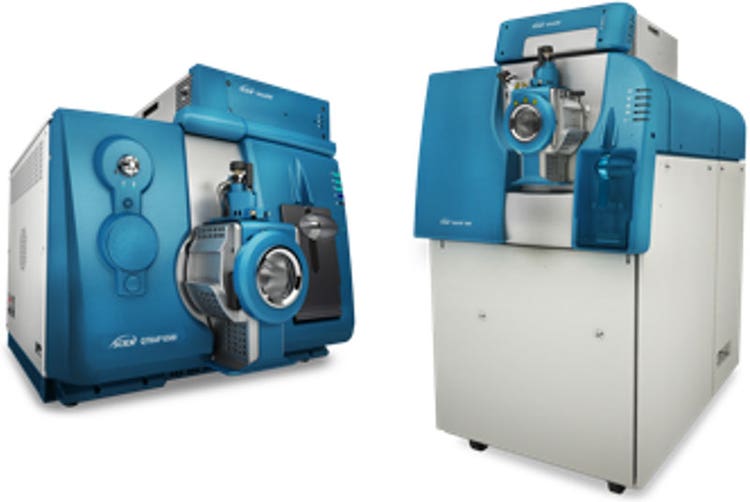
Introduction
The Turbo V Ion source has been the gold standard for quantitative and qualitative LC-MS/MS for over 10 years. The key reasons for the success of this ion source is simplicity in source architecture, orthogonal spray design and the strategic application of heated gas to the spray region to aid in the desolvation of analytes. This efficient architecture provides outstanding robustness and sensitivity when analyzing complex biological matrices with minimal maintenance. By merging two orthogonal streams of hot gas in the ESI region, efficient desolvation and hydrodynamic focusing of ions towards the orifice is achieved. For higher flow rate applications, this can translate to significant boosts in sensitivity of over unheated ESI sources. Despite robustness in performance across all modes of operation, additional gains in sensitivity, robustness and consistency have been observed through an upgrade of the heating system in the new IonDrive Turbo V source.
Key features of IonDrive Turbo V source
- High sensitivity with enhanced ionization efficiency
- Greater ion desorption rates from ESI droplets can be achieved on the new IonDrive Turbo V source using high capacity heaters with a wider sweet spot and enhanced sensitivity
- Extraordinary robustness in performance providing higher productivity
- The simplistic source architecture and orthogonal spray design with no complex spray path provides uniform temperature distribution and optimized curtain gas flow to improve robustness and ruggedness
- High throughput analysis over wide range of flow rates
- With functional flow rate ranges from 5ul/min to 3 mL/min, the IonDrive Turbo V source is the perfect match for both micro flow HPLC applications with new low dispersion electrodes and analytical flow UHPLC flow rates, delivering unmatched desolvation and stability for the most demanding applications
- Wider compound class coverage
- The ability to quickly interchange ionization modes between APCI and ESI enables wider compound class coverage and easy and faster method development
- Simple plug and play ion source design
- A tool-free source design enables plug and play capability with almost zero maintenance.
Increase in ionization efficiency
Electrospray ionization efficiency can be enhanced by 3 key parameters:
- Sample & solvent considerations like chemical nature of the analyte -proton affinity, thermal stability, solvent pH, dielectric constant and surface tension of the solvent
- Charged spray formation effected by flow rate, electric potential, nebulizer gas flow rate, electrode protrusion distance and sprayer bore diameter
- Desolvation conditions like temperature, heater gas flow, nebulizer gas flow and curtain gas flow rates
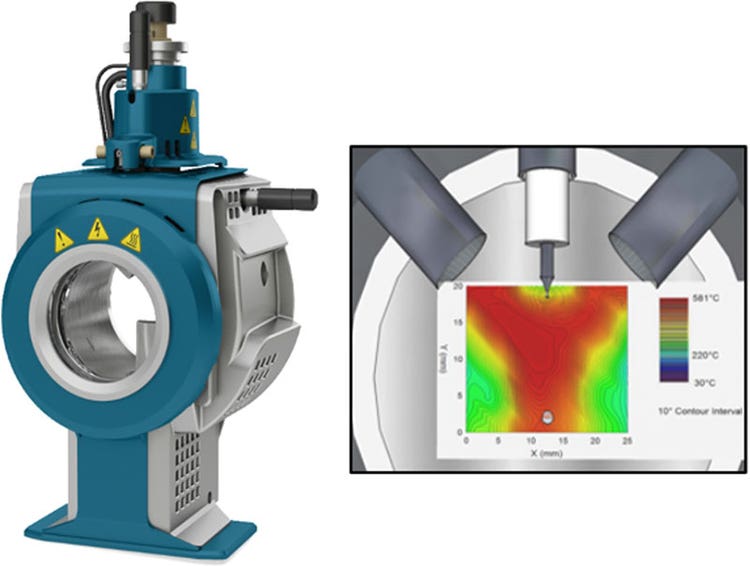
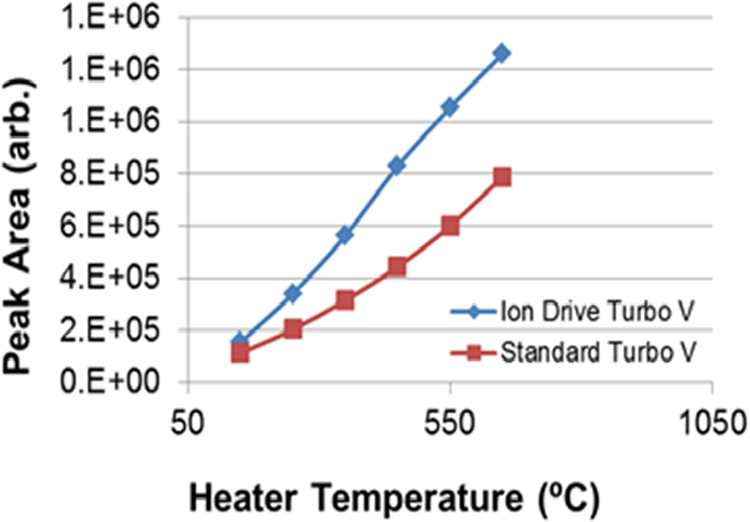
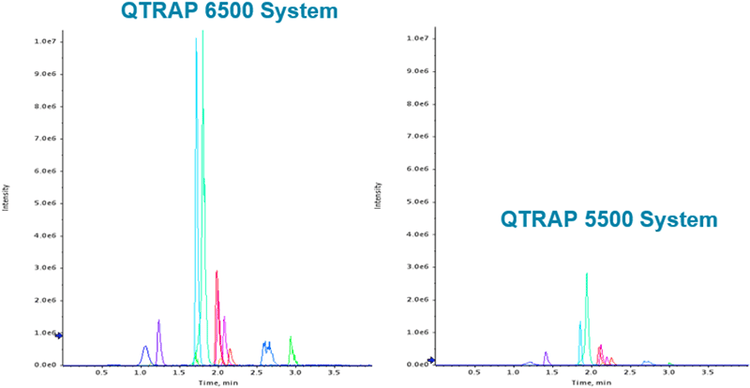
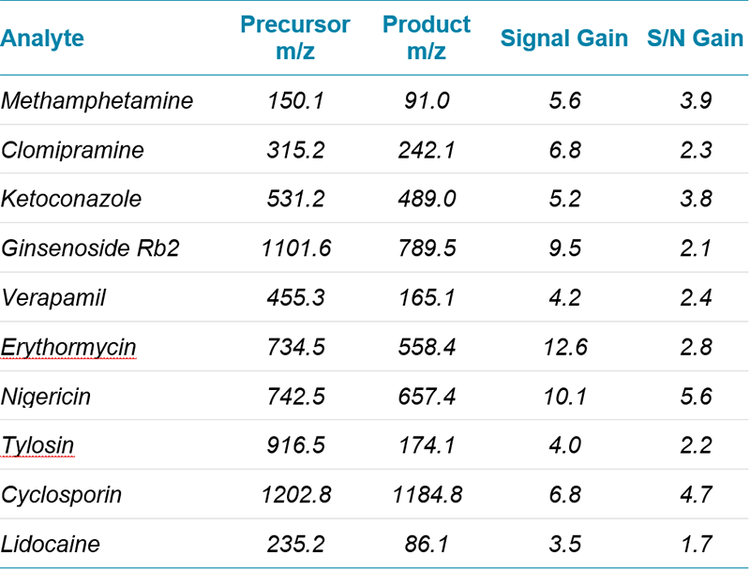
While the first parameter depends mainly on the sample of interest, both spray formation and desolvation can be optimized within an ion source for enhanced ionization efficiency. By upgrading the traditional Turbo V source heaters with a larger-diameter heaters, a wider sweet spot with hotter, larger and a more homogeneous spray region is created. As seen in Figure 1, a uniform temperature distribution and more homogeneous desolvation area is established in the IonDrive Turbo V source, increasing ion production using enhanced gas flow dynamics and optimized heater configurations while improving reliability, reproducibility and robustness. This is demonstrated below in Figure 2 and 3.
Extended robustness for higher productivity
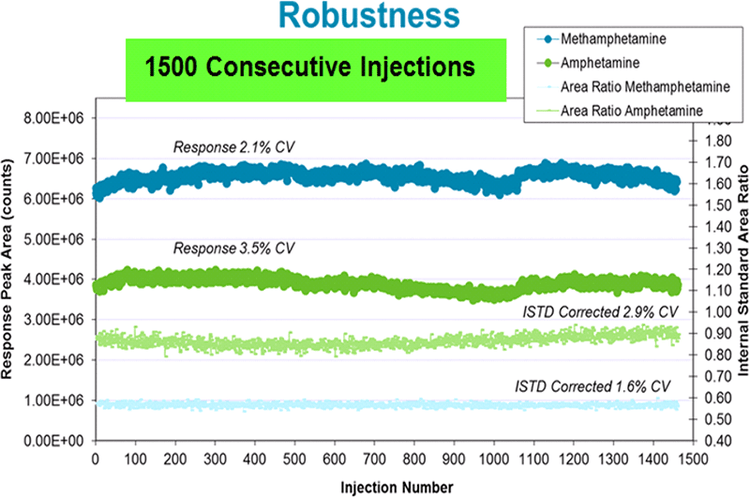
Multi-day robustness was evaluated by using 1,500 consecutive injections of methamphetamine and amphetamine in plasma in a continuously running batch lasting 3 days. The optimized curtain gas geometry and the IonDrive QJet ion guide result in rugged performance for analysis of samples in biological matrices. No divert valve was used. The relative standard deviation for all 1500 injections was < 3.5% for raw peak areas and < 2.9% for analyte to internal standard ratios, as show in Figure 4.
Efficiency over a wide range of flow rates
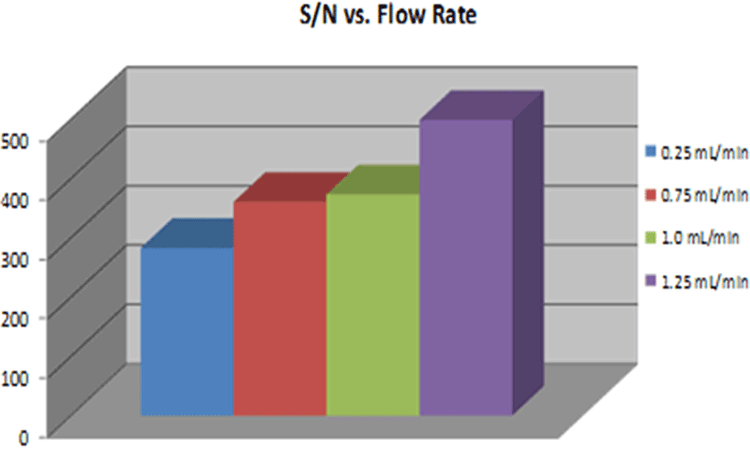
Higher desolvation capacity in the spray region also enables the use of LC methods with higher flow rates, which reduces run times and increases sample throughput. This enables researchers to take full advantage of the new fused core columns, which operate most efficiently at high flow rates. Both the LC peak area and S/N ratio measured with the IonDrive Turbo V source on the QTRAP 6500 system maintain full performance, and can even improve, at higher LC flow rates (Figure 5).
Conclusions
By establishing uniform heat distribution in the spray region of the source, the IonDrive Turbo V Source allows higher levels of sensitivity, robustness and throughput to be achieved.
- Uncompromised performance from microflow to high mL/min flow ranges can be attained.
- The unique geometry of the SCIEX Turbo V sources provides unmatched sensitivity and robustness that is well known by scientists.
- The hotter and more stable desolvation area established by the IonDrive Turbo V source allows for superior performance at high LC flow rates.
References
- Single source solution for low flow chromatography - OptiFlow Turbo V source – always working in the sweet spot of sensitivity and robustness. SCIEX technical note, RUO-MKT-02-9701-A.