Abstract
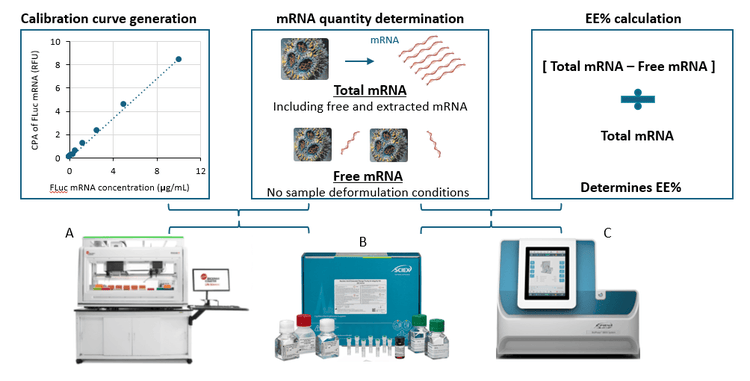
This technical note describes an automated workflow for mRNALNP encapsulation efficiency (EE%) determination by capillary electrophoresis (CE). The workflow integrates automated sample and reagent preparation on the Biomek i7 Hybrid Automated workstation with separation and analysis on the BioPhase 8800 system using the RNA 9000 Purity & Integrity kit.
The rapid expansion of mRNA -based vaccines and therapeutics has increased demand for efficient, reproducible workflows for EE% determination and mRNA purity and integrity assessment. The automated workflow described here enables streamlined, reproducible analysis while minimizing manual intervention .
Key features
- Automated EE% analysis with integrated RNA purity assessment: Enables analysis of EE% and RNA purity and integrity with size estimation in a single CE workflow
- Minimized manual intervention: Significantly reduces hands-on time and mitigates the risk of RNase contamination
- Reproducible, automated, RNA purity, integrity, and EE% analysis: %RSD values of ≤2.5% for purity and <0.5% for EE%
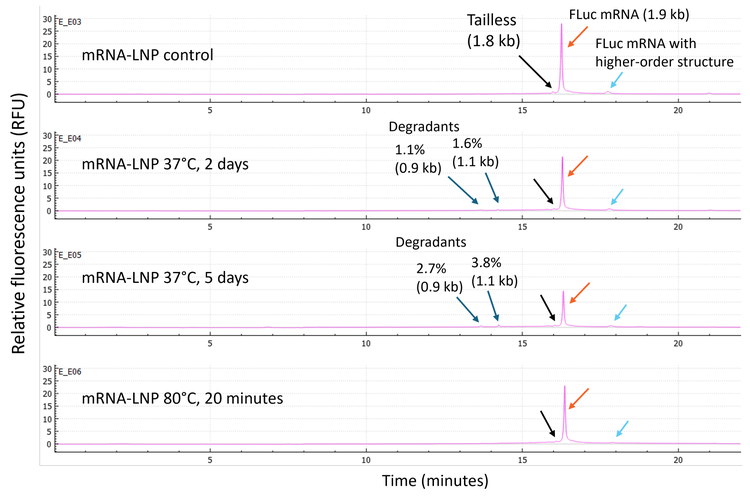
- Stability-indicating capability: Detects temperature- and time-dependent mRNA degradation in stressed mRNA-LNPs
Introduction
The success of COVID‑19 vaccines has demonstrated the effectiveness of LNP–encapsulated mRNA and highlighted its broader potential for both vaccines and therapeutics. Beyond the physicochemical properties of LNPs, mRNA EE % is a critical quality attribute (CQA) for evaluating and screening vaccine formulation and assembly processes of mRNA-LNP products.1-2 Rapid expansion of mRNA-LNP-based therapeutics has increased the demand for highly reproducible analytical workflows for EE % determination.3 In addition, mRNA integrity analysis is essential for ensuring that mRNA drug substances remain intact and functional throughout development and manufacturing. However, manual sample and reagent preparation can limit efficiency and introduce variability. Furthermore, manual procedures inherently pose a risk of RNase contamination, which can lead to RNA degradation.
To address these challenges, a fully automated workflow integrating liquid handling automation with CE-based analysis has been developed. In this study, the workflow is implemented using the Biomek i7 Hybrid Automated workstation in combination with the BioPhase 8800 system and the RNA 9000 Purity & Integrity kit. This approach enables streamlined, reproducible EE% determination and assessment of mRNA purity and integrity.
While demonstrated using the Biomek i7 Hybrid Automated workstation, the workflow can be adapted to other automated liquid handling systems.
Methods
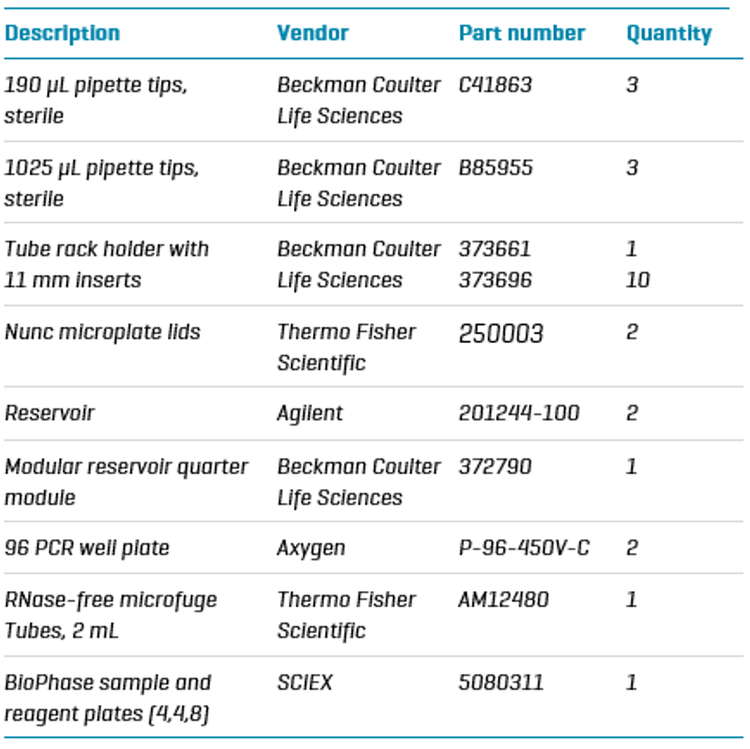
Materials: The RNA 9000 Purity & Integrity kit (P/N: C48231), sample loading solution (SLS, P/N: 608082), and the BioPhase BFS capillary cartridge - 8 x 30 cm (P/N: 5080121) were from SCIEX (Marlborough, MA). Rainin LTS filter tips were from Mettler Toledo (Oakland, CA). Nuclease-free water (NFW) (P/N: AM9932) Surfact-Amps X-100 (10% (v/v) (Triton X -100, P/N: 28314), RNA storage solution (P/N: AM7000, 1mM sodium citrate), 10 X Tris EDTA (TE) buffer (P/N: 75834) and 10X phosphate buffered saline (PBS, P/N: AM9624) were obtained from Thermo Fisher Scientific (Waltham, MA). Sucrose (P/N: S9378) was from Sigma-Aldrich (St. Louis, MO). The firefly luciferase (FLuc) mRNA (P/N: L-7602) was manufactured by TriLink BioTechnologies (San Diego, CA). The FLuc mRNA contains a 5’- cap and a 3’-poly(A) tail, mimicking an mRNA drug substance. The FLuc mRNA and heat-stressed FLuc mRNA-loaded mRNA-LNP samples were provided by Acuitas Therapeutics Inc. (Vancouver, Canada). The 0. 45 μm syringe filter (P/N: 46 54) was from PALL (Port Washington, NY). Part numbers for pipette tips, tubes, reservoirs, and plates used in the sample and reagent preparation workflow are listed in Table 1. A pair of custom-made outlet plate adapters was provided by Beckman Coulter Life Sciences (Indianapolis, IN).
Liquid handler for sample and reagent preparation: The Biomek i7 Hybrid Automated workstation (P/N C02613, Figure 1, panel A), equipped with a multichannel head, a Span-8 head, 2 ColdPlates, an orbital shaker, and a tip washing station, were from Beckman Coulter Life Sciences. The Biomek software (P/N: B87585) version was 5.1. Detailed lists of t he required part numbers for automation hardware and software are provided in the Instructions for Use (IFU).4
Storage of the RNA 9000 Purity & Integrity kit: The Acid Wash/Regenerating Solution and CE Grade water were stored at room temperature upon receipt. The Nucleic Acid Extended Range Gel and the LIF Performance Test Mix were refrigerated at 2-8°C. The ssRNA Ladder and the SYBRTM Green II RNA Gel Stain* were kept at -35°C to -15°C.5
Preparation of the gel buffer: The Nucleic Acid Extended Range Gelwas pre-warmed to room temperature and filtered through a 0.45 μm syringe filter. The SYBRTM Green II RNA Gel Stain was thawed at room temperature in the dark and then added to the filtered gel at a 500-fold dilution.
Preparation of 0.4% Triton X -100 solution: The 0.4% Triton X-100 solution (Surfact-Amps X-100) was prepared by adding 1.6 mL of 10% Triton X -100 to 38.4 mL of NFW in a 50-mL conical centrifuge tube. The solution was mixed well by carefully inverting the tube at least 20 times and avoiding bubbles.
Automated preparation of the diluent buffers for making the 8- point calibration curves: The TE diluent buffer #1 (1 mL) containing 1X TE, 1/5X 300mM sucrose in PBS, and 1/5X 1mM sodium citrate (SC) was prepared on the Biomek i7 Hybrid Automated workstation by mixing 100 μL of 10 X TE buffer, 200 μL of 300mM sucrose in PBS, 200 μL of 1mM SC, and 500 μL of NFW in a 2 mL nuclease-free tube. The Triton diluent buffer #1 (1 mL) containing 1/25 X 300mM sucrose in PBS, 1/25 X 1mM SC, and 0.2% Triton X -100 was made by mixing 40 μL of 300mM sucrose in PBS, 40 μL of 1mM SC, 500 μL of 0.4% Triton solution, and 420 μL of NFW in a 2 mL nuclease-free tube. The components in the diluent buffers were mixed well by pipetting up and down 10 times.
Automated preparation of the diluent buffers for mRNA-LNP sample treatments: The TE diluent buffer #2 (7 mL) was prepared on the Biomek i7 Hybrid Automated workstation by mixing 0.875 mL of 10X TE buffer, 1.75mL of 1mM SC, and 4.375 mL of NFW in a 4-divider reservoir. The Triton diluent buffer #2 (8 mL) was prepared by mixing 0. 336 mL of 1 mM SC, 4.168 mL of 0.4% Triton solution, and 3.496 mL of NFW in a 4-divider reservoir. The components in the diluent buffers were mixed well by pipetting up and down 10 times.
Preparation of the sample plates for processing on the Biomek i7 Hybrid Automated workstation: Two Axygen plates were used. For the analysis of total mRNA, 2 μL of the mRNA-LNP samples were transferred from the stock vial into each well of columns 2-6 on an Axygen plate. For the analysis of free mRNA, 16 μL of the mRNA-LNP samples were transferred from the stock vial into each well of columns 8-12 on another Axygen plate.
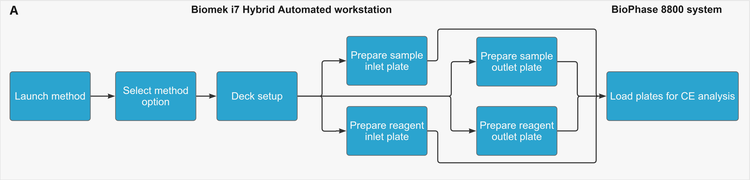
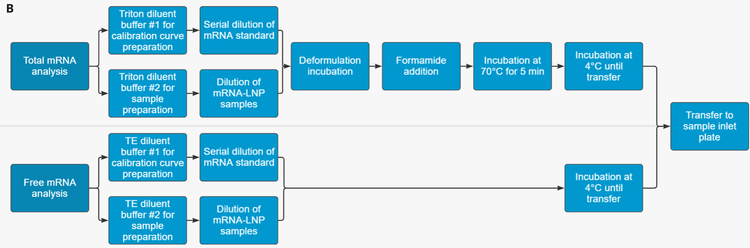
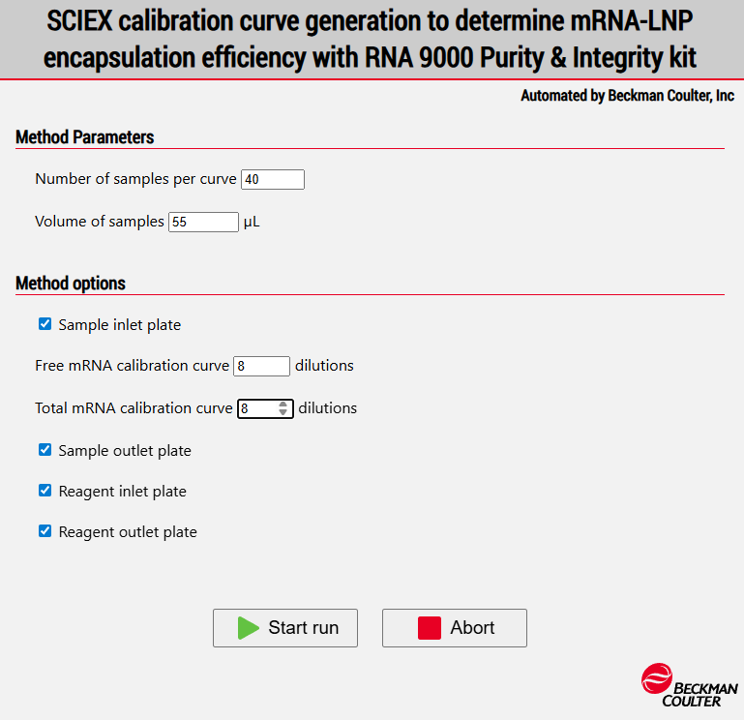
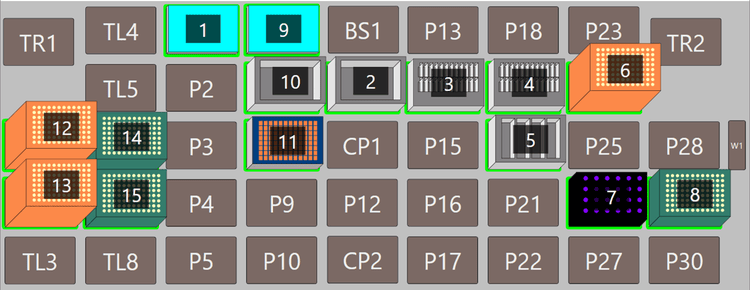
Automated sample and reagent preparation for the determination of encapsulation efficiency of the mRNA-LNP: To demonstrate the Biomek i7 Hybrid Automated workstation’s capability for supporting mRNA-LNP encapsulation efficiency determination, a full plate was processed (40 samples in addition to an 8-point calibration curve, each in TE buffer or in Triton buffer). The entire automated workflow is shown in Figure 2. After launching the method, selections were made for 40 samples at a final analysis volume of 55 μL, an 8-point fr ee mRNA calibration curve in TE buffer, an 8-point total mRNA calibration curve in Triton buffer, sample outlet plates, reagent inlet plates, and reagent outlet plates on the MOS, as shown in Figure 3. The MOS provides a structured, step‑by‑step approach to experiment setup, complemented by the Guided Labware Setup (Figure 4) for accurate deck configuration and reagent volume calculations. Users can choose from 1 to 40 samples, at a final volume of 50 to 100 μL. For calibration curves, users can choose between 3 and 8 dilutions. This automated workflow is flexible and supports customizable sample processing and throughput. Once the deck setup was completed, diluent buffers for calibration curves or sample dilution were prepared in TE or Triton X-100 using the Biomek i7 Hybrid Automated workstation. Then, the Triton diluent buffer #2 was added to the samples at 48 μL per well to release mRNA from the LNPs. The calibration curve in the Triton diluent buffer #1 was generated by serial dilution of the FLuc mRNA standard from 1 mg/mL to 7.8 μg/mL. The diluted standards (column 1) and samples (columns 2-6) were incubated at room temperature for 20 minutes on a shaker at 200 rpm. After that, equal volumes of formamide were added to each well, and the samples were incubated at 70°C for 5 minutes. Then, the plate was transferred to a cold plate for snap-chill. Next, FLuc mRNA standards were serially diluted in TE diluent buffer #1 to generate the calibration curve in column 7, followed by the addition of TE diluent buffer #2 (64 μL/well) to mRNA‑LNP samples (columns 8 -12) for free mRNA analysis . Subsequently, all preparation for the sample inlet plate, reagent inlet plate, sample outlet plate, and reagent outlet plate was also performed on the Biomek i7 Hybrid Automated workstation. Finally, sample separation and data processing were performed on the BioPhase 8800 system.
Results and discussions
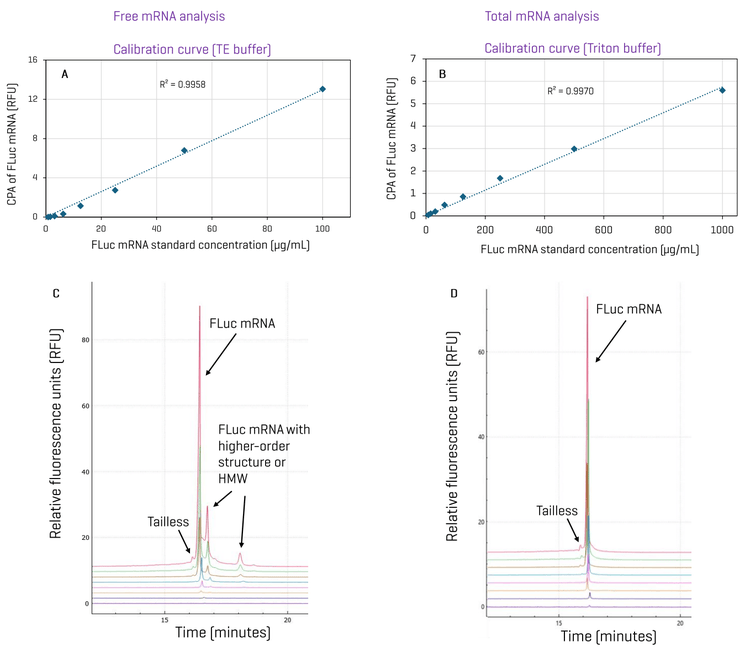
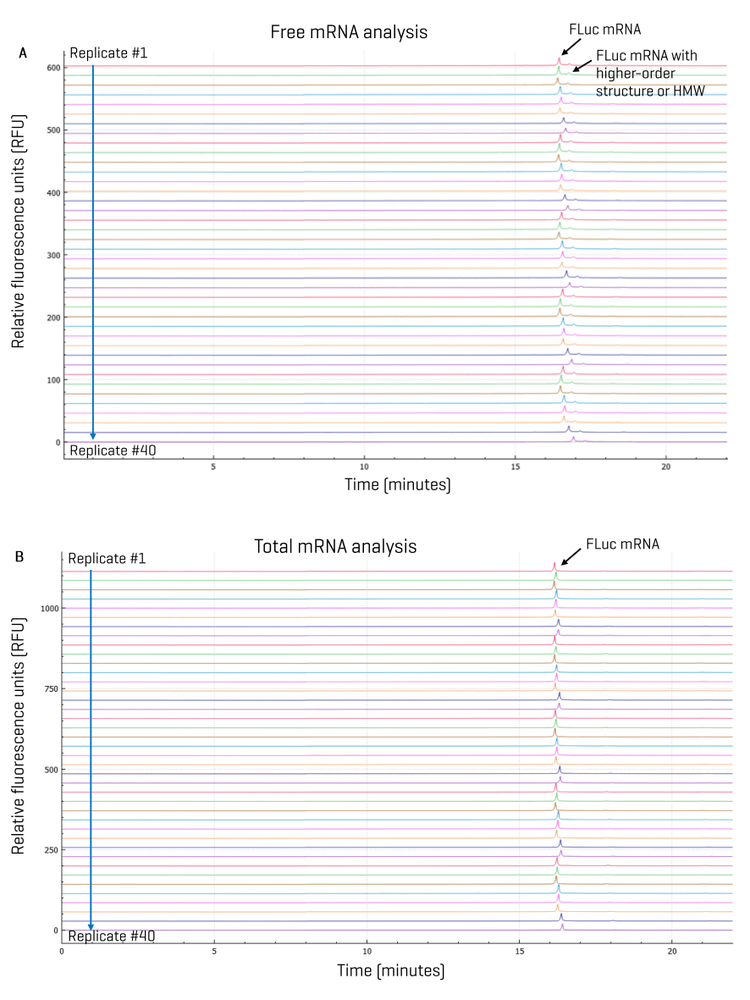
Fully automated mRNA- LNP EE% analysis: The RNA 9000 Purity & Integrity kit is a well‑established analytical tool for evaluating RNA integrity and purity.6-7 It was also used for manual EE% analysis previously.8 In this technical note, automated EE% analysis is performed with FLuc mRNA and FLuc mRNA‑loaded mRNA‑LNP samples as examples of the mRNA drug substance and the mRNA-LNP drug product. As shown in Figure 1 and described in the Methods section, the automation workflow for EE% analysis with the RNA 9000 Purity & Integrity kit on the Biomek i 7 Hybrid Automated workstation is flexible, supporting the processing of 1–40 samples, accommodating calibration curves with 8 or fewer data points, and allowing certain steps to be performed off deck to save reagents. As a practical demonstration of its robustness, EE% was performed on 40 replicates of the same mRNA-LNP sample. Serial dilutions of the FLuc mRNA standard in either TE or Triton buffer were performed by the Biomek i7 hybrid Automated workstation. The standards were then analyzed on the BioPhase 8800 system. Figures 5C and 5D show overlays of electropherograms obtained with serially diluted FLuc mRNA standards in TE or Triton buffer. CPA values of the FLuc mRNA peaks were plotted against their corresponding concentrations to generate the calibration curves in TE buffer (Figure 5A) and Triton buffer (Figure 5B). R2 values of 0.9958 and 0.9970 demonstrated excellent linearity. Stacked electropherograms of the mRNA-LNP samples analyzed for the free mRNA in TE buffer or the total mRNA in the Triton buffer are shown in Figures 6A and 6B. Consistent peak profiles were observed across replicates. No results were excluded, confirming the robustness of sample and reagent preparation by the Biomek i7 Hybrid Automated workstation. The average CPA value for free mRNA was 2.60, corresponding to a concentration of 20 μg/mL based on the calibration curve generated in TE buffer. The average CPA value for total mRNA was 2.63, corresponding to a concentration of 461 μg/mL based on the calibration curve generated in Triton buffer. The EE% for each mRNA‑LNP replicate was calculated and ranged from 94.6% to 96.4%, with an average EE% of 95.6% and a %RSD of <0.5%. These EE% results were comparable to the 95% EE% determined manually for the same mRNA-LNP sample in a previous study.8 Together, these results demonstrate that the fully automated EE% analysis workflow using the Biomek i7 Hybrid Automated workstation, the RNA 9000 Purity & Integrity kit, and the BioPhase 8800 system supports automated EE% determination of mRNA-LNP samples. In addition, the purity of the total mRNA was also assessed in these 40 mRNA-LNP samples. The average purity was 97% with a %RSD of <0.3%. These results demonstrate that the same automated workflow enables both EE% determination and assessments of mRNA purity and integrity.

Conclusions
- Single CE-based workflow for comprehensive mRNA-LNP analysis: Enables simultaneous assessment of EE%, mRNA purity, and integrity.
- Accurate, reproducible, and robust automated EE% workflow: Delivers EE% values (95.6% average) consistent with manual results (95%) across 40 replicates, with strong linearity (R² ≥ 0.995) and reproducibility (%RSD of <0.5%).
- Scalable, efficient EE% analysis without compromising data quality: Processes up to 40 samples within 9 hours with consistent performance, while reducing hands-on time and minimizing the risk of RNase contamination.
- LNP encapsulation enhances mRNA thermal stability and is detectable by the automated assay: Reveals temperature-and time-dependent degradation, with reduced full-length mRNA loss for encapsulated versus unencapsulated samples under thermal stress.
References
- Makkar, S.K. Advances in RNA -based therapeutics: current breakthroughs, clinical translation, and future perspectives. Front. Genet. 2025; 16:1675209.
- Camperi J. et al. Current Analytical Strategies for mRNA-Based Therapeutics. Molecules 2025, 30(7):1629.
- Sadaqa E. et al. The evolving landscape of mRNA therapeutics. Biointerface research in applied chemistry. 202 6;16(1):81.
- Biomek i5 and Biomek i7 Automated Workstations Instructions for Use. Beckman Coulter, Inc. P/N: B54473AD (March 2025)
- RNA 9000 Purity & Integrity kit for the BioPhase 8800 system, application guide, RUO-IDV-05-13438-D.
- Analytical procedures for the quality of mRNA vaccines and therapeutics (Draft guidelines: third edition). 2024. USP.
- Mantri P. et al. Comparison of capillary electrophoresis-based methods for the analytical characterization of purity and stability of in vitro transcribed mRNA. J Pharm Biomed Anal. 2024 Oct 15:249:116352.
- Analysis of quality attributes for mRNA vaccines and therapeutics by capillary electrophoresis. SCIEX white paper, MKT-36904-A.
Acknowledgment: We sincerely thank Acuitas Therapeutics Inc. for providing the FLuc mRNA and FLuc mRNA-loaded mRNA-LNP samples.