Abstract
Charge heterogeneity is a critical quality attribute (CQA) for monoclonal antibodies (mAbs), ADCs (antibody-drug-conjugates), and other protein therapeutics because charge variants can affect potency, stability, pharmacokinetics, and pharmacodynamics (PK/PD), and immunogenicity. Capillary isoelectric focusing (cIEF) is one of the most widely used analytical assays for this purpose.
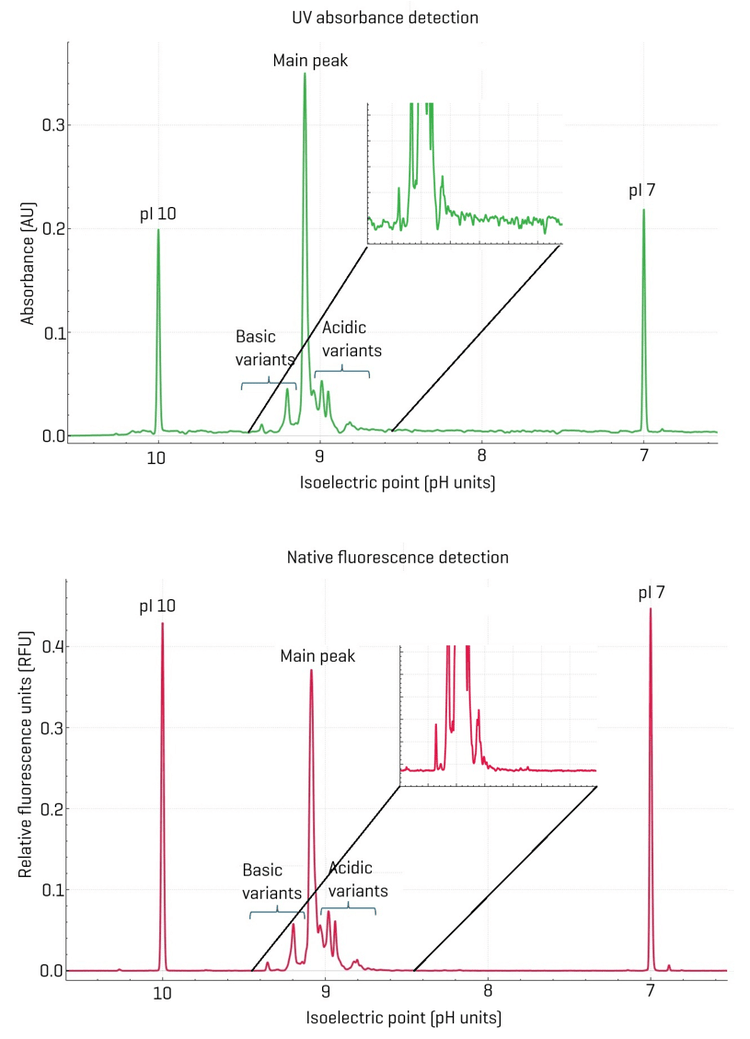
This technical note shows the side-by-side comparison between UV and NF detection schemes in cIEF separation using the BioPhase 8800 system in respect to separation profiles (Figure 1) and sample preparation repeatability.
Key Features
-
Time saving during data processing. The smoother and more stable baseline in NF allows for faster and more reliable data integration compared to UV, especially relevant when analyzing many samples.
-
Highly reproducible results between UV and NF detection modes, with an average percent relative standard deviation (%RSD) of 0.65% for area percentage composition of the main peak variant (Table 1).
-
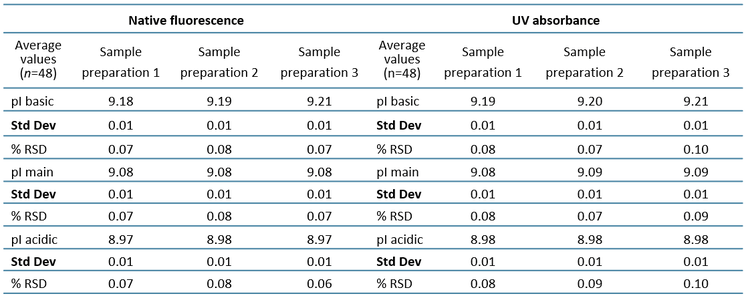
pI values are essentially identical between NF and UV for all three variants (differences ≤ 0.01–0.02), confirming method equivalence for variant positions in cIEF. The pI values found for NISTmAb charge variants are 9.1 for the main peak, pI 9.2 for the basic variant and pI 9 for the acidic variant
-
Robust workflow from sample preparation to data analysis:
- Pre-assembled cartridges are reliable and easy to use, enabling fast experiment setup without worrying about clog-prone microdevices.
- Master mix reduces low-volume related pipetting errors, increasing profile consistency.
- Same day results - robust separation of 8 samples in 60 minutes (7.5 minutes/sample), combined with friendly data processing software, enables the user to assess charge heterogeneity profile, quantify low and high abundant charge variant species, and determine pI on the same day. A feature that is especially important for in-process and analytical development samples.
- Integrated detection system allows for UV and NFD detection modes in the same sequence, saving method development time.
Introduction
cIEF creates a stable pH gradient inside a neutral-coated capillary using ampholytes. When an electric field is applied, proteins migrate until they reach their isoelectric point (pI), where their net charge is zero and migration stops. This results in highly resolved focus of the protein’s charge variants. The focused protein variants are mobilized past the detection point by means of a weak acid-base titration during the mobilization step, while maintaining the high-resolution achieved during the focusing step. Hence, cIEF can distinguish even minor differences in net charge, which is essential for critical quality attributes studies, biosimilar assessment, and comparability studies. Other charge variants arising from post-translation modification (PTMs), such as deamidation, glycosylation, oxidation, and C-terminal lysine clipping, are readily resolved.
Another notable feature of cIEF is that it provides a “charge fingerprint” for therapeutic proteins, which is critical for ensuring consistency across manufacturing lots and detecting deviations or process changes. Therefore, cIEF is widely used across the mAb lifecycle for identity testing, purity, and variant profiling. Additionally, cIEF supports regulatory expectations for monitoring charge heterogeneity, as part of product release and stability programs.
cIEF is compatible with two types of detection systems, absorbance at 280 nm (UV) and NF. A drawback of cIEF using UV detection is the high background noise from ampholytes. Ampholytes are a complex mixture of small amphoteric molecules that exhibit a strong absorbance at 214 nm, and a residual but still very intense signal at 280 nm contributing to the typical high baseline noise. Therefore, cIEF with NF detection is a great alternative to absorbance detection because it eliminates background noise, enhancing the ability to detect, profile and quantify low abundance species. This improved sensitivity is essential for detecting trace charge variants that may impact safety or efficacy.
Materials and Methods
Samples: NISTmAb, Humanized IgG1k Monoclonal Antibody (P/N: 5089359) was from SCIEX (Marlborough, MA). This molecule was diluted to 5 mg/mL in double deionized water prior to use.
Reagents: The BioPhase Capillary Isoelectric Focusing (cIEF) kit (P/N C30101), containing cIEF cathodic stabilizer, cIEF anodic stabilizer, cIEF gel, cIEF urea, cIEF anolyte, cIEF neutral capillary conditioning solution, cIEF catholyte, cIEF chemical mobilizer, cIEF formamide, and CE-grade water, was from SCIEX . BioPhase sample and reagent plates (4,4,8) (P/N 5080311), BioPhase sample plates (P/N 5080313), BioPhase reagent plates (PN 5080314), BioPhase outlet plates (P/N 5080315), and cIEF peptide marker kit (P/N A58481) were from SCIEX . The Pharmalyte IEF carrier ampholytes, broad range 3-10 (P/N 17- 0456-01, Cytiva) was purchased from VWR.
Capillaries and capillary cartridges: The cIEF experiments executed on the BioPhase 8800 system utilized the BioPhase neutral capillary cartridge- 8 x 30 cm, 50 μm inner diameter (P/N 5080119) from SCIEX.
Capillary electrophoresis instrument: The BioPhase 8800 system (P/N 5314860) equipped with UV, LIF, and NF detectors was from SCIEX. Data acquisition and analysis were performed using the BioPhase software version 1.5.
Instrument methods: The cIEF methods used in this study were described in the cIEF application guide.1
Sample preparation: pI marker master mix preparation enough for 8 wells. Mix 800 μL of 4M urea–cIEF gel, 100 μL cathodic stabilizer, 12 μL anodic stabilizer, 48 μL Pharmalyte 3–10, 8 μL each of 3 pI markers (pI 10.0, 7.0), and 32 μL of a 5 mg/mL NISTmAb. The mixture was thoroughly vortexed at room temperature and briefly centrifuged to collect the solution at the bottom of the tube. A 100 μL aliquot was dispensed into each well of the sample plate.
Results and discussion
Sample preparation repeatability
To investigate the reliability of the cIEF, 3 NISTmAb samples were prepared independently and separated using the BioPhase 8800 system with UV/NF.
With the purpose of exploring and evaluating the reproducibility of the assay, table 1 compares peak area percentages (PA%) for basic, main, and acidic charge variants of NISTmAb measured using two detection modes on the BioPhase 8800 system: NF and UV for the 3 sample preparations.
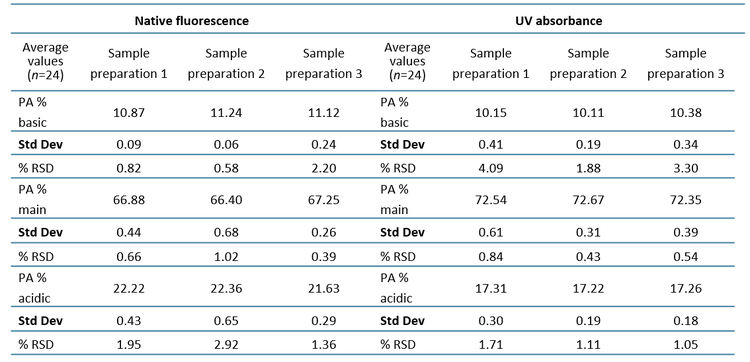
Table 1 shows that the overall low standard deviation for NF and UV detection schemes indicates highly reproducible results between the area percentage composition for the acidic, main, and basic isoform groups of NISTmAb. However, there is a considerable difference between the peak area percentage PA% between the UV and NF detection schemes.
Using NF detection, the substantially reduced baseline noise allows clearer discrimination between true peaks and background, particularly for minor species that would otherwise be lost or misclassified as noise in UV detection. As a result, the improved ability to detect low-abundance variants can lead to higher PA% values for acidic or basic species, with a corresponding decrease in the PA% of the main variant.
In summary, Table 1 shows that the lower standard deviation observed for NF compared with UV indicates that reduced baseline noise leads to substantially less data variability.
Table 2 reports the isoelectric points (pI) for the basic, main, and acidic charge variants of NISTmAb, measured side-by-side with NF and UV absorbance on the BioPhase 8800 system. It includes per-prep values, SD = 0.01 for every case, and very low %RSD (~0.06–0.10), demonstrating excellent repeatability and equivalence between detection modes.
The matching pI values confirm that variant positions in cIEF are independent of the detection mode, so NF and UV can be used interchangeably for identity/charge variant profiling without shifting the pI readouts.
The uniform SD = 0.01 and sub-0.1% RSD indicate high repeatability of sample prep and instrument performance, supporting lot-to-lot comparability, method transfer, and QC release applications.
In summary, table 2 reveals that the pI values are essentially identical between NF and UV for all three variants (differences ≤ 0.01–0.02), confirming method equivalence for variant positions in cIEF.
Conclusion
NF detection
- Stable baseline facilitates easy peak integration and time saving for data processing
- Produces a lower background, resulting in a clearer analytical signal.
- Shows higher consistency with lower %RSD values across replicates.
- Enables better detection of low-abundance species, particularly acidic variants.
UV detection
- Provides a higher relative area for the main peak.
- Exhibits greater variability in regions containing low-abundance variants.
- Shows higher ampholyte background noise, reducing sensitivity.