Abstract
NANOBODY® molecules, due to their small size and simple structure, are currently of interest as potential candidates for cancer drugs and in the treatment of autoimmune diseases.1 Multivalent NANOBODY®2,3 molecules are generated by linking individual NANOBODY® building blocks together, resulting in structures that are smaller than a classical monoclonal antibody (mAb).
Multivalent NANOBODY® molecules can exhibit a wide range of isoelectric point (pI) values due to the diversity of building blocks used in the formatting. Like mAb molecules, NANOBODY® molecules can be prone to chemical modification during their manufacturing process or storage, such as, deamidation or pyroglutamate formations resulting in acidic charge variants, whereas succinimides form basic isoforms. The assessment of these critical quality attributes (CQAs) is important, as these chemical modifications can impact the overall charge of the protein, ultimately reducing its stability and potency.4
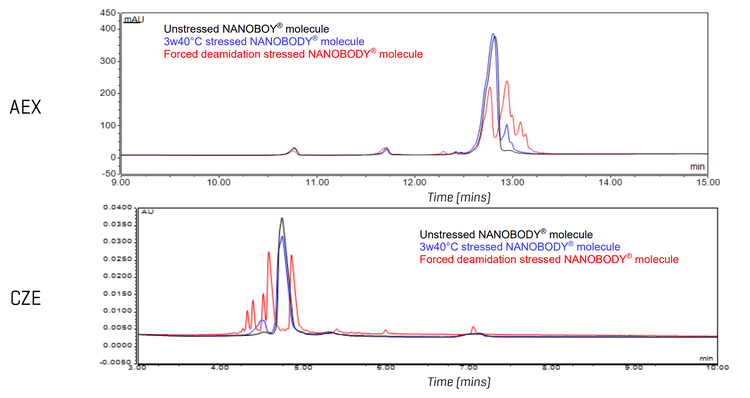
In classical CZE separation, the protein pI should always be higher than the pH of the CZE buffer so that the target proteins carry a charge and can move along the capillary towards the detector window when an electric field is applied. Normally, the pH of CZE buffer is at 5.7, which is designed to separate more basic protein molecules (above pI 7) in the classical separation. In this technical note, reversing the polarity of the applied field and using CZE to analyze acidic targets under the same classical buffer conditions was tested. The application of this approach to different NANOBODY® molecules which have been treated under various conditions to generate chemical modifications was studied. Additionally, the work also compares this approach with alternative separation modes, for example anion exchange separation (AEX) as shown in Figure 1.
Key features of CZE separation of acidic NANOBODY® molecules using a conventional buffer system
- Detection of PTMs on acidic proteins after thermal or chemical stress using the same CZE buffer used for classic separation
- Full examination of CZE separation mechanism of NANOBODY® molecules highlighted that the method could analyse acidic proteins whose pI was below 5.2 by simply reversing the polarity of separation using a classical CZE buffer without any modification.
- CZE provides faster and better resolving power than a platform AEX method for a NANOBODY® with pI < 5.2
Introduction
CZE is a widely adopted technique for separating and detecting charge variants in biopharmaceuticals. CZE was originally developed in 2011 by He et al.4 and subsequently subjected to industry ring trials in 2015.5 CZE is a robust method suitable for implementation in a GMP environment. CZE has been traditionally applied mainly to neutral or basic targets5,6 as the isoelectric point of the targets had to be above the pH of the CZE buffer which was traditionally set at 5.7. With the advent of more diverse protein structures the application of CZE to more acidic proteins are required. In this technical note the use of CZE buffers with pH 5.7 in the analysis of acidic NANOBODY® molecules was investigated.
Methods
Sample preparation: NANOBODY® molecules (45–75 kDa), originally at 10 mg/mL in formulation buffer containing amino acids (pH 4.4 –7.0), were diluted 10-fold with Milli-Q water before injection. Samples were stored in the autosampler during a batch analysis at 12°C for a maximum of 1 day.
CZE separation method:Samples were separated using a PA 800 Plus system (SCIEX). Before samples were tested, a bare fused silica capillary (length 30.2 cm, effective length 20 cm, 50 µm ID, SCIEX P/N: 338451) was conditioned with 0.1M HCl (5 min, 50 psi) and voltage conditioned (30 min, 30kV) after a CZE buffer rinse (5 min, 50 psi) using a commercially available buffer from the CZE Rapid Charge Variant Analysis kit (SCIEX, P/N: C44790)
Samples were then analyzed using a method that initially applies capillary equilibration by rinsing with 0.1M HCl (2 min, 40 psi) and the commercial CZE separation buffer (2 min, 40 psi). The sample was pressure injected (10 sec, 0.7 psi), followed by a post injection of water (10 sec, 0.1 psi). The sample was separated using reverse polarity (16 min, 30 kV, 1-min ramp) at 25°C.
At the end of a batch, a shutdown method was run that applied a rinse with 0.1M HCl (5 min, 50 psi) and water (5 min, 50 psi). An additional water rinse (10 min, 100 psi) was then performed.
CE detection: NANOBODY® molecule peaks were detected by UV adsorption at 214 nm using a 200 µm x 100 µm aperture and a data sampling rate of 4 Hz.
CE data processing:Data were collected using the PA 800 Plus system in 32 Karat software (SCIEX) and transferred in AIA format and processed in Thermo Scientific™ Chromeleon CDS (7.2.10).
Results and discussion
This investigation explored the use of a commercial CZE buffer, which was initially designed to analyze basic mAbs, for the analysis of more acidic NANOBODY® molecules. In classical CZE separation the buffer’s pH needs to be different from the pI of the target protein for it to have charge and move under an applied electric field. When the proteins have a lower pI than the buffer pH and a normal or positive voltage is applied to the capillary, the proteins will move in the reverse direction away from the detector window and will not be detected. For acidic proteins, a reverse polarity or negative field needs to be applied, which pushes the negatively charged proteins towards the detector window.
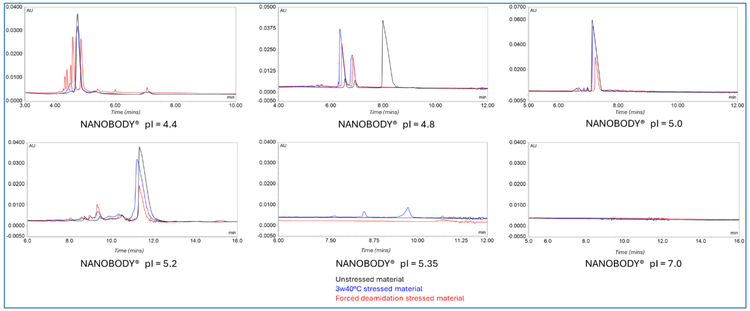
In Figure 2 the effect of the pI of the protein on the CZE separation on a series of different NANOBODY® molecules under the same conditions and using a commercial CZE buffer was studied. It was found that when the pI was above 5.35 no peaks were observed. This was expected as the pI of the NANOBODY® molecule was close to the pH of the separation buffer, preventing proteins from moving towards the detection window. As the pI of the proteins drops, separation improves and migration of the protein speeds up, producing good separation of thermally and forced deaminated stressed samples. When the pI of the NANOBODY® molecule was 5.35, only peaks associated with a thermally stressed sample were detected. This was because the protein’s pI was 0.4 pH units below that of the buffer.
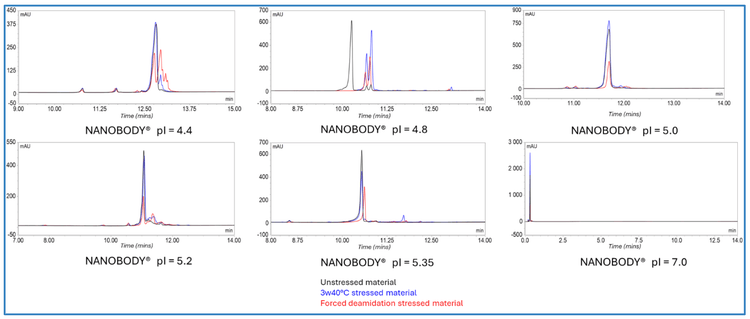
When the same proteins were analyzed by an in-house AEX method, as shown in Figure 3, separations of the NANOBODY® molecules at pI 5.35 and 5.4 were obtained. However, no separation of the NANOBODY® molecule at pI 7 was observed as the protein did not interact with the AEX stationary phase and eluted very early in the dead volume of the column (< 1 minute).
Direct comparison between the CZE and AEX separation of an acidic NANOBODY® molecule with a pI of less than 5.0, as highlighted in Figure 1, shows that CZE provides both faster separation (except for the pI 5.2 NANOBODY® molecule) and better resolution than AEX.
Conclusion
- Compared to AEX for NANOBODY® molecules with pI <5.2, CZE was found to be faster and more resolutive than the corresponding in-house AEX method.
- Analysis of acidic NANOBODY® molecules (pI below 5.2) is optimally performed under reverse polarity conditions utilizing the commercial CZE buffer from SCIEX .
- To achieve optimal separation when pI is close to the pH of the buffer (pH range 5.2- 6.2) it is recommended to adjust the pH of the CZE buffer to maintain a minimum differential of 0.5 units from the expected pI of the protein.
- For proteins higher in pI (> 6.2), it is recommended to use the classical separation (applicable for basic proteins) as previously described7.
References
- Jin B-k., et al (2023). NANOBODIES®: A review of generation, diagnostics and Therapeutics. Int. J. Mol. Sci. 2023, 24, 5994, 1-22.
- Jovčevska I and Muyldermans S (2020),The Therapeutic Potential of Nanobodies. BioDrugs 34:11–26.
- Ingram JR, Schmidt FI, Ploegh HL (2018), Exploiting Nanobodies’ Singular Traits. Ann Rev Immunol 36:695–715.
- He, Y., et al. (2011), Rapid analysis of charge variants of monoclonal antibodies with capillary zone electrophoresis in dynamically coated fused-silica capillary, J. Sep. Sci., 34 (5), p.548-555.
- Moritz, B. et al. (2015). Evaluation of capillary zone electrophoresis for charge heterogeneity testing of monoclonal antibodies, J. Chromatogr. B., 983-985, 101-110.
- Moritz, B. et al. (2017). Optimization of capillary zone electrophoresis for charge heterogeneity testing of biopharmaceuticals using enhanced method development principles. Electrophoresis 38 (24), 3136-3146.
- ejaegere,D. et al. (2023). Rapid charge variant analysis of NANOBODY® using capillary zone electrophoresis (CZE). Sciex application note document number MKT-29481-A.