Abstract
This technical note highlights the power of an EAD data-dependent acquisition (DDA) platform method1-4 for the identification of product quality attributes (PQAs) of a monoclonal antibody (mAb) and their quantification and monitoring using a single injection as part of a multi-attribute method (MAM). The streamlined MAM workflow that links the Biologics Explorer software to compliance-ready SCIEX OS software will also be demonstrated.
Introduction
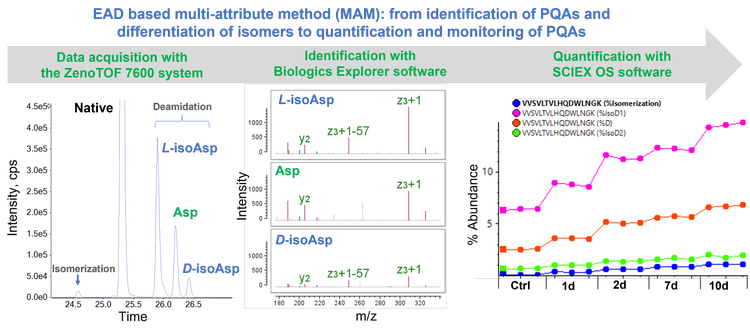
MAM is a powerful LC-MS method for simultaneously monitoring and quantifying multiple PQAs or critical quality attributes (CQAs) of a biotherapeutic. Traditionally, CID-based MS/MS is employed as the first step for identification, followed by quantification with either only MS or MS and MS/MS workflows. However, full sequence confirmation, including the differentiation of leucine vs. isoleucineand aspartic vs. isoaspartic acid (Asp vs . isoAsp) for deamidated peptides and the localization of fragile modifications, such as glycosylation, are not possible with CID-based MS/MS methodologies. Hence, the CID-based identification workflow must rely on complementary MS/MS techniques that use more advanced instrumentation in separate experiments before quantification of selected species can be performed. This challenge can be addressed using the EAD platform method5,6, which enables confident and accurate identification, quantification and monitoring of PQAs with MAM in a single injection (Figure 1).
Key features of an EAD-based MAM workflow
- Confident PQA identification and differentiation of isomers: The single-injection EAD platform method allows differentiation of isomers and PTMs that are challenging for traditional characterization and MAM methods
- Streamlined data flow: A customizable PQA list connects peptide mapping results in the Biologics Explorer software with PQA quantification and monitoring in a compliance-ready environment in SCIEX OS software
- Powerful software for peptide mapping: The Biologics Explorer software offers powerful algorithms and optimized workflows for peptide mapping and PQA selection
- Compliance-ready: PQA quantification and monitoring are performed in compliance-ready SCIEX OS software
Methods
Sample preparation: The stock solution (10 µg/µL) of NISTmAb (reference material #8671, NIST) was aliquoted into 5 vials. One aliquot (control) was kept frozen and thawed prior to trypsin digestion. The remaining 4 aliquots of NISTmAb were heated at 60ºC for 1 day, 2 days, 7 days or 10 days, respectively. Trypsin digestion of the control and heat-stressed samples was performed following denaturation by guanidine-hydrochloride, reduction with dithiothreitol and alkylation using iodoacetamide. Each sample was analyzed in technical triplicates.
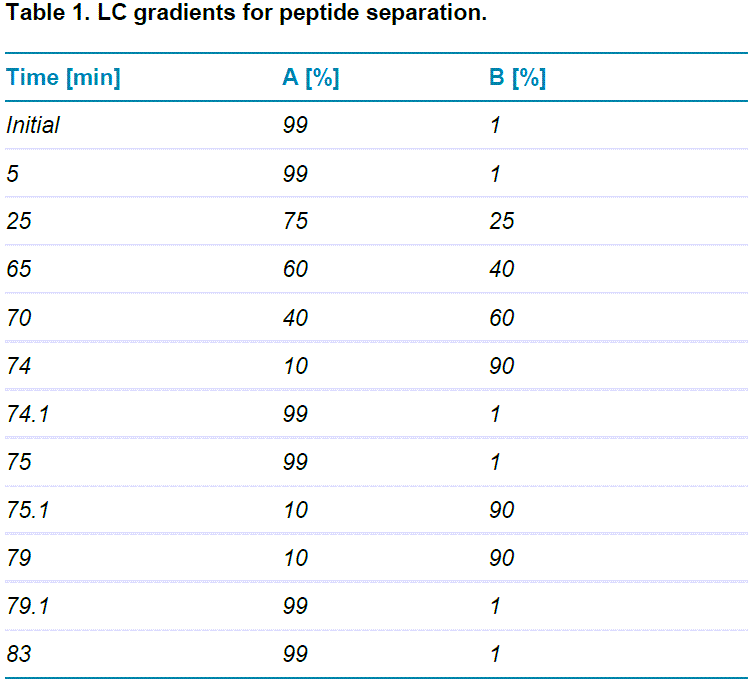
Chromatography: Peptides were separated using an ACQUITY CSH C18 column (2.1 x 150 mm, 1.7 µm, 130 Å, Waters), which was kept at 60ºC in the column oven of an ExionLC system (SCIEX). Table 1 shows the LC gradient used for peptide separation at a flow rate of 0.25 mL/min with mobile phases A and B consisting of 1% formic acid in water and 0.1% FA in acetonitrile, respectively.
Overview of MAM workflow
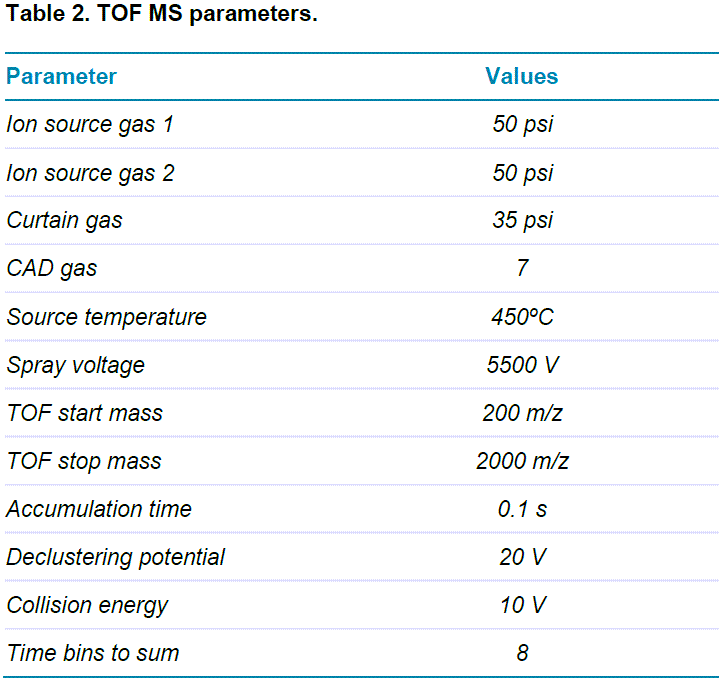
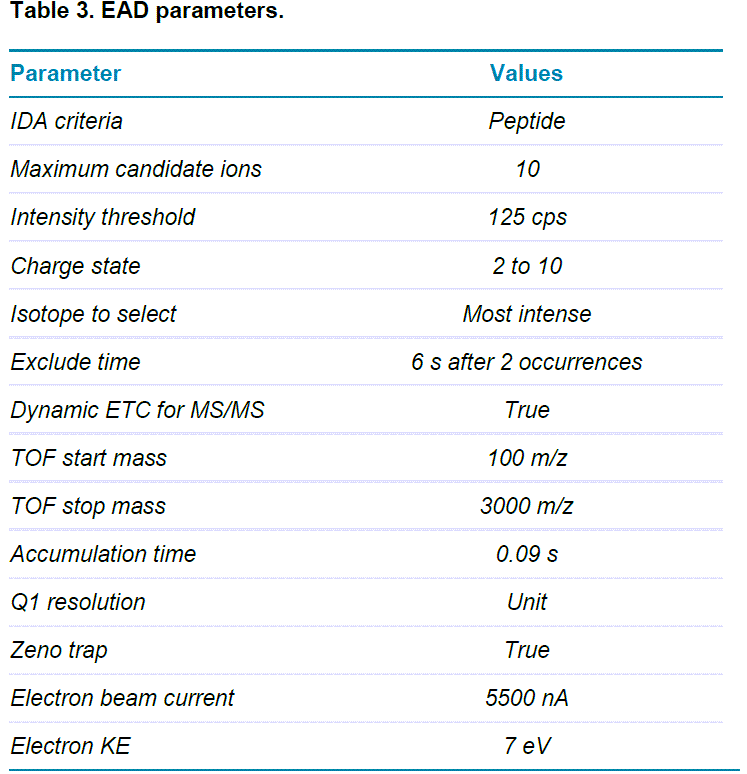
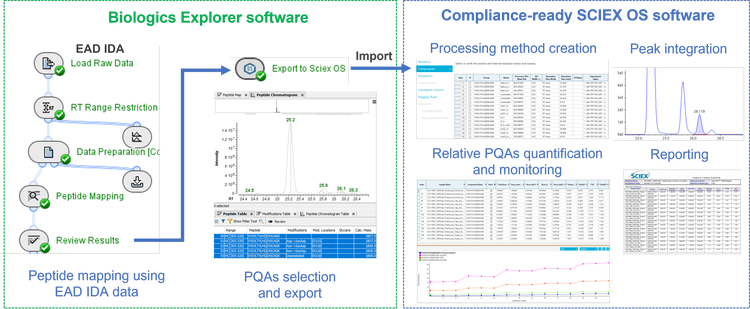
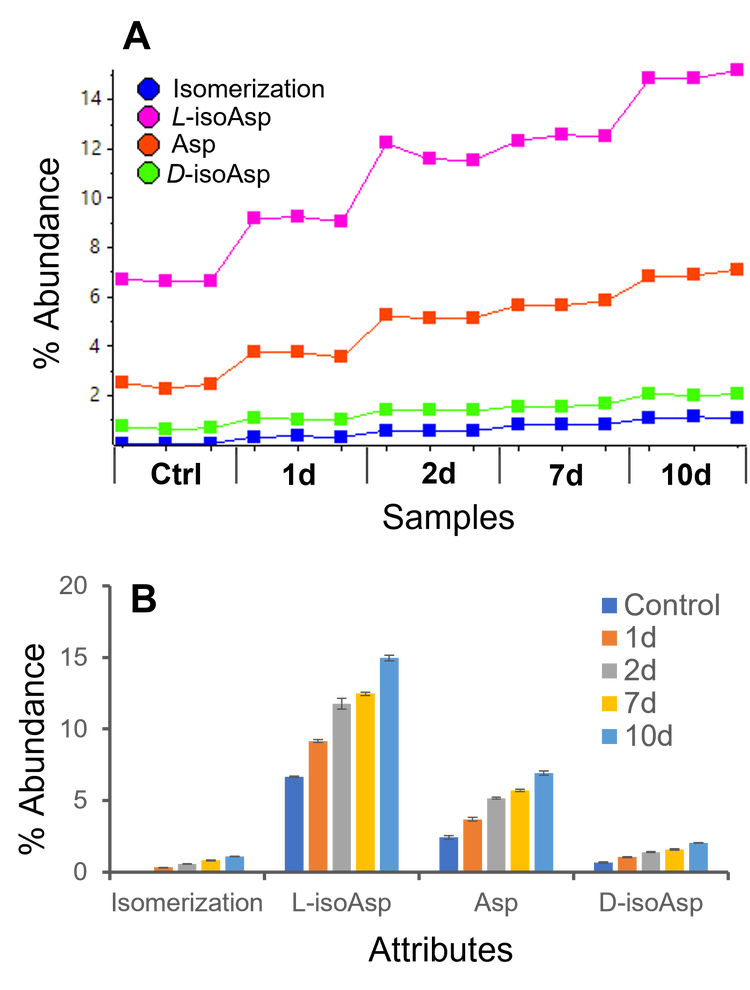
The MAM workflow described in this technical note takes advantage of the power of the EAD DDA platform method for confident peptide identification and differentiation of isomers, the robust ability of the Biologics Explorer software for peptide mapping and PQA selection and the trusted capability of SCIEX OS software for peak integration, quantification and reporting in a compliance-ready environment. The data flow for this MAM workflow is illustrated in Figure 2. The EAD DDA-based data acquired with the ZenoTOF 7600 system are processed using an optimized peptide mapping workflow template in the Biologics Explorer software. The PQAs confidently identified from peptide mapping are selected and exported to a PQA list (.TXT file), which serves as a connection between the Biologics Explorer software and SCIEX OS software. The PQA list can be directly imported into a processing method within SCIEX OS software. The peaks are then automatically integrated using the well-established MQ4 algorithm. These peak areas are used in the formula function within SCIEX OS software for the calculation of the percent abundances of PQAs. A metric plot can automatically be generated to visualize changes of the percent modification for studies of forced degradation or stability, for example. Finally, a custom report of the results can be generated and exported in different file formats, such as .doc or .pdf.
The isomerization and deamidation peaks of the peptide VVSVLTVLHQDWLNGK (abbreviated as “VVSV peptide”) from the heavy chain of the NISTmAb, HC [305-320], was examined as an example to demonstrate the power of EAD for the differentiation between Asp and isoAsp isomers and the streamlined MAM workflow for the relative quantification of these species.
Confident identification of PQAs using EAD
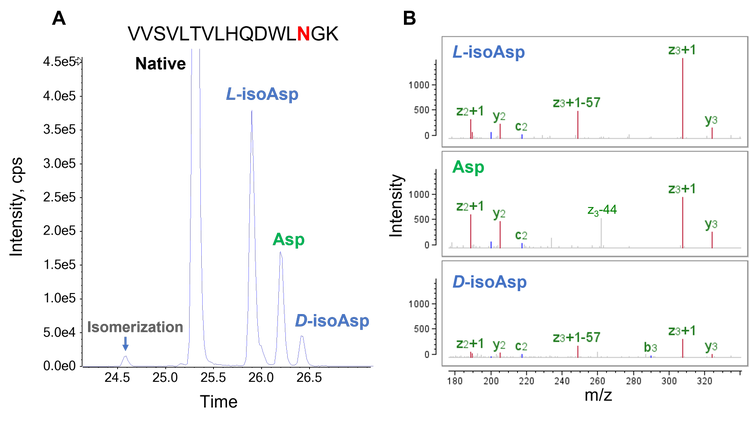
The EAD platform method is a powerful tool for confident identification and in-depth characterization of a wide range of peptides in a single injection, due to its unique capability for the preservation of labile modifications and differentiation of isomers without the need for optimization.2-6 Figure 3 highlights the chromatographic separation and identification of the isomerization and deamidation species of the VVSV peptide. While the identification of the isomerization peaks and the localization of deamidation at the Asn residue are straightforward even with CID-based methodologies, the differentiation of the 3 deamidated peaks eluting after the native species poses a challenge for standard MS/MS approaches. The detection of a signature isoAsp fragment (z3–57) derived from EAD enabled the confident assignment of these 3 deamidated peaks (Figure 3B), 2 of which were present as the isoAsp and 1 as the Asp form. The presence of these 2 isoAsp species can be attributed to aspartic acid racemization, as studied previously8,9, resulting in partial conversion of the L-form (L-isoAsp) to its racemic D- counterpart (D-isoAsp). These results demonstrate the importance of using EAD for accurate identification of PQAs.
Selection and export of PQAs
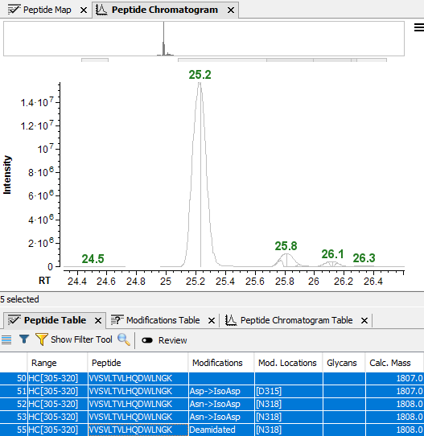
The Biologics Explorer software offers intuitive control and powerful visualization for reviewing results and selecting PQAs. As illustrated in Figure 4, the isomerization and deamidation peaks of the VVSV peptide were selected in the peptide table, with their XICs displayed in the peptide chromatogram tab above the table. The PQAs selected were exported into a .TXT file using the “Export to Sciex OS” node in the Biologics Explorer software. Subsequently, this file was imported for creating the quantification method.
Peak integration, relative quantification and monitoring of PQAs
In the MAM workflow, the creation of the processing method, peak integration and relative quantification of PQAs were all performed using the Analytics module within SCIEX OS software (Figure 2).
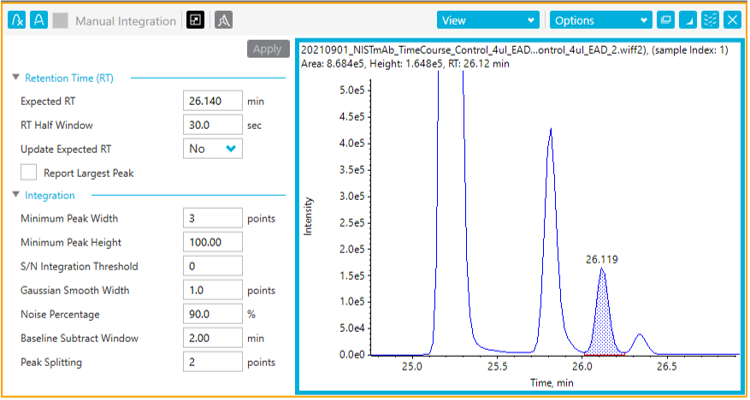
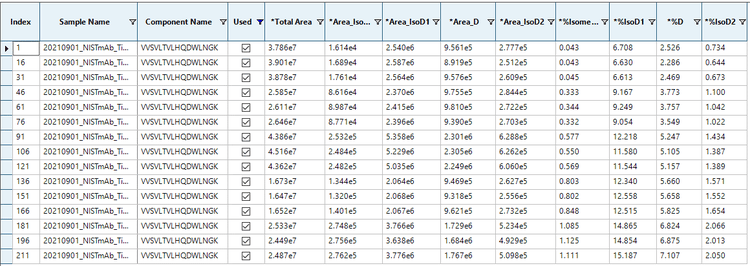
The Analytics module offers the powerful and well-established MQ4 algorithm for reproducible peak integration with minimal optimization. A comprehensive set of adjustable parameters is accessible to advanced users who may want to fine-tune the integration for certain applications. In this study, each isomer of the deamidated VVSV peptide was properly integrated with the defined quantification method (Figure 5), leading to accurate quantification of these species.
Conclusion
- Confident identification of PQAs and unambiguous differentiation of their isomers are critical for the successful implementation of a MAM
- Differentiation between Asp and isoAsp isomers from peptide deamidation, an essential class of PQAs that may affect a drug’s efficacy and safety, was achieved with a DDA platform method using EAD
- Efficient identification was enabled in the Biologics Explorer software through ready-to-use workflow templates that provided confident peptide mapping results and visualization tools with the ability to export a PQA list to SCIEX OS software for quantification
- The compliance-ready SCIEX OS software offered robust algorithms and tools for peak integration and relative quantification of PQAs
- An effective MAM workflow from identification to quantification was achieved by data flow between the Biologics Explorer software and compliance-ready SCIEX OS software
References
- Takashi Baba, Pavel Ryumin, Eva Duchoslav et al. (2021) Dissociation of biomolecules by an intense low-energy electron beam in a high sensitivity time-of-flight mass spectrometer. J. Am. Soc. Mass Spectrom. 32(8):1964-1975.
- Comprehensive peptide mapping of biopharmaceuticals utilizing electron activated dissociation (EAD). SCIEX technical note, RUO-MKT-02-12639-B.
- A new electron activated dissociation (EAD) approach for comprehensive glycopeptide analysis of therapeutic proteins. SCIEX technical note, RUO-MKT-02-12980-A.
- An evaluation of single injection platform method for advanced characterization of protein therapeutics using electron activation dissociation (EAD). SCIEX technical note, RUO-MKT-02-13965-A.
- Differentiation of aspartic and isoaspartic acid using electron activated dissociation (EAD). SCIEX technical note, RUO-MKT-02-12550-B.
- Differentiation of leucine and isoleucine using electron activated dissociation (EAD). SCIEX technical note, RUO-MKT-02-12605-B.
- Nadezda Sargaeva et al. (2009) Identification of aspartic and isoaspartic acid residues in amyloid β peptides, including Aβ 1-42, using electron-ion-reactions. Anal. Chem. 81(23): 9778-9786.
- Marine Morvan and Ivan Miksik. (2021) Recent Advances in Chiral Analysis of Proteins and Peptides. Separations 8(8): 112.
- Seongmin Ha, et al. (2017) Identification of ᴅ-amino acid-containing peptides in human serum. PLoS ONE 12(12): e0189972.
- Compliant attribute monitoring for biopharmaceutical product quality attributes employing intact mass analysis. SCIEX technical note, RUO-MKT-02-11314-A.
- A liability study on oxidation using SCIEX OS software 1.7 for intact MAM. SCIEX technical note, RUO-MKT-02-11551-A.