Abstract
This technical note highlights the capability of a capillary electrophoresis (CE)-based method for recombinant adeno-associated virus (rAAV) capsid protein characterization of in-process control (IPC) samples with a magnetic bead-based sample clean-up. The rAAVs are a common class of delivery vehicle for gene therapy due to their non-pathogenicity, low immunogenicity, and broad tropism. Each rAAV is composed of a protein shell called capsid and a single stranded DNA payload inside the capsid. The capsid is mainly made up of three viral proteins (VPs): VP1, VP2 and VP3. The capsid surface plays an important role in cell binding and transduction efficiency.1 Good process controls are critical to ensure that rAAV-based therapies are safe, effective, and manufacturable at scale.2 However, analyzing IPC samples face many challenges. IPC samples are often crude mixtures with low titer3 and contain cell debris, plasmids, host nucleic acids and proteins that could interfere with analysis through matrix effects. IPC sample analysis also requires a quick turnaround time for fast, informed decision-making. This technical note describes the optimization of a high-resolution, high-sensitivity CE-SDS-LIF (laser-induced fluorescence detection) method for fast rAAV capsid protein analysis of IPC samples and viral titer estimation in final rAAV products on a multi-capillary CE platform.
Key features
-
Showcases the capability of CE-SDS-LIF, together with a magnetic bead clean-up, to assess the quality of AAV capsid proteins in IPC samples in 2 hours, enabling fast decision making during the rAAV manufacturing process.
-
Demonstrates the capability of CE-SDS-LIF in viral titer estimation of final rAAV products.
-
Highlights how the BioPhase 8800 system can be used to speed up method development for different AAV serotypes.
-
Demonstrates the application of CE-SDS-LIF to various AAV serotype samples including AAV2, AAV5, AAV8 and AAV9
Introduction
The rAAV is one of the most widely used gene delivery vehicles for gene therapy. The AAV capsid is composed of 3 main proteins, which are approximately 87 kDa (VP1), 73 kDa (VP2), and 61 kDa (VP3) in size.4 Good process controls in the manufacturing of rAAVs are critical due to the complex nature of gene therapy products and the stringent requirements for safety, efficacy, and consistency.1 Monitoring the manufacturing process with quality assessment of IPC samples is crucial for maintaining process control and providing insights for process improvements.2 However, the viral titer of IPC samples could be at 1 x 10¹⁰ VP (viral particles)/ML or even lower,3 which is below the detection limit of UV absorbance assays and thus requires LIF detection. Over recent years, CE-SDS with LIF detection has been used to profile proteins by size in low-concentration protein samples.5 Protein labelling using Chromeo P503 has enabled the viral protein ratio to be measured in low-titer AAV products in quality control (QC) samples, but has not been applied to in-process samples.6
In this study, a published CE-SDS-LIF method for rAAV capsid analysis6 was implemented in a new lab after the sample preparation conditions for new rAAV serotypes were quickly optimized using the multi-capillary BioPhase 8800 system. The optimized method was used for viral titer estimation of the final rAAV products. Furthermore, the capability of the CE-SDS-LIF method, together with the use of magnetic bead cleanup, in analyzing the IPC samples at various production stages was demonstrated and provided insights for a better understanding of the rAAV manufacturing process.
Methods
Chemicals: The BioPhase CE-SDS Protein Analysis kit (P/N: C30085) with the CE-SDS Separation Buffer and SDS-MW Sample Buffer and the 10 kDa Internal Standard (P/N: A26487) were from SCIEX (Marlborough, MA). The Chromeo P503 dye (P/N: 30693-1MG) and dimethyl sulfoxide (DMSO) (P/N: 472301-100ML) were from Millipore Sigma (Burlington, MA); the Dynabeads CaptureSelect AAVX Magnetic Beads for cleanup (P/N: 2853522001) and dithiothreitol (DTT) (P/N: P2325) were from Thermo Fisher Scientific (St. Louis, MO).
Sample preparation: 5 μL of AAV sample, diluted to around 1 x 10¹³ GC/mL in nuclease-free water was mixed with 5 μL of SDS-MW Sample Buffer and 4 μL of 1M DTT in water. Then, 2 μL of 10 kDa Internal Standard pre-diluted 1:500 was added, and the sample was reduced. The labelling was done by the addition of 1 μL of Chromeo p503 dye working solution (prepared by a 1 to 100 dilution of the 1 mg/mL stock solution in DMSO) and incubated at 90°C for 10 minutes (min). Then, water was added to reach a final volume of 100 μL and incubated at 90°C for another 10 min. 100 μL of the diluted, prepared sample solution was transferred into a well of the sample plate for analysis on the BioPhase 8800 system. Samples with AAV2, AAV5, AAV8, and AAV9 serotypes were prepared following the same sample preparation procedure. When magnetic beads were utilized for sample clean-up, the procedure from the supplier of the beads was followed.
CE-SDS separation method: Separations were performed using the BioPhase 8800 system and a BioPhase BFS Capillary Cartridge – 8 x 30 cm (P/N: 5080121). Each 50 μm I.D. bare fused silica (BFS) capillary had a 20 cm effective length.
Capillary conditioning: 0.1M NaOH rinse for 2 minutes at 70 psi, 0.1M NaOH rinse for 8 minutes at 20 psi, 0.1M HCl rinse for 5 minutes at 20 psi, CE Grade Water rinse for 2 minutes at 20 psi, and CE-SDS Separation Buffer rinse for 10 minutes at 80 psi before each run. The applied electric field strength was 500 V/cm for all capillary electrophoresis analyses in reversed polarity mode (anode at the detection side). The samples were electrokinetically injected at 5 kV for 60 seconds.
CE detection: Dye-labelled AAV proteins were detected using a LIF detector, which employed a solid-state laser with an excitation wavelength of 488 nm and a 600 nm bandpass emission filter.
CE data processing: The BioPhase software version 1.2.22 was used for data acquisition and processing.
Results and discussion
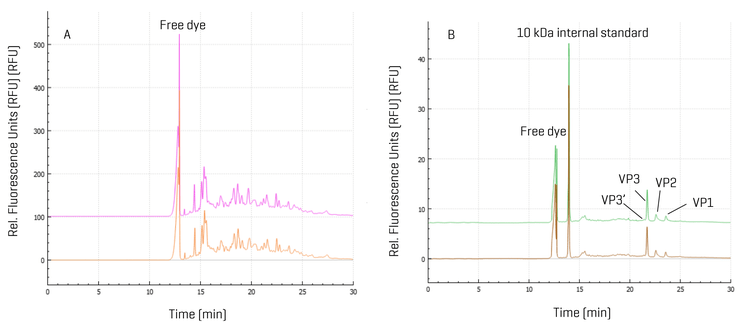
High-resolution, high-sensitivity capsid protein analysis of IPC samples by CE-SDS-LIF with a sample cleanup by magnetic beads: An AAV8 IPC sample was analyzed for capsid proteins on the multi-capillary BioPhase 8800 system by CE-SDS-LIF with p503 dye labelling. In Figure 1, panel A shows the results obtained when the IPC sample was not purified with the AAVX magnetic beads. The sample was analyzed in two replicates. In both traces, although many protein peaks were present, the AAV viral capsid protein peaks were not detected. Panel B in Figure 1 illustrates the results obtained with the same IPC sample after the sample was cleaned up using the AAVX magnetic beads. The three VP proteins: VP1, VP2, and VP3, were detected and baseline-resolved. Furthermore, a VP3 variant, VP3’, was also detected and well separated from the VP3 peak. The difference between VP3 and VP3’ was 8 amino acids or about 900 Daltons due to an alternative translation starting site for this serotype as described in published literature.7 These results demonstrated the high resolving power of the CE-SDS-LIF workflow on the BioPhase 8800 system and the capability of high-sensitivity analysis of capsid proteins in IPC samples when used together with a magnetic bead-based sample cleanup.
The detailed description of the optimization of the CE-SDS-LIF workflow for AAV capsid protein analysis is provided below.
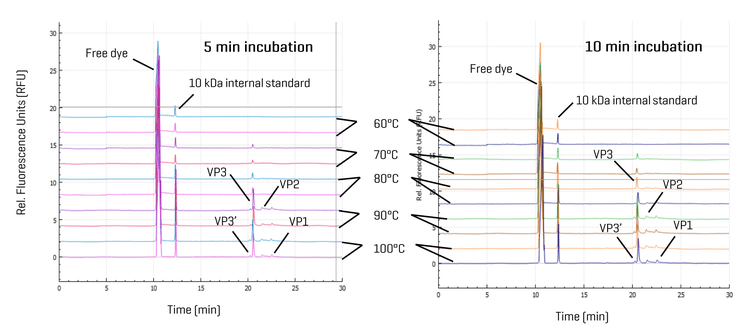
Optimization of sample preparation conditions: In the first stage of this project, the dye labelling conditions were optimized. The BioPhase 8800 system’s ability to inject eight samples simultaneously allowed five labelling temperatures and two incubation times to be tested simultaneously, making method optimization efficient (Figure 2). The signal level for VP proteins was below the detection limit at the labelling temperature of 60°C. At a 70°C labelling temperature, only the VP3 peak was detected. At 80°C, all 3 VP peaks were detected. There was better consistency found at 10 minutes of incubation time than at 5 minutes. The signal of all 3 VP peaks was significantly higher at 90°C and plateaued at 100°C. At 80°C, 90°C, and 100°C of labelling temperature, the signal level was slightly higher at 10 minutes of incubation time than at 5 minutes. Therefore, the optimal labelling temperature was determined to be 90°C, and the optimal incubation time was identified as 10 minutes. Excellent resolution was obtained between VP1, VP2, VP3, and VP3’ peaks. The resolution between VP3 and VP3’ peaks demonstrates the outstanding resolving power of the CE-SDS-LIF workflow on the BioPhase 8800 system. Due to the small size difference between VP3 and VP3’, VP3’ was not well separated from VP3 by SDS-PAGE with silver staining. It only became well identified when CE-SDS was used for AAV capsid protein analysis.7 Furthermore, a VP3 fragment, a separation condition-related artifact during liquid chromatography (LC) analysis of capsid proteins, was not present in the analysis by CE-SDS.7 Therefore, CE-SDS provides improved performance for AAV capsid analysis compared to SDS-PAGE and LC.
In addition to the labelling temperature and time, the volume of DTT solution required (1, 2, 4, or 6 μL), the amount of SDS-MW Sample Buffer used to denature the sample (12, 18, and 24 μL), the concentration of dye solution (0.2 mg/mL and 0.1 mg/mL) were also optimized using an AAV8 sample (data not shown).
The optimized conditions used for sample preparation included adding Chromeo p503 dye (1 μL at 0.1 mg/mL), 10 kDa internal standard (2 μL, pre-diluted 1:500), SDS-MW Sample Buffer (12 μL), and 1M DTT (4 μL) to the AAV sample (5 μL).
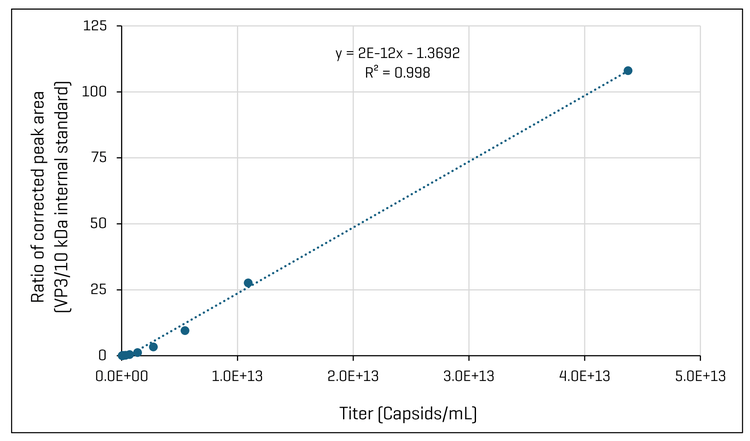
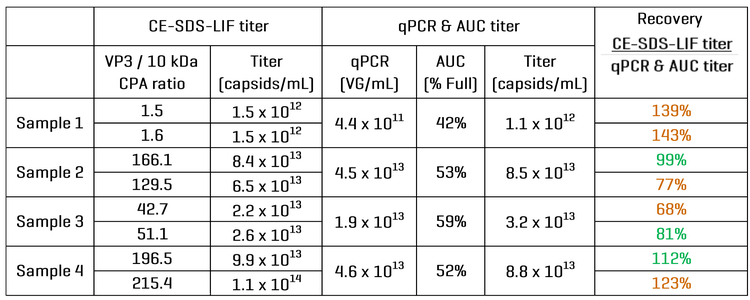
Estimation of viral particle concentration in AAV samples by CE-SDS-LIF: After the sample preparation conditions were optimized, the linearity of the detector response to the AAV titer was evaluated. AAV8 samples were serially diluted from 4.38 x 10¹³ to 4.27 x 10¹⁰ capsids/mL, reduced, and labelled under the optimized conditions. The detector response was evaluated using the ratio of the corrected peak areas of the VP3 and the 10 KDa internal standard, which helped to normalize the effect of labelling efficiency and injection volume during the analysis. Figure 3 shows that with a detector PMT gain setting of 10, an excellent linear response was observed with an R2 value of 0.998 when the peak area ratio of VP3 to 10 kDa internal standard was plotted against the AAV8 titer. The AAV titer values of 4 AAV8 samples were determined using the standard curve displayed in Figure 3. Separately, the same 4 AAV8 samples were analyzed by an orthogonal method that measures the genome titer by real-time PCR (qPCR) and the percentage of full capsids by analytical ultracentrifugation (AUC). Since AAV samples contain both empty and full capsids, but only full capsids are detected by qPCR, when converting the genomic titer to capsid titer, it is necessary to take into account the empty particles in the AAV sample. Therefore, with this orthogonal method, the AAV capsid titers for these 4 samples were determined by dividing the genome titer by the percentage of full capsids from AUC. The AAV titers determined using the CE-SDS-LIF method were similar to those obtained with the orthogonal method (Table 1). The recovery was calculated by dividing the titer obtained by CE-SDS-LIF by the titer obtained by the orthogonal method, the “qPCR & AUC titer”. The recovery was in the range of 68% to 143%. This was in line with the consideration that the CE-SDS-LIF is a totally different methodology from the qPCR and AUC. In addition, the capsid titer determined using qPCR and AUC results may have a stack-up effect due to variations from both methods.
Analysis of IPC samples: AAV production is a long and complicated process. Monitoring the quality of IPC samples allows for real-time adjustments to the production process, improving yields and reducing waste. The CE-SDS-LIF approach with sample preparation conditions optimized for QC samples was then applied to IPC samples at different stages of AAV production. However, the number of AAV capsids in IPC samples is significantly lower than in the QC samples. Consequently, the AAV samples need to be enriched before capsid protein analysis. As shown in Figure 1A, when the unpurified, unlysed AAV8 harvest was analyzed by CE-SDS-LIF with Chromeo p503 dye, none of the VP proteins were detected due to high background noise from impurities. The viral proteins were hidden among the peaks of other proteins present in the unpurified samples. In contrast, as shown in Figure 1B, when the unlysed AAV8 harvest was cleaned up using magnetic beads, all the VP proteins were detected and well resolved consistently in two different experiments. Similar results were also obtained with lysed AAV8 harvest and lysed AAV9 harvest samples (data not shown). Since the unlysed and lysed harvests occur early in the AAV production process, the capability of CE-SDS-LIF, in combination with magnetic bead cleanup, enables the early detection of process changes that may affect the quality of the AAV. The total analysis time of IPC samples was 2 hours, from magnetic bead cleanup to labelling by p503 dye to finishing the separation on the BioPhase 8800 system. This is faster than the 4 to 6 hours analysis time by ELISA, enabling faster decision-making during process improvements of rAAV production.
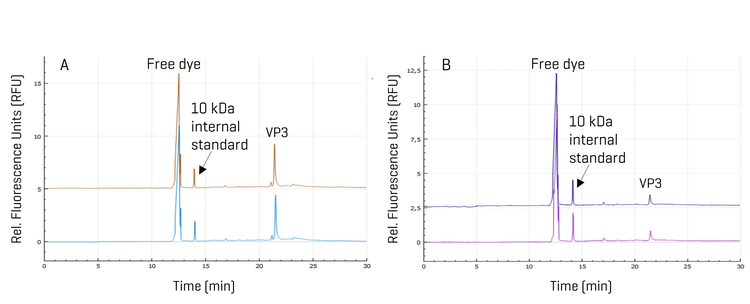
Analysis of other AAV serotypes: To further investigate whether this approach could be applied to additional serotypes, unlysed harvest samples from serotypes AAV2 and AAV5 were also analyzed (Figure 4). In both samples, VP3, the dominant viral protein, could be detected, but the VP1 and VP2 peaks were not observed. This was likely due to the lower concentration of viral particles in these samples. Consistent results were obtained with duplicate sample preparations for AAV2 and AAV5 samples, supporting good assay reproducibility.
The ability to detect viral proteins in IPC samples using CE will enable scientists to better optimize process conditions to not only improve viral titer but also help optimize the capsid viral protein ratio to improve the quality of the final product. The viral protein ratio of IPC samples is currently unavailable when conventional techniques such as ELISA are used. Therefore, using the CE-SDS-LIF workflow on the BioPhase 8800 system for AAV capsid analysis is highly advantageous, as it offers the capability to analyze both QC and in-process samples effectively. Its versatility positions it as a promising analytical tool for AAV production.
Conclusions
- CE-SDS-LIF reference method was transferred to an analytical lab successfully. Once the sample preparation conditions were optimized, the method proved effective for all the different AAV serotypes tested.
- The method provided a linear detector response to viral proteins and produced results that closely match orthogonal techniques, making it suitable for quantifying viral particles in final products.
- When a magnetic bead sample cleanup was employed, this technique was able to detect viral proteins even from very early steps of the process, such as unlysed harvest. This enables the viral protein ratio to be measured earlier upstream, as well as the viral titer of process samples, enabling earlier detection of quality changes during production.
References
- Van Vliet KM et al. The role of the adeno-associated virus capsid in gene transfer. Methods Mol Biol. 2008;437:51-91.
- Gimpel A.L. et al. Analytical methods for process and product characterization of recombinant adeno-associated virus-based gene therapies. Mol. Ther. Methods Clin. Dev. 2021;20:740-754.
- Chahal P.S. et al. Production of adeno-associated virus (AAV) serotypes by transient transfection of HEK293 cell suspension cultures for gene delivery. J. Virol. Methods. 2014 ;196:163-173.
- Rose, J.A. et al. Structural Proteins of Adenovirus-Associated Viruses. J. Virol., 1971;8:766-770.
- Sensitive AAV capsid protein impurity analysis by CE using easy to label fluorescent Chromeo Dye P503. SCIEX technical note, RUO-MKT-02-10600-C.
- Acceleration of method optimization for AAV capsid purity analysis using multi-capillary electrophoresis platform. SCIEX technical note, RUO-MKT-02-13368-B.
- Oyama, H. et al. Characterization of adeno associated virus capsid proteins with two types of VP3 related components by capillary gel electrophoresis and mass spectrometry. Human Gene Therapy. 2021;32(21-22):1403 1416.