Introduction
Liquid chromatography coupled to tandem mass spectrometry (LC-MS/MS) is a widely used analytical tool for screening and confirmation of drugs of abuse in forensic samples. The detection of several compound classes, such as the common pain drug panel and drugs of abuse is very important. While this analysis has generally been performed utilizing urine sample matrices, many research laboratories are investigating the analysis of these compounds in oral fluid matrices. Using oral fluid as a matrix provides several advantages over urine analysis. It provides a simpler collection procedure that can be witnessed which means there is less opportunity to adulterate the sample. Typical collection of oral fluid matrix involves a collection swab that retains the oral fluid matrix. After collection, the swab is subjected to extraction buffer. The resulting matrix is then analyzed for the drug compounds. The outcome for these investigations into the use of oral fluid needs to provide a means to accurately and precisely quantify compounds in a timely fashion, while having a simplified workflow that is conducive to their setting. This current effort has shown to accomplish just that. In this study we present a fast, robust, and reliable method that has afforded the detection of 41 compounds in an oral fluid matrix. The compounds included 6-MAM, alprazolam, amphetamine, benzoylecgonine, buprenorphine, carisoprodol, clonazepam, codeine, diazepam, EDDP, fentanyl, flunitrazepam, flurazepam, hydrocodone, hydromorphone, hydroxyalprazolam, lorazepam, MDA, MDEA, MDMA, meperidine, meprobamate, methadone, methamphetamine, midazolam, morphine, naloxone, naltrexone, norbuprenorphine, nordiazepam, norfentanyl, normeperidine, norpropoxyphene, oxazepam, oxycodone, oxymorphone, PCP, propoxyphene, sufentanil, temazepam and tramadol.
Key features of multiplexed LC-MS/MS for the identification and quantification of designer drugs:
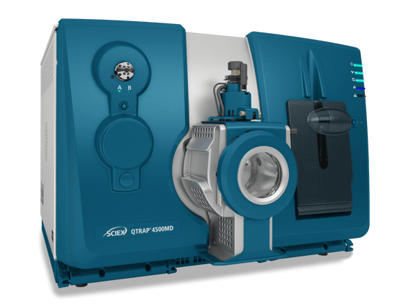
- The QTRAP System offers high sensitivity data acquisition strategies for both quantitative and qualitative experiments
- System sensitivity allows small sample volumes and simplified sample processing procedures
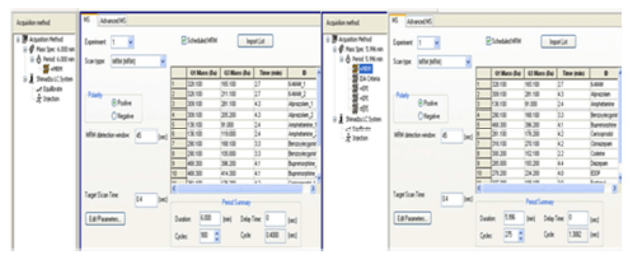
- High-throughput quantitative analysis is achieved using MRM (Multiple Reaction Monitoring) and the Scheduled MRM™ Algorithm1
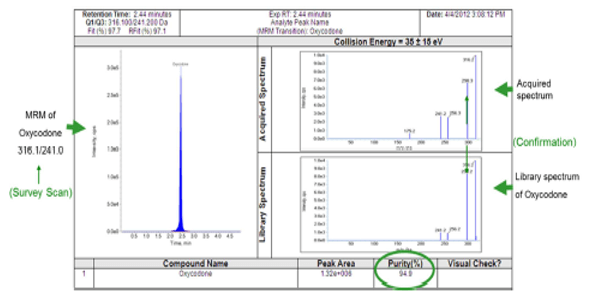
- MRM triggered EPI (Enhanced Product Ion) scans generate high sensitivity MS/MS spectra to enhance confidence of identification of analytes, even at low concentrations.
- MPX™ 2.0 High Throughput System allows significant throughput increases by maximizing utility of available MS analytical windows focusing only on areas of the chromatogram showing peak elution.
Methods
Calibrator preparation: An oral fluid matrix was spiked to various levels of the relevant compounds. The calibration curve extended above and below the industry accepted cutoff and confirmation levels.
Sample preparation:
- Add 150 μL preserved buffer to 50 μL oral fluid matrix
- Add 200 μL methanolformic Acid containing internal standards
- Vortex, centrifuge and transfer to an autosampler vial for injection
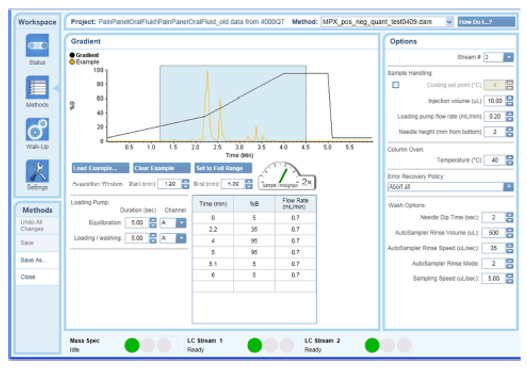
HPLC conditions: Chromatography was performed using a Phenomenex Kinetex C18 2.6 µm 50 x 3.0 mm column using ammonium formate in water as mobile phase A and formic acid in methanol as mobile phase B. A gradient was applied during chromatographic run and the total run time (not multiplexed) per stream was 6 minutes. The acquisition window was set to 3.5 minutes per stream (Figure 2) providing an increase in sample throughput of 171% during multiplexed analysis.
Results
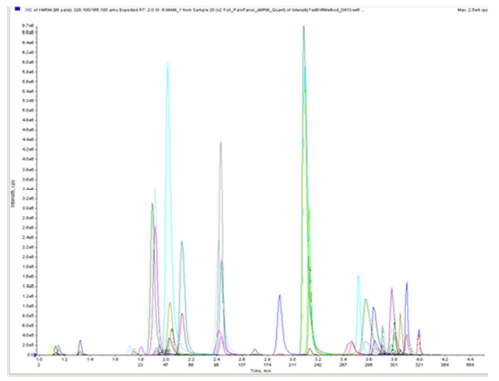
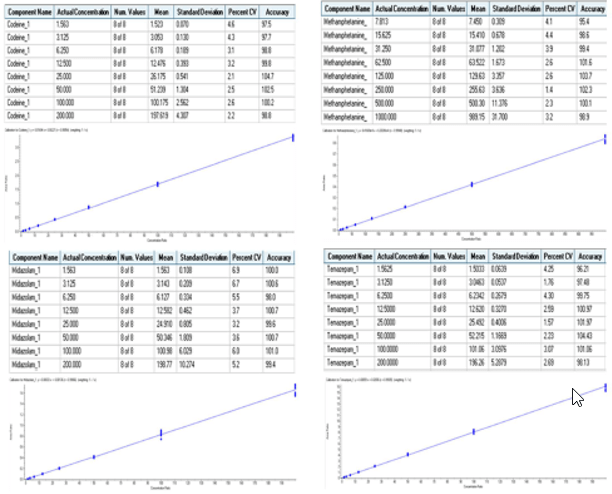
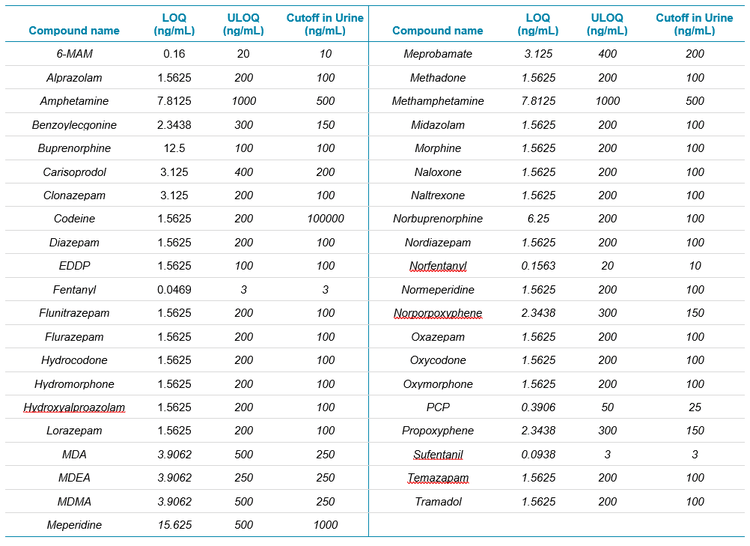
Figures 1 and 4 show typical chromatograms achieved using the described approach and quantitative results for the following analytes: codeine, methamphetamine, midazolam and temazepam. Excellent linearity and reproducibility were observed throughout the dynamic range assessed in this effort. Table 1 shows a summary of the calibration range for all 41 pain drugs. Within the listed concentration range, excellent linearity and reproducibility were achieved.
Conclusions
The QTRAP LC-MS/MS System combined with the MPX 2.0 High Throughput System is a powerful tool for ultra-fast multi-analyte quantification and identification in forensic samples. A fast, robust and simple method for the detection of 41 common pain drugs in an oral fluid matrix was developed on this system, providing the high throughput required for today’s modern laboratories. Using the Scheduled MRM Algorithm in combination with acquisition of full scan MS/MS spectra for compound identification through MS/MS library spectral searching enables large numbers of analytes to be quantified in a single method.
- This method utilized a dilute-and-shoot procedure with minimum sample prep needed
- The application of the MPX 2.0 System greatly reduced the sample run time and increased sample throughput by 171%
- High sensitivity and reproducibility of the QTRAP System enables reduced run times and therefore increased sample throughput, while maintaining data quality (sensitivity, reproducibility, and linear dynamic range, with no crosstalk)
- Excellent linearity and precision were observed for all 41 compounds in the listed calibration range
- Fast ion trap scanning speeds of the QTRAP System enabled development of a targeted screening method for these 41 common pain drugs
References
- The Scheduled MRM™ Algorithm Pro. SCIEX technical note RUO-MKT-02-8539-A.