Abstract
In this technical note, a solid-phase extraction (SPE) procedure and a robust, sensitive C-MS/MS method using the SCIEX QTRAP 6500+ system enabled the accurate quantitation of 9 steroid hormones in human serum. Sub-nmol/L level sensitivity was achieved with excellent precision (ranging from 1.9 to 8.6%) and accuracy (ranging from 92.0 to 115%) at the lowest calibrator, demonstrating the quantitative performance of the assay. The signal-to-noise ratio (S/N) ranged from 14:1 to 900:1 for the panel of 9 steroid hormones at the lowest matrix calibrator measured. In addition, excellent linearity was observed across clinically relevant concentrations, with r2 values above 0.99 across the calibration ranges for all the analytes.
Key benefits of steroid hormone analysis in human serum using the QTRAP 6500+ system
- Efficient sample preparation: Steroid hormones were extracted from human serum samples using an efficient solid-phase extraction (SPE) procedure, requiring 100 μL of human serum
- Low-nmol/L level sensitivity and excellent quantitative performance: Sensitive quantitation of steroid hormones was performed with excellent precision and accuracy (6.3% and 104.2% for corticosterone, 5.0% and 115% for cortisol, 2.1% and 95.1% for androstenedione, 3.4% and 94.9% for progesterone, 5.8% and 94.8% for 11-deoxycortisol, 5.2% and 93.6% for 21-deoxycortisol, 1.9% and 93.7% for 17-OH progesterone, 4.8% and 93.1% for testosterone and 8.6% and 89.3% for DHEAS)
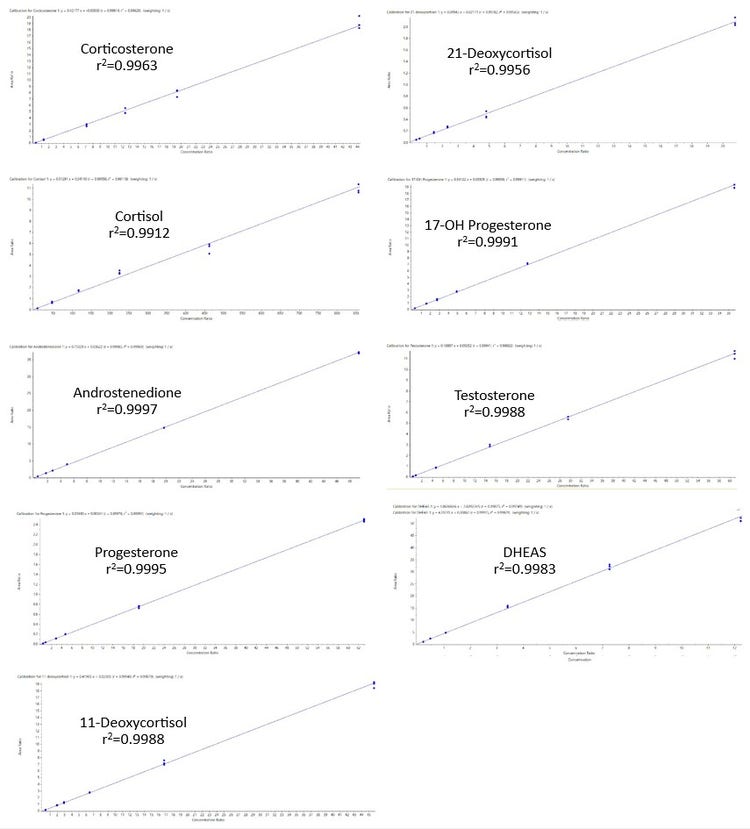
- Excellent linearity: Calibration curves for the 9 steroid hormones showed r2 values above 0.99 across the calibration ranges for all the analytes.
Introduction
Steroid hormones are essential regulators of key physiological functions such as metabolism, immune activity, and muscle maintenance. Given their structural diversity and the presence of numerous synthetic analogues, accurate quantitation of steroid profiles in biological samples is crucial. Reliable measurement supports investigations into hormone balance, metabolic function, and overall human health, providing valuable insights for clinical research applications.
Methods
Sample preparation: Sample preparation was performed using Diagnotix’s steroid panel basic reagent set (https://www.diagnotix.com/nl/lcms-uhplc/Steroids) according to the manufacturer’s specifications. 100 μL calibrators in serum matrix were used to perform the SPE procedure. This reagent set is only available in certain EU countries.
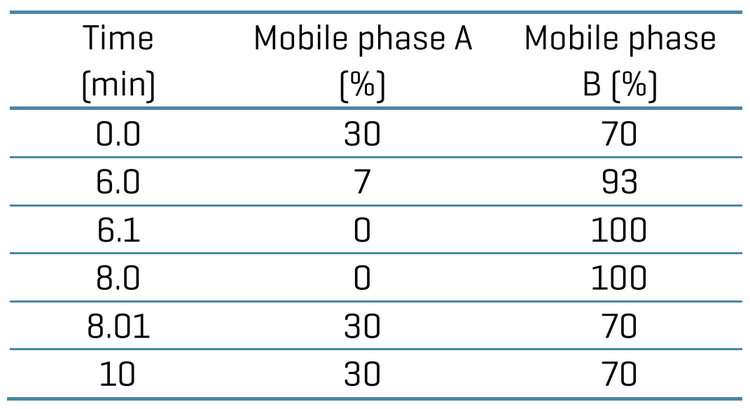
Liquid chromatography conditions: Chromatographic separation was achieved using a Phenomenex Kinetex Biphenyl column (150 x 2.1 mm, 2.6 µm, 00F-4622-AN). Mobile phases A and B from the reagent set were used. The total run time was 10 minutes at a flow rate of 800 μL/min. The injection volume was 20 μL. The LC gradient program is presented in Table 1.
Results and discussion
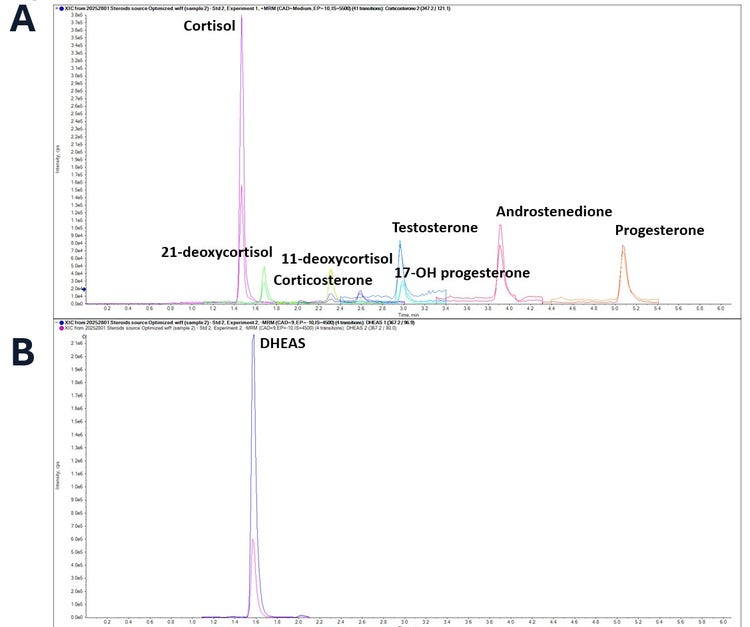
Figure 1 shows the chromatographic separation of the panel of 9 steroid hormones at the lowest calibrator level. The 10 min gradient, in combination with the column selection and mobile phase composition, resulted in separation of the panel of steroid hormones. The extracted ion chromatograms showed (S/N) values of 14:1 for corticosterone at 0.2 nmol/L, 254:1 for cortisol at 8.3 nmol/L, 58:1 for androstenedione at 0.5 nmol/L, 72:1 for progesterone at 0.4 nmol/L, 43:1 for 11-deoxycortisol at 0.4 nmol/L, 17:1 for 21-deoxycortisol at 0.3 nmol/L, 30:1 for 17-OH progesterone at 0.3 nmol/L, 51:1 for testosterone at 0.9 nmol/L and 900:1 for DHEAS at 0.2 nmol/L, calculated using the peak-to-peak algorithm in SCIEX OS.
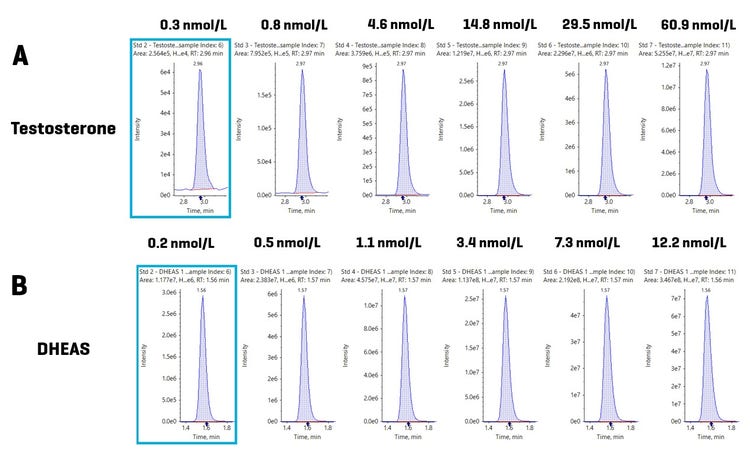
The quantitative performance of the method was investigated by injecting a series of calibrator samples spiked at the various concentration levels and injected in triplicate. Linearity, precision and accuracy were assessed across the calibration ranges for each of the 9 analytes. Figure 2 shows the representative extracted ion chromatograms (XICs) for A) testosterone and B) DHEAS their respective concentration ranges (0.3-60.9 nmol/L for testosterone and 0.2-12.2 nmol/L for DHEAS). Figure 3 shows the calibration curves for the 9 steroid hormones over the analytes’ respective calibration ranges. The plots show excellent linear responses across the calibration series, with r2 values greater than 0.99 for all the analytes.
Conclusion
A fast and sensitive LC-MS/MS method for the detection of 9 steroid hormones extracted from human serum samples was developed using the SCIEX QTRAP 6500+ system. The method demonstrated:
- Efficient sample preparation which consisted of a solid-phase extraction, requiring 100 μL of human serum sample
- Excellent linear responses across the calibration series consisting of 6 calibrators, with r2 values greater than 0.99 across the calibration ranges for all the analytes
- Good sensitivity resulting in S/N ranging from 14:1 to 900:1 at the lowest matrix calibrator measured
- High quantitation performance of the method, resulting in excellent precision from 2.1% to 8.6% and accuracy from 89.3% to 115% across the steroid hormones