Mass spectrometry solutions effortlessly incorporated into your clinical research workflows
Steroid hormone analysis for clinical research

Why LC-MS/MS is the leading choice for steroid quantitation
Steroid hormones are lipid-soluble molecules derived from cholesterol, capable of passing through cell membranes and binding to specific receptors inside cells. These hormones play a crucial role in regulating various physiological processes, including metabolism, immune response, and reproductive health. In clinical research, steroid hormone analysis plays a key role in advancing the understanding of endocrine‑related conditions, hormone dynamics, and associated physiological and pathological processes. However, traditional immunoassays often fall short due to cross-reactivity, limited specificity, and interferences from metabolites, making accurate measurement challenging.
SCIEX offers a game-changing solution with our advanced LC-MS/MS technology for steroid hormone analysis. Our comprehensive portfolio is meticulously designed to deliver the sensitivity and specificity required to accurately quantify a wide range of steroid and thyroid hormones. Unlike immunoassays, SCIEX LC-MS/MS solutions eliminate cross-reactivity and interference issues, ensuring precise and reliable hormone profiling. With SCIEX, you can confidently detect even the smallest concentrations of steroid hormones in complex biological matrices. Chromatographic separation from interferences in biological matrices is critical for achieving accurate steroid hormone quantitation. Phenomenex LC columns deliver the performance needed for effective sample clean‑up and reliable separation from matrix components, helping ensure high‑quality analytical results. Together, SCIEX and Phenomenex enable consistent, robust workflows that streamline your processes and elevate the quality of your clinical research.
LC-MS/MS analysis of steroid hormones in biological matrices
Estrogen analysis in human serum
Workflow
Precise estrogen analysis in human serum demands high sensitivity and strong specificity. Robust LC‑MS/MS methods help overcome these analytical challenges. With optimized separation and streamlined data review, you can deliver reliable, high‑quality estrogen results with confidence.
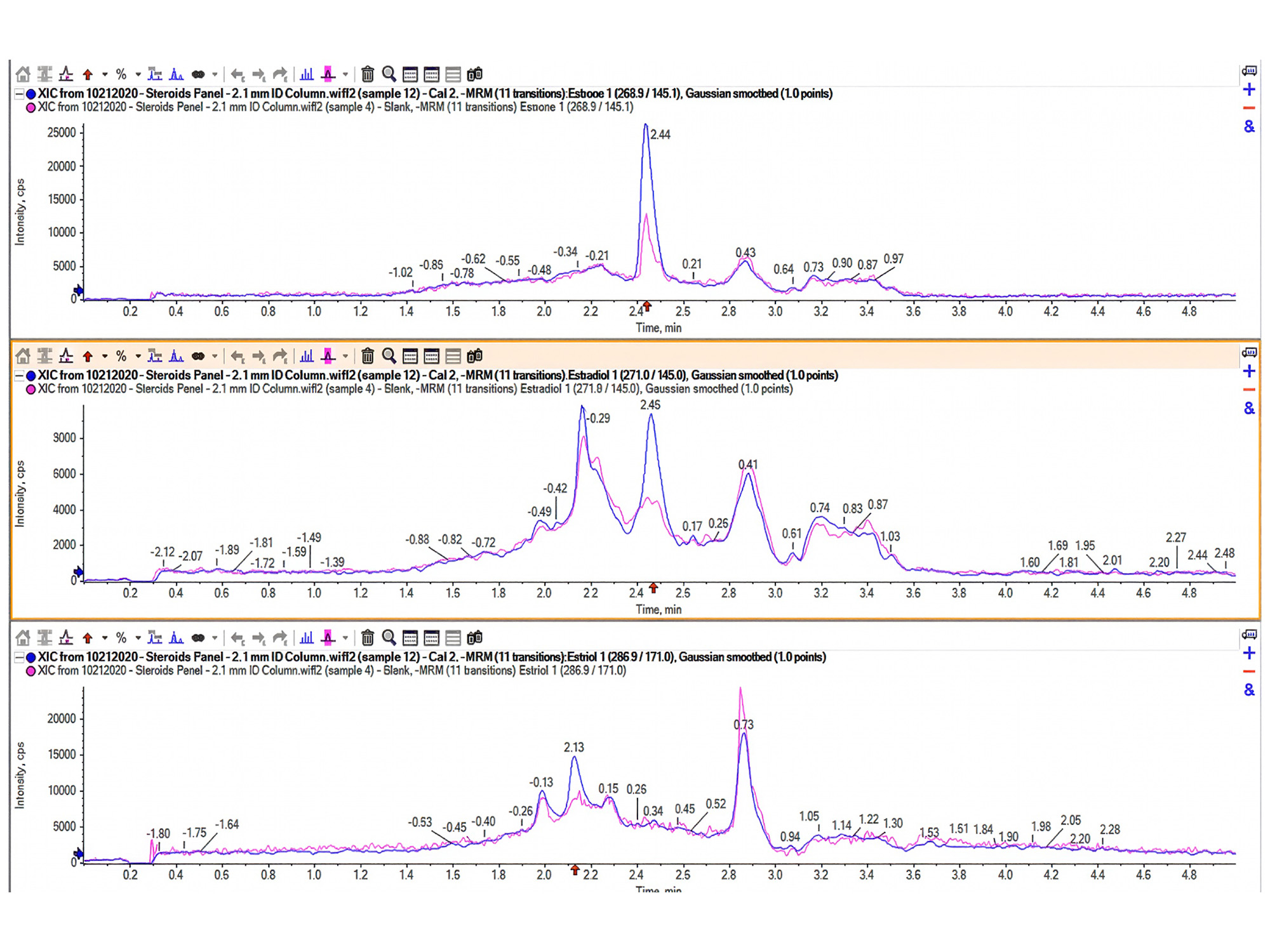
Sensitive quantitation of estrogens in human serum
Key benefits:
- Sensitivity to achieve low pg/mL LOQs with excellent quantitative performance
- Excellent linearity across 1-1000 pg/mL calibration range

QTRAP 6500+ system
The QTRAP 6500+ system offers revolutionary sensitivity, speed, and performance for your most challenging methods.
Learn more
Analysis of estrogens in plasma with rapid chromatography and reduced sample volume
Key benefits:
- LOQs below 5 pg/mL with only 200 μL of plasma
- Excellent accuracy and precision at the LOQ
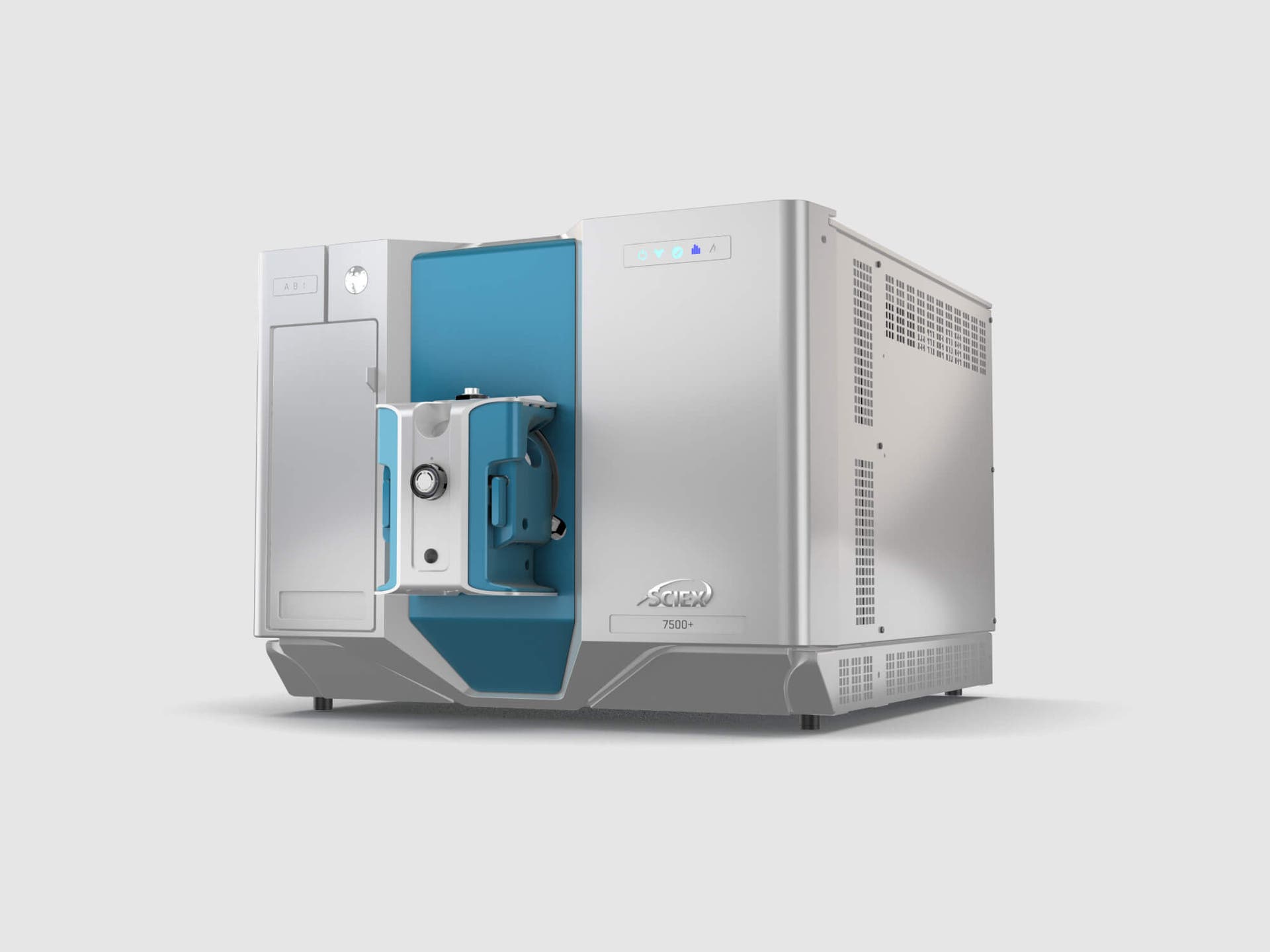
SCIEX 7500+ system
A new standard for instrument resilience and robustness. Engineered to maintain our highest sensitivity for up to twice as long in complex matrices.
Learn more
Featured resources
-
Technical note
Sensitive quantitation of estrogens in human serum
In this technical note, the combination of a rapid sample preparation procedure consisting of a liquid-liquid extraction with a robust and sensitive LC-MS/MS method using the SCIEX QTRAP 6500+ system enabled sensitive quantitation of estrogens extracted from human serum. Excellent linearity was observed across the calibration series (1-1000 pg/mL), with r2 values greater than 0.99 for all three estrogens. Low-level sensitivity was achieved at the lowest calibrator (1 pg/mL) with signal-to-noise ratios (S/N) of 55:1 for estrone [E1}, 4:1 for estradiol [E2], and 10:1 for estriol [E3]. In addition, the method showed excellent precision (%CV) and % accuracy (4.6% and 98.5% for estrone [E1], 9.2% and 102.9% for estradiol [E2], 18.4% and 104.0% for estriol [E3]] at the lowest calibrator (1 pg/mL), demonstrating the quantitative performance of the assay.
-
Technical note
Analysis of estrogens in plasma with rapid chromatography and reduced sample volume
The wide area of prevalence and biochemical importance of steroid hormones leads the estrogen group of steroids to be a highly active space in terms of biochemical and metabolic research. Steroids such as estrogens are traditionally analyzed by Radioimmunoassay (RIA) approaches, which can suffer from a number of issues believed to cause inaccuracies at lower concentrations. LC-MS/MS analysis overcomes a number of these issues, but while it is possible to achieve low limits of detection, it may potentially require the use of a large sample volume or employ a costly consumable-heavy preparation workflow to do so. In order to counteract this, the use of the new SCIEX Triple Quad 7500 system to improve sensitivity was investigated.
Testosterone analysis in human serum
Workflow
Ensuring accurate measurement of testosterone in human serum requires high sensitivity, precision, and consistent reproducibility. Overcome analytical challenges with optimized chromatographic separation and mass spectrometry conditions. Work more efficiently with intuitive software that streamlines data review so you can access your results faster.

Sensitive quantitation of testosterone in human serum
Key benefits:
- Low-pg/mL level sensitivity and excellent quantitative performance
- Excellent linearity across the 0.5-100 pg/mL calibration range
QTRAP 6500+ system
The QTRAP 6500+ system offers revolutionary sensitivity, speed, and performance for your most challenging methods.
Learn more
Aldosterone analysis in human serum
Workflow
Accurate measurement of aldosterone in human serum demands high sensitivity, precision, and reproducibility across a broad concentration range. These analytical challenges can be addressed with robust chromatographic separation using Phenomenex and SCIEX solutions. Improve efficiency with user-friendly SCIEX OS software that streamlines data review and accelerates your path to results.

Sensitive quantitation of aldosterone in human serum
Key benefits:
- Low pg/mL level sensitivity and excellent quantitative performance
- Excellent linearity across the 1-10,000 pg/mL calibration set
- Rapid sample prep
QTRAP 6500+ system
The QTRAP 6500+ system offers revolutionary sensitivity, speed, and performance for your most challenging methods.
Learn more
Sensitive quantitation of aldosterone in human serum using MRM³
Key benefits:
- MRM3 acquisition using the QTRAP to reduce matrix background and achieve a LOQ of 2.5 pg/mL with excellent accuracy and precision
- Excellent linearity across the 2.5-1000 pg/mL calibration range
- Rapid sample prep
QTRAP 6500+ system
The QTRAP 6500+ system offers revolutionary sensitivity, speed, and performance for your most challenging methods.
Learn more
Featured resources
-
Technical note
Sensitive quantitation of aldosterone in human serum
In this technical note, the combination of a rapid sample preparation procedure consisting of a liquid-liquid extraction with a robust and sensitive LC-MS/MS method using the SCIEX QTRAP 6500+ system enabled pg/mL detection of aldosterone extracted from human serum. The method demonstrated excellent precision and accuracy at the lowest calibrator (1 pg/mL). Excellent linearity was observed across the calibration series (1-10000 pg/mL), with a r2 value of 0.9960. Low-level sensitivity was achieved at the lowest calibrator (1pg/ mL) with a signal-to-noise ratio (S/N) of 4:1. In addition, the method showed excellent precision [8.8%] and accuracy (102.5%) at the lowest calibrator (1 pg/mL), demonstrating the quantitative performance of the assay.
-
Technical note
Sensitive quantitation of aldosterone in human serum using MRM³
In this technical note, a rapid liquid-liquid extraction procedure, and MRM3 acquisition on the SCIEX QTRAP 6500+ system, achieved low-pg/mL detection of aldosterone in human serum. The use of MRM3 acquisition was shown to reduce matrix background, allowing for an LOQ of 2.5 pg/mL with excellent precision (6.6%) and accuracy (107.0%), demonstrating the quantitative performance of the method. Excellent linearity was observed within the calibration series (2.5-1000 pg/mL), with a r2 value of 0.9961. Low-level sensitivity was achieved at the lowest calibrator (2.5 pg/mL) with a signal-to-noise ratio (S/N) of 8:1.
FT3 and FT4 analysis in human serum
Workflow
Accurate quantitation of FT3 and FT4 in human serum requires high sensitivity, precision, and consistent performance to support confident decision-making in demanding clinical workflows. Overcome analytical challenges with optimized chromatographic separation and mass spectrometry conditions. Enhance operational efficiency and help keep your laboratory running smoothly and reliably.
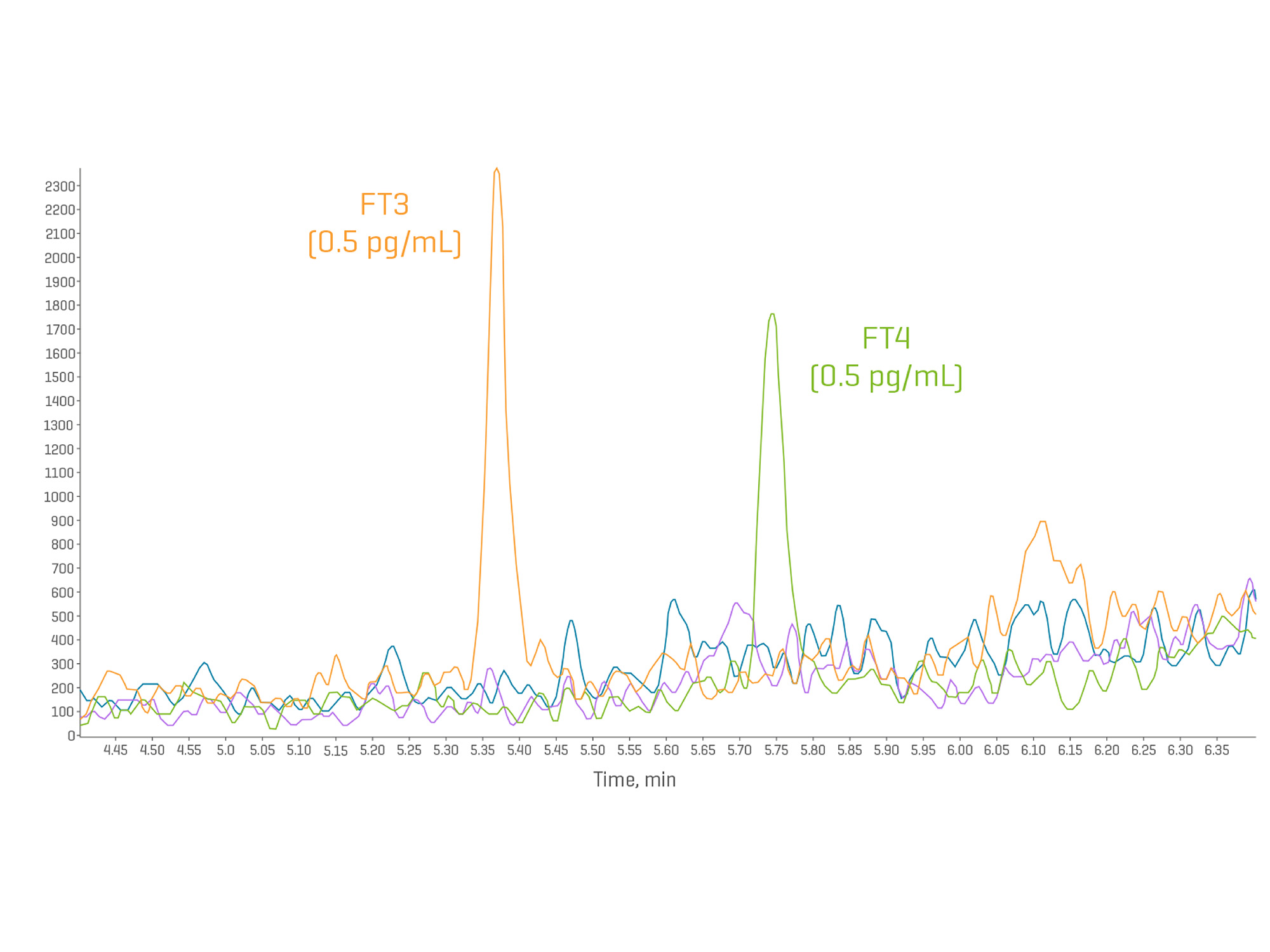
Sensitive quantitation of free triiodothyronine (FT3) and free thyroxine (FT4) in human serum
Key benefits:
- LOQ of 0.5 pg/mL with excellent accuracy and precision
- Excellent linearity across the 0.5-100 pg/mL calibration range
- Rapid sample prep
- Good chromatographic retention and separation using the Phenomenex LC column
QTRAP 6500+ system
The QTRAP 6500+ system offers revolutionary sensitivity, speed, and performance for your most challenging methods.
Learn more
Cortisol and cortisone analysis in human serum
Workflow
Accurate quantitation of cortisol and cortisone in human urine requires strong sensitivity, precision, and reliable performance across variable concentration ranges. Enhance your workflows with LC-MS/MS and support high‑throughput environments, delivering fast, accurate results for clinical research.

Quantitative analysis of cortisol and cortisone in human urine using direct injection
Key benefits:
- Rapid sample prep
- Excellent linearity
- Excellent quantitative performance at the LOQ

QTRAP 4500 system
The QTRAP 4500 system offers reliable quantitation with 100x more full-scan sensitivity over basic triple quadrupoles in the same class.
Learn more
Quantitative analysis of cortisol and cortisone in human urine using solid-phase extraction (SPE)
Key benefits:
- Efficient sample prep
- Excellent linearity
- Low nmol/L level sensitivity with accuracy and precision
QTRAP 4500 system
The QTRAP 4500 system offers reliable quantitation with 100x more full-scan sensitivity over basic triple quadrupoles in the same class.
Learn more
Featured resources
-
Technical note
Quantitative analysis of cortisol and cortisone in human urine using direct injection
This technical note demonstrates the accurate quantitation of cortisol and cortisone in human urine using a dilution and direct injection method with the QTRAP 4500 system. Low- to mid-nmol/L level sensitivity was achieved with signal-to-noise ratios (S/N) of 412:1 for cortisol at 34.0 nmol/L and 460:1 for cortisone at 41.0 nmol/L. In addition, excellent linearity was observed, with r2 values above 0.99 across the calibration range (34.0-601 nmol/L for cortisol and 41.0-693 nmol/L for cortisone]
-
Technical note
Quantitative analysis of cortisol and cortisone in human urine using solid-phase extraction (SPE)
This technical note demonstrates the accurate quantitation of cortisol and cortisone in human urine using a solid-phase extraction (SPE) procedure and analysis by the SCIEX QTRAP 4500 system. Low- to mid-nmol/L level sensitivity was achieved at the lowest calibrator with signal-to-noise ratios (S/N) of 1330:1 for cortisol at 34.0 nmol/L and 1688:1 for cortisone at 41.0 nmol/L. In addition, excellent linearity was observed across clinically relevant concentrations, with r2 values above 0.99 across the calibration range (34.0-601 nmol/L for cortisol and 41.0-693 nmol/L for cortisone).
Comprehensive multi-steroid hormone panels
Workflow
Accurate analysis of comprehensive steroid panels demands exceptional sensitivity, specificity, and reproducibility across a wide concentration range. Optimized chromatographic separation, advanced LC‑MS/MS conditions, and intuitive software help overcome cross‑reactivity and complexity—streamlining data review so you can generate reliable panel results more efficiently.

Sensitive quantitation of a panel of 19 steroids in human serum
Key benefits:
- Low pg/mL level sensitivity and excellent quantitative performance using 500 µL of serum
- Rapid sample prep
- Good chromatographic separation using the Phenomenex LC column
- Excellent linearity
QTRAP 6500+ system
The QTRAP 6500+ system offers revolutionary sensitivity, speed, and performance for your most challenging methods.
Learn more
Sensitive quantitation of 9 steroid hormones in human serum
Key benefits:
- Efficient sample prep
- Low nmol/mL level sensitivity and excellent quantitative performance
- Excellent linearity across the calibration range
QTRAP 6500+ system
The QTRAP 6500+ system offers revolutionary sensitivity, speed, and performance for your most challenging methods.
Learn more
Quantitative analysis of 9 steroid hormones in human serum
Key benefits:
- Sample prep using SPE to achieve low nmol/L sensitivity
- Good quantitative performance in the LOQ calibrator
- Good linearity
QTRAP 4500 system
The QTRAP 4500 system offers reliable quantitation with 100x more full-scan sensitivity over basic triple quadrupoles in the same class.
Learn more
Sensitivity improvements in the quantitation of steroids on the SCIEX 7500+ system
Key benefits:
- Average raw signal gains of 14-fold and S/N gains of 4.7-fold achieved compared to the QTRAP 6500+ system
- LLOQ levels as low as 2.5 fg on column achieved for a range of steroids in solvent
- Almost 3-fold improvement in precision (%RSD) for the LLO
SCIEX 7500+ system
A new standard for instrument resilience and robustness. Engineered to maintain our highest sensitivity for up to twice as long in complex matrices.
Learn more
Featured resources
-
Technical note
Sensitive quantitation of a panel of 19 steroids in human serum
In this technical note, a rapid liquid-liquid sample preparation procedure and a robust, sensitive LC-MS/MS method using the SCIEX QTRAP 6500+ enabled pg/mL detection for a panel of 19 steroids in human serum.The method demonstrated excellent precision (ranging from 0.6 to 15.7%) and accuracy (ranging from 96.8 to 103.2%) at the lowest calibrator, demonstrating the quantitative performance of the assay. In addition, excellent linearity was observed across clinically relevant concentrations.
-
Technical note
Sensitive quantitation of 9 steroid hormones in human serum
In this technical note, a solid-phase extraction (SPE) procedure and a robust, sensitive C-MS/MS method using the SCIEX QTRAP 6500+ system enabled the accurate quantitation of 9 steroid hormones in human serum. Sub-nmol/L level sensitivity was achieved with excellent precision (ranging from 1.9 to 8.6%) and accuracy (ranging from 92.0 to 115%) at the lowest calibrator, demonstrating the quantitative performance of the assay. The signal-to-noise ratio (S/N) ranged from 14:1 to 900:1 for the panel of 9 steroid hormones at the lowest matrix calibrator measured. In addition, excellent linearity was observed across clinically relevant concentrations, with r2 values above 0.99 across the calibration ranges for all the analytes.
-
Technical note
Quantitative analysis of 9 steroid hormones in human serum
This technical note demonstrates the accurate quantitation of 9 steroid hormones in human serum using a solid-phase extraction (SPE) procedure with analysis using the SCIEX QTRAP 4500 system. Low-nmol/L level sensitivity was achieved with excellent precision (ranging from 0.7 to 8.0%) and accuracy (ranging from 92.0 to 111%) at the lowest calibrator, demonstrating the quantitative performance of the assay. The signal-to-noise ratios (S/N) were 29:1 for corticosterone, 446:1 for cortisol, 55:1 for androstenedione, 35:1 for progesterone, 26:1 for 11-deoxycortisol, 16:1 for 21-deoxycortisol, 41:1 for 17-OH progesterone, 145:1 for testosterone and 1599:1 for DHEAS at the lowest calibrator measured. In addition, excellent linearity was observed across clinically relevant concentrations, with r2 values above 0.99 across the calibration ranges for all the analytes.
-
Technical note
Sensitivity improvements in the quantitation of steroids on the SCIEX 7500+ system
This technical note demonstrates a method for the analysis of 18 steroids in solvent, achieving lower limits of quantitation (LLOQ) as low as 2.5 fg on column using the SCIEX 7500+ system. The advantage of this high sensitivity was explored by comparing the results with the previous generation of SCIEX mass spectrometer (MS), the QTRAP 6500+ system. The results showed an increase in sensitivity for the SCIEX 7500+ system (Figure 1), shown in significant gains for both peak area, and signal-to-noise (S/N), utilizing optimization of the Q0 dissociation (Q0D) parameter, a feature unique to the improved front-end technology of the SCIEX 7500+ system. This increase in sensitivity could allow for simplified sample preparation, reduced injection volume or a decrease in the sample volume required compared to those previously achieved in similar workflows.
Comparison of LC-MS/MS solutions
Steroid Name | Triple Quad 4500 system | QTRAP 4500 system | SCIEX 5500+ system | SCIEX 5500+ system — QTRAP | Triple Quad 6500+ system | QTRAP 6500+ system | SCIEX 7500+ system | SCIEX 7500+ system — QTRAP |
Testosterone (Te) - male | x | x | x | x | x | x | x | x |
17-OH-Progesterone (17OHP) | x | x | x | x | x | x | x | x |
Cortisol, Cortisone | x | x | x | x | x | x | x | x |
Total T3, Total T4 | x | x | x | x | x | x | ||
Steroid Panels | x | x | x | x | x | x | ||
Aldosterone | x | x | x | x | ||||
Aldosterone – MRM3 assay |
|
|
|
|
| x |
| x |
Testosterone (Te) - female, pediatric, free |
|
|
|
| x | x | x | x |
Estrone (E1), Estradiol (E2), Estriol (E3) | x | x | x | x | ||||
Free T3, Free T4 | x | x | x | x |
All resources
-
Technical note
Sensitive quantitation of estrogens in human serum
In this technical note, the combination of a rapid sample preparation procedure consisting of a liquid-liquid extraction with a robust and sensitive LC-MS/MS method using the SCIEX QTRAP 6500+ system enabled sensitive quantitation of estrogens extracted from human serum. Excellent linearity was observed across the calibration series (1-1000 pg/mL), with r2 values greater than 0.99 for all three estrogens. Low-level sensitivity was achieved at the lowest calibrator (1 pg/mL) with signal-to-noise ratios (S/N) of 55:1 for estrone [E1}, 4:1 for estradiol [E2], and 10:1 for estriol [E3]. In addition, the method showed excellent precision (%CV) and % accuracy (4.6% and 98.5% for estrone [E1], 9.2% and 102.9% for estradiol [E2], 18.4% and 104.0% for estriol [E3]] at the lowest calibrator (1 pg/mL), demonstrating the quantitative performance of the assay.
-
Technical note
Analysis of estrogens in plasma with rapid chromatography and reduced sample volume
The wide area of prevalence and biochemical importance of steroid hormones leads the estrogen group of steroids to be a highly active space in terms of biochemical and metabolic research. Steroids such as estrogens are traditionally analyzed by Radioimmunoassay (RIA) approaches, which can suffer from a number of issues believed to cause inaccuracies at lower concentrations. LC-MS/MS analysis overcomes a number of these issues, but while it is possible to achieve low limits of detection, it may potentially require the use of a large sample volume or employ a costly consumable-heavy preparation workflow to do so. In order to counteract this, the use of the new SCIEX Triple Quad 7500 system to improve sensitivity was investigated.
-
Technical note
Sensitive quantitation of testosterone in human serum
In this technical note, the combination of a rapid sample preparation procedure consisting of a liquid-liquid extraction with a robust and sensitive LC-MS/MS method using the SCIEX QTRAP 6500+ system enabled sensitive and accurate quantitation of FT3 and FT4 extracted from human serum. Excellent linearity was observed across the calibration series (0.5-100 pg/mL), with r2 values of 0.9995 for FT3 and 0.9993 for FT4. Low-level sensitivity was achieved at the lowest calibrator (0.5 pg/mL) with a signal-to-noise ratio (S/N) of 7:1 for FT3 and 8:1 for FT4. In addition, the method showed excellent precision (%CV) and % accuracy (12.3% and 95-108% for FT3 and 11.2% and 95-100% for FT4] at the lowest calibrator (0.5 pg/mL), demonstrating the quantitative performance of the assay.
-
Technical note
Sensitive quantitation of aldosterone in human serum
In this technical note, the combination of a rapid sample preparation procedure consisting of a liquid-liquid extraction with a robust and sensitive LC-MS/MS method using the SCIEX QTRAP 6500+ system enabled pg/mL detection of aldosterone extracted from human serum. The method demonstrated excellent precision and accuracy at the lowest calibrator (1 pg/mL). Excellent linearity was observed across the calibration series (1-10000 pg/mL), with a r2 value of 0.9960. Low-level sensitivity was achieved at the lowest calibrator (1pg/ mL) with a signal-to-noise ratio (S/N) of 4:1. In addition, the method showed excellent precision [8.8%] and accuracy (102.5%) at the lowest calibrator (1 pg/mL), demonstrating the quantitative performance of the assay.
-
Technical note
Sensitive quantitation of aldosterone in human serum using MRM³
In this technical note, a rapid liquid-liquid extraction procedure, and MRM3 acquisition on the SCIEX QTRAP 6500+ system, achieved low-pg/mL detection of aldosterone in human serum. The use of MRM3 acquisition was shown to reduce matrix background, allowing for an LOQ of 2.5 pg/mL with excellent precision (6.6%) and accuracy (107.0%), demonstrating the quantitative performance of the method. Excellent linearity was observed within the calibration series (2.5-1000 pg/mL), with a r2 value of 0.9961. Low-level sensitivity was achieved at the lowest calibrator (2.5 pg/mL) with a signal-to-noise ratio (S/N) of 8:1.
-
Technical note
Sensitive quantitation of free triiodothyronine (FT3) and free thyroxine (FT4) in human serum
In this technical note, the combination of a rapid sample preparation procedure consisting of a liquid-liquid extraction with a robust and sensitive LC-MS/MS method using the SCIEX QTRAP 6500+ system enabled sensitive and accurate quantitation of FT3 and FT4 extracted from human serum. Excellent linearity was observed across the calibration series (0.5-100 pg/mL), with r2 values of 0.9995 for FT3 and 0.9993 for FT4. Low-level sensitivity was achieved at the lowest calibrator (0.5 pg/mL) with a signal-to-noise ratio (S/N) of 7:1 for FT3 and 8:1 for FT4. In addition, the method showed excellent precision (%CV) and % accuracy (12.3% and 95-108% for FT3 and 11.2% and 95-100 for FT4] at the lowest calibrator (0.5 pg/mL), demonstrating the quantitative performance of the assay.
-
Technical note
Quantitative analysis of cortisol and cortisone in human urine using direct injection
This technical note demonstrates the accurate quantitation of cortisol and cortisone in human urine using a dilution and direct injection method with the QTRAP 4500 system. Low- to mid-nmol/L level sensitivity was achieved with signal-to-noise ratios (S/N) of 412:1 for cortisol at 34.0 nmol/L and 460:1 for cortisone at 41.0 nmol/L. In addition, excellent linearity was observed, with r2 values above 0.99 across the calibration range (34.0-601 nmol/L for cortisol and 41.0-693 nmol/L for cortisone]
-
Technical note
Quantitative analysis of cortisol and cortisone in human urine using solid-phase extraction (SPE)
This technical note demonstrates the accurate quantitation of cortisol and cortisone in human urine using a solid-phase extraction (SPE) procedure and analysis by the SCIEX QTRAP 4500 system. Low- to mid-nmol/L level sensitivity was achieved at the lowest calibrator with signal-to-noise ratios (S/N) of 1330:1 for cortisol at 34.0 nmol/L and 1688:1 for cortisone at 41.0 nmol/L. In addition, excellent linearity was observed across clinically relevant concentrations, with r2 values above 0.99 across the calibration range (34.0-601 nmol/L for cortisol and 41.0-693 nmol/L for cortisone).
-
Technical note
Sensitive quantitation of a panel of 19 steroids in human serum
In this technical note, a rapid liquid-liquid sample preparation procedure and a robust, sensitive LC-MS/MS method using the SCIEX QTRAP 6500+ enabled pg/mL detection for a panel of 19 steroids in human serum.The method demonstrated excellent precision (ranging from 0.6 to 15.7%) and accuracy (ranging from 96.8 to 103.2%) at the lowest calibrator, demonstrating the quantitative performance of the assay. In addition, excellent linearity was observed across clinically relevant concentrations.
-
Technical note
Sensitive quantitation of 9 steroid hormones in human serum
In this technical note, a solid-phase extraction (SPE) procedure and a robust, sensitive C-MS/MS method using the SCIEX QTRAP 6500+ system enabled the accurate quantitation of 9 steroid hormones in human serum. Sub-nmol/L level sensitivity was achieved with excellent precision (ranging from 1.9 to 8.6%) and accuracy (ranging from 92.0 to 115%) at the lowest calibrator, demonstrating the quantitative performance of the assay. The signal-to-noise ratio (S/N) ranged from 14:1 to 900:1 for the panel of 9 steroid hormones at the lowest matrix calibrator measured. In addition, excellent linearity was observed across clinically relevant concentrations, with r2 values above 0.99 across the calibration ranges for all the analytes.
-
Technical note
Quantitative analysis of 9 steroid hormones in human serum
This technical note demonstrates the accurate quantitation of 9 steroid hormones in human serum using a solid-phase extraction (SPE) procedure with analysis using the SCIEX QTRAP 4500 system. Low-nmol/L level sensitivity was achieved with excellent precision (ranging from 0.7 to 8.0%) and accuracy (ranging from 92.0 to 111%) at the lowest calibrator, demonstrating the quantitative performance of the assay. The signal-to-noise ratios (S/N) were 29:1 for corticosterone, 446:1 for cortisol, 55:1 for androstenedione, 35:1 for progesterone, 26:1 for 11-deoxycortisol, 16:1 for 21-deoxycortisol, 41:1 for 17-OH progesterone, 145:1 for testosterone and 1599:1 for DHEAS at the lowest calibrator measured. In addition, excellent linearity was observed across clinically relevant concentrations, with r2 values above 0.99 across the calibration ranges for all the analytes.
-
Technical note
Sensitivity improvements in the quantitation of steroids on the SCIEX 7500+ system
This technical note demonstrates a method for the analysis of 18 steroids in solvent, achieving lower limits of quantitation (LLOQ) as low as 2.5 fg on column using the SCIEX 7500+ system. The advantage of this high sensitivity was explored by comparing the results with the previous generation of SCIEX mass spectrometer (MS), the QTRAP 6500+ system. The results showed an increase in sensitivity for the SCIEX 7500+ system (Figure 1), shown in significant gains for both peak area, and signal-to-noise (S/N), utilizing optimization of the Q0 dissociation (Q0D) parameter, a feature unique to the improved front-end technology of the SCIEX 7500+ system. This increase in sensitivity could allow for simplified sample preparation, reduced injection volume or a decrease in the sample volume required compared to those previously achieved in similar workflows.
Associated applications

Vitamin analysis
Monitoring vitamin levels in biological matrices requires high sensitivity and precision. SCIEX offers a comprehensive portfolio of LC-MS/MS instruments that deliver the accuracy needed for clinical and research laboratories.
Learn more