Abstract
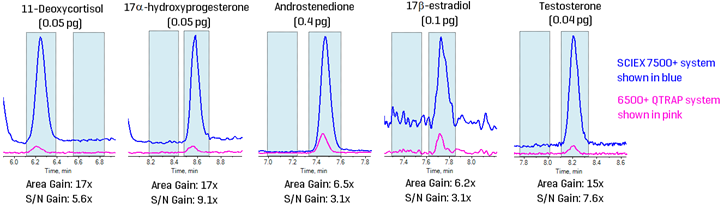
This technical note demonstrates a method for the analysis of 18 steroids in solvent, achieving lower limits of quantitation (LLOQ) as low as 2.5 fg on column using the SCIEX 7500+ system. The advantage of this high sensitivity was explored by comparing the results with the previous generation of SCIEX mass spectrometer (MS), the QTRAP 6500+ system. The results showed an increase in sensitivity for the SCIEX 7500+ system (Figure 1), shown in significant gains for both peak area, and signal-to-noise (S/N), utilizing optimization of the Q0 dissociation (Q0D) parameter, a feature unique to the improved front-end technology of the SCIEX 7500+ system. This increase in sensitivity could allow for simplified sample preparation, reduced injection volume or a decrease in the sample volume required compared to those previously achieved in similar workflows.
Introduction
Steroid measurement is essential in both biochemical research and clinical diagnostics due to the significant role steroids play in regulating metabolism, immune responses, and reproductive functions. Accurate quantitation of steroid levels is vital for diagnosing and managing various health conditions.
Historically, steroids have been measured using immunoassays and GC-MS, but these methods have limitations. Immunoassays often suffer from cross-reactivity, leading to inaccurate results, while GC-MS requires extensive sample preparation including derivatisation and long analytical run times. Liquid chromatography-tandem mass spectrometry (LC-MS/MS) has become a preferred method for steroid analysis, offering high sensitivity and specificity with minimal sample preparation. LC-MS/MS can simultaneously measure multiple steroids in a single sample, making it ideal for clinical research and diagnostics.
High sensitivity and wide dynamic range are crucial in steroid analysis because steroids are found from picomolar to micromolar ranges within biological samples. Enhanced sensitivity enables measurement in samples of smaller volumes and reduced injection volumes, which is beneficial when sample volumes are limited, particularly in paediatric clinical settings or rare specimen research. Therefore, advancements in LC-MS technology that improve peak height, area, and S/N ratios for analytes are the preferred approach to boosting sensitivity.
Key features of the quantitation of steroids in solvent using the SCIEX 7500+ system
- Enhanced sensitivity unlocked: Improved front-end technology enabled average raw signal gains of 14-fold and S/N gains of 4.7-fold achieved when compared to the QTRAP 6500+ system
- High level of sensitivity: LLOQ levels as low as 2.5 fg on column achieved for a range of steroids in solvent
- Improved analytical performance: Almost 3-fold improvement in precision (%RSD) for the LLOQ, with good linearity, accuracy and precision with the new, lower LLOQ achieved for steroid compounds over the QTRAP 6500+ system
Methods
Samples and reagents: All reagents used were of analytical grade or better. Cortisol (F), cortisone (E), corticosterone, (B), 11-deoxycortisol (S), 21-deoxycortisol (21DF), 11-deoxycorticosterone (11DOC), testosterone (T), androstenedione (A4), 5a-dihydrotestosterone (DHT), dehydroepiandrosterone (DHEA), progesterone (P4), pregnenolone (P5), 17-hydroxypregnenolone, (17OHP5), 17a -hydroxyprogesterone (17OHP4), aldosterone (Aldo), estrone (E1), 17b -estradiol (E2), estriol (E3) were all purchased from Sigma-Aldrich and Cerilliant. 11-dehydrocorticosterone (A) was purchased from Steraloids, UK.
Sample preparation: An intermediate stock solution was prepared in methanol containing steroids at concentrations ranging from 0.5-10.00 µg/mL. Subsequently, a calibration curve was generated over 5 orders of magnitude at physiologically relevant concentrations for human plasma for each steroid in a 30:70 (v/v) methanol/water mixture through serial dilutions of the stock solution.
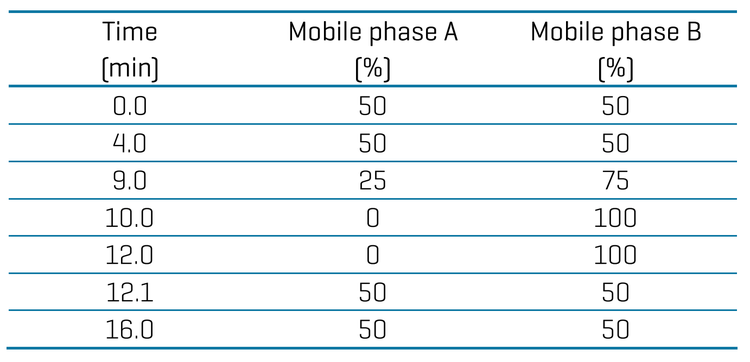
Chromatography: Chromatographic separation used a previously established method1 and was performed using a SCIEX ExionAE LC system at a flow rate of 0.3 mL/min on a Phenomenex Kinetex C18 (2.1 x 150 mm, 2.6 µm, 100 Å) column. A 16-minute gradient (Table 1) was run to separate steroids using 0.05mM ammonium fluoride in water as mobile phase A and 0.05mM ammonium fluoride in methanol as mobile phase B. An injection volume of 10 μL was used for analysis. A mixture of 1:1:1 (v/v/v) acetonitrile/methanol/water was used as a needle wash solvent
Technology improvements on the SCIEX 7500+ system
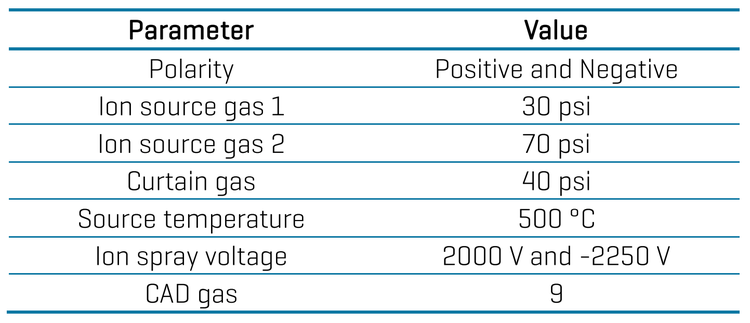
The SCIEX 7500 and 7500+ systems have several front-end technology improvements as compared to the previous versions of high-end triple-quadrupole mass-spectrometry systems such as the QTRAP 6500+ system. These include a redesign of the previous IonDrive Turbo V source, with the introduction of the OptiFlow Pro ion source, and the new D Jet+ assembly, incorporating a dodecapole geometry to the existing ion path. As part of this assembly, a voltage differential can now be applied to ions entering the vacuum region, and in Simple mode, this is applied between the Q-Jet ion guide and 1Q0 lens to achieve declustering, rather than the declustering potential (DP) value used on previous systems. This Q0D parameter is tuneable and can be useful for removal of interferences and decreasing baseline noise. The MRM transitions for each steroid were taken from the previously optimized method on a QTRAP 6500+ system, but were reoptimized, including the Q0D value for individual MRMs. Further improvements on the SCIEX 7500+ system to the front-end include the incorporation of Mass Guard technology to reduce the risk of instrument contamination,2,3 and an increase in scanning speed on the SCIEX 7500+ system, allowing for scan speeds as low as 1.2 ms.4
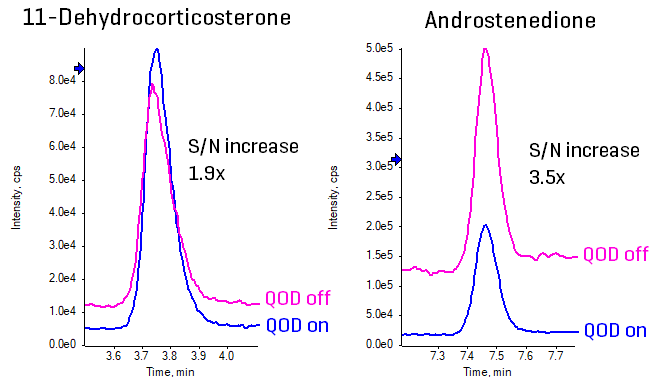
The Q0D parameter, operated in Simple mode, was used to reduce the overall noise level. While both the signal and noise may be impacted, typically the noise is reduced to a greater extent. As shown in Figure 2, this noise reduction resulted in a significant S/N increase.
Sensitivity improvements on SCIEX 7500+ system
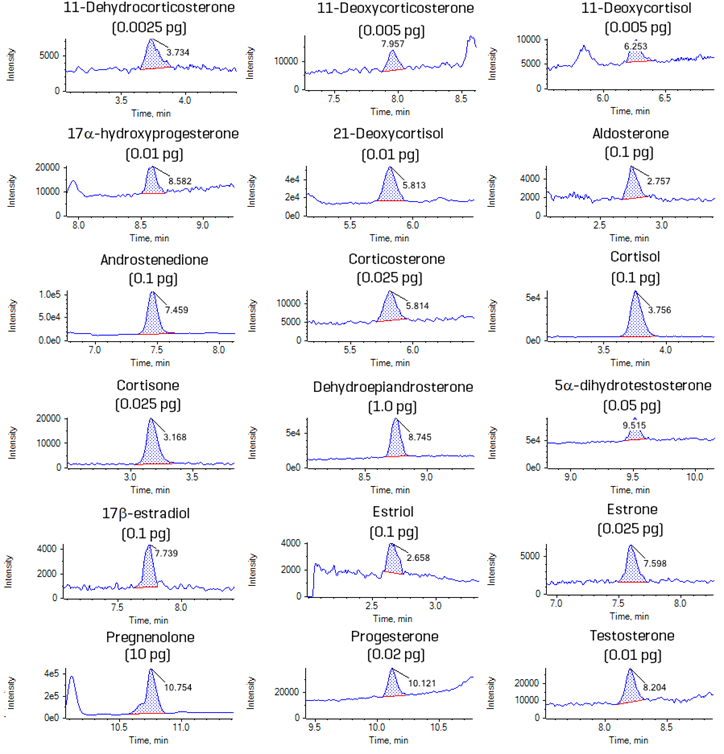
The SCIEX 7500+ system demonstrated high levels of sensitivity, allowing for the low-level quantitation of 17 steroids at sub-pg levels, reaching as low as 2.5 fg on column. The LLOQ for the quantifier MRM transition for each steroid is shown in Figure 3.

The same calibration standards were analyzed on a QTRAP 6500+ system as a direct comparison with the SCIEX 7500+ system. Figure 1 shows the clear increase in sensitivity seen on the SCIEX 7500+ system for 5 steroids, in terms of raw peak area and S/N.
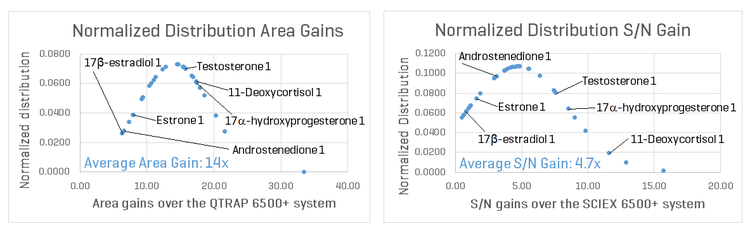
The sensitivity differences between the two systems were investigated further by normalizing the distribution of the peak areas and S/N (n=3) for each of the two MRM transitions monitored for each steroid, at the LLOQ concentration determined on the QTRAP 6500+ system. Across all transitions, the average area gain was 14-fold and the average increase in S/N was 4.7-fold (Figure 5).6
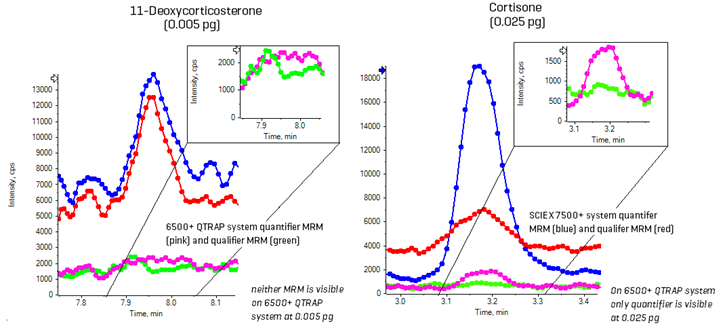
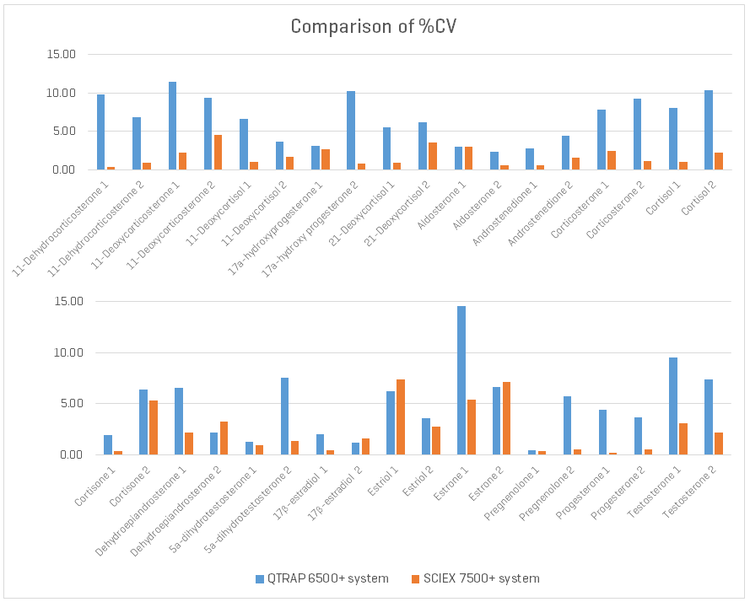
In addition to the increase in sensitivity, the reproducibility of the method was assessed by comparing the %RSD at the same concentrations for 3 replicate injections. As shown in Figure 6, excellent precision was seen for the SCIEX 7500+ system with an average %RSD of 2.1% compared with 5.9% for the QTRAP 6500+ system (Figure 6). It was not possible to compare the precision (%RSD) results of the 7500+ LLOQ values shown in Table 3 with the QTRAP 6500+ systemas more than 50% of the steroids analysed for one or both transitions at these concentrations were not detectable (S/N < 3) on the QTRAP 6500+ system (see Figure 4).
Conclusions
- High sensitivity was achieved with most steroids having an LLOQ less than 1 pg-on-column, reaching as low as 2.5 fg for 11-dehydrocorticosterone
- Good linearity was achieved for all steroids, spanning 2-4 orders of magnitude for all steroids except pregnenolone
- The method demonstrated accurate (85-115%) and precise (%RSD <13%) quantitative performance at all concentrations
- Sensitivity and precision were improved for the SCIEX 7500+ system with raw signal gains of 14-fold and S/N gains of 4.7-fold, as well as an almost 3-fold improvement in %RSD over the QTRAP 6500+ system
- The overall improvements in sensitivity, accuracy and precision of the SCIEX 7500+ system may allow for simplification of sample preparation and overall workflows, a useful tool for high-throughput laboratories
References
- Denham, S.G.; Simpson, J.P.; Diez, F.; Lee, P.; Kyle, C.; Morgan, R.; Homer, N.Z.M. A practical approach to supported liquid extraction and measurement of 18 steroids in plasma and serum by targeted liquid chromatography tandem mass spectrometry. MethodsX 2024, 12, 102728. DOI: 10.1016/j.mex.2024.102728
- Discover unparalleled sensitivity and extended instrument uptime on the highly robust SCIEX 7500+ system. SCIEX technical note, 2024, MKT-32166-A**.** https://sciex.com/tech-notes/food-beverage/food-and-beverage/Discover-unparalleled-sensitivity-and-extended-instrument-uptime-on-the-highly-robust-SCIEX-7500--system
- Redefine bioanalysis with enhanced robustness on the SCIEX 7500+ system. SCIEX technical note, 2024, MKT-31350-A. https://sciex.com/tech-notes/pharma/bioanalysis-pk/redefine-bioanalysis-with-enhanced-robustness-on-the-sciex-7500-plus-system
- Fast scanning quantitative lipidomics analysis using the SCIEX 7500+ system. SCIEX technical note, 2024, MKT-32067-A. https://sciex.com/tech-notes/life-science-research/lipidomics/fast-scanning-quantitative-lipidomics-analysis-using-the-sciex-7
- Leveraging sensitivity improvements for low-level detection of drugs, metabolites, and endogenous hormones in complex biological matrices, SCIEX technical note, 2022, RUO-MKT-02-14409-A. https://sciex.com/tech-notes/forensic/toxicology/leveraging-sensitivity-improvements-for-low-level-detection-of-d