Quantitative analysis of cortisol and cortisone in human urine using direct injection
Abstract
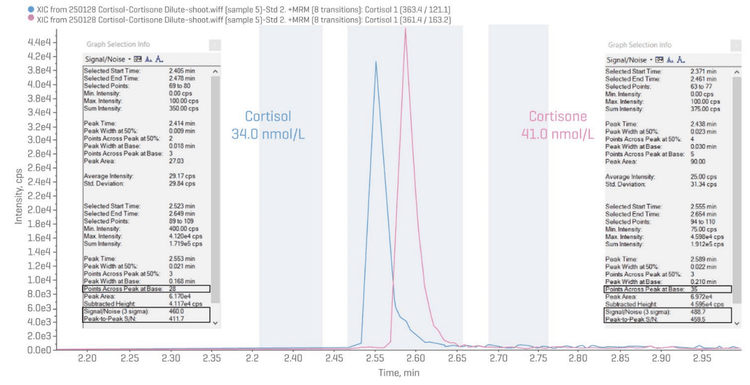
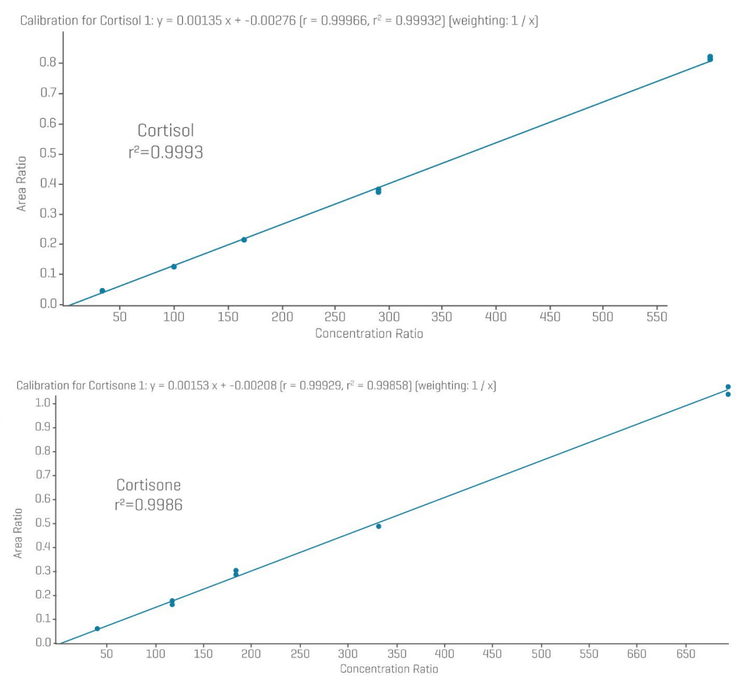
This technical note demonstrates the accurate quantitation of cortisol and cortisone in human urine using a dilution and direct injection method with the QTRAP 4500 system. Low- to mid-nmol/L level sensitivity was achieved with signal-to-noise ratios (S/N) of 412:1 for cortisol at 34.0 nmol/L and 460:1 for cortisone at 41.0 nmol/L. In addition, excellent linearity was observed, with r2 values above 0.99 across the calibration range (34.0-601 nmol/L for cortisol and 41.0-693 nmol/L for cortisone]
Key benefits of cortisol and cortisone analysis from human urine using the QTRAP 4500 system
- Rapid sample preparation. The samples were prepared using a simple dilute and direct injection procedure, requiring only 100 μL of human urine
- Excellent linearity: Calibration curves for cortisol and cortisone showed r2 values above 0.99 across the calibration range (34.0-601 nmol/L for cortisol and 41.0-693 nmol/L for cortisone)
- Excellent quantitative performance: Sensitive quantitation of cortisol and cortisone was performed with excellent precision (1.6% for cortisol and 0.4% for cortisone) and accuracy (104% for cortisol and 99.0% for cortisone) at the lowest calibrator levels (34.0 nmol/L for cortisol and 41.0 nmol/L for cortisone)
Introduction
Cortisol and cortisone are central regulators of the body’s stress response, metabolism, and immune function. Because these glucocorticoids fluctuate dynamically and can be influenced by numerous physiological and pathological factors, sensitive and selective quantitation in human urine is essential. Precise measurement of cortisone and cortisol levels provides critical insights into adrenal activity and overall endocrine balance, forming a key foundation for both clinical and biomedical research.
Methods
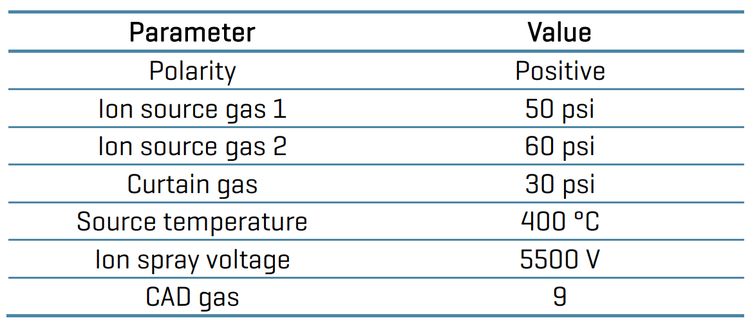
Sample preparation: Sample preparation was performed using Diagnotix’s cortisol & cortisone reagents set (https://www.diagnotix.com/en/products/cortisol-cortisone-urine-lc-ms-kit-2) according to the manufacturer’s specifications. 100 μL calibrators in human urine were used for the procedure. This reagent set is only available in certain EU countries.
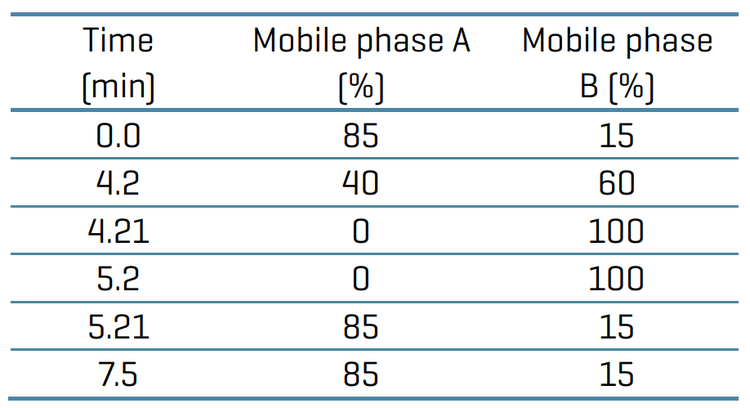
Liquid chromatography conditions: Chromatographic separation was achieved using a Phenomenex Luna Omega Polar C18 column (100 x 2.1 mm, 2.1 μm, 00D-4760- AN). Mobile phases A and B from the reagents set were used. The total run time was 5 min at a flow rate of 550 μL/min. The injection volume was 5 μL. The LC gradient program is presented in Table 1.
Results and discussion
Figure 1 shows the chromatographic separation of cortisol and cortisone in a control human urine sample at a final concentration of 34.0 nmol/L for cortisol and 41.0 nmol/L for cortisone, respectively. The extracted ion chromatograms (XICs) showed a S/N of 412:1 for cortisol and 460:1 for cortisone, at the lowest matrix calibrator measured (34.0 nmol/L for cortisol and 41.0 nmol/L for cortisone), calculated using a peak-to-peak algorithm.
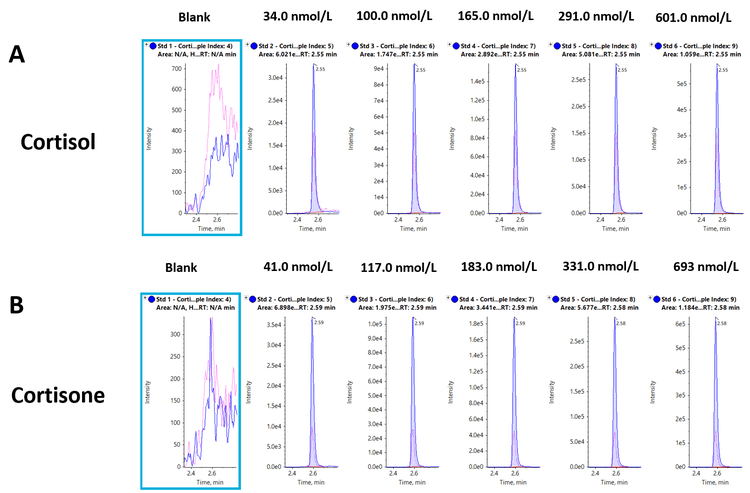
Figure 2 shows the XICs for A) cortisol and B) cortisone across their respective concentration ranges (34.0-601 nmol/L for cortisol and 41.0-693 nmol/L for cortisone). The peaks shown for the lowest matrix calibrators measured (34.0 nmol/L for cortisol and 41.0 nmol/L for cortisone) are well above the blank peak for both analytes.
The quantitative performance of the method was investigated by injecting a series of calibrator samples spiked at concentrations ranging from 34.0-601 nmol/L for cortisol and 41.0-693 nmol/L for cortisone, respectively. Linearity, accuracy and precision were assessed across the calibration ranges for each of the two analytes. Figure 3 shows the calibration curves for cortisol (top) and cortisone (bottom) over the analyte calibration ranges. The plots show excellent linear responses across the calibration series, with r2 values greater than 0.99 for both analytes.
The accuracy and precision values were calculated by 3 replicates in matrix at the lowest matrix calibrators measured (34.0 nmol/L for cortisol and 41.0 nmol/L for cortisone). The accuracy was 104% for cortisol and 99.0% for cortisone E, respectively. The precision (%CV) was 1.6% for cortisol and 0.4% for cortisone.
Conclusion
A fast and accurate LC-MS/MS method for the detection of quantitation of cortisol and cortisone extracted from human urine samples was developed using the SCIEX QTRAP 4500 system. The method demonstrated:
- Fast sample preparation, which consisted of a simple dilution and direct injection procedure, requiring only 100 μL of human urine
- Good sensitivity at the lowest calibrator level, resulting in S/N) of 412:1 for cortisol at 34.0 nmol/L and 460:1 for cortisone at 41.0 nmol/L
- Excellent linear responses across the calibration series consisting of 5 calibrators, with r2 values greater than 0.99 for both analytes
- High quantitation performance of the method, resulting in excellent precision (1.6% for cortisol and 0.4% for cortisone) and accuracy (104% for cortisol and 99.0% for cortisone) at the lowest calibrator levels (34.0 nmol/L for cortisol and 41.0 nmol/L for cortisone)