Abstract
In this technical note, a rapid liquid-liquid sample preparation procedure and a robust, sensitive LC-MS/MS method using the SCIEX QTRAP 6500+ enabled pg/mL detection for a panel of 19 steroids in human serum.The method demonstrated excellent precision (ranging from 0.6 to 15.7%) and accuracy (ranging from 96.8 to 103.2%) at the lowest calibrator, demonstrating the quantitative performance of the assay. In addition, excellent linearity was observed across clinically relevant concentrations.
Key benefits of steroid hormone analysis in human serum using the QTRAP 6500+ system
- Low pg/mL level sensitivity and excellent quantitative performance: Sensitive quantitation of a panel of steroids was performed with excellent precision (ranging from 0.6 and 15.7%) and accuracy (ranging from 97.8 and 104%) at the lowest calibrator levels (ranging between 1 and 500 pg/mL)
- Rapid sample preparation: A panel of steroid hormones were extracted from human serum samples using liquid-liquid extraction with 500 µL of human serum, evaporation and reconstitution in 125 µL of 40:60 (v/v) methanol/water
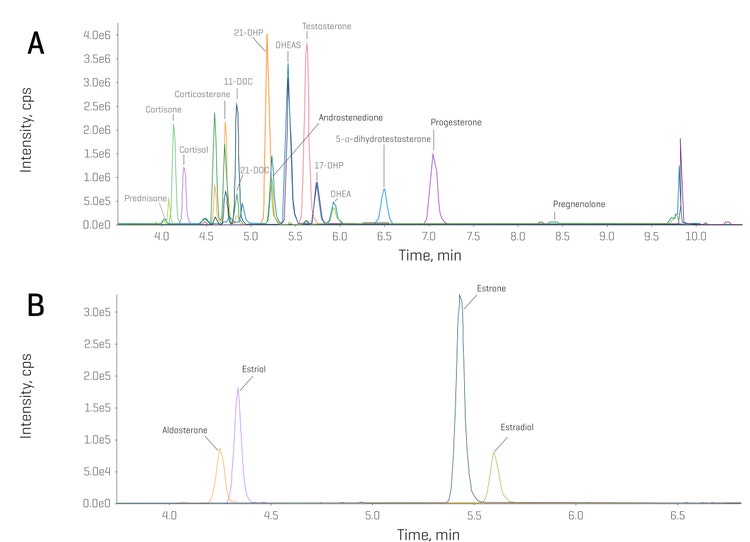
- Chromatographic separation: Optimized LC conditions enabled chromatographic separation of a panel of 19 steroid hormones
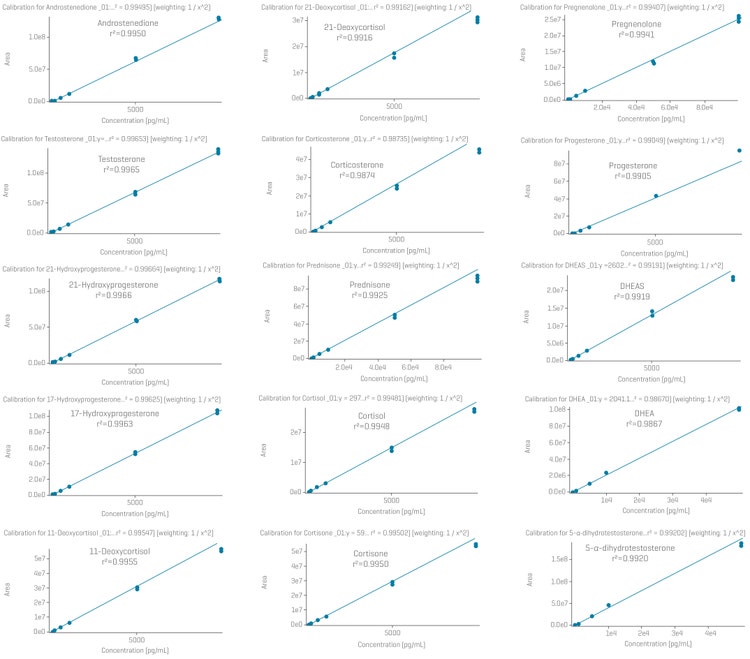
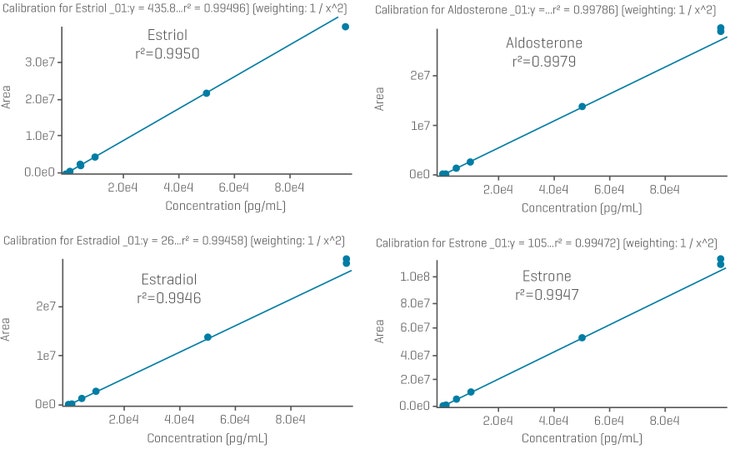
- Excellent linearity: Calibration curves for the panel of steroid hormones showed r2 values above 0.98 (sig figs) across the calibration ranges
Introduction
Steroid hormones represent a chemically heterogeneous class of bioactive molecules that exert critical control over metabolic pathways, immune modulation, and musculoskeletal homeostasis. Owing to their extensive structural diversity, low endogenous concentrations, and the coexistence of numerous synthetic and endogenous analogues, robust and highly selective quantification in complex biological matrices is required. Precise determination of steroid hormone concentrations enables detailed assessment of endocrine function and metabolic regulation, forming a foundational component of advanced clinical investigations and biomedical research.
Methods
Sample preparation: A panel of steroid hormones was extracted from human serum using a liquid-liquid extraction method using 500 µL of human serum, evaporation, and reconstitution in 125 µL of 40:60 (v/v) methanol/water.
Liquid chromatography: Chromatographic separation was achieved using a Phenomenex Kinetex C8 column (50 x 2.1 mm, 2.6 µm, 00B-4497-AN). Mobile phase A was ammonium fluoride in water, and mobile phase B was ammonium fluoride in methanol. The LC flow rate was 600 μL/min, and the total run time was 12 minutes.
Mass spectrometry: Data was collected using a QTRAP 6500+ system with an IonDrive Turbo V source operated in both positive and negative electrospray ionization (ESI) modes. The scheduled MRM algorithm was used in the SCIEX OS software (version 3.1.6) to collect 10-12 data points for quantifiable data. Compound-dependent parameters were optimized by infusion.
Data processing: Data processing was performed using SCIEX OS software (version 3.1.6). Peak integration was achieved using the MQ4 algorithm. Quantitative analysis was conducted in the Analytics module of SCIEX OS, where calibration curves, concentration calculations, and assay precision statistics were automatically generated.
Results and discussion
Figure 1 shows the chromatographic separation of a panel of steroid hormones at the lowest calibrator level. The 12 min gradient, in combination with the column selection and mobile phase composition, resulted in separation of the panel of steroid hormones. The extracted ion chromatograms showed (S/N) ranging from 10:1 to 125:1 at the lowest matrix calibrator measured, calculated using the peak-to-peak algorithm in SCIEX OS.
The quantitative performance of the method was investigated by injecting a series of calibrator samples spiked at the various concentration levels for the panel of steroid hormones. Linearity, precision and accuracy were assessed across the calibration ranges for each of the 19 analytes. Figure 2 shows the calibration curves for the 15 steroid hormones analyzed in positive mode over the analytes’ respective calibration ranges. Figure 3 shows the calibration curves for the 4 steroid hormones analyzed in negative mode over the analytes’ respective calibration ranges. The plots show excellent linear responses across the calibration series, with r2 values greater than 0.98 for all the analytes.
The precision and accuracy values were calculated from 3 replicates of the lowest matrix calibrators analyzed. The precision (%CV) and percent accuracy were 8.5% and 102% for androstenedione at 5 pg/mL, 14.6% and 99.9% for testosterone at 1 pg/mL, 12.2% and 27.1% for 21-OHP at 5 pg/mL, 15.6% and 102% for 17-OHP at 5 pg/mL, 4.0% and 97.8% for 11-DOC at 5 pg/mL, 11.4% and 98.2% for 21-DOC at 5 pg/mL, 15.7% and 96.8% for corticosterone at 10 pg/mL, 3.5% and 102% for prednisone at 50 pg/mL, 2.1% and 99.0% for cortisol at 50 pg/mL, 5.0% and 97.8% for cortisone at 50 pg/mL, 9.1% and 101% for pregnenolone at 500 pg/mL, 3.5% and 103% for progesterone at 5 pg/mL, 1.1% and 100% for DHEAS at 50 pg/mL, 11.8% and 102% for DHEA at 50 pg/mL, 4.4% and 100% for 5-α-dihydrotestosterone at 10 pg/mL, 0.6% and 101% for aldosterone at 100 pg/mL, 10.6% and 100% for estrone at 10 pg/mL, 9.3% and 101% for estradiol at 10 pg/mL, 6.5% and 104% for estriol at 50 pg/mL.
Conclusion
A fast and sensitive LC-MS/MS method for the detection of a panel of 19 steroid hormones extracted from human serum samples was developed. The method demonstrated:
- Fast sample preparation which consisted of a liquid-liquid extraction
- Excellent linear responses across the calibration series, with r2 values greater than 0.98 for all analytes
- Good sensitivity resulting in S/N ranging from 10:1 to 125:1 at the lowest matrix calibrator measured
- High quantitation performance of the method, resulting in excellent precision and accuracy lowest matrix calibrators measured