Sensitive quantitation of testosterone in human serum
Abstract
In this technical note, the combination of a rapid sample preparation procedure consisting of a liquid-liquid extraction with a robust and sensitive LC-MS/MS method using the SCIEX QTRAP 6500+ system enabled sensitive and accurate quantitation of FT3 and FT4 extracted from human serum. Excellent linearity was observed across the calibration series (0.5-100 pg/mL), with r2 values of 0.9995 for FT3 and 0.9993 for FT4. Low-level sensitivity was achieved at the lowest calibrator (0.5 pg/mL) with a signal-to-noise ratio (S/N) of 7:1 for FT3 and 8:1 for FT4. In addition, the method showed excellent precision (%CV) and % accuracy (12.3% and 95-108% for FT3 and 11.2% and 95-100% for FT4] at the lowest calibrator (0.5 pg/mL), demonstrating the quantitative performance of the assay.
Key benefits of testosterone analysis from human serum using the QTRAP 6500+ system
- Low-pg/mL level sensitivity and excellent quantitative performance: Sensitive quantitation of testosterone was performed with excellent precision (8.0%) and accuracy (97.7%) at the lowest calibrator level [0.5 pg/mL]
- Rapid sample preparation: Testosterone was extracted from human serum samples using a liquid-liquid extraction (LLE) , evaporation, and reconstitution sample preparation
- Excellent linearity: Calibration curve for the testosterone showed an r2 value of 0.9954 across the calibration range (1- 1000 pg/mL)
Introduction
Testosterone, a steroid hormone primarily associated with male physiology, also plays important roles in female health, influencing mood, bone density, and reproductive function.1,2 In women, testosterone is produced in smaller quantities by the ovaries and adrenal glands, circulating at much lower concentrations than in men. Accurate quantitation of testosterone in female and male biological samples is essential in clinical research, particularly for studies investigating hormonal imbalances, endocrine disorders, or the effects of therapeutic interventions.
Methods
Sample preparation: Testosterone was extracted from human serum using a liquid-liquid extraction (LLE), evaporation, and reconstitution sample preparation procedure.
Liquid chromatography: Chromatographic separation was achieved using a Phenomenex Kinetex C8 column (50 x 2.1 mm, 2.6 µm, 00B-4497-AN). Mobile phase A was ammonium fluoride in water and mobile phase B was ammonium fluoride in methanol. The total run time was 12 minutes.
Mass spectrometry: Data was collected using a QTRAP 6500+system with an IonDrive Turbo V ion source and operated in electrospray ionization (ESI) positive mode. The Scheduled MRM algorithm was used in SCIEX OS software (version 3.1.6) to collect the appropriate number of data points for quantifiable data. Compound-dependent parameters were optimized by infusion.
Data processing: Data processing was performed using SCIEX OS software (version 3.1.6). Peak integration was achieved using the MQ4 algorithm. Quantitative analysis was conducted in the Analytics module of SCIEX OS, where calibration curves, concentration calculations, and assay precision statistics were automatically generated.
Results and discussion
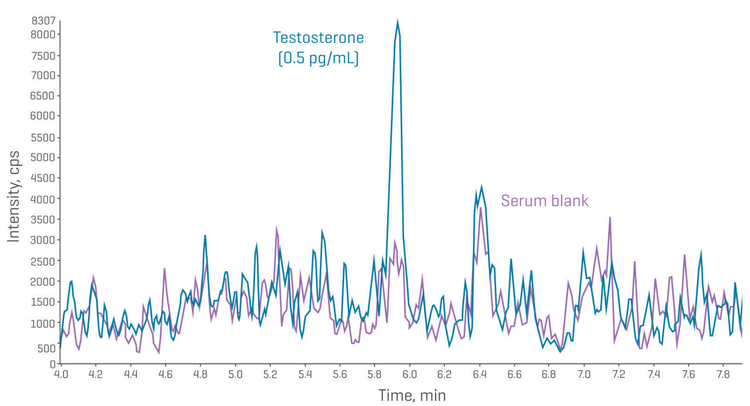
Figure 1 shows testosterone in a control human serum sample at final concentrations of 0.5-1000 pg/mL. The extracted ion chromatograms showed a signal-to-noise (S/N) ratio of 5:1 at the lowest matrix calibrator concentration [0.5 pg/mL], as calculated using a peak-to-peak algorithm.
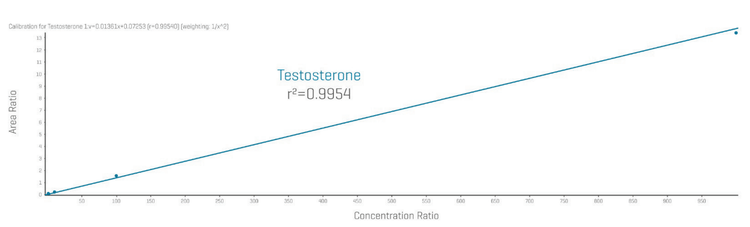
The quantitative performance of the method was investigated by injecting a series of 3 calibrator samples spiked at each concentration between 0.5-1000 pg/mL. Linearity and precision were assessed across the calibration range. Figure 2 shows the calibration curve for testosterone. The plot shows an excellent linear response across the calibration series, with an r2 value of 0.9954.
The accuracy and precision values were calculated from 3 replicate injections of the lowest matrix calibrator analyzed. The accuracy was 97.7% and precision (%CV) was 8.0%.
Conclusion
A fast and sensitive LC-MS/MS method for the detection of testosterone in human serum samples was developed. The method demonstrated:
- Fast sample preparation which consisted of liquid-liquid extraction
- Excellent linear responses across the calibration series, with an r2 value of 0.9954
- Good sensitivity resulting in S/N of 5:1 at the lowest calibrator level (0.5 pg/mL)
- High quantitative performance of the method, resulting in excellent precision (8.0%) and accuracy (97.7%) at the lowest calibrator level (0.5 pg/mL)
References
- Musshoff, F.; Madea, B. Review of biologic matrices (urine, blood, hair) as indicators of recent or ongoing cannabis use. Ther. Drug Monit. 2006, 28 (2), 155-163. DOI: 10.7759/cureus.78785
- Holst JP, Soldin OP, Guo T, Soldin SJ: Steroid hormones: relevance and measurement in the clinical laboratory. Clin Lab Med. 2004, 24:105-118. DOI: 10.1016/j.cll.2004.01.004