Abstract
Using the high-resolution X500R QTOF system and SCIEX OS software, high-resolution MS and MS/MS information on polypropylene infusion bottle extracts were analyzed in both positive and negative ion mode. Using an extractable/leachable library, compounds were identified through targeted screening. Unmatched peaks were further assessed using Chemspider analysis. Nineteen compounds were identified from a methanol extraction of the polypropylene bottle.
Introduction
Polypropylene infusion bottles have gradually replaced traditional infusion packaging such as glass bottles and polyvinyl chloride (PVC) soft bags because of their light weight, convenient transport, and low risk of cross-contamination. As such, these types of bottles have become the mainstream in infusion packaging containers in China.1 Polypropylene commonly contains additives to improve its softness, flexibility, and resistance to external aggressions (light, chemical, micro bacteria, oxidation etc.). Examples that are added during the production process include antioxidants, acid scavengers, flame retardants, plasticizers, lubricants and dyes. As these additives are not bound to the polymer there is a potential for migration from the container to the container’s content. This application note describes a mass spectrometric approach for the characterization of extracts from polypropylene infusion bottles.
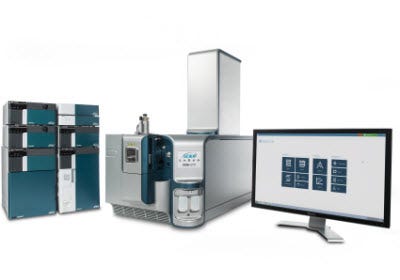
The sensitivity, selectivity and specificity afforded by quadrupole time-of-flight (QTOF) mass spectrometry means that the initial determination of non-volatile, organic extractable and leachable (E&L) compounds is often performed using this technique. The SCIEX X500R QTOF system is commonly run in a non-targeted Information Dependent Acquisition (IDA) mode to obtain high-resolution TOF MS and TOF MS/MS data. It allows for TOF MS quantification and provides high confidence in screening with MS/MS information from one injection. The acquired MS/MS data can be searched against the SCIEX E&L high-resolution MS/MS spectral library for compound identifications through MS/MS spectral database matching.
Key benefits of leachable analysis using the SCIEX X500R QTOF system and SCIEX OS software
-
Sensitive, fast-scanning, benchtop hybrid quadrupole time-of-flight mass spectrometer
-
Intuitive SCIEX OS software for acquisition and data processing for quantitative and qualitative workflow\
- The SCIEX OS software interface is intuitive and easy to use with one-button automatic tuning and calibration function ensuring high-quality and reliable data are obtained
- With the ability to build and use customized tags and result filters, data can be browsed and reported quickly
-
SCIEX open access E&L high-resolution MS/MS spectral library composed using data acquired on a SCIEX accurate mass QTOF system. This library, in combination with powerful search algorithms, enables specific, sensitive, robust, accurate and efficient compound identification by matching data to library spectra, acquired with similar experimental conditions as the data.
Workflow overview
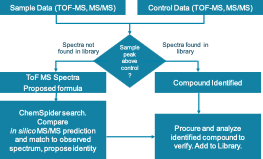
The overall workflow for non-targeted data acquisition and compound identification on the SCIEX X500R QTOF system used in this application is shown in Figure 1 and described below:
1. An Information Dependent Acquisition (IDA) method was created consisting of one TOF MS survey scan and up to 10 dependent TOF MS/MS scans triggered from the survey scan in each cycle.
- Due to the high scanning speed (up to 100 Hz) on SCIEX X500R QTOF systems, MS/MS data is likely to be acquired for most compounds in the sample
- High selectivity for MS/MS is achieved through use of unit resolution on Q1 and therefore IDA MS/MS provides the most interference free fragmentation information
2. The identity of a detected compounds was confirmed using the screening processing workflow in the SCIEX OS software. A non-targeted peak-finding algorithm was used to identify and integrate signals from the TOF MS. The corresponding acquired MS/MS spectra were searched against the E&L high-resolution MS/MS spectral library of compounds and listed potential candidate matches to the experimental data.
3. If an acquired spectrum was not matched to a library spectrum, further evaluation of the peak would be performed using the direct integration of SCIEX OS software with ChemSpider. A molecular formula would be proposed based on the exact mass of the precursor and this formula would be searched in ChemSpider. The output of the ChemSpider search would include potential hits and MOL files. In silico fragmentation of the potential structures would be compared to the acquired MS/MS spectrum and the best match would be selected by the user as the proposed compound.
Methods
Sample preparation: The cap and the body of the polypropylene infusion bottle were extracted with 15% ethanol in accordance with the packaging material guidelines and then were directly analyzed by LC-MS/MS analysis.
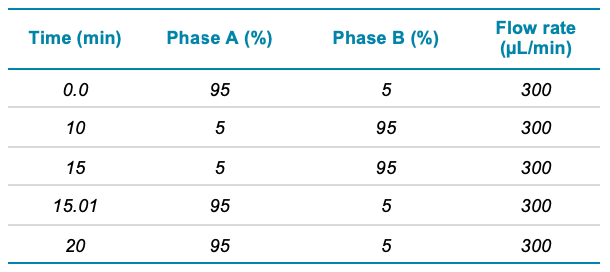
Chromatography: Separation was performed using an ExionLC system and a Kinetex C18 column (100 X 2.1 mm, 2.6 µm). The column temperature was held at 40°C. The injection volume was 5 µL. The gradient profile for positive ion analysis is outlined in Table 1. The solvents used for positive ion mode analysis was (A) water with 0.1% formic acid and (B) methanol. For negative ion mode, the solvents used were (A) 0.02% ammonium formate and (B) methanol.
Mass spectrometry: MS analysis was performed using the X500R QTOF system using electrospray ionization and two separate injections, in positive ion and negative ion mode. The IDA workflow was used for analysis, with a TOF MS mass range of 100-1000 m/z and the MS/MS mass range of 50 – 1000 m/z. MS/MS was acquired on the top 10 precursors above the set intensity threshold. The Dynamic Background Subtraction setting was activated (DBS on). The ion source parameters were ISV 5500 V / -4500 V, TEM 550 °C, CUR 30 psi, CAD Medium, GS1 55 psi, GS2 60 psi.
Data processing
Two levels of processing were used in the method to identify peaks of interest.
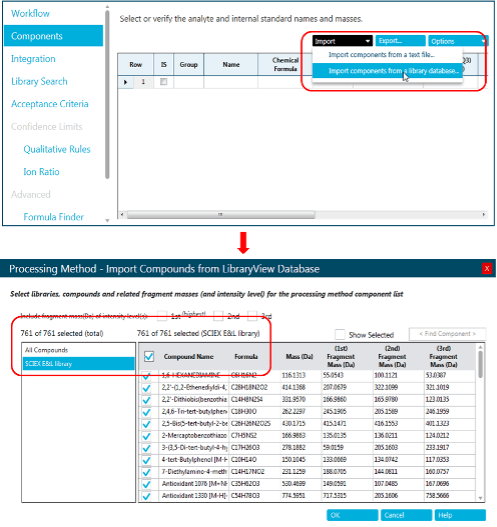
First, a targeted component identification process was followed using the targeted component analysis method with the Analytics module in SCIEX OS software. The database of packaging material compounds was imported into the Components option creating a targeted extraction list that included the compound name and molecular formula, as shown in Figure 2. Based on this information, the extraction mass is calculated by the software and the presence of chromatographic peaks is evaluated.
Second, a non-targeted peak-finding algorithm was used to identify and integrate signals from the TOF MS.
Once peaks were identified by either method, the corresponding MS/MS spectra were searched against the SCIEX E&L high-resolution MS/MS spectral library for identification.
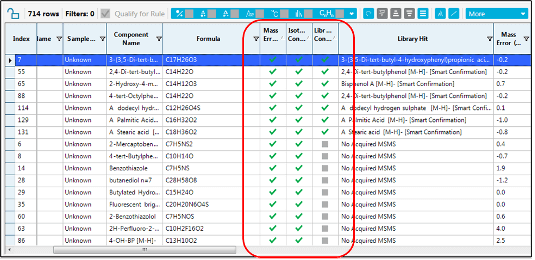
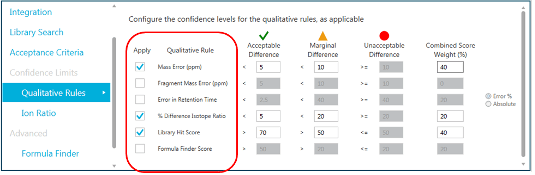
A traffic light system indicates the confidence of the identification based on accurate mass, isotopic pattern, library matching and retention time (if there is no RT information, it can be ignored). The SCIEX OS software allows the user to filter the results to only show compounds that were detected with pass acceptance criteria (Figure 3) using user defined confidence (Figure 4). An overall combined score will be given to each result based on the weighting given to each of the four parameters and recorded in the results table.
Targeted identification results
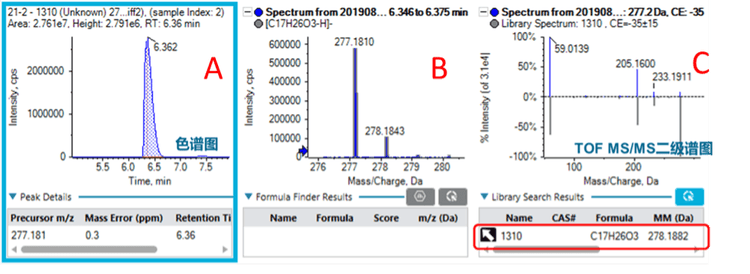
As shown in the example in Figure 5, multiple criteria, including library matching, are used to provide confidence in the identification of an E&L compounds from an ethanol extract. Antioxidant 1310 (3,5-di-tert-butyl-4-hydroxyphenylpropionic acid) is a degradation product of antioxidant 1010 (tetra[β-(3,5-di-tert-butyl) 4-hydroxyphenyl) propionic acid] pentaerythritol ester). Figure 5A shows the extracted ion current chromatogram where the retention time is used for confirmation of the compound. Figure 5B shows the measured mass and isotopic distribution, overlaid with the theoretical values, and Figure 5C shows the mirrored image of the MS/MS library matching results. The upper blue part is the MS/MS spectrum obtained from the extract sample, and the lower gray part is the MS/MS spectra from the E&L database. The results are easily visualized and the combined score is above 95, demonstrating high confidence in this example compound identification.
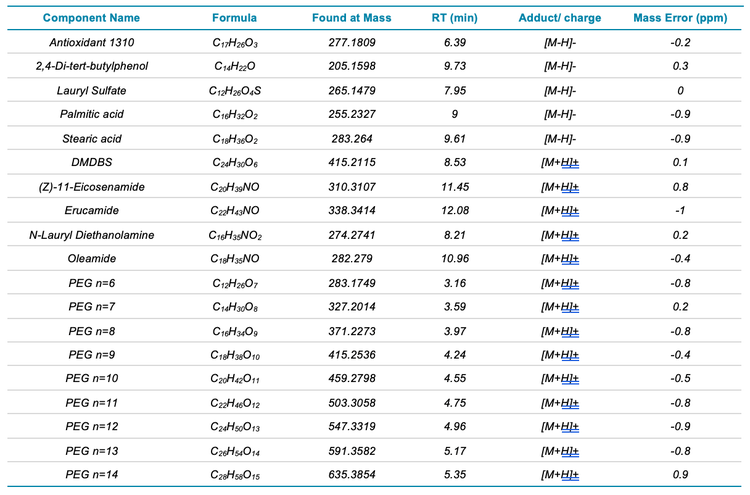
Confident and rapid identification of constituents in extracts was achieved. A total of 14 components were identified in the positive ion mode, and 5 components were identified in the negative ion mode, all with a comprehensive score of 80 points or more. Among them are antioxidants, antistatic emulsifiers and lubricants. One example is PEG (polyethylene glycol), which has excellent lubricity, moisture retention and dispersibility, and is often used in adhesives, antistatic agents and softeners. The identification results are shown in Table 2.
Non-targeted identification
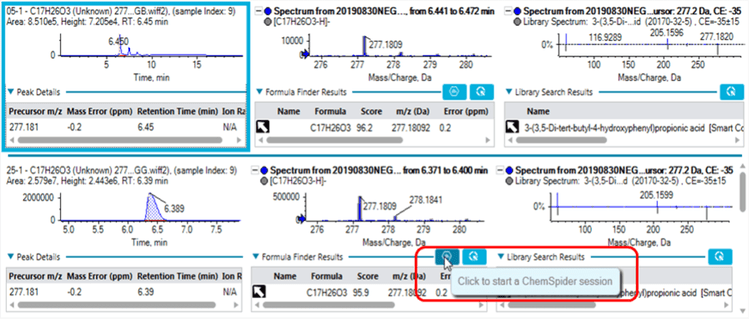
In a non-target identification, all data were processed using the sample vs. control qualitative workflow of the Analytics module in SCIEX OS software. Using this workflow, which is outlined in Figure 1, sample and control injections were compared after running the peak-finding algorithm. Only peaks in the sample that had areas greater than those found in the control by a threshold factor set in the method were selected for further evaluation. Setting a non-targeted data processing workflow within the software allows for the automatic peak finding and reporting of more m/z features. At the same time, these can be compared and verified with the results of the targeted identification. The SCIEX OS software can also be directly interfaced with the ChemSpider database, relying on a powerful network database to further increase confidence and comprehensiveness in the resulting candidate structure identifications (Figure 6).
Confirmation of identification results
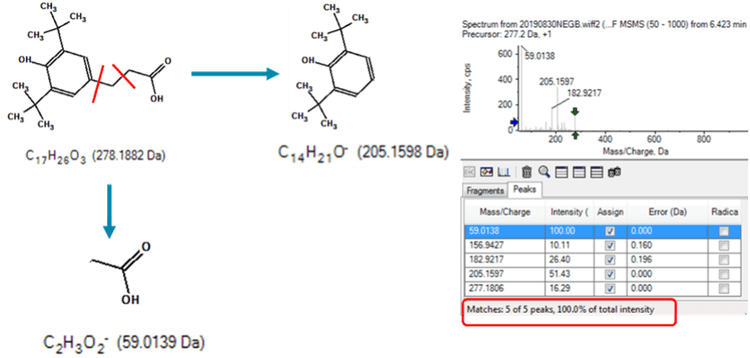
The extract from the polypropylene infusion bottle was analyzed for the antioxidant 1310 in the first-level mass spectrum in the ESI negative ion mode. The powerful Fragment Pane function of SCIEX OS software was used to analyze the fragments and elucidate the fragmentation pattern. All the secondary fragments can be reasonably explained, and the matching between the theoretical spectrum and the experimentally acquired spectrum is 100% (Figure 7).
Summary
Using the SCIEX X500R QTOF system high-resolution mass spectrometer and powerful SCIEX OS software, it is possible to obtain high-resolution MS and MS/MS information for extractable compounds from polypropylene infusion bottle extracts. The SCIEX open access E&L high-resolution MS/MS spectral library was used to search high-resolution MS/MS spectra for high-confidence compound identification. This library, in combination with powerful search algorithms, enables specific, sensitive, robust, accurate and efficient compound identification through instrument-specific library MS/MS spectral matching.