Abstract
This technical note demonstrates the performance of EPA Method 1633A for the analysis of 40 PFAS in surface water, soil and fish tissue. Using the SCIEX 5500+ system, initial demonstration of capability (IDC) experiments yielded experimental method detection limit (MDL) concentrations lower than the finalized, pooled values for aqueous matrices. Method robustness was demonstrated across 40 hours of extracted matrix and solvent standard injections. Mean accuracy ranged from 88% to 111% and the mean %CV was 4.9%. Further, using the Phenomenex Luna Omega Polar C18 column, the method achieved ~3 min resolution of TDCA from PFOS and PFHxS. Finally, analysis of sludge and soil standard reference materials (SRMs) showed comparable concentrations to their certified values, demonstrating good method accuracy.
Key benefits of the EPA Method 1633A analysis using the SCIEX 5500+ system
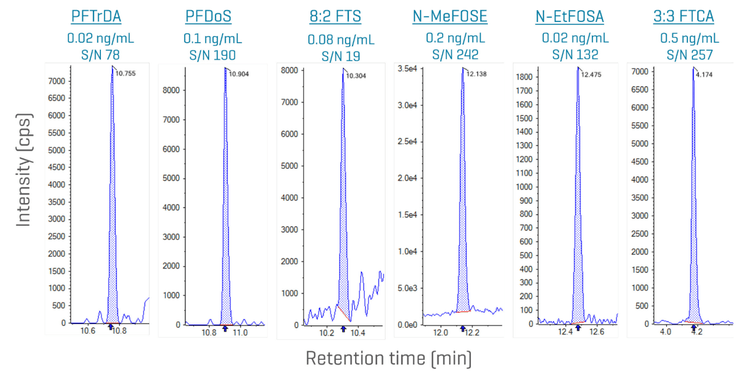
- The observed limits of quantitation (LOQ) were 0.1x to 0.5x of the EPA level 1 standard (Figure 1), except for PFOSA
- The Phenomenex Luna Omega Polar C18 column enabled the chromatographic separation of taurodeoxycholic acid (TDCA) from PFOS (>2 min) and other PFAS analytes, as well as good retention and peak shape for early eluting PFAS
- The method showed excellent robustness across ~40 hours of 125 continuous injections of solvent standards and matrix samples. The mean accuracy of the continuing calibration verification (CCV) standard (n=10) was 98%.
- The accurate quantitation with real-world samples was demonstrated using SRMs
Introduction
EPA Method 1633A is an isotope dilution LC-MS/MS method that expands upon previously published drinking water PFAS methods (EPA Methods 533 and 537.1) to additional environmental matrices including aqueous samples (such as waste water), solids, biosolids and tissues.1 The method also broadens the analyte list to incorporate long chain perfluorinated sulfonic acids (PFNS, PFDS, PFDoS), perfluorooctane sulfonamides (FOSAs), perfluorooctane sulfonamide ethanols (FOSEs) and x:3, fluorotelomer carboxylic acids (FTCAs). In contrast to earlier EPA PFAS methods, Method 1633A requires monitoring of two fragment ions for most analytes, enhancing analytical confirmation and data quality.
The environmental samples analyzed using EPA Method 1633A present significant matrix challenges that can compromise LC-MS/MS performance. To mitigate these challenges, the method specifies two solid-phase (SPE) clean-up steps using both a weak anion-exchange (WAX) cartridge and a carbon-based sorbent. In this technical note, a stacked Phenomenex WAX/graphitized carbon black (GCB) cartridge configuration was used to streamline sample preparation and reduce overall processing time. Additionally, a Phenomenex Luna Omega Polar C18 column resulted in good retention and peak shape for early eluting analytes as well as meeting the chromatographic requirement for separating PFOS from the endogenous bile acids. The Phenomenex “Designed for PFAS” product portfolio are QC tested and verified to ensure low PFAS background.
Methods
Sample preparation: Methods followed those prescribed by the EPA Method 1633A documentation1 and are briefly described.
For aqueous matrices (bottled spring water), the samples were spiked with the extracted internal standard (EIS) mixture. The pH was normalized to 6.5 if necessary and the sample was extracted using WAX/GCB solid phase extraction (SPE) cartridges.
For solid matrices (Ottawa sand mixed with reagent water), the samples were spiked with the EIS mixture and extracted 3 times with 0.3% methanolic ammonium hydroxide. The combined supernatants were reduced under nitrogen gas and interferences were removed using the WAX/GCB SPE cartridges.
For the tissue matrix (pollock fillets), homogenized samples were spiked with the EIS mixture and then extracted sequentially with 0.05M potassium hydroxide, acetonitrile and then 0.05M potassium hydroxide in methanol. The combined supernatants were reduced in volume under nitrogen gas and interferences were removed using the WAX/GCB SPE cartridges.
The WAX/GCB extraction and cleanup procedures for all sample matrixes used the Phenomenex Strata PFAS WAX/GCB stacked SPE cartridges (P/N: CSO-9207, 200 mg WAX/50 mg GCB, 6 mL). Cartridges were conditioned with 1% methanolic ammonium hydroxide and then 0.3M formic acid. After sample loading, cartridges were washed with water and then 1:1 (v/v), 0.1M formic acid/methanol. The cartridges were eluted with 1% methanolic ammonium hydroxide. The final eluant was spiked with the non-extracted internal standard (NIS) mix.
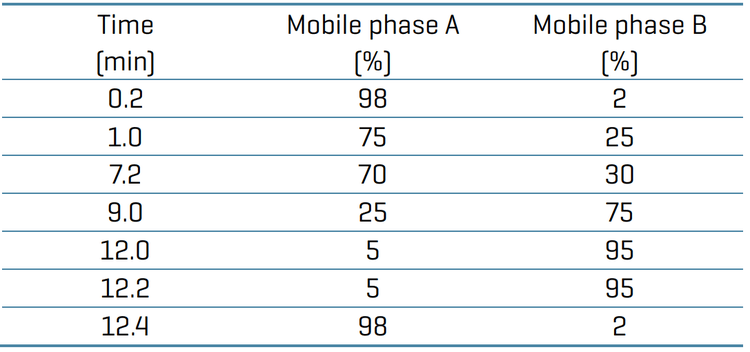
Chromatography: An ExionLC AD system was used that had been modified to remove the fluoropolymer tubing as well as the addition of a delay column (Phenomenex Luna C18). The analytical column was the Phenomenex Luna Omega Polar C18 column (100 mm x 2.1 mm, 3 µm, P/N: 00D-4760-AN) with a SecurityGuard ULTRA guard cartridge (EVO-C18, P/N: AJ0- 9298). Mobile phase A was 2mM ammonium acetate in 95:5 (v/v) water/acetonitrile and mobile phase B was acetonitrile. The flow rate was 0.4 mL/min and the gradient conditions are presented in Table 1. The injection volume was 2 µL and the column oven was set to 40°C.
Mass spectrometry: Samples were analyzed using the SCIEX QTRAP 5500+ system with the Turbo V ion source in negative electrospray ionization mode. The source/gas parameters included: CAD 9 psi, CUR 45 psi, GS1 50 psi, GS2 50 psi, ISV - 4500 V and TEM 450°C. Data were acquired using the Scheduled MRM algorithm with a target scan time of 0.3 s. Compound-specific parameters were optimized for collision energy (CE), declustering potential (DP) and collision exit potential (CXP). Two transitions per compound were monitored except for PFBA, N-MeFOSE, N-EtFOSE, PFMPA and PFMBA, which did not have stable secondary transitions, as allowed by the EPA Method 1633A criteria.
Quality control: The initial calibration samples (ICAL) were evaluated by the quality control (QC) criteria listed in the EPA 1633A method. For linearity, the relative standard deviation (RSD) values for the calibration response ratio (RR) and response factor (RF) were required to be <20%. The % ion ratio was required to be within 50% of the ion ratio for the level 4 calibrant (2.5–62.5 ng/mL in vial concentration). Finally, % accuracy was required to be within ±30% of the nominal value.
The CCV standard (level 4) was injected 10 times during the batch of 125 injections, comprising both solvent standards and matrix samples, to assess the method robustness.
The MDL was calculated as prescribed in 40 CFR 136, Appendix B.2 Briefly, 7 blank and spiked samples were prepared and carried through the extraction process for each of the water, soil and fish tissue matrices. MDL spike levels were 0.1x of the level 1 standard for water and 0.5x of the level 1 standard for soil and fish tissues. The higher MDL in either the blank or spiked sample was selected as the initial MDL.
Data processing: Samples were processed with the Analytics module of SCIEX OS software, version 3.1.6. Analyte responses were normalized to their respective extracted internal standards (EIS). PFTrDA was quantified using the average areas of 13C2-PFTeDA and 13C2-PFDoA, as specified. The mean response factor regression was used for calibration curves, based on method requirements. Three replicates of the calibration standards were performed.
Chromatographic retention and peak shape
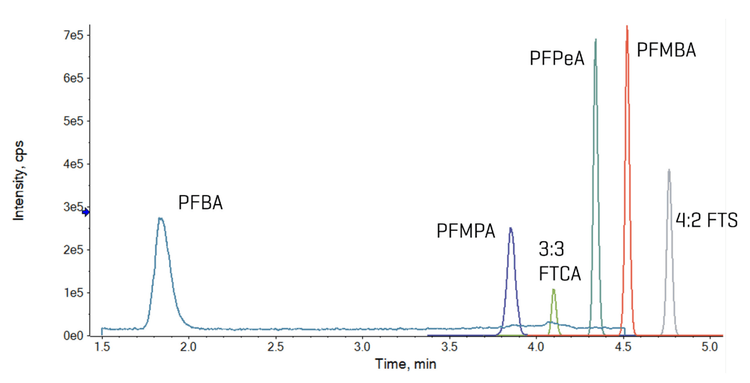
Early eluting, relatively polar compounds often experience poor retention and peak shape using traditional reverse-phase LC columns. In this method, the combined hydrophobic interactions and polar modified particle surface characteristics of Phenomenex Luna Omega Polar C18 column resulted in PFBA retention of ~1.8 min with excellent, symmetrical peak shape for all early eluting compounds (Figure 2).
Calibration standards: Sensitivity, accuracy, precision, ion ratio and linear dynamic range
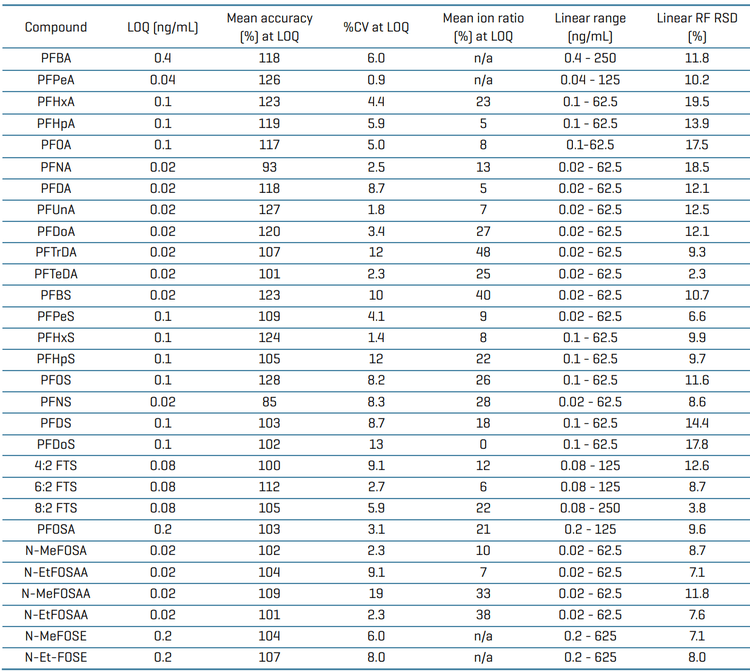
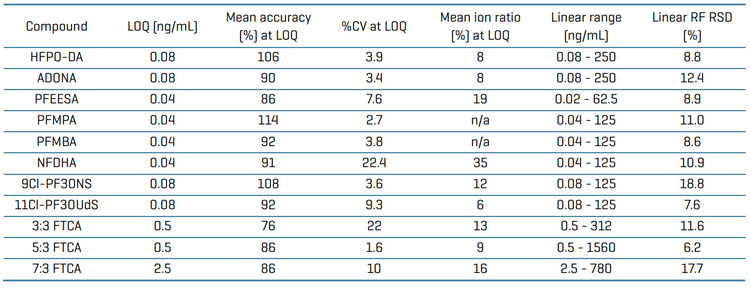
Sensitivity of the calibration standards exceeded the performance described in the EPA Method 1633A document. The LOQ criteria were defined as ±30% accuracy and the ion ratio ±50% of level 4 calibration standard. The observed LOQ concentrations were 0.1x to 0.5x of the EPA level 1 standard, except for PFOSA. LOQs ranged from 0.02–0.1 ng/mL for the PFCAs, PFSAs, sulfonamides, sulfonamide acids and fluorinated ether acids (Table 2). Figure 1 shows representative chromatograms at the LOQ for the new PFAS classes included in the EPA Method 1633A. The x:3 FTCAs were prepared at higher levels in the calibration standards and the LOQs ranged from 0.5–2.5 ng/mL.
The calibration curve was run in triplicate to obtain accuracy and precision statistics. At the LOQ concentration, the average accuracy was 106% (76%–128%) and the average %CV was 7% (0.9%–22%), indicating excellent data quality at low levels of quantitation. Observed ion ratios were within 50% of the ion ratios for the level 4 calibrator and linearity (RSD of RF and RR) was below 20% (Table 2).
Method robustness
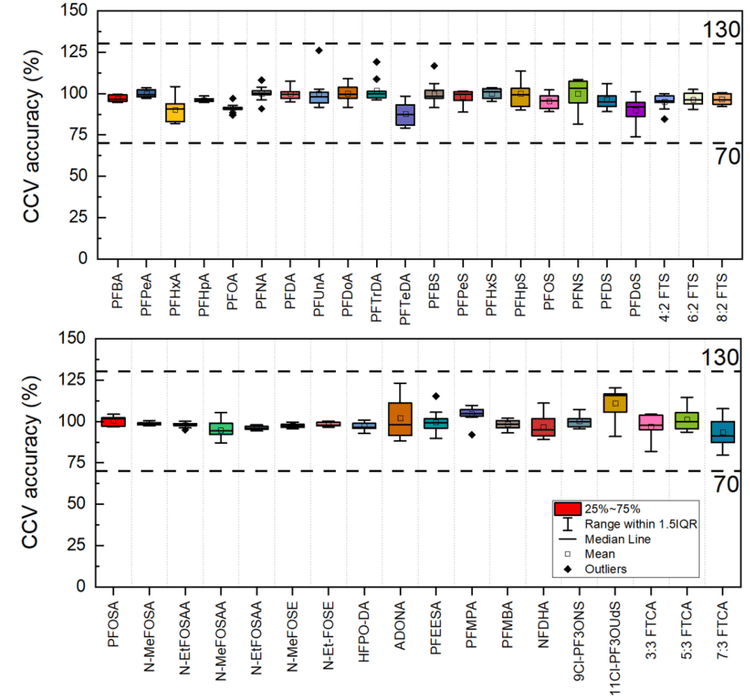
The method showed excellent robustness throughout ~40 hours of continuous instrument analysis and across 125 injections of solvent standards and water, soil and fish tissue. The mean accuracy of the CCV standard (n=10) was 98%, ranging from 88% to 111%. The mean %CV was 4.9%, indicating excellent precision of the CCV standard (Figure 3). These results demonstrate the capability of the SCIEX 5500+ system to analyze the complex matrices included in the EPA Method 1633A with excellent data quality.
Method detection limits in soil, fish tissue and water
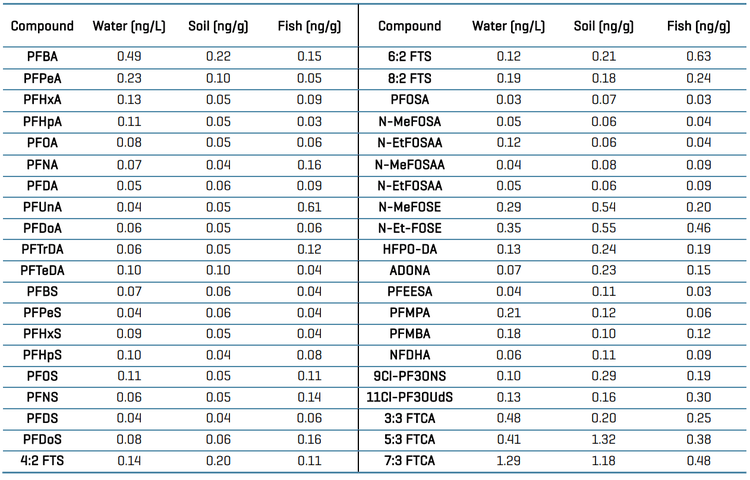
The MDL is defined as the minimum measured level that can be reported with 99% confidence that the measured concentration is distinguishable from the method blank. The MDL must be determined using procedures outlined by the EPA.1 The MDL is a statistic calculated across multiple samples and does not assess raw analyte signal-to-noise. Overall, MDL values for aqueous samples ranged from 0.03–1.29 ng/L in aqueous matrix, 0.04-1.32 ng/g in the soil matrix and 0.03-1.10 in the fish matrix. These MDLs met the pooled values specified in EPA Method 1633A (Table 3), demonstrating the ability of the method to generate sensitive and precise data in a diversity of environmental matrices.
Bile salts interference check
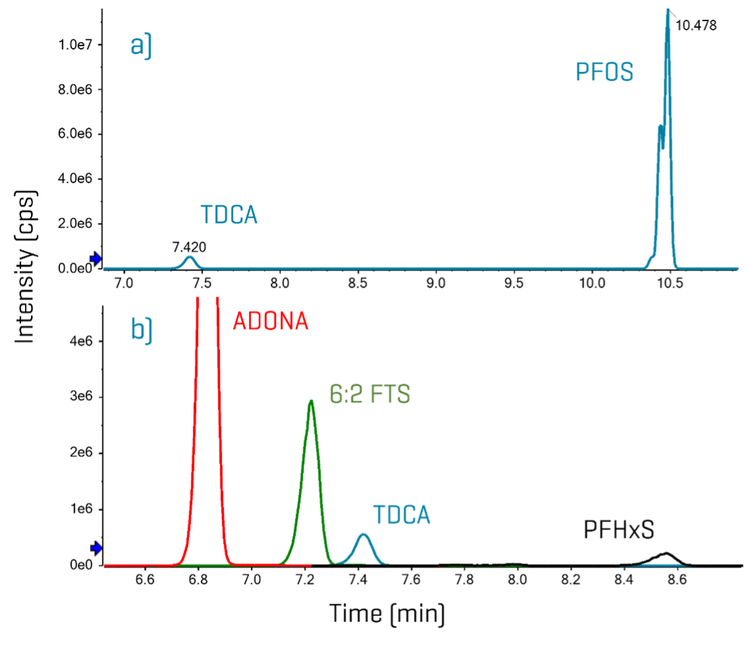
Biological tissues have been shown to contain endogenous interferences for PFHxS and PFOS, which might result in false positives. Specifically, taurodeoxycholic acid (TDCA) is a bile acid with the same m/z 499>80 MRM transition as PFOS and therefore might cause high bias or false positive reporting if there is co-elution, depending on the chromatographic conditions.3 Therefore, the LC column, mobile phase and chromatographic gradient were carefully chosen to ensure that TDCA did not elute within 1 min of PFOS and to ensure that TDCA did not coelute with any of the target analytes, as established by the EPA Method 1633A requirements (Figure 3). Using this method, TDCA and PFOS were chromatographically separated by ~3 min using the Phenomenex Luna Omega Polar C18 column (Figure 4, top panel). Although the observed chromatographic separation was longer than required, this was necessary to ensure that none of the PFAS analytes coeluted with TDCA (Figure 4, bottom panel).
Accurate quantitation with QC and NIST SRM samples
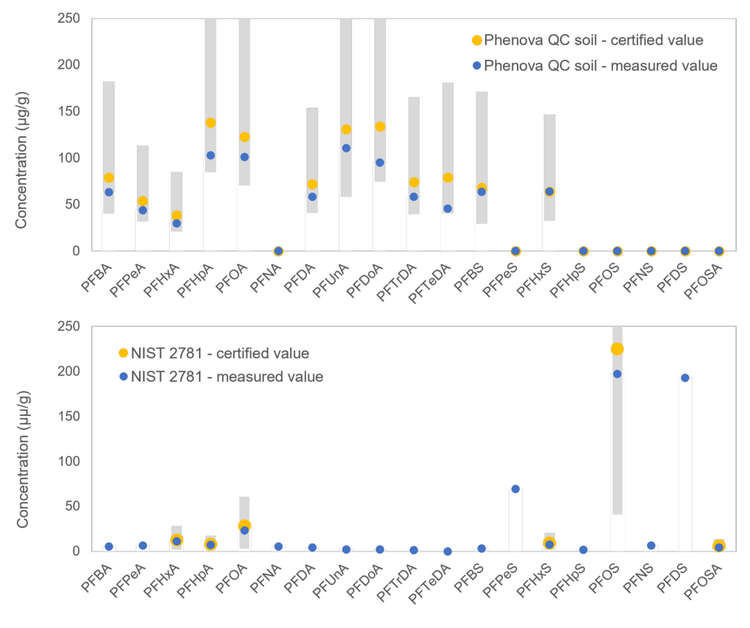
A domestic sludge sample (NIST SRM 2781) and Phenova QC soil sample were analyzed to evaluate method accuracy. Our measurement (Figure 4, blue dots) was comparable to and within the error of certified values4 (Figure 5, yellow dots). For the NIST SRM, PFPeS and PFDS that were not reported in the literature were also detected in this analysis.
EPA 1633A requires a dual stage clean-up procedure using both a WAX cartridge and carbon-based sorbent. In this technical note, the Phenomenex Strata PFAS stacked SPE cartridge was used instead of a separate WAX SPE cartridge and GCB dispersive SPE (dSPE). Previous studies have demonstrated equivalent method accuracy and lower variance of the stacked cartridges in aqueous and soil matrices, as compared to separate WAX and GCB dSPE.5,6 These results highlight the significant sample preparation time savings and greater robustness of using the stacked SPE cartridges.
Near-LOQ level detection in unspiked real-world samples
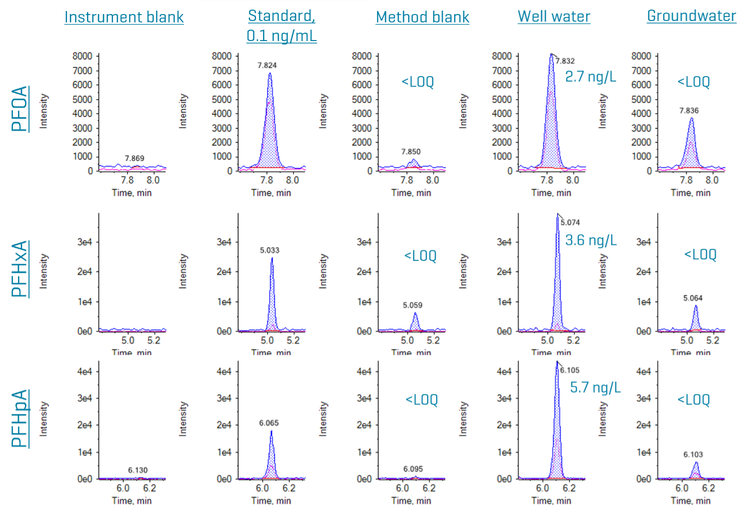
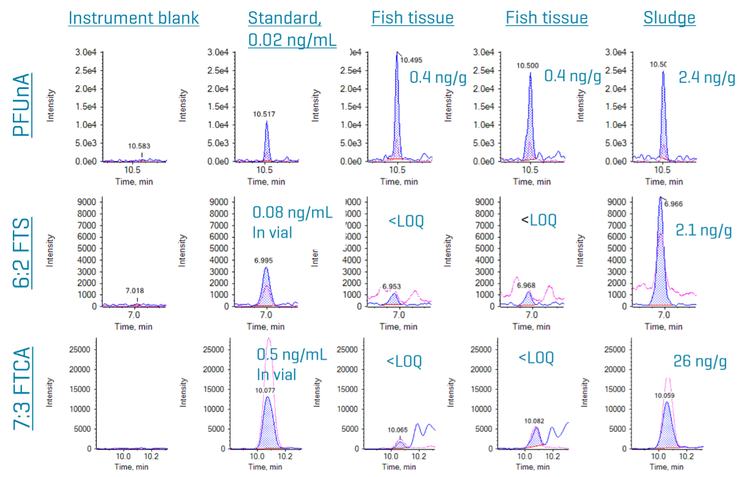
To test the real-world samples, unspiked matrix samples, including well water, groundwater, fish tissues and sludge, were analyzed. A few compounds were detected at near-LOQ levels, demonstrating the performance of the method in various matrices. Figure 6 shows example chromatograms of PFCAs in unspiked well water and groundwater samples, which were comparable to the LOQ level standard (0.1 ng/mL in vial). Figure 7 shows example chromatograms of PFUnA, 6:2 FTS and 7:3 FTCA in fish tissue and sludge samples.
Conclusions
- This technical note demonstrated the ability to meet the EPA Method 1633A requirements using a method developed on the SCIEX 5500+ system.
- The observed LOQ concentrations were 0.1x to 0.5x of the level 1 EPA standard, except for PFOSA
- Chromatographic separation was achieved using the Phenomenex Luna Omega Polar C18 column to avoid matrix interference by TDCA; the LC column also showed good retention and peak shape of the early eluting analytes
- The method showed excellent robustness throughout ~40 hours of 125 continuous injections of solvent standards and matrix samples. The mean accuracy of the CCV standard (n=10) was 98%.
- The accurate quantitation with real-world sample was demonstrated using NIST SRM sludge sample and Phenova QC soil sample; previous results have demonstrated the ability of the Phenomenex Strata PFAS stacked (WAX/GCB) SPE cartridge to generate accurate data for EPA Method 1633A
- The performance of the analysis near LOQ level was tested in various real-world unspiked samples
References
- Method 1633, Revision A. Analysis of per- and polyfluoroalkyl substances (PFAS) in aqueous, solid, biosolids, and tissue samples by LC-MS/MS. U.S. Environmental Protection Agency, Office of Water, Washington, DC, December 2024. EPA Doc. No. 820-R-24-007.
- United States Environmental Protection Agency. (2016) Definition and procedure for the determination of the method detection limit, revision 2. EPA 821-R-15-006, 40 CFR 136, Appendix B.
- Benskin JP, Bataineh M, Martin JW. (2007) Simultaneous characterization of perfluoroalkyl carboxylate, sulfonate, and sulfonamide isomers by liquid-chromatography-tandem mass spectrometry. Anal. Chem. 79(17): 6455-6464.
- National Institute of Standards and Technology. (September 15, 2015). Certificate of Analysis. Standard Reference Material 2781.
- Robinson, A.; Johnson, T.; Khan, A.; Lord, H.; Jack, R.; Lodge, S.; Tackett, B. (2024) Evaluation of extraction options for EPA Method 1633. Phenomenex TN-0155.
- Shimizu, M.; Butt, C.M.; Bassignani, P.; Jack, R.; Lodge, S.; Tackett, B. (2024) Use of a simplified extraction method using a stacked SPE for soil extracts for EPA Method 1633. Phenomenex TN-0169.