Abstract
This technical note demonstrates the SCIEX novus V55 system as a powerful, next-generation mass spectrometer delivering highly accurate and precise quantitation of PFAS in drinking water using EPA Method 533. Excellent quantitative performance was achieved in laboratory fortified blanks (LFBs) with mean accuracies of 91%-128% at the 2 ng/L method reporting limit (MRL) concentration and 89-126% at 40 ng/L, and precision <20%CV across both spiking levels. A minimal system background, typically 1-2% of the MRL in the laboratory reagent blank (LRB), further enabled confident, high-quality data critical for trace-level monitoring. By leveraging the SCIEX OS Batch Automation Decision Rules, QC criteria, including carryover following the high-level calibration standard, can be automatically monitored, driving early risk mitigation, minimizing batch failures and reruns and maintaining high throughput operation.
Key benefits of PFAS analysis in drinking water using the SCIEX novus V55 system
Good retention and peak shape using the Phenomenex Luna Omega PS C18 column. Symmetrical peak shape was shown for early eluting analytes, such as PFBA and PFPeA with retention times (RTs) of 1.7 min and 2.0 min, respectively
Excellent quantitative performance in method spikes. Mean accuracies ranged from 91% to 128% at the 2 ng/L MRL level and from 89% to 126% at 40 ng/L in LFBs (n=7), with a mean precision of <20%CV across both levels
Automated QC monitoring to minimize batch failures. SCIEX OS Batch Automation Decision Rules monitored QC criteria with automated batch intervention to maintain sample throughput
Application to real-world samples. The method was applied to 7 field drinking water samples with PFBS detected greater than the MRL in one sample
Introduction
Per- and polyfluoroalkyl substances (PFAS) in drinking water are regulated in multiple countries and regions through either enforceable maximum contaminant levels (MCLs) or advisory guidelines. In the United States, the Environmental Protection Agency (EPA) established MCLs for PFOA, PFNA, PFOS, PFHxS, PFBS and HFPO-DA in April 2024. In addition, several U.S. states have implemented their own PFAS MCLs or guidance values, in some cases, expanding the number of regulated analytes and adopting more stringent action levels. Analysis of PFAS in drinking water is performed using liquid chromatography-tandem mass spectrometry (LC-MS/MS), commonly in accordance with EPA Method 5331 or earlier methods such as EPA 537.12 and 537.3 These methods employ solid-phase extraction (SPE) to concentrate and clean up water samples prior to instrumental analysis and require strict adherence to quality control criteria, including accuracy and precision requirements for laboratory water spike samples. This technical note describes the analysis of PFAS in drinking water using EPA Method 533 on the SCIEX novus V55 system. The novus V55 system is the smallest mass spectrometer in its class, 35% more compact compared to the SCIEX 5500+ system. Also, the improved energy efficiency reduces heat output and lab cooling needs by up to 40% as compared to the 5500+ system.
Methods
Sample preparation. Full method details are described in the EPA method 533 document.1 Briefly, a 250 mL sample was preserved by adding ammonium acetate (final concentration of 1 g/L) and spiked with the suite of isotope dilution analogue standards (EPA-533APDS, Wellington Laboratories, Guelph, ON). Samples were extracted and concentrated using Phenomenex Strata™-X-AW polymeric solid-phase extraction (SPE) cartridges (500 mg/3 mL, P/N: 8B-S038-HBJ). Extracts were reconstituted in 1 mL of 80:20 (v/v) methanol/water and spiked with the isotope performance standards.
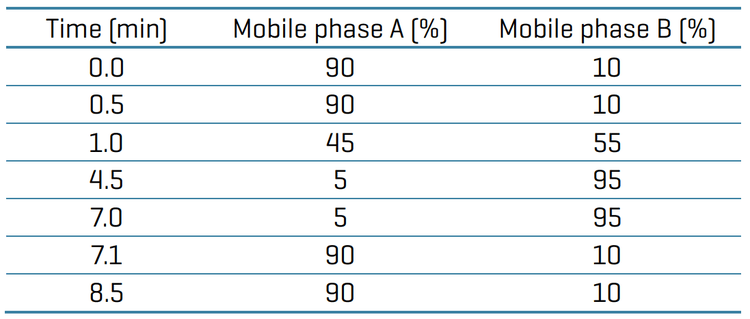
Liquid chromatography. Chromatography was performed with an ExionLC AE system using a Phenomenex Luna C18(2) (50 x 4.6 mm, 5 μm, P/N: 00B-4252-E0) as the delay column and a Phenomenex Luna Omega PS C18 (50 x 2.1 mm, 3 μm, P/N: 00B-4758-AN) as the analytical column. The mobile phases were water (“A”) and methanol (“B”), both modified with 5mM ammonium acetate. The flow rate was 0.600 mL/min and the gradient program is presented in Table 1 with a total runtime of 8.5 min. The column oven was set to 40oC and the injection volume was 2 μL.
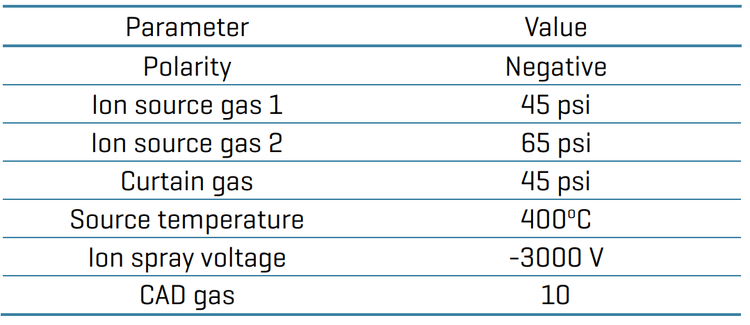
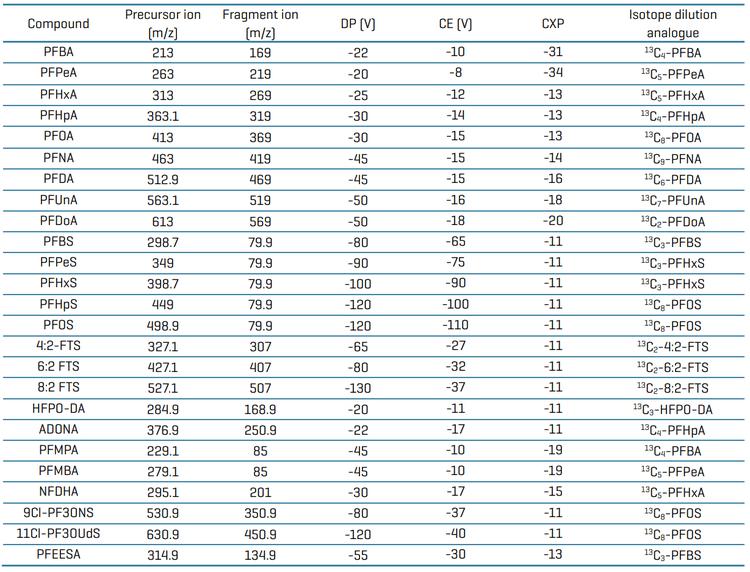
Data analysis. The SCIEX OS software (version 5.0) was used for data acquisition and processing. Analyte raw area counts were normalized to the corresponding isotope dilution analogue (see Appendix). As per the EPA 533 criteria, the calibration curve was forced through the origin. The reported concentrations for the sulfonic acids were corrected for the sodium or potassium salt content. The “Decision Rules” workflow was used with the Acquistion Batch Automation feature to illustrate the automated, real-time monitoring of QC samples.
Batch decision rules
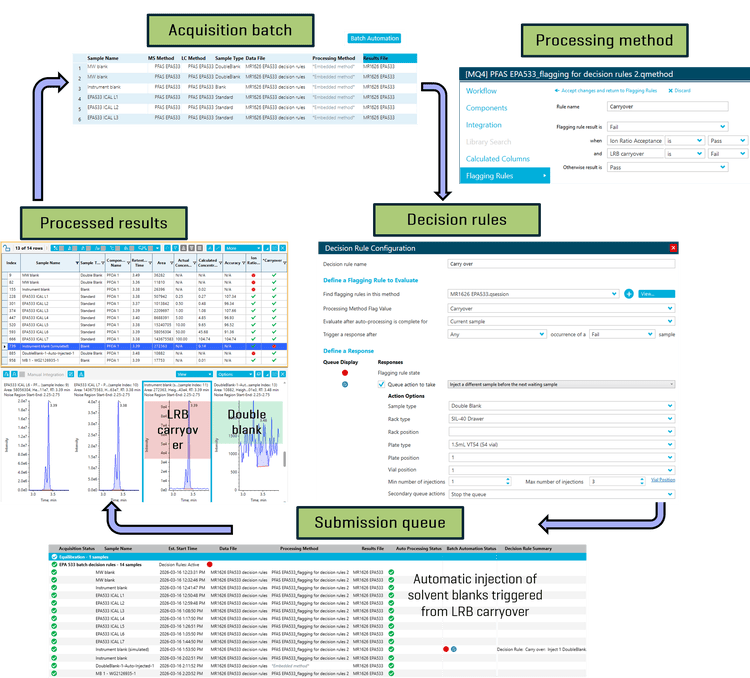
EPA Method 533 specifies that the laboratory reagent blank (LRB), analyzed immediately after the highest calibration standard, exhibits background PFAS concentrations less than one-third of the MRL. Exceedance of this threshold results in all positive results within the batch to be invalid and typically necessitates complete batch reanalysis. This causes significant time and throughput impacts for the lab. To mitigate this risk, SCIEX OS features batch acquisition “Decision Rules” that enable real-time, automated data monitoring and corrective action (Figure 2). First, a flagging rule (“carryover”) was created within the processing method to identify LRB results exceeding one-third of the MRL. Batch “Decision Rules” were then configured to automatically insert a double blank injection if this carryover flag failed. In this example, up to 3 consecutive double blanks were permitted; persistent failures resulted in batch stoppage. An intentionally contaminated LRB [“instrument blank (simulated)”] was evaluated to illustrate the effectiveness of this feature. These results demonstrate the flexibility of the SCIEX OS Batch Decision Rules to minimize batch failures and maintain sample throughput.
Chromatographic retention and analyte separation
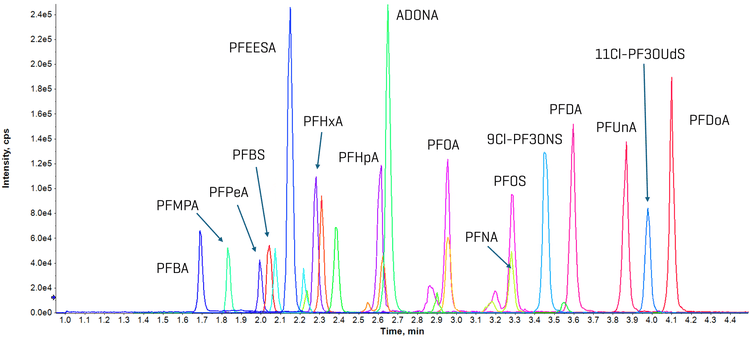
The combination of the Phenomenex Luna Omega PS C18 column and gradient conditions used, showed good chromatographic retention from the void volume as demonstrated by the individual PFAS compounds eluting from 1.7 min (PFBA) to 4.1 min during the 8.5 min runtime (Figure 3). Separation from the void volume, and potential co-eluting interferences is essential for maintaining good data quality. All compounds exhibited good peak symmetry using the PS C18 column and most PFAS were baseline separated. Further, clusters of branched isomers partially separated from the linear isomer peak for PFAS such as PFNA, PFOA, PFHxS and PFOS.
Sensitivity of the novus V55 system
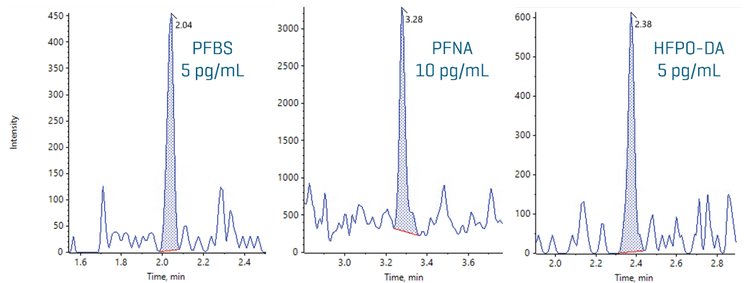
Analysis of low-level standards showed detectable peaks at concentrations ranging from 5 to 10 pg/mL using the 2 μL injection volume (Figure 4). In general, the sensitivity of the sulfonic acids was greater than the carboxylic acids due to the slightly higher source temperature used. These results demonstrate the capability of the novus V55 system for trace level PFAS analysis of the broad analyte panel in EPA Method 533.
Calibration standard quantitative performance:
Accuracy and linear dynamic range
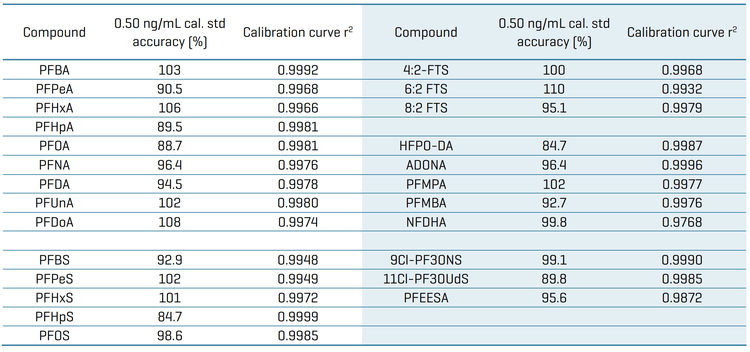
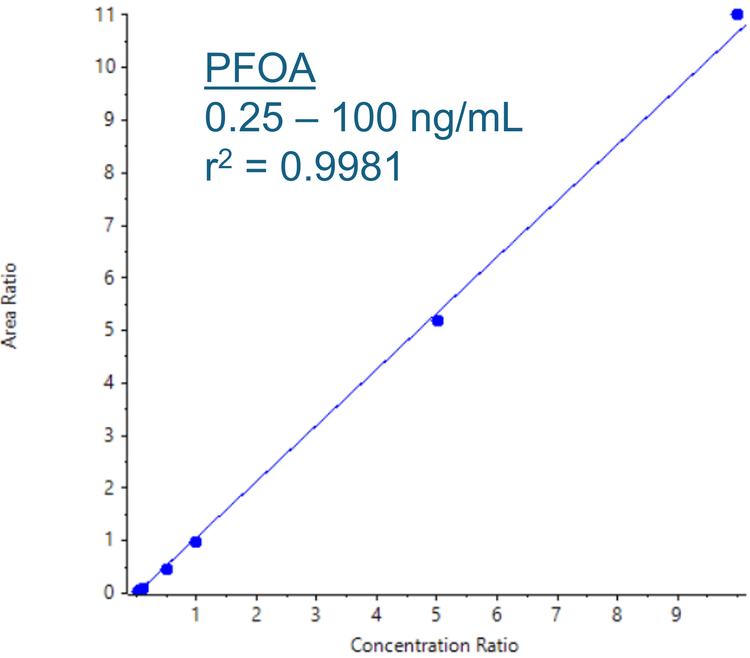
Calibration standards were prepared in 80:20 (v/v) methanol/water and analyzed at 7 levels from 0.25 ng/mL to 100 ng/mL (n=1). These calibration levels represent in-sample concentrations of 1 ng/L to 400 ng/L, accounting for the 250x SPE concentration factor. At the MRL level, 0.50 ng/mL, the accuracy ranged from 84.7% to 110% across the panel of 25 PFAS compounds, demonstrating good quantitative performance (Table 3). All compounds showed good linearity throughout the calibration range with r2 values ranging 0.987 to 1.000 (see Figure 5 for PFOA). The only exception was NFDHA which is prone to in-source degradation and exhibited saturation in the 100 ng/mL standard. These results demonstrate the ability of the novus V55 system to accurately quantify PFAS across the 3 orders of linear dynamic range.
Method performance in laboratory fortified blanks (LFBs): Accuracy and precision
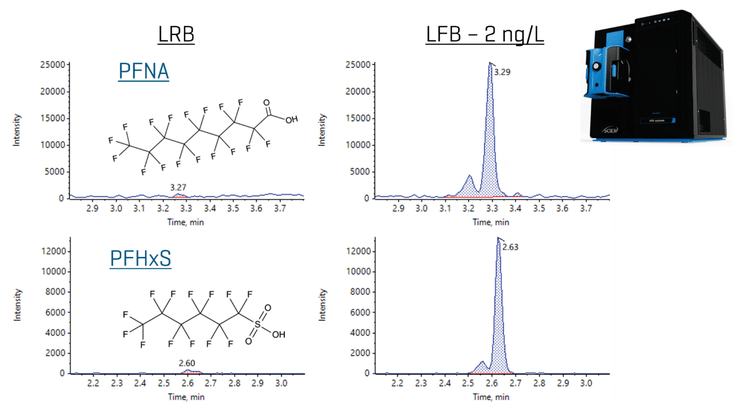
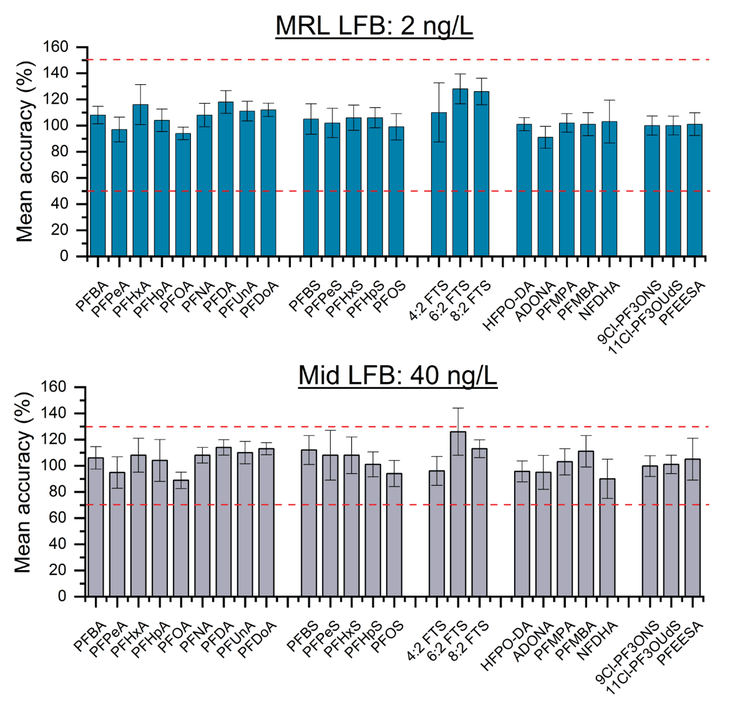
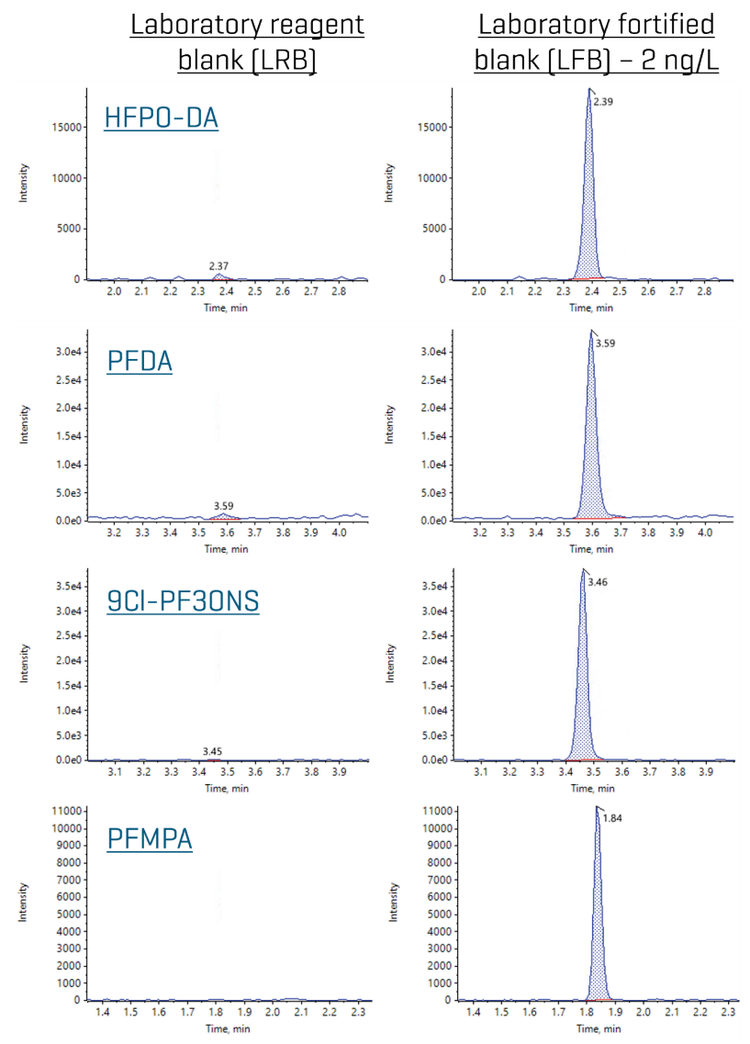
The method accuracy and precision were evaluated through laboratory fortified blank (LFB) spikes at 2 levels: the MRL (2 ng/L) and 40 ng/L (n=7). In addition, laboratory reagent blanks (LRBs) were prepared and analyzed with each LFB set (n=7). At the 2 ng/L MRL level, the mean accuracy ranged between 91%-128% (Figure 6), within the EPA 533 performance criteria of 50-150% for LFB samples spiked within 2x of MRL. Similarly, the mean accuracy ranged between 89%-126% at the 40 ng/L level, within the EPA criteria of 70-130% for LFB samples spiked at higher levels. The mean precision was <20%CV for both LFB spiking sets except for 4:2 FTS in the 0.5 ng/L spikes (23%CV). XICs for HFPO-DA, PFDA, 9Cl-PF3ONS and PFMPA in the 2 ng/L LFB are shown in Figure 7.
The LRBs showed very low background contamination at levels less than the lowest calibration standard (0.25 ng/mL). In general, the LRB peak areas were 1-2% of the MRL peak area.
These results demonstrate the ability of the novus V55 system to produce accurate and precise data, with very low system background, for the quantitation of PFAS in drinking water using the EPA Method 533.
Real-world drinking water sample analysis
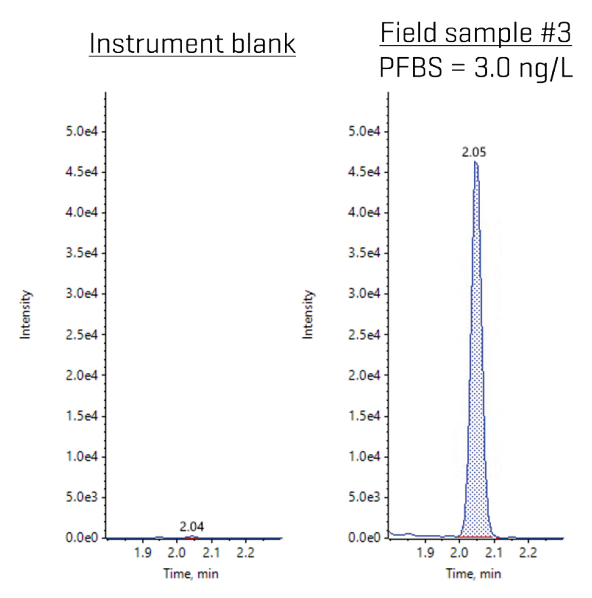
The method was applied to 7 real-world drinking water samples. PFAS concentrations were below the MRL for all analytes except for PFBS in field sample #3 at 3.0 ng/L (Figure 8). These results are consistent with the generally low levels of PFAS detected in background drinking water samples. Overall, this demonstrates the capability of the novus V55 system to quantify PFAS in real-world drinking water samples using EPA Method 533.
Conclusions
The technical note demonstrated:
- Application of EPA Method 533 for PFAS in drinking water using the novus V55 system
- Good chromatographic performance using the Phenomenex Luna Omega PS C18 column; symmetrical peak shape and separation from the void-volume for early-eluting analytes (PFBA = 1.7 min, PFPeA = 2.0 min)
- Reliable quantitative accuracy and precision in laboratory fortified blank samples; with mean accuracies of 91–128% at 2 ng/L (MRL) and 89–126% at 40 ng/L (n = 7 per levels), and mean precision maintained at <20% CV across both levels
- Automated QC monitoring in the SCIEX OS software to maintain sample throughput, SCIEX OS Batch Automation Decision Rules effectively monitored QC criteria, minimizing batch failures while mitigating potential impacts
- Applicability to real-world samples; method was applied to seven field drinking water samples, with PFBS detected above the MRL in one sample (3.0 ng/L)
References
- Rosenblum, A. and S.C. Wendelken. Method 533: Determination of per- and polyfluoroalkyl substances in drinking water by isotope dilution anion exchange solid phase extraction and liquid chromatography/tandem mass spectrometry. United States Environmental Protection Agency, Washington, November 2019. https://www.epa.gov/sites/production/files/2019-12/documents/method-533-815b19020.pdf
- Shoemaker, J.A.; Grimmett, P.E. Boutin, B.K. Method 537: Determination of selected perfluorinated alkyl acids in drinking water by solid phase extraction and liquid chromatography/tandem mass spectrometry (LC/MS/MS), version 1.1. United States Environmental Protection Agency, Washington, DC, September 2009. EPA Document#: EPA/600/R-08/092
- Shoemaker, J.A. and D.R Tettenhorst. Method 537.1: Determination of selected per- and polyfluorinated alkyl substances in drinking water by solid phase extraction and liquid chromatography/tandem mass spectrometry (LC/MS/MS), version 2.0. United States Environmental Protection Agency, Washington, DC, March 2020. EPA Document#: EPA/600/R-20/006
Appendix