Abstract
Here, a set of LC-MS/MS methods on the SCIEX Triple Quad 3500 System was developed which can completely cover the current Chinese national standards for detection in an aqueous environment: surface water environmental quality standards (GB3838-2002), national drinking water standards (GB5749-2006) and groundwater quality standards (GB14848-2017).
Introduction
The standards for surface water environmental quality (GB3838-2002), the national standards for drinking water (GB5749-2006) and groundwater quality standards (GB14848-2017) issued by China currently stipulate the limit values of several compounds determined by the LC-MS/MS method.
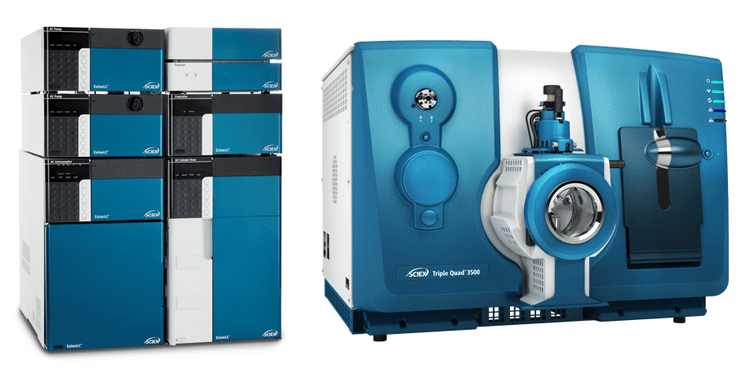
Here, the SCIEX Triple Quad™ 3500 LC-MS/MS System was used to develop a workflow for quantifying 22 compounds in water (including 2 additional microcystin compounds), which provides a simple and rapid solution to address these regulations in such aqueous environments.
Key features of the LC-MS/MS method
- This method covers the 20 compounds in the Chinese national standards GB 3838-2002, GB 5749-2006, and GB 14848-2017 and two additional microcystin compounds of concern
- The determination limits of the 22 compounds fully meet the sensitivity requirements of the above standards
- Direct injection of water samples without enrichment or extraction
- A fast and simple method which improves laboratory efficiency
Methods
Sample preparation: The water sample was analyzed by direct injection, with no sample treatment.
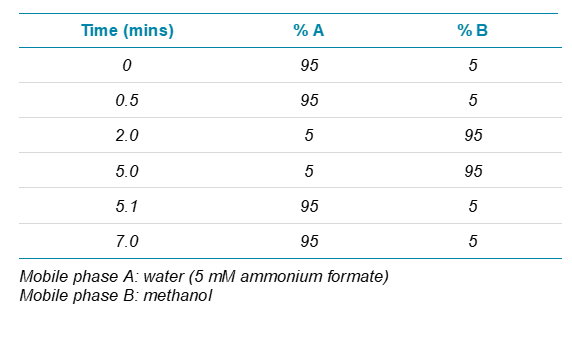
Chromatography: Separation was achieved using the SCIEX ExionLC™ System with a Phenomenex Kinetex Biphenyl (50 × 3.0 mm, 2.6 µm). The flow rate was 0.4 mL/min with an injection volume of 100 µL. Gradient information is provided in Table 1.
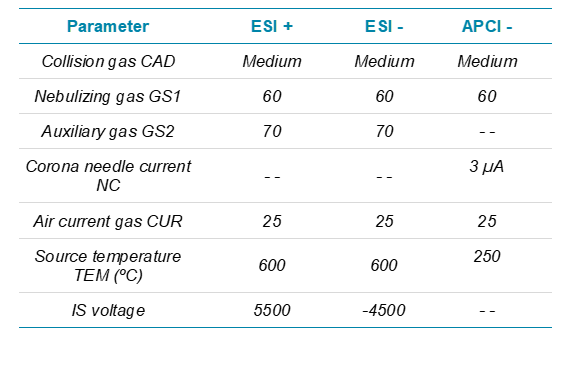
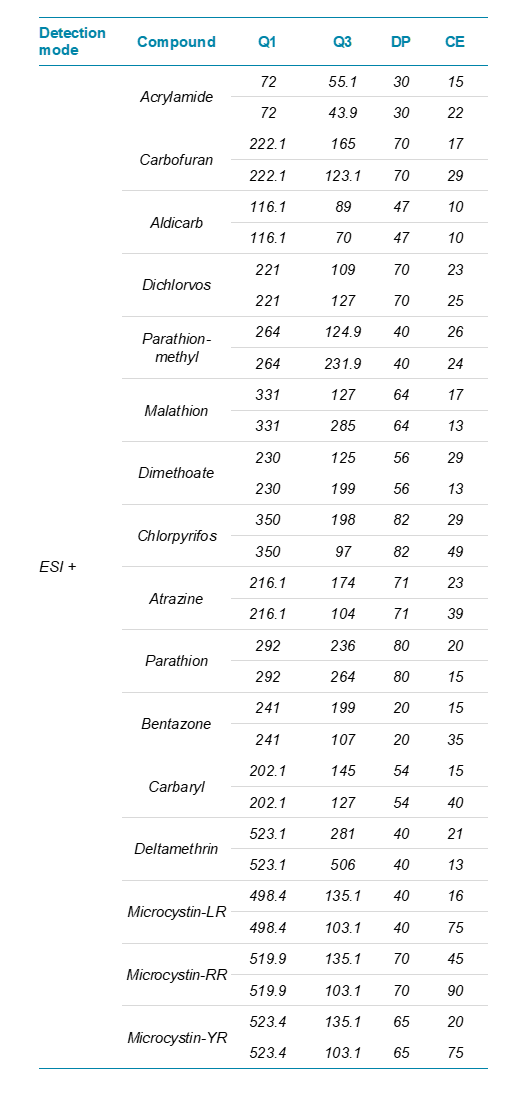
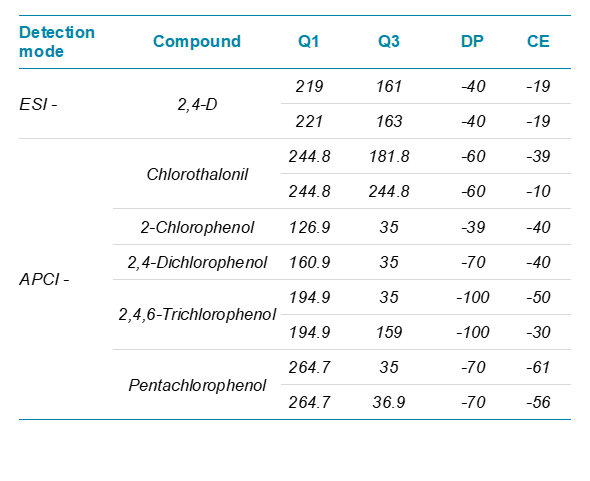
Mass spectrometry: Samples were analyzed using the SCIEX Triple Quad 3500 LC-MS/MS System. The method was divided into ESI positive, ESI negative and APCI negative ion modes of detection. Method parameters are described in Tables 2 - 4.
Data processing: The data was processed using SCIEX OS Software (version 1.4).
Results
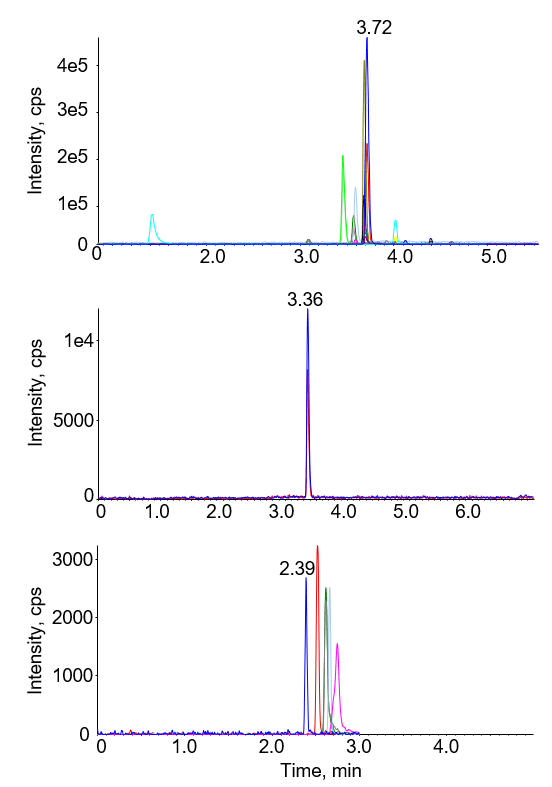
The chromatographic separation achieved on the Kinetex Biphenyl is shown in Figure 1. Peaks are well defined and resolution is sufficient for accurate and reliable quantification.
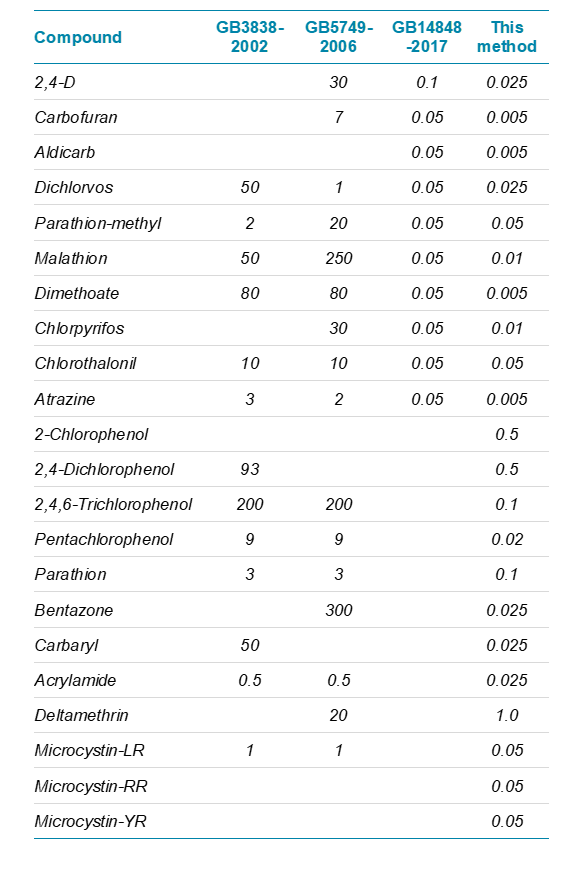
Calibration curves were generated for all 22 compounds in the method. Results are summarized in Table 5 and compared to the requirements for the Chinese national standards. The lower limits of quantification achieved with this method meet or surpass the current requirements.
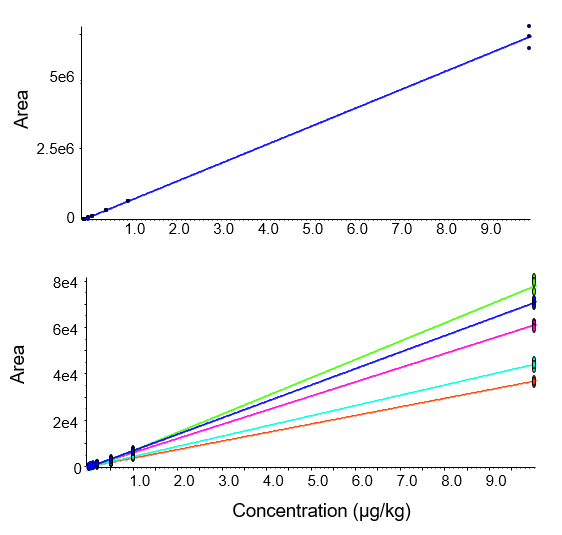
Very good linearity was achieved for each compound in water with r > 0.99, as shown in Figure 2. These calibration curves can be applied to the detection of analytes in actual samples.
Conclusions
A workflow comprising LC-MS/MS methods on the SCIEX Triple Quad 3500 System was developed which can completely cover the current Chinese national standards for surface water environmental quality standards (GB3838-2002), national drinking water standards (GB5749-2006) and groundwater quality standards (GB14848-2017). The lower limit of the method was better than the current standard, providing an accurate quantitative LC-MS/MS detection method.