Abstract
This technical note demonstrates the application of EPA Method 1633A using a novel mass spectrometer, the novus V55 system. Strong quantitative performance was shown at the limit of quantitation (LOQ) with most PFAS exhibiting ±10% accuracy on the quantifier ion and overall accuracies ranging from 80 to 129% (Figure 1). In addition, the LOQ ion ratios consistently met the EPA ±30% acceptance criteria relative to the level 5 standard. Method performance was further supported by the LLOPR recoveries (2x LOQ) ranging from 90 to 110% for most analytes and precision values <20% CV, well within the EPA 1633A quality control (QC) criteria. Chromatographic separation using the Phenomenex Luna Omega PS C18 column provided effective resolution of the bile acid interferences from PFOS, along with sufficient retention and symmetrical peaks for early eluting PFAS. Finally, the method was successfully applied to the analysis of real-world environmental water samples, demonstrating suitability for monitoring applications and routine environmental workflows.
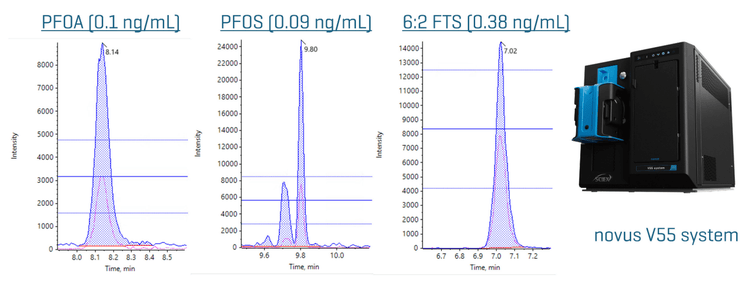
Key benefits of PFAS analysis using EPA Method 1633A with the SCIEX novus V55 system
Good LOQ quantitative performance. Accuracies mostly within ±10% for the quantifier ion at the LOQ, ranging between 80 and 129% considering all PFAS. Further, LOQ ion ratios were within ±30% of the level 5 standard ion ratio
LLOPR recovery within EPA 1633A QC criteria. Method spikes at 2x LOQ showed mean recovery from 90% to 110% for most PFAS with mean precision ranging from 4.4% to 20%
Chromatographic performance using the Phenomenex Luna Omega PS C18 column. Excellent separation of bile acid interferences from PFOS, as well as good retention and symmetrical peak shape for early eluting PFAS
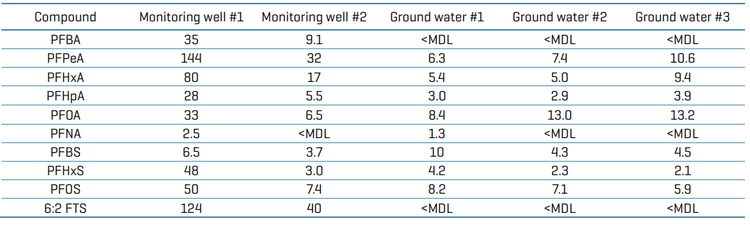
Successful application to real-world environmental water samples. The C5-C9 PFCAs and C4, C6 and C8 PFSAs were detected in two monitoring well and three groundwater samples, as well as PFBA and 6:2 FTS in the monitoring well samples
Introduction
EPA Method 1633A is an isotope dilution LC-MS/MS method that builds on existing EPA drinking water methods (Methods 533 and 537.1) by extending their applicability to a wider range of environmental matrices, including non-potable water samples, solids, biosolids and biological tissues.1,2 In addition, the method expands the target compound list to cover long-chain perfluorinated sulfonic acids (PFNS, PFDS, PFDoS), perfluorooctane sulfonamides (FOSAs), perfluorooctane sulfonamide ethanols (FOSEs) and x:3 fluorotelomer carboxylic acids (FTCAs). Unlike earlier EPA PFAS methods, Method 1633A mandates the acquisition of two fragment ions, where appropriate, providing improved compound confirmation and overall data robustness. This technical note presents the quantitation of PFAS in environmental samples using EPA Method 1633A on the SCIEX novus V55 system. The novus V55 system delivers full triple quadrupole quantitative performance in the smallest mass spectrometer in its class, 35% more compact compared to the SCIEX 5500+ system. Also, the improved energy efficiency reduces heat output and lab cooling needs by up to 40% as compared to the 5500+ system
Methods
Sample preparation. Full method details are described in the EPA Method 1633A document.2
For the onging precision and recovery (OPR) samples, a clean sand-based matrix was used. The samples were initially spiked with the EIS mixture and extracted 3 times with 0.3% (v/v) methanolic ammonium hydroxide. The combined supernatants were reduced under nitrogen gas and interferences were removed using the WAX/GCB SPE cartridges.
The method was applied to various real-world aqueous samples including monitoring well water, groundwater and surface water. For these aqueous matrices, the samples were spiked with the extracted internal standard (EIS) mixture. The pH was normalized to 6.5 if necessary and the sample was extracted using WAX/GCB solid phase extraction (SPE) cartridges.
The WAX/GCB extraction and cleanup procedures for all sample matrices used the Phenomenex WAX/GCB stacked SPE cartridges (P/N: CSO-9207, 200 mg WAX/50 mg GCB, 6 mL). Cartridges were conditioned with 1% (v/v) methanolic ammonium hydroxide and then 0.3M formic acid. After sample loading, cartridges were washed with water and then 1:1 (v/v) 0.1M formic acid/methanol. The cartridges were eluted with 1% (v/v) methanolic ammonium hydroxide. The final eluant was spiked with the non-extracted internal standard (NIS) mix.
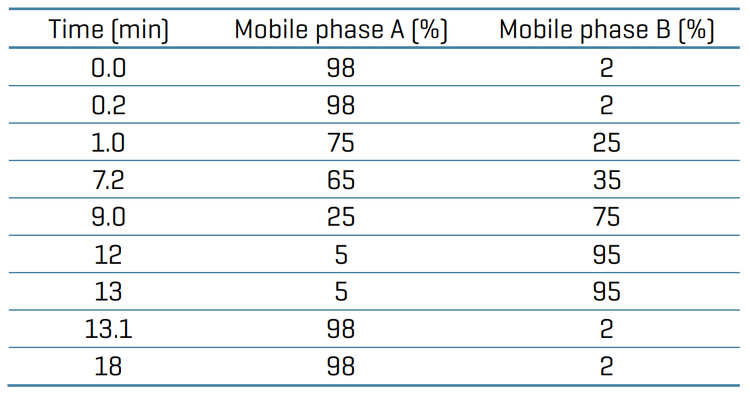
Liquid chromatography. Chromatography was performed using an ExionLC AE system with the Phenomenex Gemini C18 (50 x 3 mm, 3 μm, P/N: 00B-4439-Y0) and Phenomenex Luna Omega PS C18 (100 x 2.1 mm, 3 μm, P/N: 00D-4758-AN) as the delay and analytical column, respectively. The mobile phases were 95:5 (v/v) water/acetonitrile with 2mM ammonium acetate (“A”) and acetonitrile (“B”). The LC was operated using the gradient program described in Table 1 with a flow rate of 0.4 mL/min and a total runtime of 18 min. The injection volume was 2 μL and the column oven was set to 40o C.
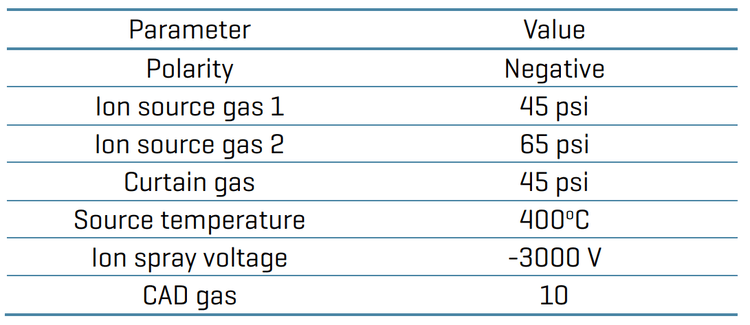
Mass spectrometry. Samples were analyzed using the novus V55 system with the OptiFlow source under negative mode electrospray ionization. Data was acquired using scheduled multiple reaction monitoring mode (sMRM) with two transitions per compound except for PFBA, N-MeFOSE, N-EtFOSE, PFMPA and PFMBA, which did not have stable secondary transitions, as allowed by the EPA Method 1633A criteria. The target cycle time was 0.4 sec.
Data analysis. The SCIEX OS software (version 5.0) was used for data acquisition and processing.
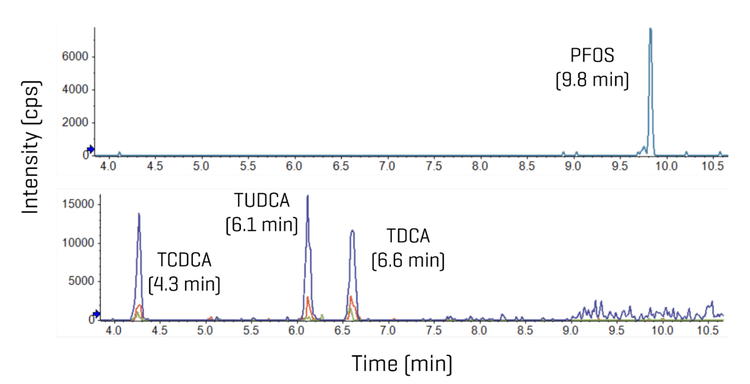
Chromatographic separation of bile acid interferences
Taurine-conjugated bile acids, including taurodeoxycholic acid (TDCA), taurochenodeoxycholic acid (TCDCA) and tauroursodeoxycholic acid (TUDCA), are known interferences for PFOS analysis in biological tissues. When analyzed using nominal-mass instrumentation, these compounds have a Q1 precursor mass that is indistinguishable from PFOS and share the [SO3]- fragment ion with PFOS. Although the [FSO3]- fragment is typically monitored to minimize false positives and ensure good quantitation for PFOS, chromatographic separation is essential for confirmation using two MRM transitions and to monitor for ion ratio tolerances.
In this method, the combined use of the Phenomenex Luna Omega PS C18 column, optimized mobile phase composition, and gradient conditions achieved excellent chromatographic resolution between PFOS and the taurocholic acids. TDCA was separated from PFOS by approximately 3.2 min (Figure 2). TCDCA (RT=4.3 min) and TUDCA (RT=6.1 min) were also well resolved from PFOS, achieving sufficient retention time differences for confident detection and accurate quantitation. The method performance greatly exceeded the EPA 1633A requirement of 1 min chromatographic separation.
Good chromatographic retention and peak shape for early eluting PFAS
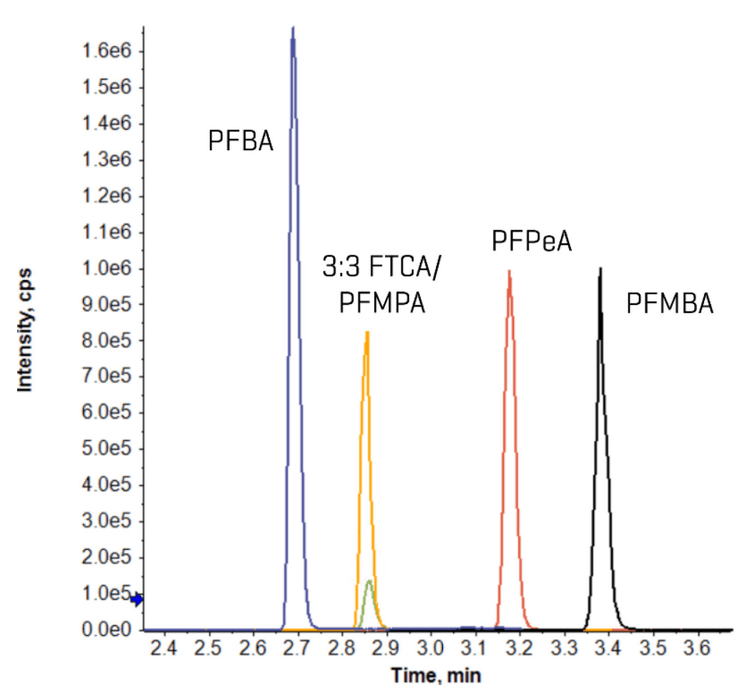
Early eluting polar analytes often exhibit poor chromatographic performance on conventional reverse-phase LC columns, as shown by asymmetric or fronting peak shapes. This behavior can compromise quantitative accuracy and overall data quality. In this method, the positive surface charge characteristics of the Phenomenex Luna Omega PS C18 column, combined with solvent vial composition, produced well-defined, symmetrical peaks. Extracted ion chromatograms for the early eluting compounds in the mid-level (L5) calibration standard, including PFBA, 3:3 FTCA, PFMPA, PFPeA, are shown in Figure 3.
Calibration standard performance: Sensitivity, accuracy, ion ratio and linear dynamic range
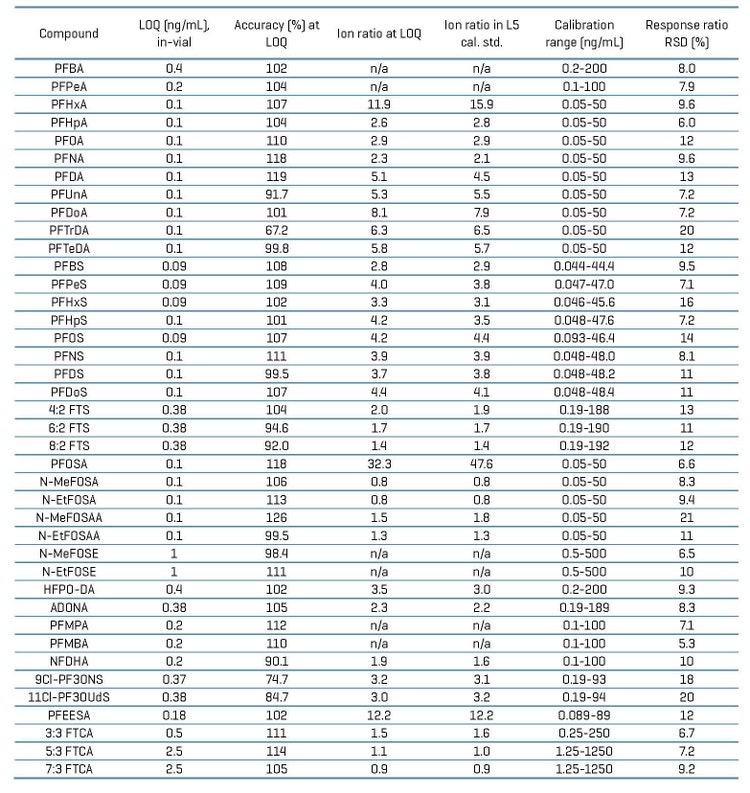
The quantitative performance of the solvent-based calibration standards was superior to the EPA 1633A criteria and is summarized in Table 3. Limits of quantitation (LOQs) for perfluoroalkyl carboxylic acids (PFCAs), sulfonic acids (PFSAs), sulfonamides, sulfonamide acids and fluorinated ether acids ranged from approximately 0.1 to 0.4 ng/mL (in-vial) across the various chain-lengths. In contrast, the sulfonamide ethanols (N-MeFOSE and N-EtFOSE) and x:3 fluorotelomer carboxylic acids (FTCAs) showed reduced sensitivity in the ESI source and therefore demonstrated higher LOQs, ranging from 1 ng/mL to 2.5 ng/mL. Overall, the method achieved LOQs approximately 2x lower than those specified in EPA 1633A, demonstrating the ability of the V55 system to surpass the method’s sensitivity requirements. For this method, the LOQ was defined as analytes exhibiting ±30% accuracy and the ion ratio tolerance within ±30% of level 5 calibration standard.
As shown in Table 3, the LOQ standard accuracies were mostly within ±10% and ranged between 80% and 129% when considering the quantifier ion for all analytes. Further the LOQ ion ratios were within ±30% of the level 5 ion ratio, surpassing the ±50% criteria in EPA Method 1633A. Ion ratios were not calculated for PFBA, PFPeA, N-MeFOSE, N-EtFOSE, PFMPA and PFMBA since these analytes have only one stable MRM transition. Further, the calibration curve showed 3 orders of linear dynamic range except for 9Cl-PF3ONS and 11Cl-PF3OUdS which exhibited detector saturation in the high level standard. As specified by EPA Method 1633A, the correlation coefficient, r, and coefficient of determination, r2, cannot be used to confirm linearity. Instead, the relative standard deviation (RSD) of the response ratio must be ≤20%. As shown by Table 3, all analytes met this criterion.
Method performance evaluation: Blanks and ongoing precision and recovery samples (OPR)
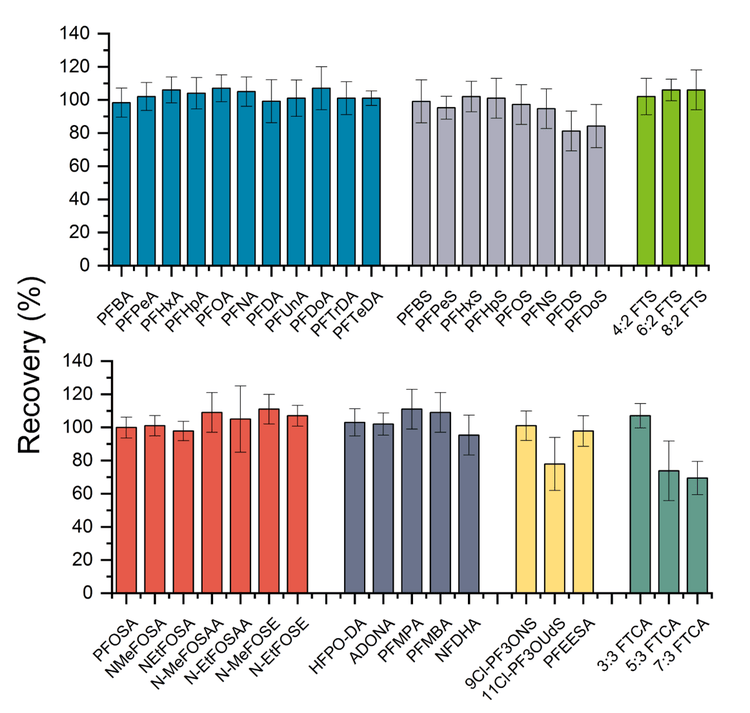
The quantitative performance was evaluated through method blanks and OPR samples in a clean sand-based matrix. These samples represent method spikes performed at the low-level (LLOPR), representing 2x LOQ, and the mid-level, representing 25x LOQ (n=7 per level). As shown in Figure 4, the mean LLOPR recovery for the quantifier ion was mainly between 90% to 110%. Lower recovery was observed for 11Cl-PF3OUdS (78%), 5:3 FTCA (74%) and 7:3 FTCA (69%), presumably because these compounds do not have exact mass-labelled surrogates. However, EPA 1633A specifies flexible recovery acceptance limits, which depend on the analyte and matrix, and vary from 40% to 160%. All analytes were well within the EPA 1663A recovery criteria for solid matrices. Further, the mean LLOPR precision ranged from 4.4% to 20%, also within the EPA criteria. Similar trends were observed in the mid-level OPR samples.
Most analytes were not detected in the method blanks (n=7). The only exceptions were PFHxS and PFOS, which had area counts <1/3 of the L1 standard.
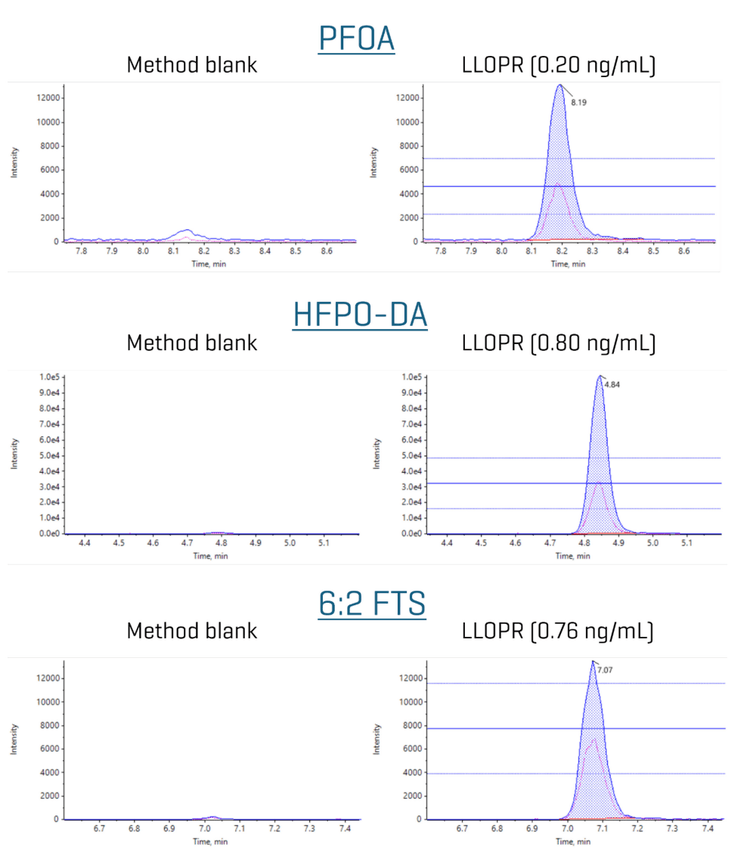
Overall, these results demonstrate the ability of the sample preparation method and the novus V55 system to produce accurate and precise quantitative data for EPA Method 1633A, with low background contamination. Figure 5 shows XICs for PFOA, HFPO-DA and 6:2 FTS in a representative method blank and LLOPR sample.
Application to real-world water samples
The EPA Method 1633A was applied to seven real-world water samples representing monitoring wells (2), groundwater (3) and surface water (3). Overall, only the C4-C9 PFCAs and C4, C6 and C8 PFSAs were detected in the two monitoring well and three ground water samples (Table 4). In addition, PFBA and the 6:2 FTS were detected in the monitoring well samples. None of the targeted analytes were detected above the LOQ concentration in the three surface water samples. The 4:2 and 8:2 FTS, perfluorooctane sulfonamides, sulfonamidoacetic acids and sulfonamide ethanols, fluorotelomer carboxylic acids, and ether carboxylic and sulfonic acids were not detected in any sample. PFAS concentrations were generally higher in the monitoring wells as compared to the groundwater samples, with monitoring well #1 showing the highest levels for most compounds. Within the monitoring well samples, the PFAS profile was dominated by PFPeA, PFHxA and 6:2 FTS. PFAS patterns were more uniform among the ground water samples.
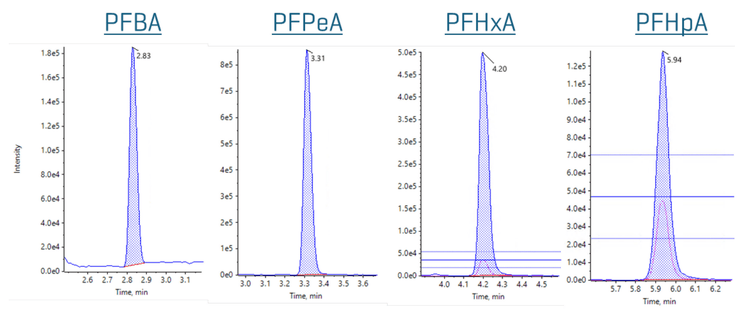
Figure 6 shows quantifier XICs for PFBA, PFPeA, PFHxA and PFHpA in the monitoring well #1 sample. The PFHxA and PFHpA XICs also show the qualifier MRMs (pink trace) and ±50% ion ratio tolerance lines. Only one transition was monitored for PFBA and PFPeA.
Conclusions
The technical note demonstrated:
- Application of EPA Method 1633A using a novel mass spectrometer, the novus V55 system, achieving QC criteria
- Good quantitative sensitivity, with calibration standard LOQ accuracies mostly within ±10% for quantifier ions and full compliance with EPA Method 1633A ion ratio criteria across the PFAS panel
- Excellent low-level method performance, as evidenced by LLOPR recoveries exceeding EPA QC criteria and good precision for method spikes at 2xLOQ
- Chromatographic performance using the Phenomenex Luna Omega PS C18 column, including effective separation of PFOS from bile acid interferences and well-retained, symmetrical peaks for early-eluting PFAS
- Successful application to real-world environmental water samples, with detection of multiple PFCAs, PFSAs, and the 6:2 FTS in monitoring well and groundwater samples
References
- Rosenblum, A. and S.C. Wendelken. Method 533: Determination of per- and polyfluoroalkyl substances in drinking water by isotope dilution anion exchange solid phase extraction and liquid chromatography/tandem mass spectrometry. United States Environmental Protection Agency, Washington, November 2019. https://www.epa.gov/sites/production/files/2019- 12/documents/method-533-815b19020.pdf
- Method 1633, Revision A. Analysis of per- and polyfluoroalkyl substances (PFAS) in aqueous, solid, biosolids, and tissue samples by LC-MS/MS. U.S. Environmental Protection Agency, Office of Water, Washington, DC, December 2024. EPA Doc. No. 820-R-24-007.