Abstract
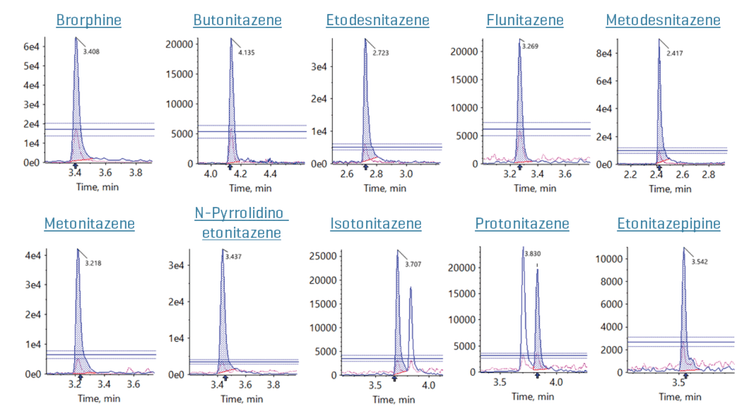
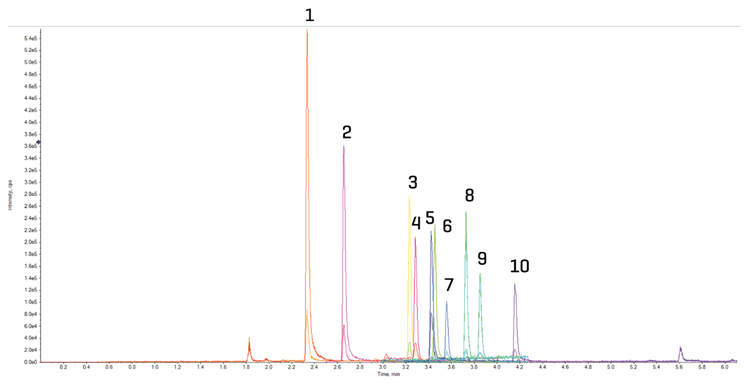
This technical note demonstrates a comprehensive workflow for the analysis of 9 nitazene analogs and brorphine in dried blood spots (DBS). Using the SCIEX 7500 system, and only 10 µL of blood with the Capitainer®B DBS sampling cards, the method achieved limits of quantitation (LOQ) from 0.3 to 0.5 ng/mL. Further, good sensitivity and quantitative performance was shown at the 1 ng/mL calibrator with precision <15% and accuracy within ±19% (see Figure 1 for XICs). The optimized sample extraction procedure resulted in matrix effects within 85–115% and ion suppression values between -15 and 15% due to blood and filter paper components. The method recovery was between 15–20%, typical for drug compounds in DBS
Key benefits for the analysis of nitazenes and brorphine in DBS using the SCIEX 7500 system
- Efficient extraction method. Fast and optimized procedure for extracting novel synthetic opioids (NSOs) from DBS
- Low-ng/mL sensitivity with minimal sample volume. LOQs ranged from 0.3 to 0.5 ng/mL using the 7500 system and only 10 μL of blood on DBS cards
- Good quantitative performance. Precision (%CV) <15% and accuracy (%bias) <19% were measured for the 10 analytes at the lowest (1 ng/mL) calibrator level
- Minimized matrix effects and ion suppression. Matrix effects due to blood and filter paper ranged between 85 and 115%, resulting in ion suppression values between -15 to 15%
- Wide method applicability. The method can be extended to include a larger number of synthetic opioids as new substances emerge onto the recreational drug market
Introduction
The introduction of highly potent novel synthetic opioids (NSOs) to the recreational drug market has contributed to the significant rise in accidental drug overdoses. In recent years, nitazenes, a class of synthetic opioids originally developed as potent pain reliever opioid analgesics in the 1950s, has emerged in the illicit drug supply. Nitazenes have been implicated in overdose mortality, primarily due to their exceptionally high potency. Nitazenes have also been found as adulterants in street heroin, cocaine and other counterfeit preparations that are designed to mimic the effects of controlled opioids. Nitazenes are a major public health challenge due to the high occurrence of intoxications and accidental fatalities in combined opioid drug toxicity cases.
NSO detection can be performed in a variety in biological matrices including blood, urine and oral fluid. While these conventional matrices provide a reliable means of detecting NSOs, the use of DBS has become an extremely valuable and straightforward alternative. Compared to traditional venous blood sampling, DBS analysis has many advantages including (1) minimally invasive sample collection procedures, (2) small sample volume requirements, (3) increased analyte stability, and (4) logistical advantages such as convenient sample storage and transport with reduced chance of sample adulteration or degradation. Given the small sample volume in DBS (usually in the 5-50 µL range) and the high potency of nitazenes, accurate quantitation at trace levels requires the use of sensitive LC-MS/MS instrumentation. Therefore, an optimized sample preparation procedure was developed to selectively extract these substances from DBS, in combination with the ultra-trace level sensitivity of the SCIEX 7500 system, for a panel of 9 nitazene analogs and brorphine. The developed method provided the ability to quantify low levels of NSOs extracted from DBS with excellent precision and accuracy. Full results are presented in the associated peer-reviewed paper.1
Methods
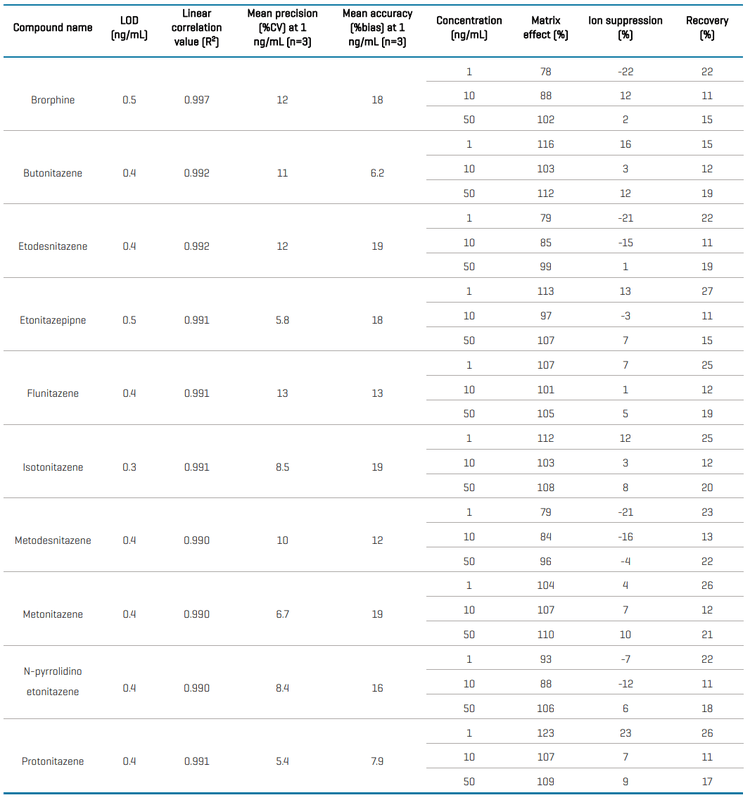
Target analytes and samples: A panel of 10 analytes, including 9 nitazene analogs and brorphine, as well as the internal standard, fentanyl-D5, were purchased from Comedical (Trento, Italy). Two solutions were prepared: a 100 ng/mL standard mixture containing the 10 target analytes in methanol and a 1.0 µg/mL fentanyl-D5 internal standard solution in methanol/acetonitrile (3:1, v/v) which was used as the extracting solvent. Table 3 lists the name, LOD, linear correlation value (R2), accuracy (%bias) and precision (%CV) at the lowest calibrator level (1 ng/mL), as well as the matrix effect (%), ion suppression (%) and recovery (%) at three calibrator levels (1, 10 and 50 ng/mL) for each of the 10 analytes targeted in this panel.
Calibrator preparation: Six levels of calibrators were prepared by spiking the standard solution mix into blank human whole blood to final concentrations of 1, 2, 5, 10, 25 and 50 ng/mL.
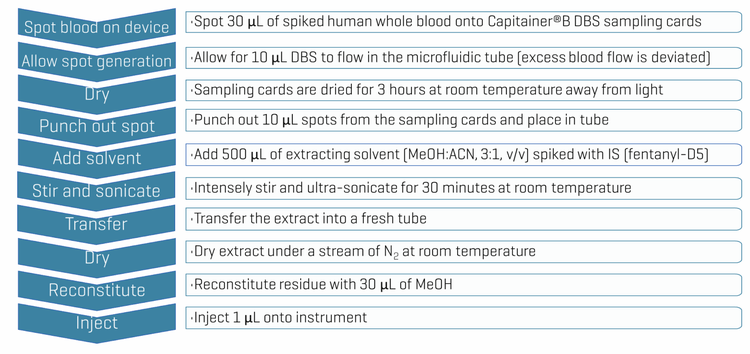
Sample preparation and DBS sample extraction procedure: Capitainer®B cards were used as the micro-sampling devices. These cards are haematocrit-independent and designed to ensure that the exact amount of blood is flowed into the microfluidic tube while the excess volume is diverted to another collection disc. 50 μL aliquots of blank human whole blood were fortified with a working solution of all ten analytes at six calibrator levels. 30 μL of the spiked whole blood calibrator solutions were deposited on the Capitainer®B card, 10 μL spots were generated and allowed to dry for at least 3 hr at room temperature. The spots were punched out and extracted with 500 μL of methanol/acetonitrile (3:1, v/v) fortified with the fentanyl-D5 internal standard solution (final concentration of 1.0 µg/mL). The extraction mixture was stirred and then sonicated at room temperature for 30 minutes. The resulting extract was transferred to a fresh tube and dried under a stream of nitrogen at room temperature and then reconstituted in 30 μL of methanol. The extraction procedure is summarized in Figure 2.
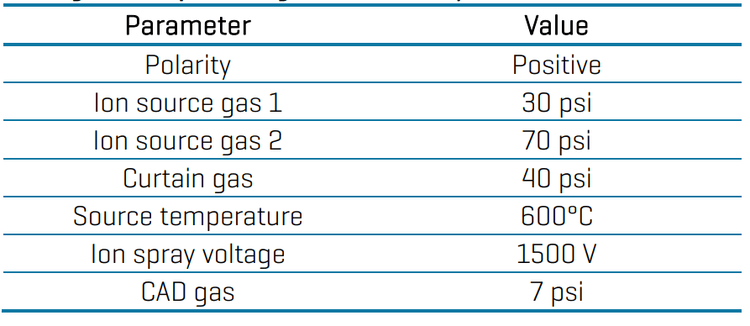
Mass spectrometry: Samples were analyzed using a SCIEX 7500 system equipped with an OptiFlow Pro Ion Source and E Lens probe. The ionization source was equipped with an electrospray ionization (ESI) probe that was operated in positive mode. A single acquisition method consisting of 22 MRM transitions, 20 for the 9 nitazene analogs and brorphine and 2 for fentanyl-D5, was created using the Scheduled MRM algorithm in SCIEX OS.
Table 2 shows the optimized source and gas parameters used. Two MRM transitions were monitored for each of the 10 targeted analytes and each calibrator was injected in triplicate.
Chromatographic separation of nitazenes and brorphine in DBS extracts
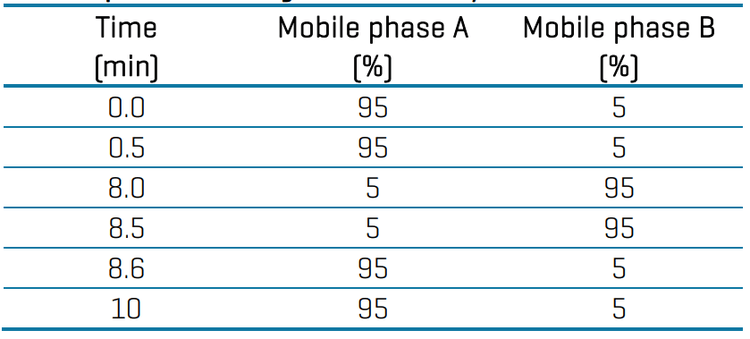
Figure 3 shows the chromatographic separation of the targeted analytes in a 10 ng/mL human whole blood calibrator sample. The selection of the Phenomenex Kinetex C18 column, and the optimized mobile phase composition and gradient conditions, achieved the baseline separation of the 10 targeted analytes within the 10 min run time. This included the isomeric species, isotonitazene and protonitazene. The baseline separation of these two analytes ensured good data quality.
Robust detection method leads to accurate and sensitive analyte quantitation
The ability to accurately detect trace levels of highly potent NSO in human whole blood is critical to toxicologists as it provides valuable insight into the causation of accidental overdoses. The series of calibrator solutions were injected in triplicate to evaluate the quantitative performance of the system to accurately measure low levels of NSOs extracted from DBS with a high level of precision and accuracy. Figure 4 shows representative extracted ion chromatograms (XICs) for the two MRM transitions monitored for A) brorphine and B) isotonitazene, two highly potent NSO that have been linked to accidental overdoses in poly-drug, authentic use cases. The XICs display overlays of both the quantifier and qualifier ions for a blank injection and for the 6 calibrator levels ranging from 1 to 50 ng/mL. Also displayed in Figure 4 are the confirmatory ion ratio lines between the two transitions which help to visualize the ion ratio tolerances. The lower limits of detection (LOD) for the 10 targeted analytes ranged from 0.3 to 0.5 ng/mL using the 10 μL blood volume of the DBS. Further, Figure 1 shows XICs and ion ratio tolerances for brorphine and the 9 targeted nitazenes in the 1 ng/mL extracted DBS calibrator. Overall, the method sensitivity observed is well within the relevant range for monitoring low NSO levels in combined opioid drug toxicity cases resulting in accidental overdoses.
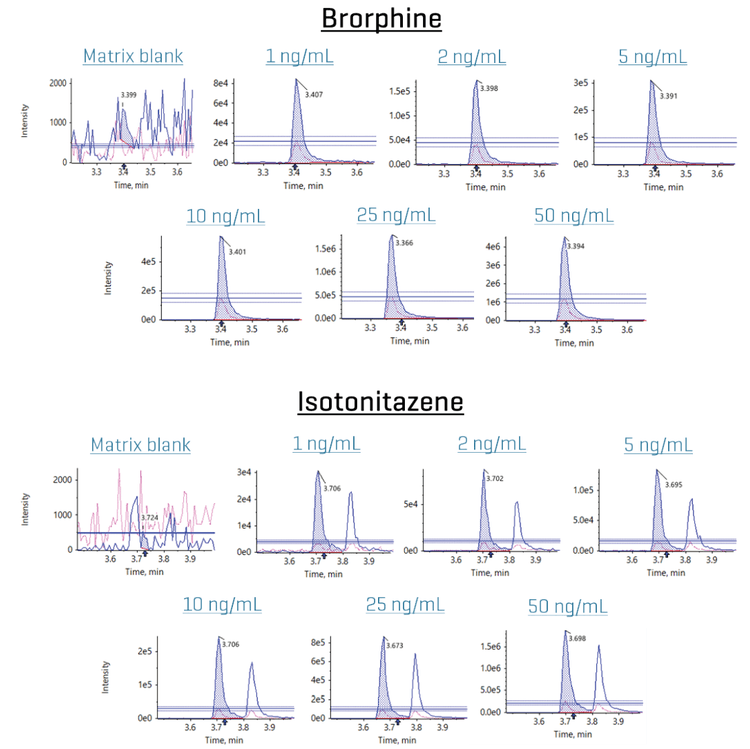
The quantitative performance of the method was also evaluated by calculating the average (n=3) precision (%CV) and accuracy (%bias) at the lowest (1 ng/mL) calibrator level (Table 3). The precision and accuracy values were found to be <15% and <19%bias, respectively, at the 1 ng/mL calibrator level for the 10 target analytes. The results demonstrate the capability of the method to reliably quantify NSO in DBS at trace level sensitivity with excellent accuracy and precision.
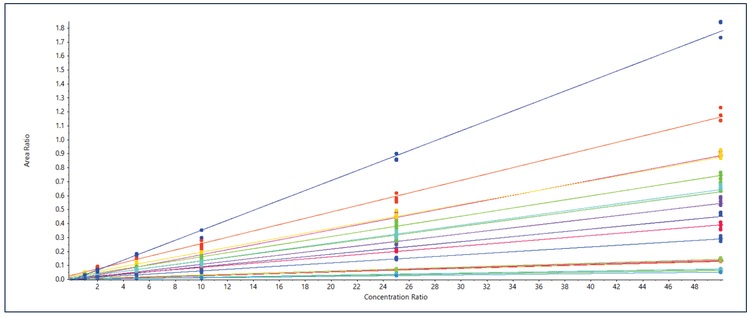
Calibration curves were generated using the two MRM transitions monitored for each analyte. Figure 5 shows the resulting regression curves plotted from 1 to 50 ng/mL for each of the 10 NSO targeted in this study. The calibration curves demonstrated excellent linearity across the calibration series, with R2 values greater than 0.990 for the 10 targeted analytes.
Optimized sample extraction procedure leads to low matrix effects and low ion suppression
Developing a fast sample extraction procedure capable of extracting opioid analgesics is critical to attaining reproducible results. The efficiency of the sample extraction procedure was investigated by calculating the matrix effect (%), ion suppression (%) and recovery (%) at three calibrator levels (1, 10 and 50 ng/mL). Three replicates of blank dried blood samples, three spots without blood and three samples without the filter paper (extraction solvents only) were spiked with the target analytes and internal standard.
The matrix effect (%) was calculated as the percentage ratio between the matrix-matched standard response to the neat standard response for the three calibrator levels. The ion suppression was calculated by subtracting the calculated matrix effect (%) from 100%. The matrix effects due to the blood and filter paper components ranged between 85 and 115%, resulting in ion suppression values corrected by internal standard between -15 and 15%.
The recovery was calculated as the mean peak area spiked pre-and post-extraction (n=3), expressed as a percentage.The recovery values were between 15 and 20%. Although the recovery was low, they are within the range typically observed for DBS studies.2 This observation highlights the necessity of using deuterated internal standards in DBS workflows to compensate for analyte loss. Fentanyl-D5 was used as the internal standard in this study. Despite being low, the recovery values are reproducible across the calibration range and across the NSOs targeted in this study. The quantitative performance of the method, including the LOD, linear correlation (R2 values), as well as the precision (%CV) and accuracy (%bias) values at the lowest calibrator level (1 ng/mL), matrix effect (%), ion suppression (%) and recovery (%) at three calibrator levels are summarized in Table 3.
Conclusions
This technical note demonstrated:
- A fast extraction method providing selective extraction of nitazenes and brorphine from DBS with minimal matrix effect and ion suppression
- Detection levels ranging from 0.3 to 0.5 ng/mL for the 10 target analytes were achieved using a blood sample volume of only 10 μL
- Good quantitative performance with precision (%CV) <15% and accuracy (%bias) <19% at the 1 ng/mL calibrator level
- Excellent linearity, with R2 values > 0.990 for the 10 analytes included in this panel across the calibration range (1 to 50 ng/mL)
- Reproducible quantitation for low-level detection of nitazenes and brorphine from DBS, despite low analyte recovery
- A sample preparation procedure, combined with the trace-level sensitivity of the 7500 system, that can be applied to other novel synthetic opioids as they emerge onto the recreational drug market
References
- Ververi, C.; Galletto, M.; Massano, M.; Alladio, E.; Vincenti, M.; Salomone, A. Method development for the quantification of nine nitazene analogs and brorphine in dried blood spots utilizing liquid chromatography-tandem mass spectrometry. J. Pharm. Biomed. Anal. 2024, 241, 115975. DOI: 10.1016/j.jpba.2024.115975
- Massano, M.; Incardona, C.; Gerace, E.; Negri, P.; Alladio, E.; Salomone, A.; Vincenti, M. Development and validation of a UHPLC-HRMS-QTOF method for the detection of 132 new psychoactive substances and synthetic opioids, including fentanyl, in dried blood spots. Talanta 2022, 241, 123265. DOI: 10.1016/j.talanta.2022.123265