Comprehensive LC-MS workflows for antibody drug conjugate (ADC) analysis
Abstract
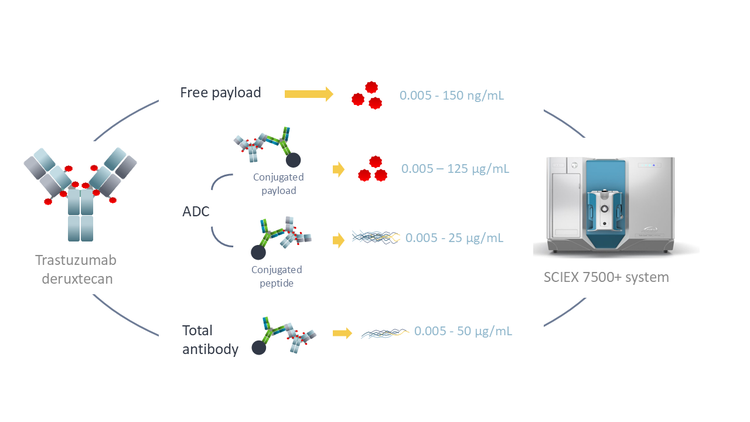
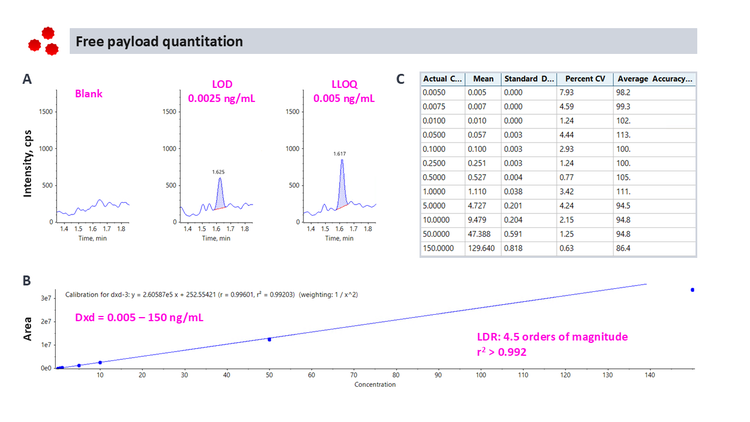
This technical note demonstrates a sensitive workflow for 4 key quantitative pharmacokinetic/pharmacodynamic (PK/PD) assays using trastuzumab deruxtecan (TDx) in rat plasma on a nominal mass spectrometer. A lower limit of quantitation (LLOQ) of 0.005 ng/mL was achieved for the free payload (deruxtecan; Dxd) and 0.005 µg/mL was achieved for the conjugated payload, total antibody and ADC quantitation (Figure 1).
Key benefits of ADC analysis using the SCIEX 7500+ system
- Sensitive and comprehensive workflows for ADC analysis: An LLOQ of 0.005 ng/mL was achieved for the free payload and 0.005 µg/mL was achieved for the conjugated payload, total antibody and ADC workflows using the SCIEX 7500+ system
- Meet the critical quantitative performance criteria: Achieve an accurate quantitative performance with high reproducibility with %CV <10 at all concentrations across a wide linear dynamic range (LDR) spanning up to 4.5 orders of magnitude
- Streamlined data management: SCIEX OS software, a 21 CFR Part 11- compliant platform, simplifies data acquisition and processing.
Introduction
Antibody–drug conjugates (ADCs) are hybrid therapeutics that link a monoclonal antibody to a cytotoxic payload through a chemical linker. While this design enables targeted delivery of cytotoxic small molecules, it also creates distinct analytical challenges. Tailored workflows are required to capture the pharmacokinetic and pharmacodynamic behavior of each component of the ADCs.
The ADC quantitation workflow typically comprises three key assays: free payload, total antibody, and conjugated ADC (measured either by payload or by peptide) quantitation (Figure 1). Conjugated payload assays are particularly valuable when cleavable linkers are employed and when an anti-payload antibody is available, offering both specificity and sensitivity to track payload stability. Conversely, conjugated peptide assays are preferred when ADCs carry non-cleavable linkers or when heterogeneous conjugation strategies make direct payload measurement less representative of actual ADC exposure.
TDx serves as a suitable model ADC for demonstrating this workflow, owing to its cleavable linker and the availability of a selective anti-payload antibody. In this study, we present a sensitive, multi-assay ADC quantitation workflow encompassing measurements of free payload, total antibody, payload-based conjugated ADC, and peptide-based conjugated ADC.
Methods
Sample preparation for free payload quantitation: Dxd was dissolved in DMSO and diluted with a 1:1 (v/v) water: acetonitrile mixture to obtain working standards. The spike-in solvent was prepared by precipitating plasma with methanol at a 1:3 (v/v) ratio, followed by dilution with water to yield a final solvent containing 10% methanol. A calibration curve was prepared by spiking 5 µL of working standards into 95 µL of spike-in solvent.
Immunoprecipitation for the quantitation of the total antibody and payload-based ADC:Phenomenex BioZen MagBeads (20 mg/mL) were prepared according to the user manual. Biotinylated goat anti-human IgG antibody was added to the beads and the mixture was incubated for 1 hour at 21 °C. The beads were washed three times and then reconstituted in PBS. Calibration standards were prepared by spiking TDx into 100 µL of rat plasma and briefly vortexing. A volume of 25 µL of conjugated beads and stable isotope-labeled standards was added to the mixture and incubated for immunocapture. After an hour of incubation, the beads were washed with PBS and 10 mM ammonium bicarbonate, respectively. To elute, beads were incubated in 100 µLwater containing 0.1% TFA for 10 minutes. Samples were split into 2 sets. A volume of 50 µL was used for total antibody quantitation analysis. Samples were neutralized with 500 mM ammonium bicarbonate, followed by the addition of trypsin at a concentration of 1 µg per well and incubated overnight at 37 °C. Reaction was terminated using formic acid. The remaining 50 µL was used for papain digestion to quantify conjugated payload. 10 µL of 100 µg/mL papain was added to each well and incubated overnight. Digestion was terminated by spiking 10 µL of 10% formic acid in water.
Sample preparation for peptide-based ADC quantitation: 1µg of Biotinylated anti-Dxd antibody was added to the washed Biozen MagBeads and incubated for 1 hour at 21 °C. From the wash steps and onwards, the total antibody method was followed.
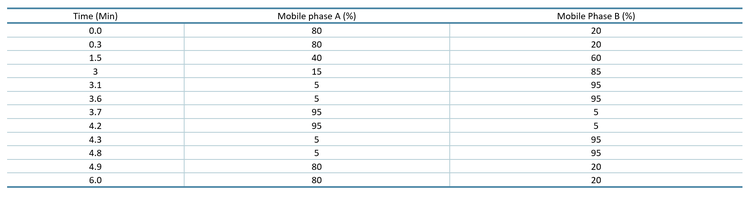
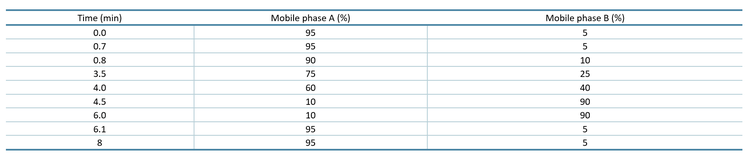
Chromatography: All samples were vortexed, centrifuged and transferred to sample vials. Separation was achieved on an ExionLC AD system using a Phenomenex Kinetex C18 column (2.1 x 50 mm, 1.7 µm, 100 Å) for all methods. 0.1% v/v formic acid in water was used as mobile phase A and 0.1% v/v formic acid in acetonitrile was used as mobile phase B. Table 1 shows the LC gradient for free and conjugated payload assays and Table 2 shows the LC gradient for total antibody and ADC assays.

Results
The unique molecular design of ADCs enables targeted drug delivery, allowing the payload to exert its cytotoxic effect at the site of action. However, not all payloads can be successfully delivered to cancer cells due to the loss of unwanted drugs in the circulation before they reach the target cell, resulting in toxicity and side effects.2 Quantitation of free payload and conjugated payload in plasma is crucial in the assessment of stability, safety and therapeutic index of the ADC drug.3,4
The analytical performance was evaluated based on the requirement that the accuracy of the calculated mean should be between ±20% at the LLOQ and between ±15 at higher concentrations. The %CV of the calculated mean of the concentration should be below 20% at the LLOQ and below 15% at all higher concentrations.5
Figure 2 shows the overview of the free payload quantitation assay. An LLOQ of 0.005 ng/mL was achieved for Dxd in extracted rat plasma with no detectable interferences (Figure 2A). Linearity was achieved with a coefficient of determination (r2) of >0.992 with a concentration range spanning 4.5 orders of magnitude (Figure 2B). The assay accuracy was within ± 14% with %CV < 8 for all concentrations (Figure 2C).
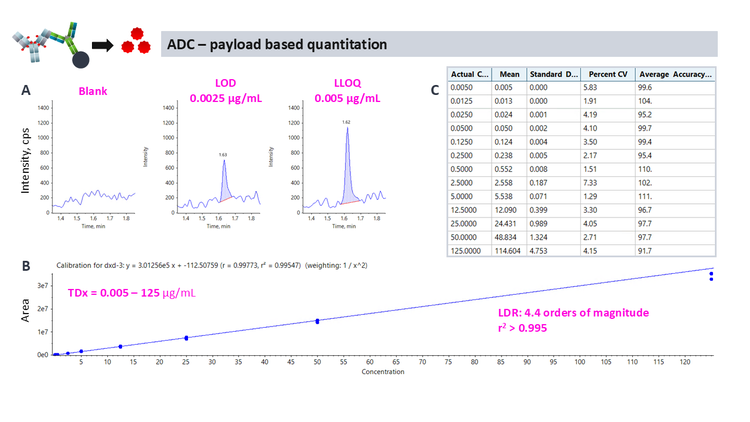
Figure 3 summarizes the results from the payload-based ADC assay. Briefly, TDx was spiked in rat plasma followed by immunocapture, elution and digestion with papain to release the payload. The released Dxd was quantified as a surrogate measure of the intact ADC. Figure 3A shows the representative chromatograms from the conjugated payload assay. No interference was detected in the matrix blank and an LLOQ was achieved at 0.005 µg/mL. The linearity for the conjugated payload assay was achieved between 0.005 – 125 µg/mL. A concentration range spanning 4.4 orders of magnitude was achieved with an r2 >0.995 (Figure 3B). Quantitative assay performance was presented in Figure 3C. The assay accuracy was within ± 11% with %CV <6 for all concentrations (Figure 3C).
Total antibody quantitation provides a complete profile for the development of the therapeutic. The antibody component bears a cytotoxic payload; therefore, its quantitation is essential for evaluating the stability and PK behaviour of the antibody component in the ADC complex.6
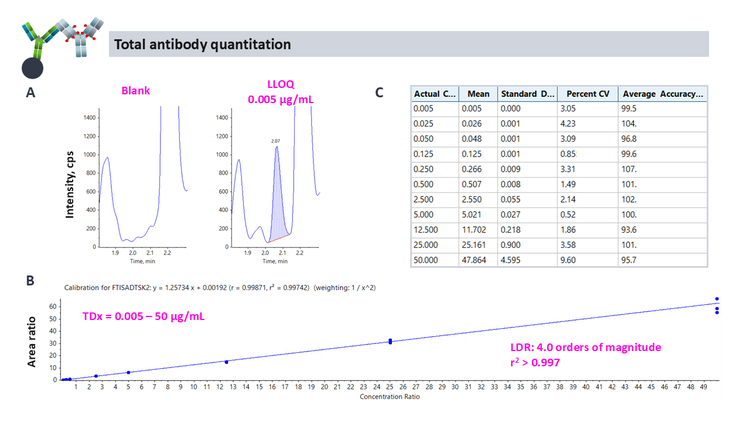
Figure 4 summarizes the total antibody quantitation assay. No interference was detected in the matrix blank. An LLOQ was achieved at 0.005 µg/mL (Figure 4A). Good linearity was demonstrated, with an r²> 0.997 and a concentration range spanning 4 orders of magnitude (Figure 4B). Quantitative assay performance was presented in Figure 4C. The assay accuracy was within ±7% with the %CV <10 at all concentrations (Figure 4C). Quantitation of the ADC enables assessment of actual therapeutic exposure and on-target delivery potential by measuring the pharmacologically active species in circulation.7
Conclusion
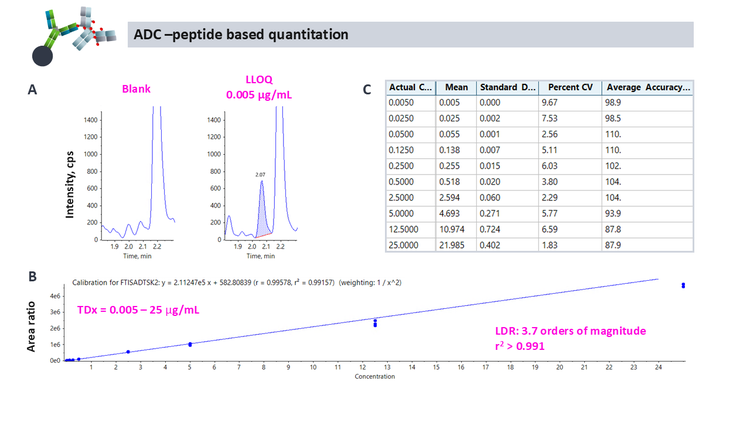
- Good sensitivity levels were demonstrated with 4 key assays for ADC analysis using the SCIEX 7500+ system. An LLOQ of 0.005 ng/mL was achieved for the free payload assay and an LLOQ of 0.005 µg/mL was achieved for conjugated payload, total antibody and ADC assays
- Overall, linearity was achieved with an r2 ≥0.991 across a wide range of LDR up to 4.5 orders of magnitude
- Quantitative performance was achieved with accuracy within ±14% of the nominal concentration and high reproducibility with %CV <10 for all assays
- All assays were run on a one-column and the same mobile phase system, enabling an efficient workflow setup for ADC analysis
- SCIEX OS software was used for streamlined data acquisition, processing, and management. SCIEX OS software is a compliant-ready (21 CFR Part 11) platform to support regulated and unregulated bioanalysis on the SCIEX 7500+ system
References
- Ultra-sensitive LC-MRM analysis for trastuzumab-emtansine quantification in rat plasma. SCIEX technical note RUO-MKT-02-11886-A.
- Fu, Z. et al. (2022) Antibody drug conjugate: the “biological missile” for targeted cancer therapy. Sig Transduct Target Ther 7, 93.
- Sasso, J. M. et al. (2023) The Evolving Landscape of Antibody-Drug Conjugates: In Depth Analysis of Recent Research Progress. Bioconjug Chem. 2023, 34 (11), 1951–2000.
- Mak, S.Y. et al (2024) A simple and highly sensitive LC–MS workflow for characterization and quantitation of ADC cleavable payloads. Sci Rep 14, 11018.
- Bioanalytical Method Validation, May 2018.
- Gorovits, B. (2015). Bioanalysis of Antibody–Drug Conjugates. Bioanalysis, 7(13), 1559–1560.
- Huang, Y. (2021) Characterization of Antibody–Drug Conjugate Pharmacokinetics and in Vivo Biotransformation Using Quantitative Intact LC-HRMS and Surrogate Analyte LC-MRM. Anal. Chem. 93, 15, 6135–6144.