Abstract
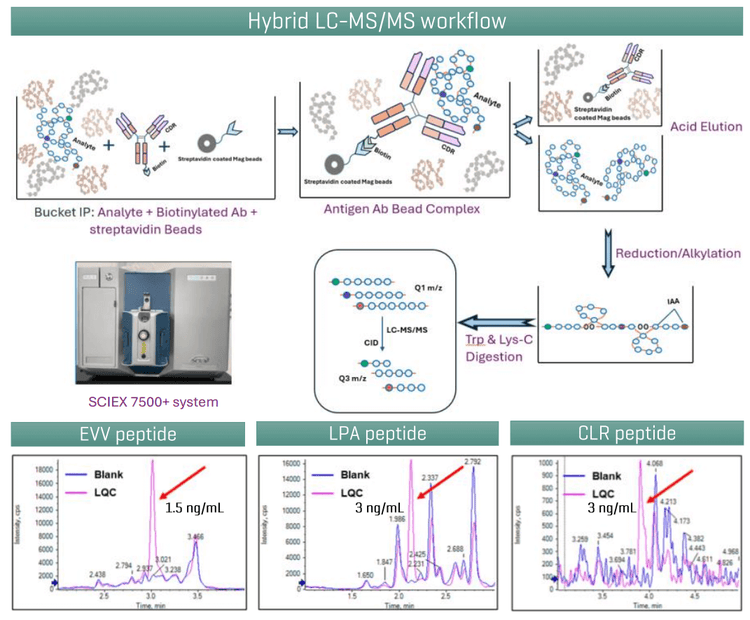
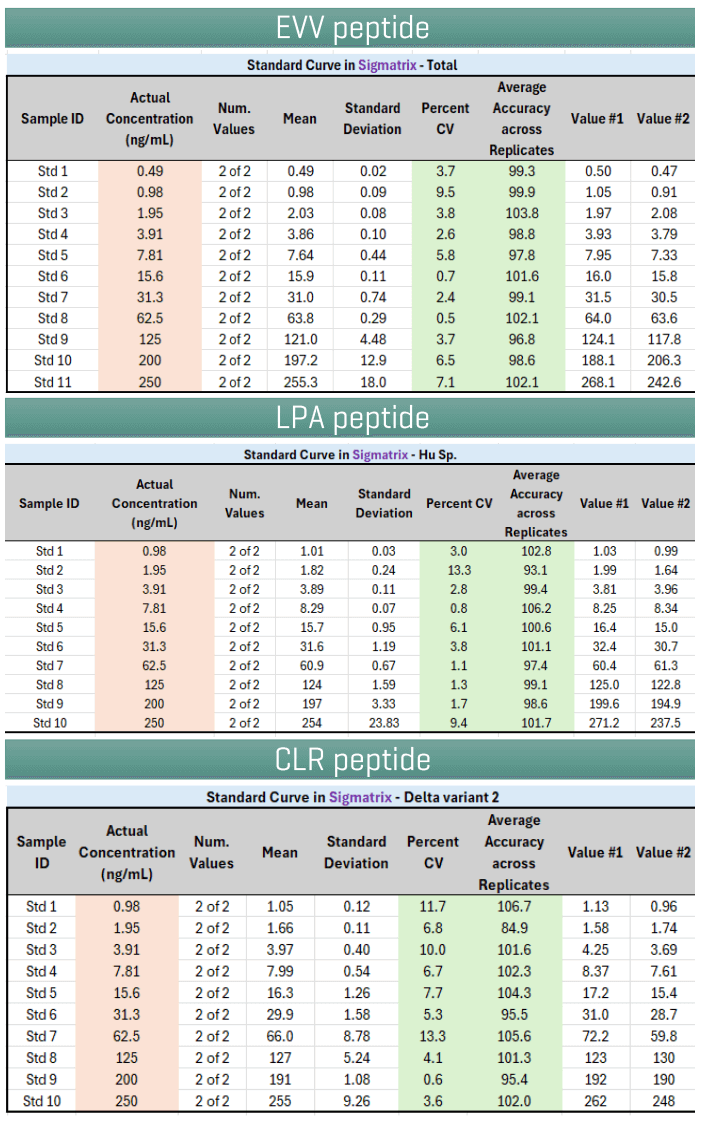
This technical note demonstrates a sensitive method for the quantitation of protein biomarkers and the gene therapy marker in the cynomolgus macaque (cyno) brain matrix using the SCIEX 7500+ system. A lower limit of quantitation (LLOQ) of 0.49 ng/mL (EVV peptide - total measurement) and 0.98 ng/mL (LPA - human specific and CLR peptides - translated protein from gene therapy) was achieved in extracted cyno brain samples (Figure 1).
Recently, gene therapy has provided a cure for undruggable diseases through a targeted approach for treatments. In gene therapy, it is crucial to be able to monitor and quantify specific markers or translated gene products that may be applied to assess the therapeutic efficacy or help in identification of any potential adverse effects.1 Therefore, analytical methods that are sensitive and can differentiate gene therapy markers from endogenous proteins are needed for accurate quantitation in a complex matrix.2
Key benefits for analysis of endogenous protein marker analysis using the SCIEX 7500+ system
-
Sensitive quantitation of human protein in cyno species: Achieve an LLOQ of 0.49 ng/mL for EVV peptide and 0.98 ng/mL for LPA and CLR peptides for the quantitation of total and human specific protein biomarker and its gene therapy product in cyno brain
-
Differentiation of protein biomarker and gene therapy product: Baseline separation of signature peptides from a protein biomarker and the gene therapy product was achieved for accurate quantitation
-
Effortlessly meet critical quantitative performance criteria: Achieve accurate quantitative performance of EVV, LPA and CLR peptides with %CV <15 at all concentration levels
-
Streamlined data management: SCIEX OS software, a 21 CFR Part 11-compliant platform, simplifies data acquisition and processing
Introduction
According to the World Health Organization3, neurological disorders affect one in 3 individuals and are therefore, of primary concern. The underlying pathology of neurodegenerative diseases is not addressed by current therapeutics, which instead have a heavy focus on symptom management.4 As neurodegeneration worsens, pharmaceutical treatments become less effective. Therefore, gene therapy, which involves altering or inducing the expression of specific proteins, can play a major role in correcting the underlying mechanisms.5
To effectively evaluate the therapeutic efficacy of gene therapy drug products, highly sensitive assays are necessary to ensure precise and accurate quantitation of any crucial markers or specific gene products.
Methods
Sample preparation: Immunoprecipitation with biotinylated anti-protein Ab and streptavidin beads were utilized to capture the protein biomarker and the gene therapy product. KingFisher Flex was applied for wash and elution steps post capture of the analytes of interest from the cyno brain matrix. The eluted protein was then reduced, alkylated and then subjected to trypsin (for EVV and LPA peptides) and lys-c (CLR peptide) digestion overnight at 37°C. The final solution was quenched with formic acid prior to LC-MS/MS analysis.
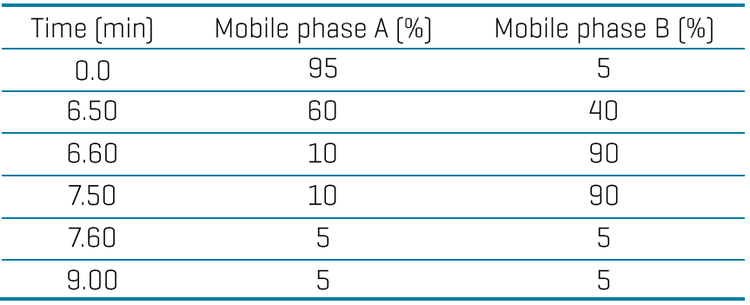
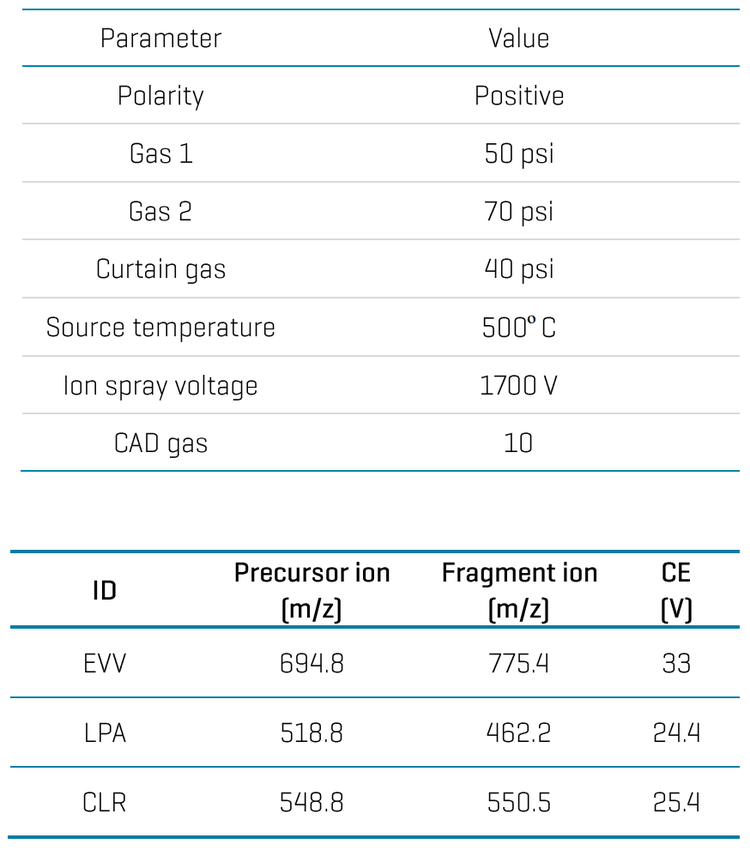
Chromatography: Reverse phase chromatography in positive mode is utilized for separation of monitored peptides. A combination of deionized water and acetonitrile with formic acid and the presence of DMSO was used as mobile phases. Ascentis Express Peptide ES-C18 column (75 x 2.1 mm, 2.7 µm) was utilized for chromatographic separation.
Quantitative performance on the SCIEX 7500+ system
An immunocapture with streptavidin-coated magbeads workflow resulted in clean samples that enabled a sensitive quantitation of the peptides in the cyno brain matrix using the SCIEX 7500+ system.
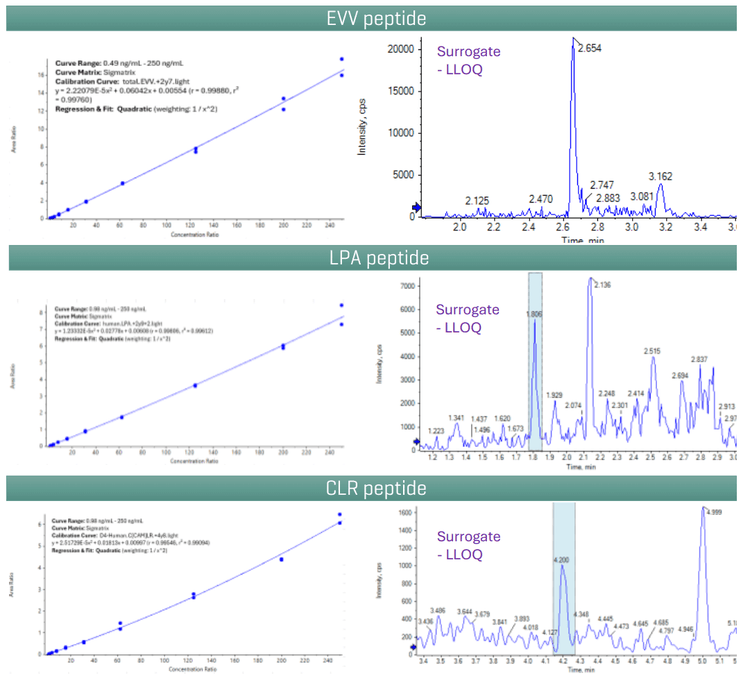
The method achieved acceptable linearity, accuracy and precision from 0.49 ng/mL to 250 ng/mL for the EVV peptide and 0.98-250 ng/mL for the LPA and CLR peptides, respectively with an acceptance criteria of 25% for LLOQ and 20% for Standards and QCs. A coefficient of determination (r2) of >0.999, 0.996 and 0.991 was achieved for the EVV, LPA and CLR peptides, respectively. For all 3 peptides, a quadratic regression was applied with 1/x2 as the weighing factor.
An LLOQ of 0.49 ng/mL (EVV peptide) and 0.98 ng/mL (LPA and CLR peptides) was achieved in extracted cyno brain matrix as represented by the surrogate XICs in Figure 2.
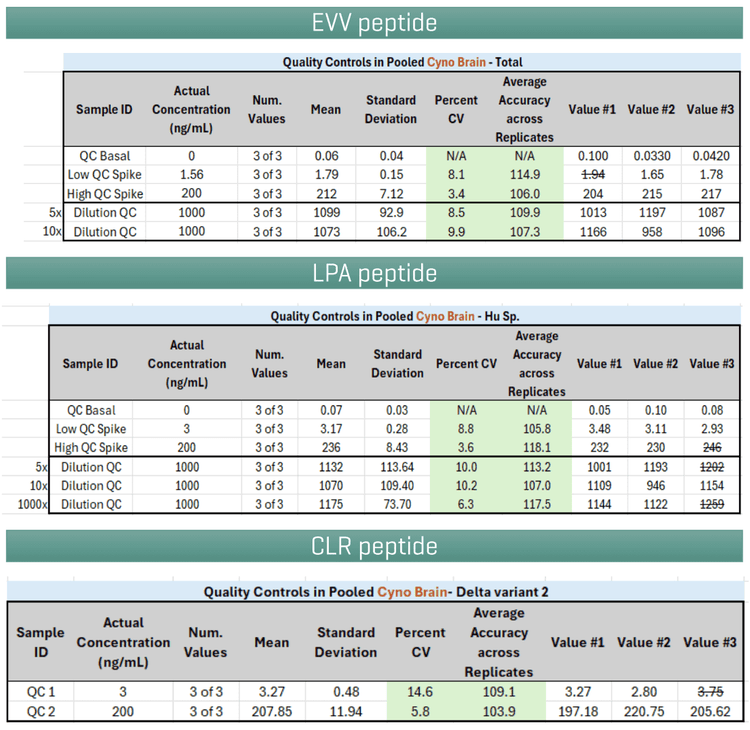
QC samples were evaluated for EVV, LPA and CLR peptides (Figure 4).For EVV peptide, basal (0 ng/mL), low (1.56 ng/mL) and high (200 ng/mL) QC levels were assessed along with 2 dilution QCs (5x and 10x). Similarly, basal (0 ng/mL), low (3 ng/mL) and high (200 ng/mL) QC levels were analyzed for the LPA peptide together with 3 dilution levels (5x, 10x and 1000x). For the CLR peptide, low (3 ng/mL) and high (200 ng/mL) QC levels were evaluated. Overall, accuracy was within ±18% of the nominal concentration while %CV was <15%.
Comparative analysis against SCIEX 7500 system
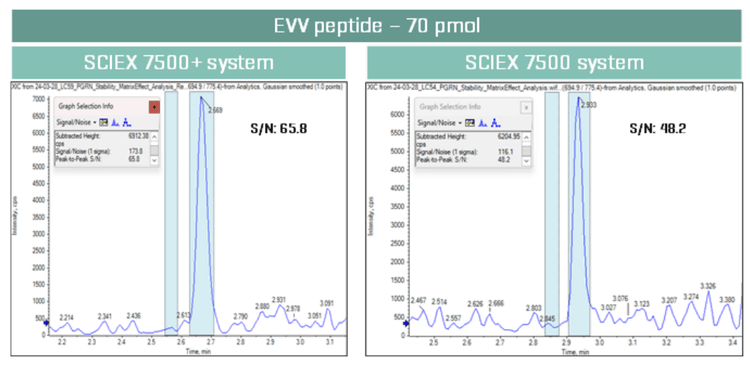
A quantitative comparison was performed between SCIEX 7500+ system and SCIEX 7500 system. A 70 pmol sample of EVV peptide was analyzed on the SCIEX 7500+ system and the SCIEX 7500 system. In this comparison, it was observed that the overall sensitivity and the S/N ratio were comparatively similar between both MS platforms (Figure 5).6,7
Compliance-ready SCIEX OS software
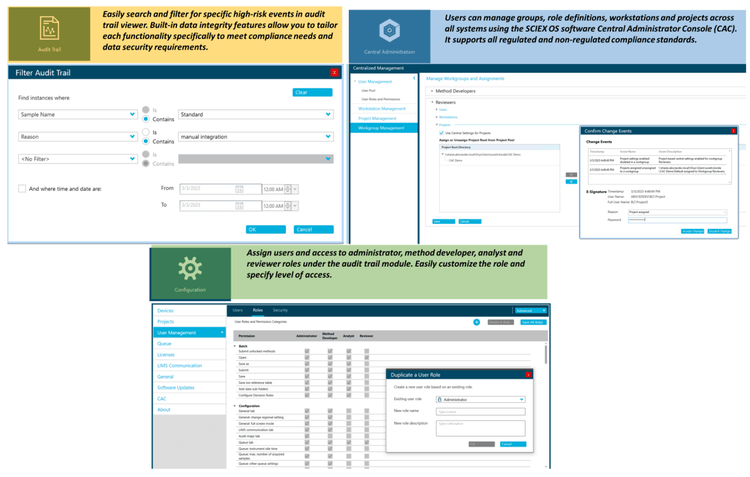
Equivalent SCIEX OS software capabilities for regulated bioanalysis can be executed on the SCIEX 7500+ system, ensuring high fidelity when performing method transfers while retaining critical compliance features. SCIEX OS software is a closed system and requires records and signatures to be stored electronically, meeting the regulations outlined by 21 CFR Part 11. SCIEX OS software can open raw data files from any visible storage location within a closed network by using designated processing workstations.
Figure 6 illustrates the features of SCIEX OS software that are used to monitor the audit trail, acquire and process data, and configure user access. The audit trail feature enables users to audit critical user actions and locks in data integrity. The Central Administrator Console (CAC) feature allows users to centralize acquisition and processing using a single platform to maximize efficiency for multi-instrument laboratories, independent of compliance standards.
The configuration module allows users to assign roles and access as the administrator, method developer, analyst and reviewer.
Conclusion
-
An LLOQ of 0.49 ng/mL was achieved for the EVV peptide, and 0.98 ng/mL was achieved for LPA and CLR peptides in cyno brain matrix
-
Linear range across concentrations ranging from 0.49 ng/mL to 250 ng/mL for EVV peptide and from 0.98 ng/mL to 250 ng/mL for LPA and CLR peptides was achieved
-
Excellent linearity was reached with an r2 of >0.999, 0.996 and 0.991 for the EVV, LPA and CLR peptides, respectively
-
Highly reproducible (%CV <15%) analysis was demonstrated for analysis of EVV, LPA and CLR peptides on the SCIEX 7500+ system
-
Comparable quantitative performance was demonstrated on the SCIEX 7500+ system and the SCIEX 7500 system
-
Retain data management and compliance-readiness (21 CFR Part 11) features using SCIEX OS software to support regulated bioanalysis on the SCIEX 7500+ system
References
- Eliza N Fung, Peter Bryan, Alexander Kozhich: Techniques for quantitative LC–MS/MS analysis of protein therapeutics: advances in enzyme digestion and immunocapture. Bioanalysis 2016, 8(8), 847-856. 10.4155/bio.16.24
- Myler HA, Given A, Kolz H, Mora JR, Hristopoulos G. Biotherapeutic bioanalysis: a multi-indication case study review. Bioanalysis 2011, 3, 623–643. 10.4155/bio.11.33
- Over 1 in 3 people affected by neurological conditions, the leading cause of illness and disability worldwide. WHO, News release, 2024.
- Vivek Sudhakar, R. Mark Richardson. Gene Therapy for Neurodegenerative Diseases. Neurotherapeutics 2019 16,166–175. https://doi.org/10.1007/s13311-018-00694-0
- Jichao Sun, Subhojit Roy. Gene-based therapies for neurodegenerative diseases. Nature Neuroscience. 2021, 24(3), 297-311. 10.1038/s41593-020-00778-1.
- Redefine bioanalysis with enhanced robustness on the SCIEX 7500+ system. SCIEX technical note, MKT-31350-A.
- Quantitative performance of a next-generation, highly robust triple quadrupole mass spectrometer. SCIEX technical note, MKT-30856-A